I’m deeply impressed by Prime Minister Modi’s patronage of Jahan-e-Khusrau, a festival celebrating the syncretic and refined traditions of Urdu culture. Given the backdrop of Babri Masjid’s destruction and the Gujarat riots, both of which left lasting scars, Modi the Wise’s pivot towards fostering a secular, aesthetic Urdu culture is both unexpected and strategic.
In doing so, Hindu-defined India may be poised to accomplish for Urdu culture what the Pahlavis did for Persian—modernizing it, making it sophisticated and aspirational, and removing the excesses of exclusivist religious overtones.
If Pakistan has long seen itself as the custodian of Urdu, Modi is now positioning India as its true inheritor—one that can mainstream it, integrate it, and make it a cultural powerhouse beyond sectarian confines.
Baloch, Aboriginal, and Beyond: Tracing Forgotten Lineages & Evolving Identities
I recently came across a fascinating family history article by Sabah Rind, a writer of Baloch and Australian Aboriginal descent. Her lineage is remarkably complex—she is at least a quarter Iranian, predominantly Baloch (5/8), with the remainder Malay (1/16) and Aboriginal (1/16) heritage. Yet, despite generations of intermarriage, her roots remain deeply embedded in the Global South and the Islamicate world.
Sabah Rind, the authoress, a “Baluch descendant”
Her father is Baloch, but her grandfather was half Baloch, a quarter Aboriginal, and a quarter Malay—a lineage shaped by centuries of Indian Ocean migration, trade, and cultural fusion.
Dr. Umber Rind- a “Pakistani descendant”
Among the 400 descendants of the original Badoola-Marium pairing, Sabah remains one of the most ethnically Baloch, while many others have assimilated or drifted toward new identities over time. Her cousin, Dr. Umber Rind (they seem to share the same grandfather, Numrose, and it’s a bit confusing since they discuss different ancestries) writes on being a proud Indigenous Muslim woman descended from the cameleers.
Gulam and Mariam’s four children (l-r): Nurdin, Mirdost, Nora, Numrose
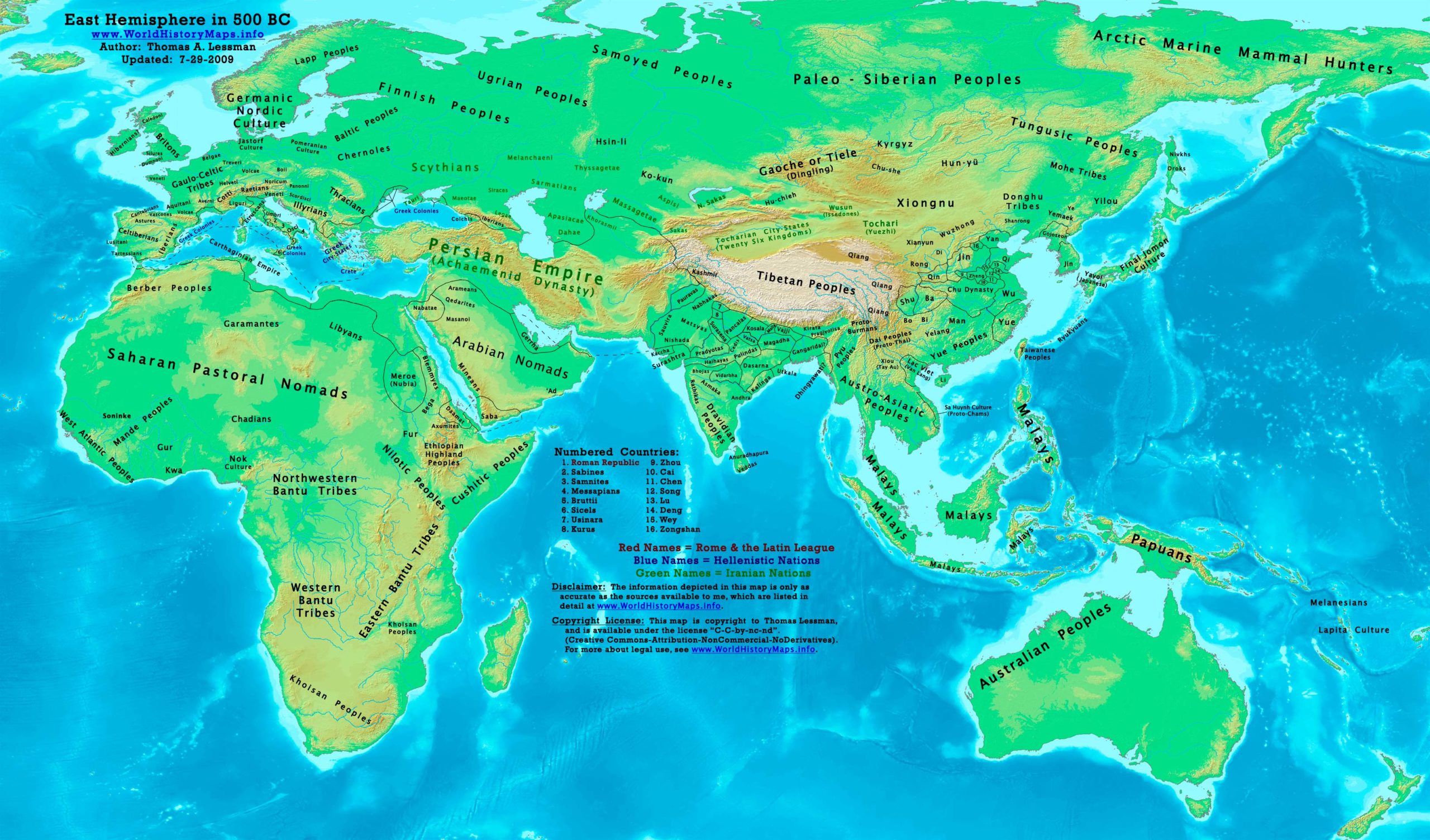
The histories of Armenia and Georgia are intricately intertwined with Greater Iran, as evidenced by several dynasties with Iranian origins. Georgia shares a similar historical profile, indicating close ties between the two regions (I won’t even touch on Azerbaijan, which to my mind is simply Russified Iran). With regards to the North Caucasus, notwithstanding Russian ethnic cleansing & genocide (apparently what inspired Dune), there is heavy Persian-Iranian influence (though of course I don’t know nearly enough of the history of the region).
All three of the Great Houses of the Kingdom of Armenia (331 BC to 428 AD) were Iranian origin.
Orontid Dynasty (potential ancestral ties to the Achaemenians): Dating back to the 6th century BCE, the Orontids were influential rulers in ancient Armenia during the Achaemenid Persian Empire’s reign.
Artaxiad Dynasty (descendants of the previous Orontids, the clue is in the Iranian-loaded name Arta): Succeeding the Orontids, the Artaxiads governed the Kingdom of Armenia from the 2nd century BCE to the 1st century CE, overseeing its territorial expansion and cultural flourishing.
Arsacid Dynasty (Armenia): A branch of the Parthian Arsacid dynasty in Iran, the Armenian Arsacids ruled from the 1st to the 4th century CE, with periods of Roman influence interspersed with periods of independence.
There are many other dynasties like the Chosroid, Mihranids, Bagratid (the clues are so obvious in the names) and then even in the Kingdom of Cilician Armenian (the region & inhabitants suffered genocide under the Young Turks) the Rubenid–Hethumid Dynasty had Iranian-links even in the Middle Ages. There is an exotic dynasty, the Mamikonians, who apparently had Chinese-origins but even they intermarried with Iranian nobility eventually.
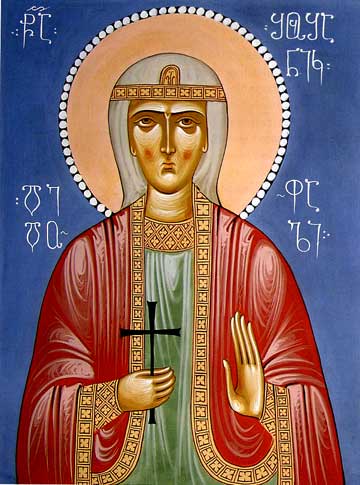
However, the case of St. Shushanik (pictured above & below) highlights the tension between Christianity in the Caucasus, with its Eastern roots but “West-facing” orientation, and Iranianism, particularly Zoroastrianism.
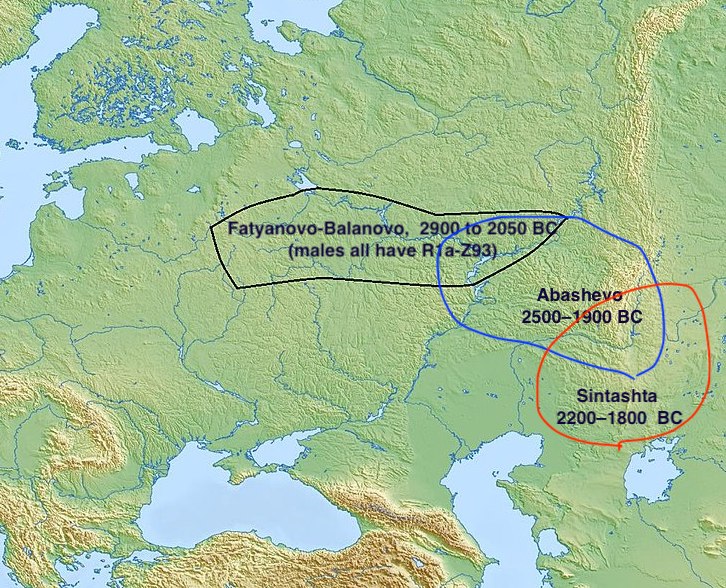
YFull has amassed an extensive database of modern and ancient Y-DNA samples and computed time estimates for the formation of various branches. This post will outline some important observations from looking at the page for R1a-Z93, which arose in the steppe and became the dominant Y haplogroup in Fatyanovo culture and its descendant Abashevo and then the Sintashta culture, from which steppe ancestry in India and Iran ultimately originates.
Indic Lineages
Examining lineages with samples found almost exclusively in South Asia is instructive, especially when we look at formation dates of the lineages.
Dates
Consider the famous R1a-L657. The estimated formation date and TMRCA for it is ~2100 BCE.
That could of course be a fluke defined by some sort of later founding effects. But we can consider the other major subclade of R1a-Z93, namely R1a-Z2124. This is sometimes assumed to be an Iranic clade, but it contains Indic sub-branches as well, such as R-YP523 with a formation time of ~2100 BCE and TMRCA of ~1700 BCE, and R-Y46 and R-Y43743 both with formation time and TMRCA of ~1800 BCE. A little messier but also likely originally Indic is R-Y37 with a formation time of ~2500 BCE and a TMRCA time of ~2000 BCE.
Based on these, we can estimate that the main steppe migrants into India branched off from the rest of the steppe ~2100-1800 BCE. A plausible scenario is that at the same time that many Sintashta clans were spreading out and establishing the cultures of the Andronovo horizon as well as related cultures like Tazabagyab, one or more clans chose to travel past them into the Hindu Kush and the Indian subcontinent, contributing the bulk of steppe ancestry seen in modern day Indians. This is backed up by the fact that the Indian lineages seem to split off close to the time of expansion of R1a-Z93 into star like phylogeny, which is a tell-tale sign of rapid population expansion and migration of the kind observed archeologically in the Andronovo horizon.
Indic Samples in Arabia
What’s interesting is when we take a look at sublineages of these that have ended up in the Arabian peninsula, where modern Arabs have apparently been enthusiastic adopters of genetic testing services. There are some lineages from recent centuries (especially related to Pakistani lineages), but also many that go back significantly further.
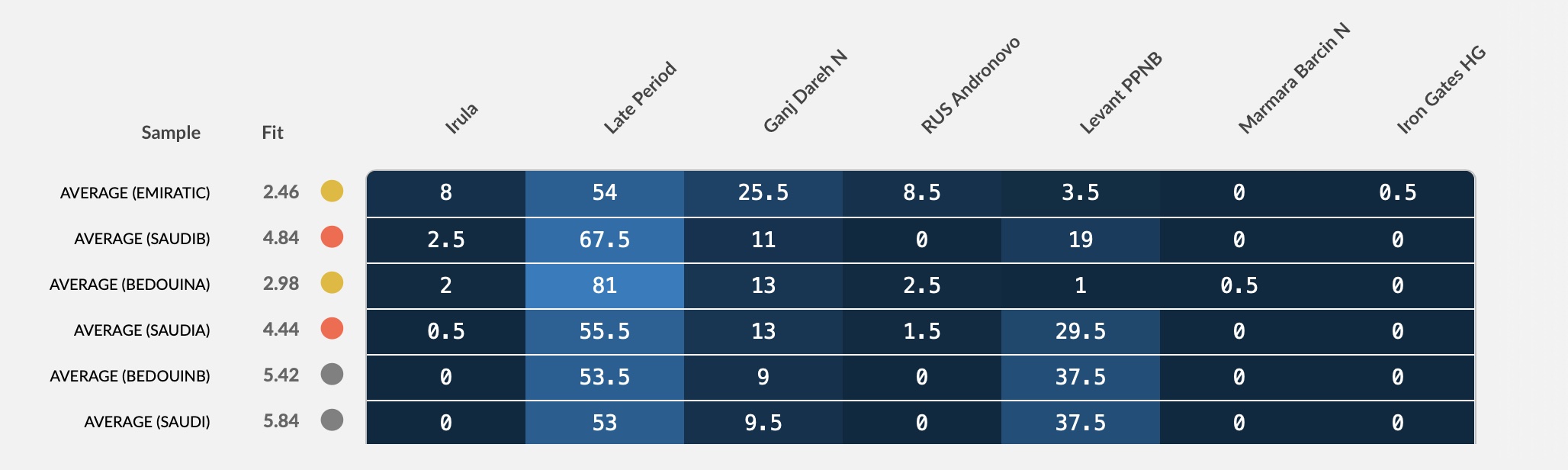
Likely all of these (or at the very least the first two) entered the Arabian peninsula via medieval, early historic, and protohistoric Indian Ocean traders. These samples are found across Arabia, including in Qatar, Bahrain, Oman, and western Saudi Arabia. In fact, we can see that there is some AASI admixture (using Irula as a proxy) in some modern populations in the Arabian peninsula.
Iranic Lineages
Russians
Unfortunately, very few samples from Iran are available, and they do not allow us to make meaningful conclusions. Fortunately, we have many samples available in Russia that are surviving descendants of Sintashta / Andronovo lineages, both in Z2124 and R1a-Y3 (from which L657 descends on the Indian side).
Both R-Y75187 and R-S23592 exhibit a mix of old (dating as far back as Andronovo) and modern samples in the Central Steppe in Turkic-speaking places like Bashkorstan, Tatarstan, Kazakhstan, and Kyrgyzstan. Another that shows modern samples in Russia (as well as an Azeri Iranian sample) is R-Y38987.
It should be noted that these R1a lineages are cannot be from any outflux from India – both their ancient and modern samples remain in the steppe, and no samples in these lineages are found in India. Additionally, the lineages were not spread by Buddhism, as the various Kipchak Turks such as Bashkirs and Tatars that settled this region of Russia practice Tengrism (or previously practiced Tengrism for those that have since adopted Islam), and never practiced Buddhism, unlike Turks and Mongols further to their east who adopted Buddhism.
Iranic Lineages in Arabs
What about Iranian influence in and near the Arabian peninsula? Well, R-BY149647 has both an Andronovo and modern Russian steppe sample as well as descendants in Arab countries. R-F1417 shows a lineage in Russia, another lineage in Arabs, as well as a sample in an Iranic tribe in ancient Kyrgyzstan.
Notably though, nearly all these samples are located in Kuwait or Ash Sharqiyah Province of Saudi Arabia. These likely originate with Iranian settlement and rule of modern day Kuwait under the Persian Empires. As such, though we don’t have many direct samples from Iran, neighboring Kuwait provides a useful source of data for Iranian lineages. Iran was not historically known as a major participant in the Indian Ocean trade, and this distribution of Iranic lineages appears to reflect that.
Conclusion
In summary, we’ve found that Indian R1a lineages from the steppe date to the early 2nd millennium BCE, consistent with a migration into India simultaneous with the Andronovo horizon. We’ve also found that we can observe surviving Iranic lineages in the Central Steppe in Russia, and that Iranian lineages to Kuwait and Ash Sharqiyah by land, while Indian lineages appear in the entire Arabian peninsula via ancient and medieval sea trade.
I have a post (right now at 5,500 words) that I’m working on relating to caste, the CISCO case, and the US, for my Substack. I want it to be my “last word” on the topic…but basically, the issue here is that Leftist-prog types who believe in the total malleability of culture somehow also believe that Indian Americans are moving their society in toto to the US without modification. This is obviously false. You can speculate why this is happening, but it’s just a fact.
Also, Saagar Enjeti is asked about his caste on Red Scare. It’s kind of a joke, as the hosts are pro-Indian (especially Dasha). I am hopefully going to on Red Scare in the next six months to talk about genetics (last time I was in New York Anna K. was out of town).
Episode 17: Mughals-the socio-cultural milieu and their Decline
Another Browncast is up. You can listen on Libsyn, Apple, Spotify, and Stitcher (and a variety of other platforms). Probably the easiest way to keep up the podcast since we don’t have a regular schedule is to subscribe to one of the links above!
Episode 17 of the series of Podcasts on the history of Indian sub-continent.
Maneesh speaks to Jay and Omar on the socio-cultural milieu of the Mughals and their decline.
Across the two episodes on Mughals we haven’t talked about the Sikhs and the Rajpoots. We plan to do dedicated episodes on them.
A notable miss across both the episodes is Kabir Das. Perhaps an episode on the great spiritual figures of the millennium some day !
Sources and References:
1. Advanced Study in the History of Medieval India : Volume II by J.L Mehta
2. The History and Culture of the Indian People: Volume 7. The Mughul Empire
3. Akbar and His India by Irfan Habib
4. Culture of Encounters: Sanskrit at the Mughal Court by Audrey Truschke
5. The life of a text: performing the Rāmcaritmānas of Tulsidas by Philip Lutgendorf
6. Three Bhakti Voices Mirabai, Surdas, and Kabir in their Time and Ours by John Stratton Hawley
7. The Mughals and the Sufis by Muzaffar Alam
8. Did Aurangzeb Ban Music? Questions for the Historiography of His Reign
by Katherine Butler Brown [ARTICLE]
9. The Early Sūr Sāgar and the Growth of the Sūr Tradition
by John Stratton Hawley [ARTICLE]
10. Hidden in Plain View: Brajbhasha Poets at the Mughal Court
by Allison Busch [ARTICLE]
11. The Meeting of Musical Cultures in the 16th-century Court of the Mughal Akbar by Bonnie C. Wade [ARTICLE]
History podcast: Episode 16- The rise of the Mughals
Another Browncast is up. You can listen on Libsyn, Apple, Spotify, and Stitcher (and a variety of other platforms). Probably the easiest way to keep up the podcast since we don’t have a regular schedule is to subscribe to one of the links above!
In this episode, Omar and Jay discuss the rise of the “Great” Mughals. We start from the rise of Babur and follow through the empire his descendants. We do not cover the challengers to the Mughal hegemony (Maharana Pratap, Chattrapati Shivaji and Lachit Borphukan) OR the fall of the Mughal empire or other softer aspects in this episode. All that will be covered in the coming episodes.