BrownCast Podcast episode 21: A conversation with Thomas Chatterton Williams, a cosmopolitan in Paris

Another BP Podcast is up. You can listen on LibsyniTunes and Stitcher. Probably the easiest way to keep up the podcast since we don’t have a regular schedule is to subscribe at one of the links above.

You can also support the podcast as a patron (the primary benefit now is that you get the podcasts considerably earlier than everyone else…). Would appreciate more positive reviews.

This week we have a conversation with Thomas Chatterton Williams, a writer based in Paris. He is the author of Losing My Cool: Love, Literature, and a Black Man’s Escape from the Crowd and a contributor to The New York Times Magazine.

The discussion was wide-ranging, as we discussed being a writer, cosmopolitanism, race and identity, the nation-state, and finally the prospects for France in the 21st century. Really hard to summarize, so I have to just recommend for you to listen.

BrownCast Podcast episode 19: Conversation with Saloni – a globalist centrist edgelord

Another BP Podcast is up. You can listen on LibsyniTunes and Stitcher. Probably the easiest way to keep up the podcast since we don’t have a regular schedule is to subscribe at one of the links above.

You can also support the podcast as a patron (the primary benefit now is that you get the podcasts considerably earlier than everyone else…). Would appreciate more positive reviews.

Nearly 20 episodes in, I thought it would be useful to gain some perspective. Here are the traffic trends:

In the next month or so I will be recording a podcast with Thomas Chatterton Williams and Shadi Hamid. The podcast explores what we’re interested in, but I have to be honest that I doubt this would have ever happened without reader feedback.

On this episode, I have a wide-ranging discussion about globalization, globalism, and being Steven Pinker’s bulldog with my friend Saloni. A graduate student in behavior genetics at KCL, Saloni grew up in Hong Kong, carries an Indian passport, and is a hanger-on in the neoliberal shill conspiracy. Somehow she became an “internet person.”

A toxic cocktail of American narcissism and Indian American self-righteousness

Like many of you, I’m monitoring what’s going on in the Indian subcontinent. I’m not saying much because I don’t know much. No value to add.

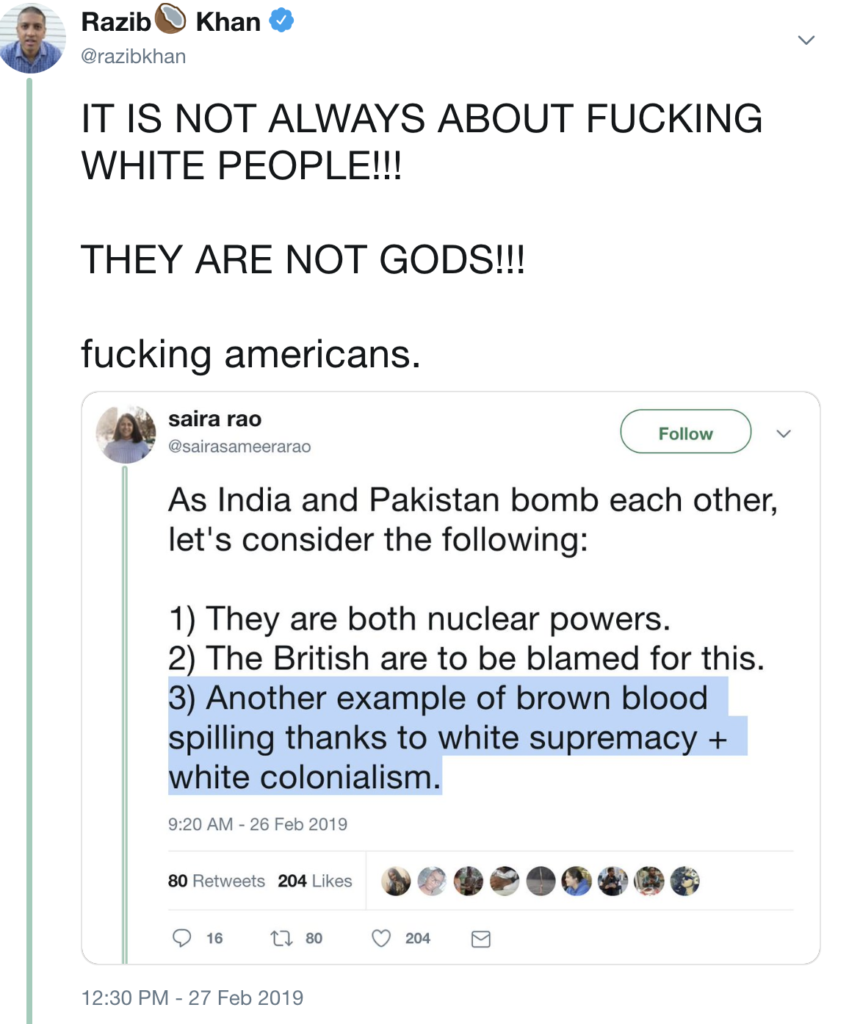
But then this showed up in my timeline, and I honestly could not believe that the confluence of characteristics we’ve been talking about recently might lead to such bizarre self-obsessed comments:

I see this person’s comments in my timeline way too often. Best case scenario is that she’s some sort of ideological grifter who knows how to push buttons. But this indecent.

I now support quotas on (South) Asian Americans at elite universities (a)

This is a follow up to:

I now support quotas on (South) Asian Americans at elite universities

Video gets especially interesting 16 minutes in. Some main take aways:

  • Almost half of all people in the world are Asians. Having a similar ratio of Asian students at elite US institutions is being “diverse”
  • Many different parts of Asia are extraordinarily diverse with many different cultures (Vietnam, India, China, Indonesia). Allowing Asians into elite American institutions enhances diversity.
  • Asians top every metric for admissions except personality profiles, where Asians consistently rank far lower than any other group.
  • Mass discrimination against Asians creates segregation at schools since non Asian kids need to receive different separate remedial classes. Many non Asian kids at elite institutions upon entry lack the math skills to take entry level classes.
  • Asians use to be America’s only reliable Republican voting block (for example backing George Herbert Walker Bush in 1992 and Bob Dole in 1996). The 2016 and 2018 elections are the first time Asians have overwhelmingly voted Democrat. Asians now vote more Democrat than Latinos.
  • Many Asians think they can change Democrats from the inside. And they have had some success. They have persuaded many Democrats to vote for Asian interests on affirmative action.
  • In the last 6 minutes they discuss how the massive over representation of Asians at elite educational institutions is causing a major shift to the left
    • There are surveys of incoming freshman students. They reflect America and their parents. Or center right.
    • Exit surveys of senior students find that they have shifted sharply to the left. They trend left to socialist to communist upon graduation.

My own observation is one that several leading academic professors have also noted. High School Asian American kids, particularly Desi ones, often have contempt for their parents, Asia, older Desis, Asian culture and Asian religions. They are often deeply ashamed and guilty about their Asian privilege and about the ways Asians practice “white supremacy”, racism, bigotry, prejudice, sectarianism, hate, oppression, exploitation towards others. There is a sense that the reason Asians are so successful around the world is because Asians steal from others. This phenomenon extends to undergraduate students but is still not common among Asian Americans over 22 years old.

How much of this phenomenon is being driven by self hatred, self loathing, guilt and a contempt for Asian and Desi cultures and religions? What if anything can be done about this?

As a partial aside, Brown Pundits podcast plans to interview some practitioner Dharmics (including Buddhist, Jain, Sikh) professors in academia. One question we can ask them is how much anti Dharmic phobia comes the indoctrination of Dharmic children in high school and undergraduate university against Dharmic faiths.

I now support quotas on (South) Asian Americans at elite universities

A Harvard Law Professor Is Representing Harvey Weinstein. Students Say This Makes Them Unsafe, Demand His Resignation:

Harvard’s administration is taking students’ concerns seriously, and has agreed to conduct a review of Sullivan.

“In this situation, we would like to have a more complete understanding of the current environment at Winthrop House,” wrote Dean of the College Rakesh Khurana in an email, according to The Harvard Crimson.

One of The Crimson’s own staff members*, Danukshi Mudannayake, is spearheading the effort to remove Sullivan. She started a change.org petition that claims his representation of Weinstein as “not only upsetting, but deeply trauma-inducing.” According to Mudannayake, Sullivan has made clear that he does not “value the safety of students he lives with in Winthrop House.”

The American system is upsetting. To be frank, it’s a feature, not a bug. Presumption of innocence exists not in cases where it is easy to support the innocent, but in cases where it is hard. In the United States of America there are people who commit horrible crimes, and lawyers who defend them and lawyers who prosecute them. This is all part of the system.

It is tough on the heart. But it works. Unlike some societies, the will of the majority does not dictate the outcome (in theory).

Seeing those names was like a punch in the stomach. This is not the sort of “model minority” that I’d like to encourage.

Brown is all, all is brown

There emerged a question in the comments below as to what was “brown” or “desi”?

Ah, the old demarcation problem! Since there is no “Pope of Brownness” we can all offer our opinions. I take a “liberal” and “broad” view.

There are children adopted from India in the United States who are as physically South Asian as anyone. But often they were raised as English-speaking American Christians. Though many attempt to reconnect with “their culture”, the reality is that their family is the family who adopted them. Their culture is the culture in which they grew into adulthood. But, because of the way they look people make assumptions about them. Perhaps people are racist against them as South Asians.

Despite their involuntary cultural alienation from all things South Asian, I have a difficult time thinking that these kids are not brown. Especially if they so want to identify as such.

In contrast, you have the case of people of various races who convert to religions with a South Asian provenance or were raised in those religions. Imagine someone whose parents convert to Hinduism, and raise them in India, but they are half Japanese and English American. They don’t “look” Indian. Brown. Or desi. But if they are raised in India, and practice a form of Hinduism, and speak Indian languages, I have a hard time saying that they don’t have a right to “claim” being desi or brown.

There are obviously many other cases. But I wanted to present these two as opposing and inverted instances, as I think they are the boundary conditions of what desi or brown identity is. People can say what they want about themselves. They could be an Iyer raised in Chennai who claims that they’re really not Indian or desi. Or, someone could be a Russian Karelian who is devoutly Orthodox who claims they Indian. I suspect most of us would think that this is nonsense. To be brown or desi does have boundaries.

But we can make the boundaries crisp and tight. Or broad and loose. For example, to assert that to be desi one has to be a believing and practicing Hindu who is racially South Asian would be a narrow definition.

Or, we can make them broad.

As an American, a broad definition works best for me. My children may not speak a South Asian language, worship Hindu gods, or look particularly “Indian.” But of their eight great-grandparents, four of them were born in British India. They have some claim I think to that heritage and identity, if not as strongly as those genuinely encultured.


The Immigrants Anthem

Very lovely words from the Irish Times:
You can love a second country just like you love a second child. Wholly and completely. You just wrap your arms around it and embrace it. New love opens up for the second without there being any less love for the first. You have nothing to lose and so much to gain. I will find a red dress. And we will swear allegiance. Hand on heart.
This explains my idea of national identity very completely. I don’t see it as either/or but rather more of an “and” proposition.

BrownCast Podcast episode 16: Native Americans and a globalized world

Another BP Podcast is up. You can listen on LibsyniTunes and Stitcher. Probably the easiest way to keep up the podcast since we don’t have a regular schedule is to subscribe at one of the links above. You can also support the podcast as a patron (the primary benefit now is that you get the podcasts considerably earlier than everyone else…). Would appreciate more positive reviews.

This week we’re doing something different…but also something you are going to have to expect. The “BrownCast” and “Brown Pundits” are labeled “brown” because the founders of this weblog are brown. We are obviously interested in Indian/South Asian/Desi topics…but that’s not all we are. In fact, the three original founders, myself, Zach, and Omar, are confirmed dilettantes.

One of the “privileges” of being white is that you are interested in whatever you want to be interested in. You don’t just opine on “white” topics, you opine on the world because the world is your canvas. In the year 2019, my own opinion is that more nonwhites need to decolonize their minds, get over white people and their fraught relationship with a race which dictated the terms of the 19th and 20th centuries and grasp the chaotic, polycentric, and globalized 21st century with two hands.

Cross the threshold. Step into the future. It’s interesting…if sometimes a bit too interesting.

The conversation in this podcast starts out with specific concerns and questions about how Native Americans in the USA are reacting to the candidacy of Elizabeth Warren. Brett Chapman lays out the concerns of his own people rather well. He is a lawyer, so that is to be expected! But, the conversation moves to issues relating to Catalan and Scottish independence, and reconsiderations of the sacrosanct nature of the Eurocentric Westphalian system.

Native American experiences are not just particular, they’re universal, and global.

This is 2019 and the 21st century. Two Americans, one a brown 1.5 generation semi-immigrant, one a Native American, and a brown Briton, get together and have a discussion about continental European politics. It’s our business. The world is our business. And our business is the world.

Why do South Asians have heart disease?


Why Do South Asians Have Such High Rates of Heart Disease?:

Some of the most striking findings to come out of Masala relate to body composition. Using CT scans, Dr. Kanaya and her colleagues found that South Asians have a greater tendency to store body fat in places where it shouldn’t be, like the liver, abdomen and muscles. Fat that accumulates in these areas, known as visceral or ectopic fat, causes greater metabolic damage than fat that is stored just underneath the skin, known as subcutaneous fat.

…. Cardiovascular risks tended to be highest in two groups: those who maintained very strong ties to traditional South Asian religious, cultural and dietary customs, and those who vigorously — embraced a Western lifestyle. Those with lower risk are what the researchers call bicultural, maintaining some aspects of traditional South Asian culture while also adopting some healthy Western habits.

This discrepancy plays out in their dietary behaviors. Almost 40 percent of Masala participants are vegetarian, a common practice in India that is widely regarded in the West as heart healthy. But vegetarians who eat traditional South Asian foods like fried snacks, sweetened beverages and high-fat dairy products were found to have worse cardiovascular health than those who eat what the researchers call a “prudent” diet with more fruits, vegetables, nuts, beans and whole grains (and, for nonvegetarians, fish and chicken). People who eat a Western style diet with red and processed meat, alcohol, refined carbohydrates and few fruits and vegetables were also found to have more metabolic risk factors.

I think one of the issues with the “traditional” lifestyle combined with modern affluence is that they aren’t actually eating like their (our) ancestors would eat. Though fried snacks and sweetened beverages are acceptable in vegetarian diets, I doubt that this was on the menu for many Indians who lived on vegetarian diets in the past. The two “bad” dietary options are really converging on modern processed/high cal diets from different pathways.

Brown Pundits on Instagram!

Contributors, commenters, lurkers:

Happy to announce that Brown Pundits is officially on Instagram! You can find the profile here: https://www.instagram.com/brown_pundits. Please do give the account a follow.

I’ve noticed in my social media travels that the desi presence on Instagram these days is quite strong. There’s been a proliferation of profiles dedicated to desi history and culture that have seen some pretty expansive growth (e.g. Brown History, southasia.art). And as the sole and best source of heterodox views on all things South Asia, it’s only fair that BP gets it on the fun.

The primary purpose of the page will be boost the signal of the Brown Pundits Podcast, which is off to a great start and has already recorded a number of fantastic episodes. But of course, the page will be a work in progress.

Please do leave any comments or suggestions you have in the comments. Also open to any suggested “tag lines” we can include in the bio: as a starter, I went with “Punditry by Browns, for Browns.”

Brown Pundits