Jaswant Singh: The Last Liberal Conservative

Major Jaswant Singh (1938-2020), a former Indian army officer and distinguished parliamentarian and politician passed away recently. He served high office in the first BJP/NDA regime (1998-2004) and was, variously, the Defence, External Affairs and Finance Minister. Perhaps his most enduring legacy was his deft handling of India’s foreign policy in the aftermath of India’s nuclear tests in 1998. Most famously, his dialogues with the US Deputy Secretary of State Strobe Talbott helped cement Indo-US ties in the aftermath of the Cold War era.

There are some excellent obituaries- from allies, critics and rivals alike- which give us a good sense of the man and his persona. For me, the obituary that really struck a chord was the one by the senior Indian journalist Shekhar Gupta in his Cut the Clutter show.  It is worth quoting him verbatim:

Jaswant Singh was the last Indian liberal conservative… A conservative in the sense that he brought in a Hindu sensibility, a love for Indian culture. But liberal enough…to embrace everybody… and not interfere in anybody’s way of life and allow a healthy debate… he would have fitted the Swatantra Party very well and would have brought to it the one thing it seemed to lack in the 1950s and 60s: a strong appeal to nationalism”.  

With Singh’s passing, it does feel that the last vestiges of the Vajpayee era are fading away. In his obituary for Singh, the journalist Saeed Naqvi, by no means a cheerleader for the BJP says that “Vajpayee’s was a cabinet of women and gentlemen, a few rotten apples notwithstanding.” Old fashioned virtues of moderation, decency and honour were valued by Vajpayee, and there was no one who epitomised old school more than Jaswant Singh. Through his career as a soldier and public servant and his sense of noblesse oblige, this thoroughbred Rajput proved to be a worthy Kshatriya by virtue of his karma.  In that, he was not alone. Dr. Karan Singh of the Dogra dynasty of Jammu & Kashmir and Captain Amrinder Singh of the House of Patiala are others of his generation who come to mind, albeit with different political ideologies.
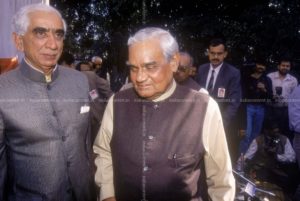
Jaswant Singh and Atal Bihari Vajpayee: The last of the Liberal Conservatives. Source: Indiacontent.in

As a self-avowed liberal conservative, it is hard to not feel a tinge of sadness at this. One got the sense that men like Vajpayee and Singh were able to balance tradition and modernity: adept at blending the Burkean with the Vedantic, and equally well versed in the Bhagavad Gita and the Indian Constitution.

I could name half a dozen prominent BJP politicians in the Vajpayee years who could have identified as liberal conservatives. I struggle to name any noteworthy ones in the Modi-Shah BJP. The closest that comes to mind is the Odisha politician Baijayant Panda, but he is not prominent or important enough in the party. Others such as the former Maharastra Chief Minister Devendra Fadnavis or the current Madhya Pradesh Chief Minister Shivraj Chauhan had the potential to tailor their politics in this direction with the right backing and support. Unfortunately the signal from the leadership is that chest-thumping nationalism and ideological purity counts for more than moderation and compromise. Unlike a Jaswant Singh, these politicians do not have the intellectual courage or independence of spirt to breach the party line and chart their own path. It is a sad indictment on Indian politics, one that would have undoubtedly greatly depressed Jaswant Singh.
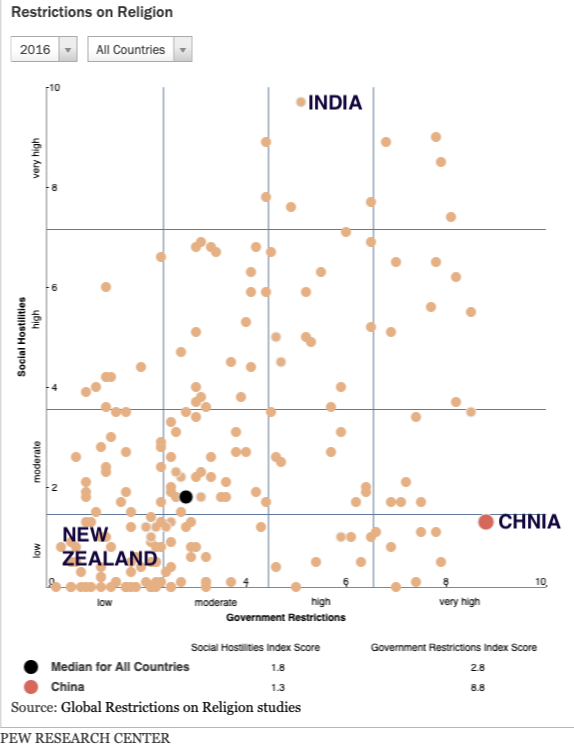

China, strong government, free society, India, weak government, strong society

In our discussion on the podcast, Abhinav talked about China and India in relation to society vs. government. I stumbled on this chart from Pew that illustrates it.

China’s government controls religion much more than India’s government. But on a personal level, the Chinese have much more freedom in their religious identity. Indians are simply not equipped to understand how religion does not have corporate power as an identity in the same way in East Asia, which means the stakes for individual religious experimentation are far lower.

Brown Pundits Browncast episodes 128 and 129

This week two quick episodes with two sagacious repeat guests.

– With Jasper Gregory I revisit the situation in Vietnam. From coronavius, to BLM, to K-Pop.

– With Abhinav Prakash I discuss the Hathras rape, how it relates to caste politics in UP, and the various Dalit groups in that state.

You may notice a difference in sound quality. I decided to get a legitimate microphone. I think that will reduce the complaints about sound quality. Since it cost some money, I wouldn’t mind more Patreon subscriptions.

Playing with fire ?

Unless you are living under a rock, you will have noticed the Babri demolition conspiracy verdict. All 32 accused including the firebrand Ashok Singhal and Uma Bharti were acquitted of the conspiracy charge. A conspiracy charge is notoriously difficult to prove in Indian court even with Political will, in this case from an objective perspective, the charge was unlikely to stick owing the excessive burden of proof required to prove conspiracy.

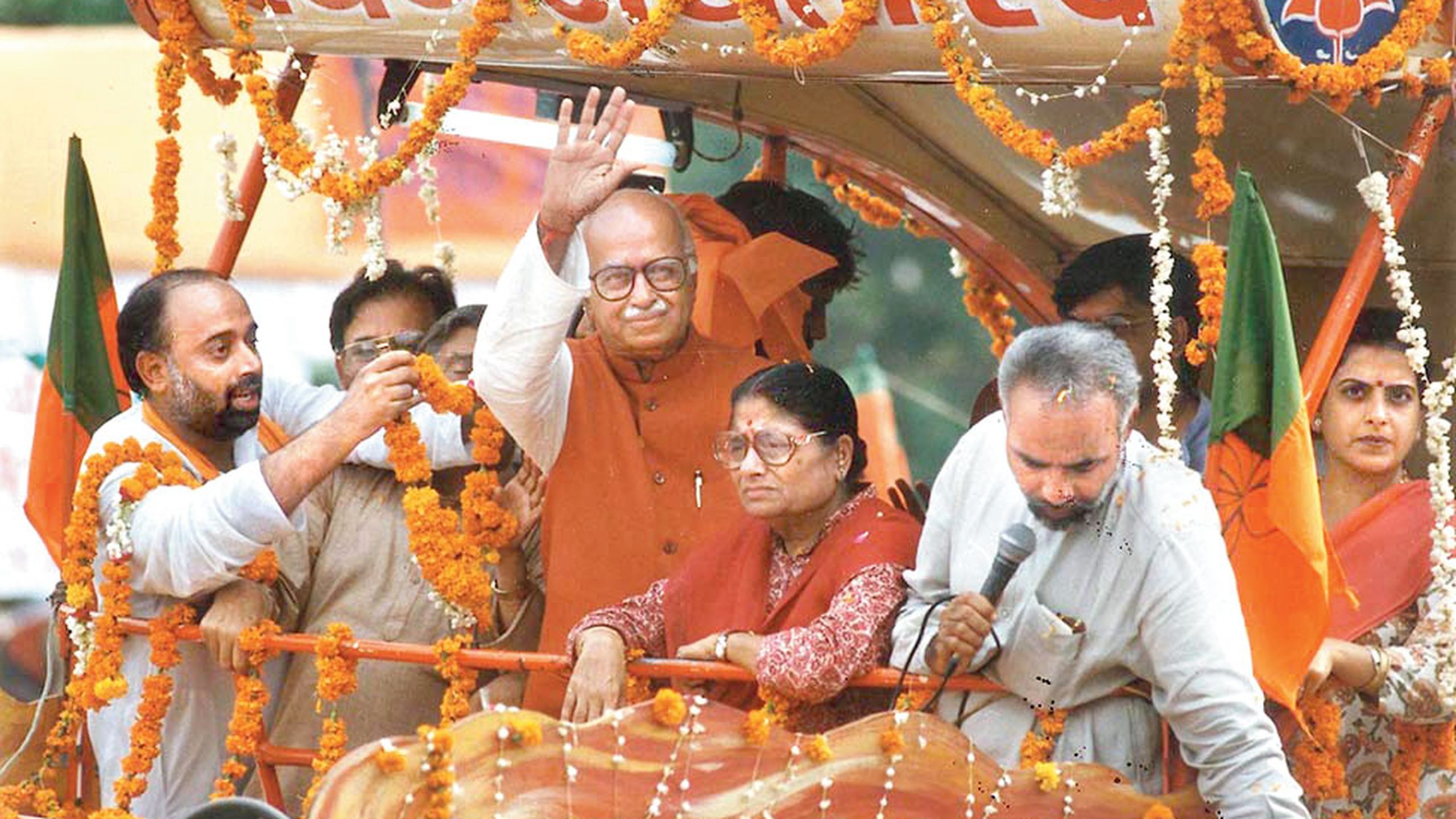
I came across this interview of Advani with Prannoy Roy from 2000.

After six years of Modi Shah, Advani appears like a fresh of breath air (to my liberal ears). Notwithstanding his role as the prime mover of the Ram Janmabhooni movement which left trails of blood across the country, Advani appears significantly liberal to my eyes in 2020. The willingness to talk to the enemy (as seen in a range of interviews given to aggressive media), comparatively more respect to democratic ethos and institutions, and an overall soft spoken-ness.

However, the interview leaves us with the question – Is Advani telling the truth?

There seem to be three potential chain of events which led to the culmination of the demolition of Babri Masjid.

  1. The aim of the Rath Yatra by Advani was always to demolish the mosque and the previous years were spent in raising support for the demolition of the mosque. This was the narrative the most far left and far right in India believe.  In other words, the whole movement was a conspiracy under a facade of Rath Yatra.
  2. The leadership of the movement – namely Advani, Murli Manohar Joshi, and to a lesser extent Vajpayee under the umbrella of RSS (this included the current Prime minister) never really planned to break the mosque. Their aim was to mobilize the Hindu over and above their caste boundaries. The mobilization has political benefits as well as social benefits in response to Islam. However, during the movement, a small group actually conspired to break the mosque. That means if there was a conspiracy, either the top leadership was kept in dark or the top leadership turned a blind eye towards it. This seems to the claim made by Advani and Vajpayee where both of them on record called the demolition of the mosque as the saddest day of their life.
  3. The mass movement got carried away in hubris. After years of chest thumbing, for the karsevaks – this was the moment to go down in the history and they did.

If either of 2 and 3 is true, it is fair to say the BJP and Sangha Parivar leaders were playing with fire and when the fire got out of control it burned every one to a certain extent. Though today even if the fire was unintended, the fruits of the fire continue to be reaped.

Population structure in West Bengal and Bangladesh

The Genomes Asia 100K has put their Indian paper out. It’s OK, and mostly focuses on the fact that Indians are enriched for inbreeding vis-a-vis other world populations. There are several layers to this. In some cases, as among South Indian Hindus and Muslims, there is cousin-marriage. But, in other cases, for example, Scheduled Castes and Scheduled Tribes, there seem to be extreme bottleneck effects due to delimited marriage networks. Finally, even among large population groups, such as Iyers, there seems to be some elevation of runs of homozygosity due to endogamy.

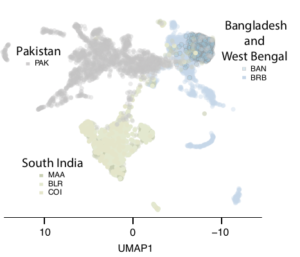
But that’s really not what I’m interested in. This preprint has a lot of Bengalis from Birbhum district in West Bengal of various castes. The UMAP (an advance over PCA in some ways) figures aren’t super informative, but you can see that their pooled sample recapitulates the Indian subcontinent. In fact, West Bengals on the whole are to the “west” of Bangladesh samples. Totally unsurprisingly.

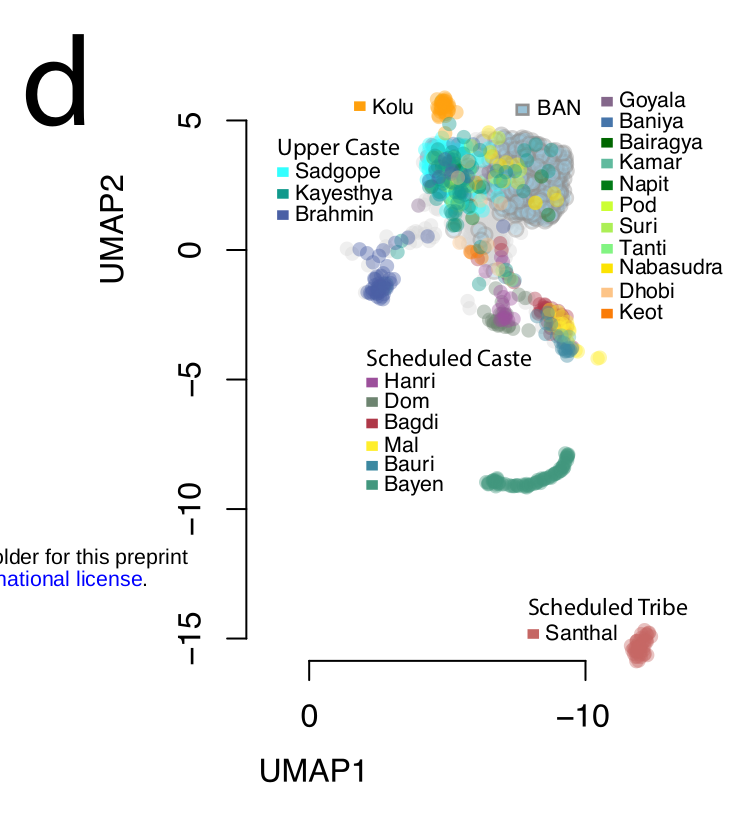
The main reason I’m putting this post up is the UMAP plot below. It’s hard to read (they will clean it up for final publication), and I don’t know all the castes (I’m assuming “Nabasudra” is a typo). But some things that jump out

1) Bengali Brahmins are distinct.

2) Kayastha are generic West Bengalis.

3) Some of the West Bengal samples are in the Bangladesh (collected from Dhaka) distribution. These are probably descendants of Bangal migrants from the east.

4) Some groups are very distinct. That’s partly due to strong endogamy, and in the case of Santhals high East Asian ancestry (they’re Munda). Other groups are less distinct. The “Namasudra” seem to be two groups. One overlaps with the main Bengali cluster (slight bias toward Bangladeshis), while a second group is shifted toward Scheduled Castes.

I assume readers can make more heads or tails of this, as I don’t know much about caste in West Bengal (and yes, the figure is very badly labeled/colored; this is a preprint)

Addendum: Not comments about Jatts please. I will delete them.

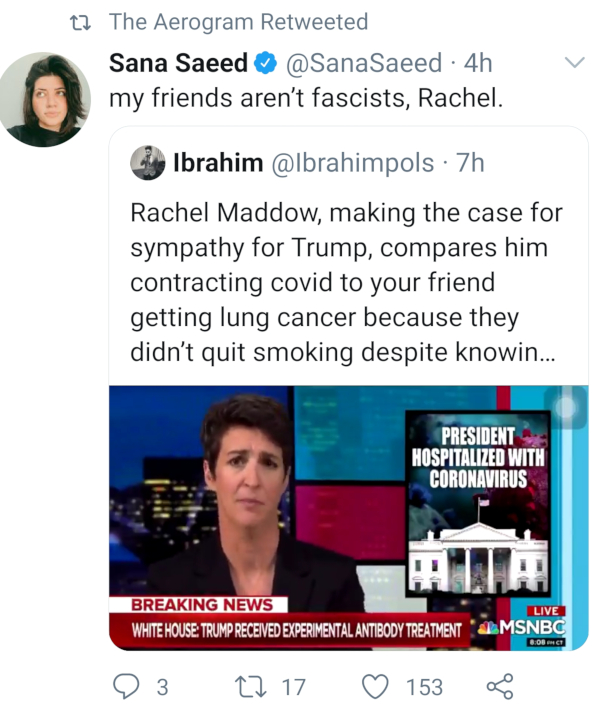
The AJPlus exception! Fascism for thee, but not me


I am not a media person, so I do not understand the deal with AJPlus and its “woke” journalists.

AJPlus is owned by the Al Jazeera Media Group, which is a catspaw of the government of Qatar. Qatar is a Salafi petrostate run for the benefit of the Thani family and is run like a capitalist caste state. I’ve been to Qatar. It’s a fine place if you have money, but perhaps less fine if you one of the laboring classes.

I don’t begrudge Sana Saeed for making a living, but I doubt she would begrudge herself that opportunity if she was on the outside looking in.

The world is complicated. I dislike engaging in guilt-by-association but woke journalists at AJPlus do it constantly. It’s like they don’t see the glasshouses that they live in.

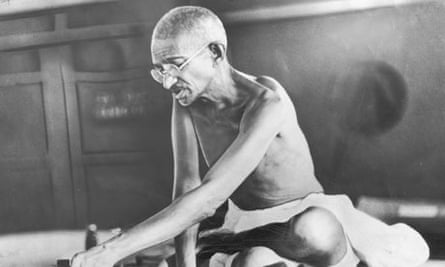
Some brief points on Gandhi

A brief summary of my views about Gandhi

  • I have seen the entire “Mi Nathuram Godse Boltoy” play and read the entire speech by Nathuram Godse. Till my late teens, I was impressed by parts of Godse’s arguments but today I find them misguided and half baked and his actions hasty and counterproductive (From Hindutva POV). On further reading – especially Gandhi’s own writings and other commentaries my views have changed almost 180Degrees wrt Gandhi. A lot of hatred of Gandhi in MH brahmin circles is due to the 1948 Anti Brahmin riots.
  • He would be best classified as a Brave Pacifist Extremist. He combined both Tilak’s and Gokhale’s tactics. He was not a moderate like Gokhale, nor did he condone violence like Tilak – yet he tried to encapsulate both streams in Congress before him.
  • Prima facie a lot of his pacifism seems excessive and inefficient, but when you read Gandhi’s own writings on Violence as a tool against oppression the pragmatism of his position comes through.
  • Non-violence was the path of least resistance and hence extremely helpful in building national movement while instilling democratic values in the populous.
  • His pacifism was more rooted in Jain/Jesus’ influences on him than Hindu Ahimsa.
  • His Ahimsa probably won’t have worked against other colonial powers.
  • Gandhi deserves the most credit for increasing the involvement of the Indian populous into the freedom struggle.
  • He said and did a lot of stupid things that cannot be defended no matter what. His moral grandstanding can be seen as extremely patronizing.
  • His campaign against untouchability had a significantly more impact than he gets credit for.
  • His fasts which can be seen as moral blackmail did a lot of good for the country too. The 1932 Poona pact being a primary example. I also see his controversial 1948 fast for money transfer to Pakistan (for which he finally died) as not without merit.
  • His solution for most Hindu-Muslim conflicts was naive. He can be rightfully accused of being very soft on Muslim extremists. Khilafat movement was arguably a great blunder.
  • Blaming Gandhi for Partition is extremely unfair. If anything the blame must reside with Nehru/Patel for their greed for power.
  • His ideas about bottom-up Swarajya and sustainability appear naive and stupid in the 21st century.
  • Some moments in Gandhi’s life are extremely extraordinary – eg: His Satyagrahas, his reception by Manchester mill workers, his conflict resolution in Naokhali.
  • Why he favored Nehru (over Patel) who was very unlike Gandhi is a mystery to me. Guha and others have tried but I am not convinced.
  • He understood the country much more than his peers.
  • Influence Gandhi has had on foreign movements is extraordinary – MLK, Mandela. He is along with Yoga the two strongest candidates for Indian soft power.
  • Liberal criticism of Gandhi (South African racism, Casteism, Sexism) miss the point of Gandhi. Seldom have public figures changed their views on issues with changing times so drastically and so transparently. IMO that’s the quality that keeps Gandhi apart from other famous politicians.
  • I guess distant future history will remember Gandhi as a flawed yet great human being – in league with Jesus and Mohammad.
  • He is undoubtedly the most consequential (hence Greatest ?) Indian from the 20th century.
  • In the long run, as already seen by the RSS/BJP embrace of Gandhi, his legacy is safer than others (Like Nehru)

Rape Culture, Indian Edition

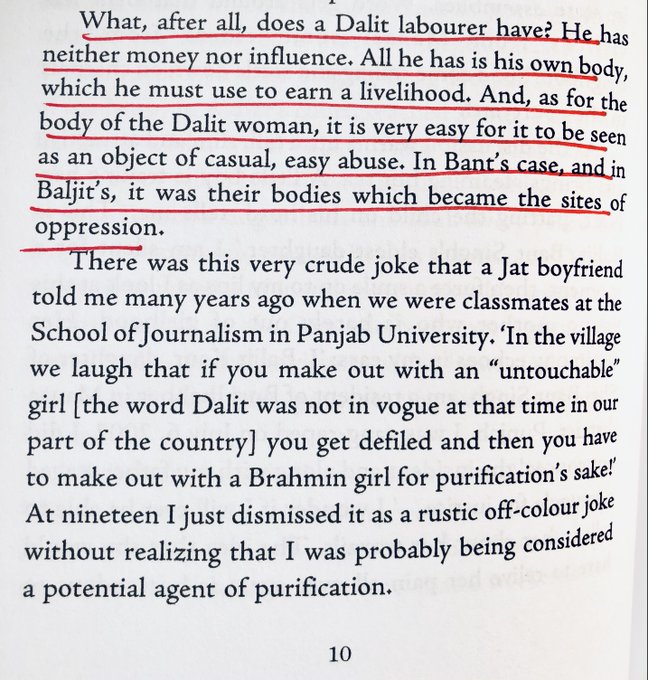
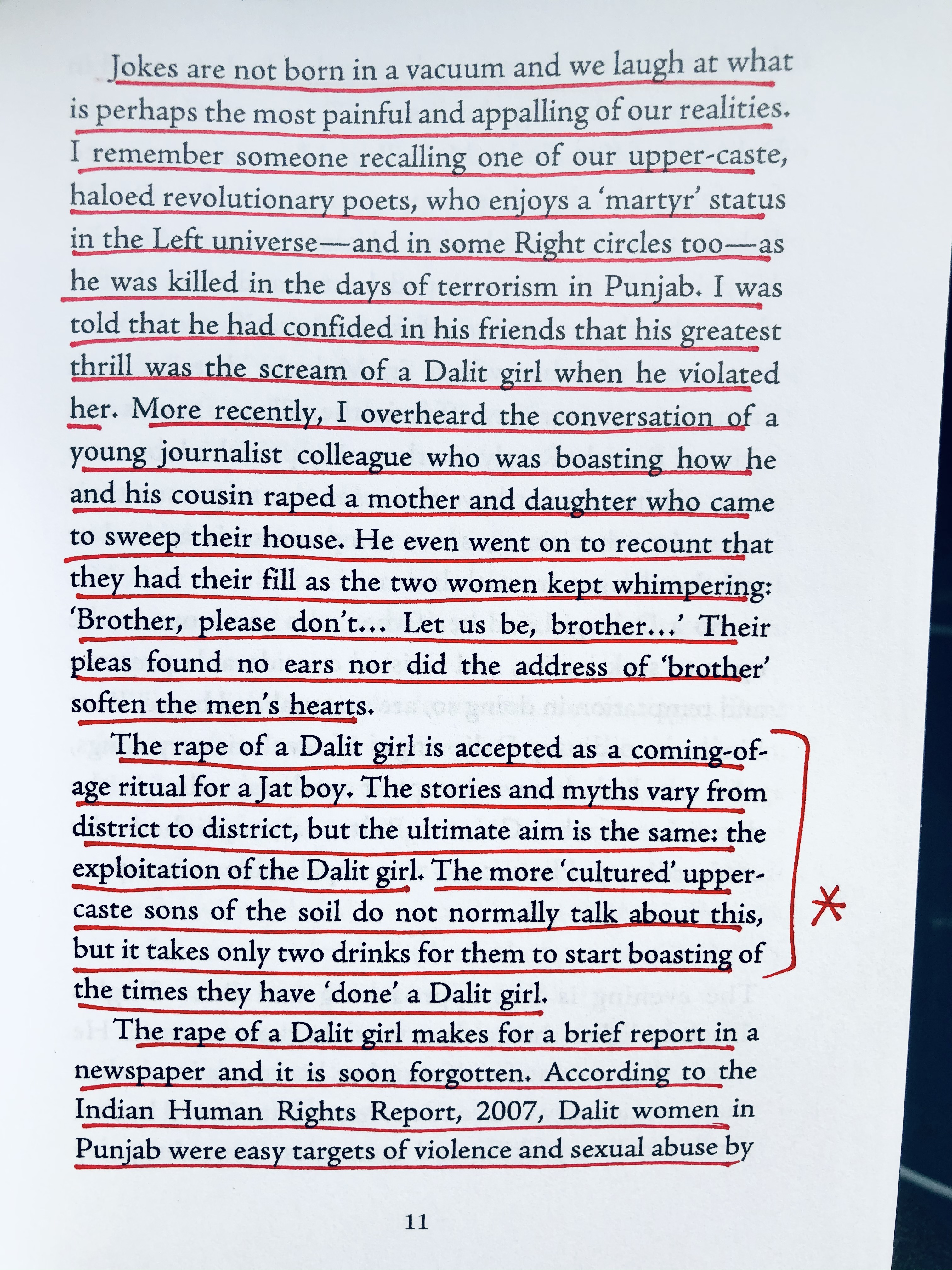
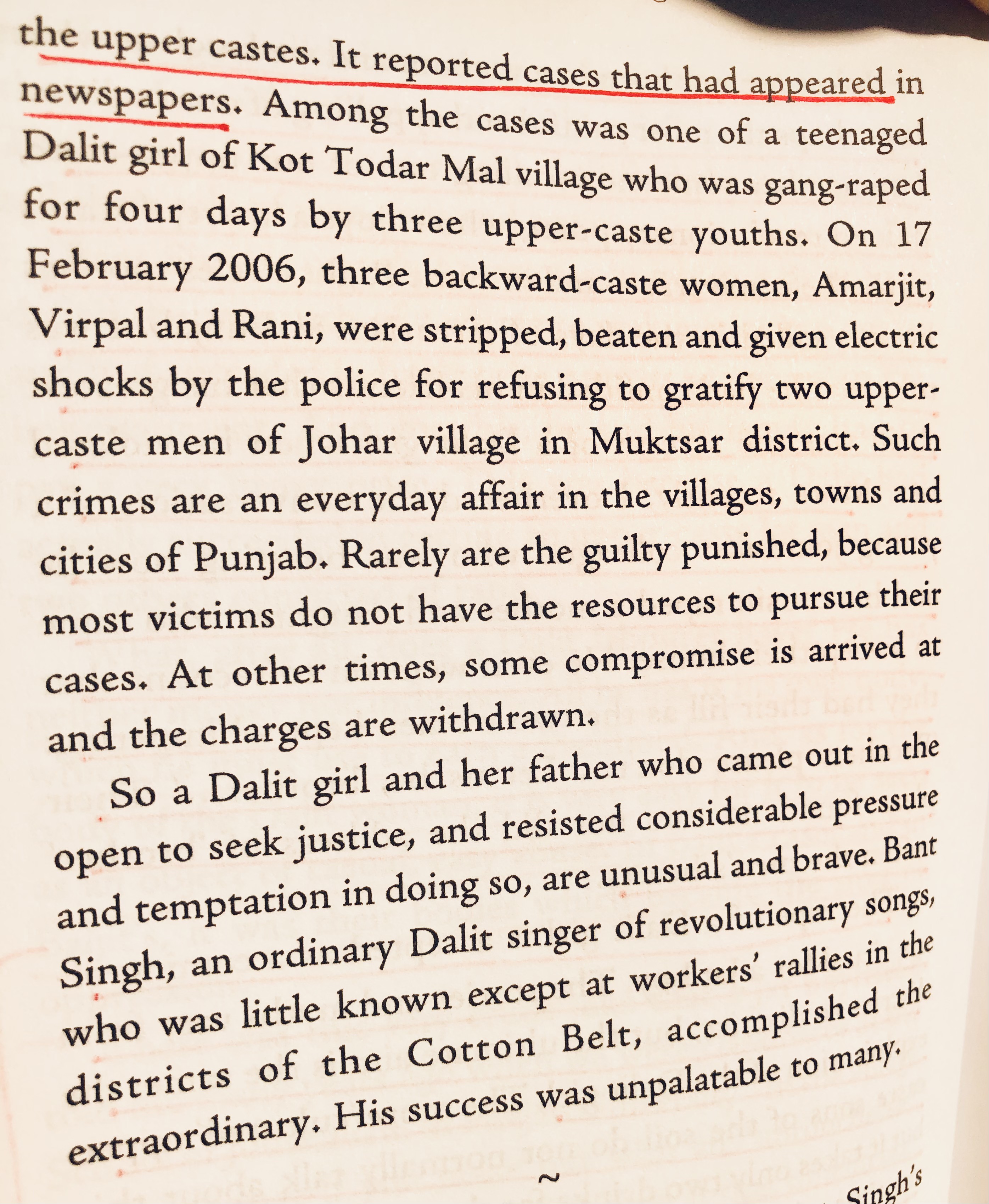
There is news about another rape case (alleged rape case?) making wavers in India and Twitter regular @conradkbarwa posted some excerpts from a book by poet and journalist Nirupama Dutta that you can see below:


Image

Image

Image

The anecdotes listed in these pages are obviously very disturbing and shocking, and I have no doubt that even if Nirupama moves in unusually nasty company, many such cases do occur across the Indian subcontinent and in most of them the police are yet another source of oppression (and sometimes even a second rape in the police station). The excerpts above are from East Punjab, so from a land that we are not entirely unfamiliar with (apart from whatever similarities exist across east and west Punjab, my in-laws are from villages near Ludhiana). It made me think about our own Punjab and the various anecdotes I have heard about rape of lower class women in villages as well as the use of sweepers and servants for sexual favors in urban areas. And of course, about the well publicized recent rape cases in Pakistani Punjab and about Razib Khan’s comment somewhere that “THIS is what a real rape culture looks like”. Which led to a tangential question in my mind: what are the similarities and differences between rape culture in Pakistani Punjab and Indian Punjab? 

  1. Differences in terms of actual prevalence and mechanics? Is such rape more common? less common? about the same? What figures do we have? How reliable are they? What is the trendline? How does this compare to other societies? 
  2. Differences in how it is framed: rapes in Pakistan tend to be framed as either class oppression (mostly by leftist/liberal commentators) or as “declining morals due to Indian movies, western influence, modernization, etc” (Islamist and/or traditional commentators). Rapes in India tend to be framed as class oppression too at times, but it seems that liberals and even traditional leftists in India (or about India, this is also true of most sympathetic Western commentators) seem very likely to blame “Brahminism” and the caste system as very specifically Indian forms of rape culture, not comparable to similar atrocities that happen to lower class populations in other countries (though I assume that population numbers being what they are, most actual rapists in East Punjab are  likely to be Jats or other local elites, Sikhs rather than Hindus, and rarely Brahmins). There is also a traditionalist view in India (that “lax morals, westernization, bollywood ” etc are to blame) and of course Hindutva types will add “love jihad” or “Muslim/Turkic colonization” to the list of putative causes. What are the most important causes in your view? 
  3. Which brings me to the real trigger for this post: Do you think the focus on caste in East Punjab (as in Nirupama Dutta’s book) and its relative absence in Western Punjab stories reflects a real difference in how easy it is to rape poor girls and get away with it? I know most Pakistanis will say this is exactly the case and that we are much better off since we are Muslims and any caste-ism that exists in us is a legacy of Hinduism, is less than it is in East Punjab, is fading fast and is the reason we have less rapes already, while Indian society will remain stuck in rape culture because of “Brahminism”.  Of course this is a question that in principle can be answered. What is the prevalence of the rape/sexual abuse of lower class women in Pakistani Punjab vs East Punjab? If it is really lower, then it needs an explanation. If it is not lower, then it may be that the focus on Brahminism is taking the public discussion (and possible solutions) into unhelpful areas? Or is it Pakistan that needs to talk more about caste rather than class to catch up to the reality? 
  4. I am not revealing any secrets by adding that this is connected to a personal feeling that left/liberal discourse is focused on political needs (defeating BJP/Hindu revivalism in this case)  and when you add that the usual human thing of finding a convenient narrative and beating it to death, it is possible that Pakistanis are actually a little better at analyzing their own society because they don’t have to carry this burden. But I am aware that this may be an extension of “grass is greener on the other side” on my part, and it is in fact the case that conversion to Islam (or “Indus man superiority”) has made Pakistanis less rapey than Indians. But if this is the case, why are Sikhs still rapey? does Brahminism work on them more than it does on Punjabi Muslims? (I am also aware that 6 out of ten readers will misunderstand what I am trying to ask here, but that is par for the course and I am more interested in the 4 who do get the question).

Fire away…

Brown Pundits