
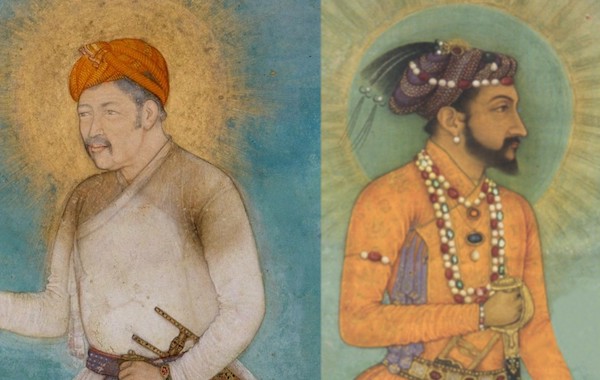
The above are portraits of Akbar the Great and his grandson Shah Jahan that date to about 1630. Akbar had died about 25 years before the portrait, but its likeness seems close to how he was described by his relatives; fair-skinned and with a definite East Asian cast to his features. Akbar’s mother was ethnically Persian, while his father was mostly of Turco-Mongol background. Shah Jahan, in contrast, looks typical for a North Indian noble. This is reasonable because three of his grandparents were Hindu Rajputs. Only Akbar himself was not ethnically Indian.
But they say do not judge a book by its cover. A stylized fact of the Mughals at their peak is that from Akbar, to Jehangir, to Shah Jahan and finally Aurangzeb, there was a progressive ratcheting up in the power and influence of Sunni orthodoxy in the inner circle of the court. The 100 years after the reign of Akbar can be seen a series of victories by international Sunni institutions like the Naqsbandi order. This integration into a broader Islamic world can even be seen in Shah Jahan’s choice of Muntaz Mahal, an ethnic Persian of recent immigrant background, as his primary consort.
I think of these things sometimes because periodically there are outbreaks of argument about whether the Mughals were Indian or colonizers on the internet, and the two sides are extremely reductive and stark. This makes sense since it’s all rhetoric. But often they collapse and erase the texture.
One thing that is important to note is that it does seem clear that the Mughal conquest of India saw a deeper integration of India into the Islamic world than the period of the Delhi Sultanate and its successor states. Though many of these states were of Turco-Iranian origin, and cultivated Persian high culture, they were not as coherent or focused in their ideology as the Mughal Empire that succeeded them (during the Bengal Sultanate that Bengali did become a language at court). India had long been seen as a land of opportunity for Muslim adventures, but the Mughals systematized it, encouraging the migration of Iranians, especially Sunnis fleeing a newly Shia state, into its civil administration and Afghans and Turkic Central Asians into its military.