
On 28 December 2010, the question was not ideology or politics, but naming.
brownpundit(s). brownguru(s). brownsmarts. brownfolks. brownidiots.
The instinct was already there: reclaim brown without asking permission, and refuse the performance of respectability that so often polices minority intellectual spaces. The reply came quickly and decisively.
Brownpundits.
The first post, Hello World, went live on 30 December 2010. Fifteen years later, what matters is not that a blog survived. Many do. What matters is how it survived: without institutional backing, without funding, without ideological capture, and without deference to credentials masquerading as truth. Brown Pundits was never designed as a platform for prestige. It was designed as an intellectual retreat; a place where arguments stand or fall on substance, not accent; where brownness is neither explained nor apologised for; where disagreement is not heresy. That posture, upright, unbought, unafraid, is why Brown Pundits still exists.
A Discipline, Not a Brand
Brown Pundits began with a simple wager: that the English-language internet still had room for a South Asian intellectual space that did not need permission. No institutional sponsor. No ideology police. No professional incentives. Just writers who believed that brown questions, Indian, Pakistani, Bangladeshi, diasporic, could be argued in public with rigor and dignity. Fifteen years on, Brown Pundits remains. That endurance is not luck. It is structure. We lasted because we never built this as a brand. We built it as a discipline.
The point has never been agreement. The point has been posture: stand upright, test claims, correct errors, refuse theatre. Independent platforms fail for predictable reasons. They chase virality. They harden into faction. Or they monetize attention until thought becomes marketing. Brown Pundits avoided those traps by being unusually boring in the right ways: we publish, we argue, we edit, we keep the record. Nobody here is paid to write. That is not moral vanity. It is why we remain unpurchasable.
Five Years of Solidarity
Over the last five years, some of the most important work has not been online at all. It has been the steady, unglamorous work of civic seriousness: reading dense documents, tracking deadlines, understanding procedure, and watching institutions scramble when they assume nobody is paying attention. During this period, there has also been sustained dialogue with a small circle of intellectually serious allies; quiet, exacting minds with a gift for clarity under pressure and an instinct for how power hides behind process. Not public figures. Not brands. Just adults: difficult to gaslight, uninterested in theatrics, precise about the record.
That kind of solidarity resets the baseline. You stop mistaking polish for integrity. You stop confusing titles with truth. You learn to clock everything. You learn that the record is not drama; it is protection. That discipline carries back into Brown Pundits. It shows in how disputes are handled, how errors are named, and how authority is tested rather than absorbed.
The SD Episode as Proof
The recent SD exchange was not, in the end, about architecture. It was about authority: who is allowed to explain, who is expected to absorb, and what happens when the subject speaks back. We engaged the way Brown Pundits always has. We read closely. We identified the errors. We insisted on precision. We treated the exchange as part of the record, not as outrage content. What mattered was not that corrections were made; corrections are normal and welcome.
What mattered was the instinct that surfaced at the start: revise quietly, respond pedagogically, assume the critique will not notice the shift. That instinct is older than any one writer. It is a patterned behaviour in how authority manages challenge in brown-facing spaces. And yet, precisely because Brown Pundits exists, the record held. The language moved. The posture changed. This was not a “victory.” It was proof of concept. The platform did what it is meant to do.
“Brown” Is Not an Ethnicity; It Is a Civilizational Composite
The deeper reason Brown Pundits still matters is that brown is not a neat identity. It is not a single bloodline, doctrine, or grievance. It is a civilizational composite with a long memory and a hard geography. The Indian subcontinent is layering, not essence:
-
ancient coastal and inland populations
-
Dravidian continuities and transformations
-
Aryan synthesis and institutionalisation
-
Islamicate overlays that became native in texture, not merely foreign in rule
-
British power, whose administrative afterlife still structures class and accent
And beyond this lie the East, the Northeast, the mountain corridors, the sea routes. This is why Brown Pundits resists simplification. The subcontinent is not a monoculture, a single trauma, or a single pride. It cannot be narrated by those who treat it as a site for extraction; political, academic, or aesthetic.
What Fifteen Years Means
Fifteen years is long enough to know what this site is for. Not fame. Not power. Not money. Not outrage. Those are cheap forms of relevance. Brown Pundits exists to keep an alternative alive: an intellectual retreat on the open web where brown life can be examined with seriousness; where hierarchy is not mistaken for truth; where criticism is not treated as insolence; where the record matters. We are not untouchable, and we do not aim to be. But we are not easily compromised, because everyone here has a life outside the internet. That is our freedom. Fifteen years on, the mission remains unchanged:
Stand upright | Read closely | Correct what is wrong | Refuse permission structures | Keep the record |
That is why we are still here.
Congratulations on 15 years!
I do feel (based on my experience both in this iteration and in the previous iteration) BP has “hardened into faction” to an extent. India and Pakistan dominate subcontinental discourse and it has become increasingly difficult for Indians and Pakistanis to engage in a civil manner with each other. Over the past 15 years, the India-Pakistan relationship has only deteriorated.
Given that reality, it is only natural that there will be friction between Indians and Pakistanis on many contentious issues. However, there are certain people on this forum who seem to see their purpose as being only to troll Pakistan and Pakistanis. That sometimes makes this forum a hostile environment.
Again, I am not trying to censor anyone’s political views. But people need to engage in good faith. Some of the rhetoric used here about Pakistan is absolutely appalling.
Also “Brown” goes beyond just India and Pakistan. We do have sbarrkum bringing a Sri Lankan perspective but it would be nice to have people from other South Asian countries as well.
.
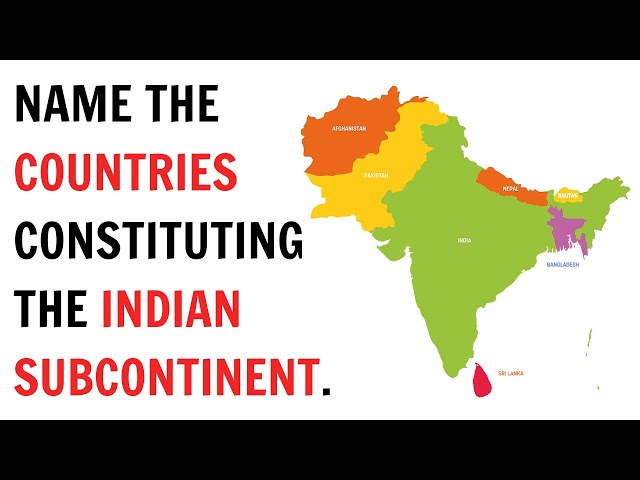
West Afghanistan cant be considered geographically Indian Subcontinent. The Hindu Kush is divider of the subcontinent,
The Hindu Kush form the boundary between the Indus watershed in South Asia, and Amu Darya watershed in Central Asia.
Like the Continental Divide in Western US.Rockies
https://en.wikipedia.org/wiki/Hindu_Kush
Yes, Afghanistan is not technically part of the subcontinent. Even half of Pakistan is not on the subcontinent but on the Iranian Plateau.
This is why I prefer the term “South Asia” to “Indian Subcontinent” (which is strictly a geographical term).
Indian subcontinent hi rahega, Mr “South Asian”.
Once again, you are missing the point. “Indian Subcontinent” is a geographical term. That’s fine.
“South Asia” is a geopolitical term. Afghanistan is not part of the Indian subcontinent geographically. It is part of South Asia.
Yes but then it’s better to use the more tighter Indian Subcontinent than South Asia.
Like I would prefer Iranian Plateau or Turan rather than these Eurocentric names (Middle East??)
Which term you use depends on the context.
Indian Subcontinent is a geographical expression not a geopolitical one. So if we are talking about geography then it’s fine. Otherwise, it doesn’t make sense.
It’s just a geographical fact that Afghanistan is not part of the Indian subcontinent. As Sbarrkum mentioned, the Hindu Kush is considered the boundary of the subcontinent.
Also from a political perspective, “Indian” subcontinent is a term that may be offensive to some Pakistanis and Bangladeshis. It assumes that India (the nation-state) is central to the subcontinent. In Pakistan, people often use the (rather awkward) “Indo-Pak subcontinent”.
“South Asia” avoids these problems.
Personally, I’m not bothered by the term “Middle East” though for course it is a Eurocentric perspective. I guess “West Asia” is an alternative term.
It is India – Hindustan
Punjab wasn’t a part of Central Asia; albeit Western Punjab can be seen as the lowlands of the Iranian Plateau
Balochistan is not part of the “Indian subcontinent”, it’s clearly on the Iranian Plateau. Afghanistan is not part of the subcontinent.
Anyway, people are free to use the terms they want. As far as I’m concerned, “Indian subcontinent” is a geographical expression not a geopolitical one. I will use South Asia.
Indian.
Congratulations. Here’s to many more years of thinking and writing about what matters.