
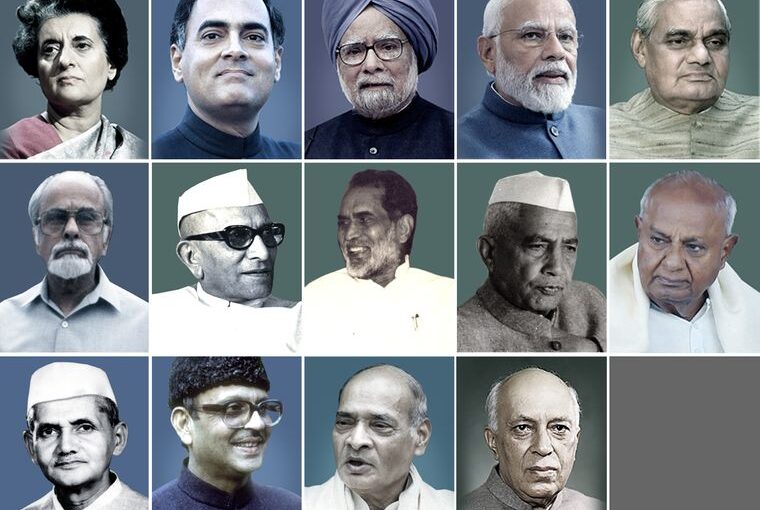
Replying to Sbarrkum got me thinking; instead of relitigating India-Pakistan, a more interesting question: across 14 India Prime Ministers, who actually did the job best?
Simple question. Hard answer.
Make the case. What criteria matters most to you?
- Economic stewardship
- Institutional integrity
- Foreign policy judgment
- Social cohesion
- Crisis management
No slogans. No party loyalty. Just reasoning.
Moderated for substance. Indian-centred perspectives prioritised.
A few facts after the jump.
Who were the Woman & Men: 14 Prime Ministers, 13 Hindu, 13 men, 13 upper caste, 13 Aryan — yet the exceptions are telling: Manmohan Singh (Sikh), Indira Gandhi (woman), and Narendra Modi (OBC) each broke a different ceiling. Three came from the same family (Nehru, Indira, Rajiv). The majority served under Congress; only two PMs have come from BJP; Vajpayee and Modi.
Tenures: Nehru served the longest at 17 years. Two PMs died in office — Nehru (natural causes, 1964) and Shastri (Tashkent, 1966, the day after signing the peace accord with Pakistan, circumstances remain disputed). Indira Gandhi was assassinated in office by her own bodyguards in 1984; Rajiv was assassinated in 1991 but after leaving office, during an election campaign. The shortest substantive tenure belongs to Charan Singh, who served five months and never once faced Parliament.
Regional representation has been heavily skewed toward the Hindi heartland and UP in particular; Nehru, Shastri, Indira, Rajiv, Vajpayee, Charan Singh, VP Singh, Chandra Shekhar (though of course the Nehru-Gandhis were famously Kashmiri Pandits rather than UPites per se, Kabir’s distant cousins so to speak). Narasimha Rao was the first and only South Indian PM, striking given the south’s economic and demographic weight.
On Brahmins: five of fourteen were Brahmin, but three of those five were Nehru-Gandhi dynasty; so really only two independent Brahmin PMs. More dynastic than caste, as it turns out.
The Congress paradox: the party that built its identity around social inclusion produced the most dynastic, upper-caste-dominated succession in Indian political history. BJP, rhetorically the party of Hindu consolidation, elevated India’s first OBC Prime Minister.
A footnote on geography and genetics: even the sole South Indian PM was a Brahmin; arguably the most Aryanised of Dravidians. Not a single PM has been unambiguously Dravidian.
For me, there is no question. The answer is Pandit Nehru.
It is because of Pandit Nehru that India is a constitutionally secular state. This is very impressive–especially given that there had just been a violent Partition and Pakistan had been created explicitly as a homeland for Muslims. The Hindu Mahasabha argued that India should be a constitutionally Hindu state but Pandit Nehru shut that down.
Despite whatever criticisms one can make of Indian secularism (even under Congress), this was the right decision in principle and certainly gave India the “moral high ground” over Pakistan.
If Quaid-e-Azam had not died within one year of Pakistan’s creation, he may have been able to set the foundations of Pakistan just as Pandit Nehru was able to set the foundations of the Republic of India.
On the point of Indira being the only woman PM: It is interesting that in all three countries that arose from British India, the only women leaders have been either the daughters or wives of male leaders (Indira, Benazir, Sheikh Hasina and Khalida Zia). Patriarchy is certainly something that unites South Asia.
I don’t think Benazir could have become PM had she not been Bhutto’s daughter. Similarly, I don’t think Maryam Nawaz would even have a chance of becoming PM had she not been Nawaz Sharif’s daughter.
Indira did sort of neutralise Pakistan as a threat tbf especially on the Eastern Wing so there is that..
very few leaders have been able to comprehensively ground their enemy neighbours so successfully
but even so BB & MN have personal charisma, like Indira
Definitely, the fact that Mrs. Gandhi was able to break Pakistan was a big success for her.
On the other hand she was responsible for the “Emergency” which is a deeply problematic episode in India’s history.
Sikhs also probably have a very different perspective on Indira.
My point regarding BB and MN was that Pakistan is a deeply patriarchal country. And there are many Muslims who believe that a woman cannot lead a political party. So the fact that BB became PM (twice) was largely due to the fact that her father had treated her as his heir while he was alive.
MN is clearly Nawaz Sharif’s heir. He’s made it very clear to his brother that his job is only to hold the fort until Maryam is ready to take over.
yes I thought others would be commenting
The greatest indictment on Indira is her failure to get the Indian economy going.
Nehru, I have some sympathy for, because he was only following the conventional popular technocrat wisdom of his time – but he did get a few massive things wrong – both in economic policy and foreign policy. However, given the infancy of the Indian Republic, I think we need to keep all of that in the appropriate context. I find the vitriol and seething hatred of Nehru in the Indian RW laughable and annoying.
I think its an easier conversation to say who was the worst, then the best. To be honest, India has had some … “OK” PMs, nobody really stands out as the “best”.
Again, could do a LOT worse than the likes of Jawahar, Indira, LBS, PVNR, ABV, MMS etc. And in the likes of VP Singh, Gowda, even Morarji – we kinda have done.
How could I have left out Chandrasekhar! A strong contender for worst along with VPS
how do you think the current incumbent fares in this list
Admin Note: Stop Spamming BB
“Concerns about Imran’s health echo across UK Parliament”
https://www.dawn.com/news/1975881/concerns-about-imrans-health-echo-across-uk-parliament
I don’t like Imran at all and I will defer to Pak Fauj if they consider him a national security threat. However–like every other prisoner– he is entitled to medical care.
Speculation in Pakistan is that a deal is in the air. Just as Mian Sahab was allowed to go to England on the pretext of his health, IK may be allowed to leave Pakistan for medical treatment. However, it doesn’t look like IK is willing to take such a deal since a lot of his political reputation rests on his “resistance” to the hybrid regime.
Mian Sahab was smart and decided to live to fight another day.
The “merits” of the case for Imran being ‘disappeared’ indefinitely like this are flimsy.
This is illegal and immoral incarceration of the most popular political leader, and most famous Pakistani ever. Simply because he dared to raise his voice against the kleptocracy that holds power in Pakistan.
Anybody who supports the Pakistani military’s continued persecution of Imran Khan, cannot claim to be ‘liberal’ with a straight face.
I have my own views on Imran – his efficacy, and impact on Pakistan and on India. But on a personal note, I will say this much, I do not doubt the man’s intent to be an honest servant to his own country – of course the road to perdition is paved with the best of intentions.
Imran Khan has been tried and convicted by the Pakistani courts. As a non-Pakistani, your opinions about those court judgements are neither here nor there.
There is absolutely no excuse for inciting attacks on our military installations. You do not attack Pak Fauj and expect things to go well for you. Anyone who thinks otherwise is extremely foolish.
Imran’s co-conspirator, General Faiz Hameed has been court martialed.
“Kleptocracy” is offensive. XTM has asked you not to use provocative language.
The best Imran can hope for is a deal where he is allowed to leave Pakistan for “medical care”. This is exactly the deal that was given to Mian Sahab when Imran was PM.
If he’s smart, he’ll take the deal. You never know what happens in Pakistani politics and he may be rehabilitated in a few years. But for that, he has to apologize to Pak Fauj,
I have absolutely no sympathy for Imran. He exulted when Mian Sahab and Maryam Bibi were in jail. He deserves everything that’s coming to him. No one messes with Mian Sahab.
you constantly make judgements about India and Indian politics..
RNJ is making a ton of sense fwiw; you can acknowledge when he is making sense
The constant hostility from him, is …tiresome. Is it in line with the pledge?
yes you are right; taking offence at “Kleptocracy” is absurd.
thanks for pointing it out, I’ll let this comment stand but I feel justifying the imprisonment of IK is noisy and low signal diversions..
as everyone on this blog knows, my preference is to be as light a moderator as possible and to give everyone advance notice when I ratchet up.
but yes sorry you are right in this instance; K has been hostile to you ever since he always brings up the past when I ask him NOT to do that.
its ok, I am not asking for censorship, because I think his comments only serve to spotlight his own biases and contradictions.
Just that he’s trying to use your shoulder to push his weaponization of terms he is uncomfortable with.
Your attempts to be evenhanded and push the direction of the conversation in the right direction are visible, and appreciated.
thank you, the way I see it it’s like an evolving constitution; I don’t mind the current Kleptomaniac post thoroughly rebutted and then we can deem the word to be applicable or not applicable.
It is a bit like genocide.
I’ve realised free speech is not free unless it is tightly moderated for quality, which is inherently subjective (and hence why an active Admin is required).
Admin Note: Low Signal Comment
Everyone is entitled to their judgements. That’s fine.
But just as non-Indians cannot question the judgements of Indian courts (Otherwise PM Modi has blood on his hands for Godhra), Non-Pakistanis cannot question the judgements of Pakistani courts.
Imran Khan incited his followers to attack Pakistan’s military installations. This is completely and utterly unforgivable.
Double Amen
so no one is entitled to principles in the Land of the Pure
What is the principle?
Mian Sahab was convicted by Pakistani courts and sent to jail along with Maryam Bibi. This was because he got on the wrong side of Pak Fauj,
IK got on the wrong side of Pak Fauj and has been sent to jail.
It’s exactly the same thing.
People have their heroes and their villains. The people defending IK (not just on this blog) were not defending Mian Sahab at the time.
yes that’s not really the basis for a sound country, is it?
If we think Mian Sahab’s “conviction” was legitimate than so is Imran’s.
Both can be called political victimization.
Imran was delighted that Mian Sahab and Maryam Bibi were suffering in jail. The same is happening to him now so he and his followers shouldn’t complain,
People shouldn’t get on the wrong side of Pak Fauj and they’ll all stay out of jail.
“people shouldn’t get on the wrong side of Stalin and they wouldn’t get sent to the gulag”.
both were flawed. The military’s job is to defend the border, not play political game of thrones. It does so, because it wants to continue looting Pakistan – Kleptocracy.
Just by dressing up feudal jagirdari in a uniform, you don’t convert a despotic organization into a patriotic one.
The Pakistan military awards itself Pakistani land, decides where Pakistani buys fertilizer from (at monopolistic inflated prices) and decides who becomes Prime Minister. It prioritizes its own agenda at the expense of ruining the national economy and HDI. Patriots from Pakistan should be saying this, not me.
“The military’s job is to defend the border”– I agree. I have always argued for civilian supremacy.
However, you don’t recognize that Pakistan is an ideological state (whether you like it or not). Pak Fauj is the guardian of the “ideology of Pakistan”.
That is simply reality.
You don’t get to define Pakistani patriotism.
Pak Fauj is our best deterrence against India. If they want to award themselves some DHAs, they deserve it.
Without the Fauj and our nuclear weapons, India would have broken Pakistan into even more pieces by now.
I think Vajpayee ascended to the PM’s chair a couple of decades too late. I think he had it in him to be special.
But hypotheticals are what they are.
yes he felt to be a very intellectual leader
A footnote on geography and genetics: even the sole South Indian PM was a Brahmin; arguably the most Aryanised of Dravidians. Not a single PM has been unambiguously Dravidian.
you are implying narasimha rao. the second one was deve gowda, an o b c. aryanised ?? no idea
Mea Culpa!!
thank you for the correction.
“Persian, The Gentle Mother of Urdu”
By Sophia Khan
https://apinksamosa.substack.com/p/persian-the-gentle-mother-of-urdu
Urdu is Indian
That’s a low-signal comment. You are trolling.
Yes, Urdu has its roots in the area around Delhi. It is the Persianized register of Hindustani just as Hindi is the Sanskritized register. This is the linguistic consensus.
However, Urdu is the national language of Pakistan.
Spanish is the national language of most of Latin America.
Still is a European language.
touche; Urdu is a language of the UP & Deccan but is withering in its homeland or rather transforming
but it is definitely a transplant from India and the Ganges
So? I acknowledged that its roots are from the area around Delhi. Both Urdu and Hindi evolved from Khari Boli.
However, it is the national language of Pakistan. Every single Pakistani who has gone to school can read Urdu in the Nastaliq script.
How many Indians have reading knowledge of Urdu? I suppose Muslims can read the script since they learn to read the Arabic script.
I doubt they can.. do Muslims learn to “read” the Quran all around the world by learning the Arabic script?
if that is the case then it’s really nonsensical for Turks and other ethnicities not to use the Perso-Arabic script.
I had to learn the Arabic script in order to learn to read the Quran–a project that didn’t last too long but one my nani insisted on.
Ataturk deliberately chose to use the Latin alphabet for Turkish in order to Europeanize Turkey.
it is and it isn’t but the thread is getting derailed
LOL Persian is not the “Mother” of Urdu, more like Stepmother
Pakistan is currently striking Afghanistan in response to the spate of Afghan aided terror attacks we have suffered (including the imambargah in Islamabad). It’s called Operation Ghazab lil-Haq or “Righteous Fury”
Those who will criticize this shouldn’t forget that this was India’s exact reasoning for “Operation Sindoor”.
Unlike Pakistan, Afghanistan is not a nuclear weapon state. They really should have thought before messing with us.
https://www.dawn.com/live/pak-afghan-clashes
Khawaja Asif has said “The Taliban became a proxy for India” and “Our patience has run out. Now there is an open war”.
Interesting ..
As someone was discussing India population “advantage”
the US moved in 2025 into net emigration, the product not merely of an exodus of “illegal” immigrants but also an increase in the number of Americans choosing to become expats?
If this trend holds, the US faces the prospect of population contraction, since its birth rate, currently 1.6 per reproduction-age woman, is well below the replacement rate.
The Wall Street Journal:
The number of U.S.-based academics seeking jobs overseas rose by more than a fifth last year… Professors teaching abroad blamed the American right for slashing research funding, and the left for policing university speech.”
There is no single data set that precisely registers the estimated 4 to 9 million Americans already living outside the U.S. The State Department estimated 1.6 million lived in Mexico in 2022, a number that has likely grown in the postpandemic years—although recent cartel violence has unnerved some expats
The author Yves Smith: I knew in the 1990s that I would become an expat but was still anchored here by the need to earn a living. One thing even the interviewees do not address is the considerable stress of relocating abroad. (She now resides in Thailand)
Read the rest here
https://www.nakedcapitalism.com/2026/02/trump-policies-and-donald-dash-expats-produce-net-emigration-for-us-prospective-population-shrinkage.html
“Prime Minister Modi Humiliated India During His Visit to Israel”
By Eitay Mack
https://thewire.in/diplomacy/prime-minister-modi-humiliated-india-during-his-visit-to-israel
“Whatever the reason for the visit, Prime Minister Modi humiliated both himself and India. He acted and spoke like the leader of a minor state visiting a global power, desperate to curry favour.”
Eitay Mack is an Israeli human rights lawyer.
Modi did seem very servile
One of the most embarrassing moments of Modi’s visit to the Knesset came when Speaker Ohana presented him with the “Knesset Medal,” purportedly for his “contribution to the State of Israel and the Jewish people,” calling it “the highest honor the Knesset can bestow.” In reality, this was a complete fabrication: no such decoration exists in any Knesset regulation or in Israeli law. Modi posted on X that “it is a great honor for me to receive the Knesset Medal. I accept it with humility and deep gratitude. This is not an honor for one individual, but an expression of the strong and enduring friendship between India and Israel.
As usual the Merchants of Venice took the Indian for a ride.
A TimesOfIsrael article
Shalom Wald identified an “antisemitic wave” that had intensified following the Gaza conflicts in 2021 and 2023,.
JPPI says Beijing’s escalating rivalry with the US, alignment with Muslim nations, and adoption of anti-Western narratives is changing its previously positive attitude to Jews
Anti-Jewish tropes have moved from marginal online spaces into official media, academia, and state-sanctioned discourse, often through a deliberate and complete blurring of distinctions between Israel, Jews, and Judaism, the study found.
https://www.timesofisrael.com/report-finds-geopolitics-driving-chinese-pivot-toward-antisemitism/
“How ‘Vaishnava Jana To’ changed from Gandhi’s time to ours”
By Malini Nair
https://scroll.in/magazine/1090926/how-vaishnava-jana-to-changed-from-gandhis-time-to-ours
An interesting article. Basically a folk bhajan was classicized and set in a raga (Khamaj).
I particularly like Kaushiki Chakraborthy’s rendition which is linked in the article.
“The Man India Remembers as a Villain Is Someone Else’s Hero”
By Chinmay Kulkarni
https://ielephantheaded.substack.com/p/the-man-india-remembers-as-a-villain
On Timur
No doubt it’s Pandit Nehru
[…] called RNJ’s use “kleptocracy” offensive, when used to describe Pakistan. I understand the instinct. Words carry weight. But here’s my […]