
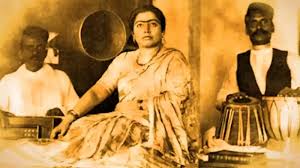
There has been some discussion of courtesan culture on X.T.M’s recent thread.
While BB is probably trolling, I am using the opportunity to provide links to some pieces that I have written discussing courtesan culture. These pieces can be read by anyone who is interested in an informed discussion of the topic.
I will briefly quote from my essay Thumri and Social Change (originally written as part of my Masters coursework):
Thumri was traditionally associated with tawayafs, a Persian word which appears in Hindi/Urdu around the middle of the 19th century. Although currently associated with prostitution, the word originally denoted high class courtesans who were highly-skilled singers and dancers trained in the arts of poetry and conversation. Aristocrats would send their sons to tawayafs to be trained in manners and etiquette (Du Perron 2007: 1-2). Prior to colonial rule, courtesans were associated with royal courts. With the decline of these courts, courtesans increasingly began to entertain in their own private salons. They were often wealthy and, because of their unmarried status, were able to move around freely (2). Thumri was one of the principal genres of courtesan performance. The texts often express female desire, usually in the form of love-in-separation (viraha). The heroine either curses the day her lover left her or pleads with him not to abandon her. These themes made thumri ideal for courtesan performance as the performer could act out the anguish and desire experienced by the song’s heroine (3).
Asides from the above piece, some further relevant links are:
Review: Siren Song: Understanding Pakistan Through Its Women Singers by Fawzia Afzal-Khan
Review: Umrao Jan Ada by Mirza Ruswa (translated by Khushwant Singh and M.A. Husaini)
Review: Tawaifnama by Saba Dewan

I am sure how relevant this is going to be, but if you are interested in the history of courtesan within South Asia. I would suggest the book “When Sun Meets Moon: Gender, Eros, and Ecstasy in Urdu Poetry” by Scott Kugle, which is a book that looks at the lives of the Sufi Pir Siraj and the famous courtesan Mah Laqah Chandabai, including their literary contributions.
Also, if you want to look at the pre-12th century history of courtesans that shaped the post-12th century history. I would also suggest the two main works of satire: Kuttanimata of Damodaragupta and the courtesan keeper of Kshmendra. Both center courtesans in their narratives set in pre-12th century Kashmir. Also, the Rasamanjari of bahnudatta writen in 15th century would be useful work since it talks about the 384 types of heroes and heroines alongside their complex details like Viraha for example.
Thank you for recommending the Kugle book. I found a PDF and will check it out 🙂
I’ve read a lot about about this topic–partly because I’m personally fascinated by it and also because it was relevant to the topic of my research.
I found Vikram Sampath’s My Name is Gauhar Jan! The Life and Times of a Musician to be particularly fascinating. Another good book was Neelum Saran Gour’s novel Requiem in Raga Janki.
https://kabiraltaf.substack.com/p/review-requiem-in-raga-janki-by-neelum
Another interesting book that concerns modern descendants of the hereditary dancing community of South India (Tamil and Telugu speaking regions) is “Unfinished Gestures” by Davesh Soneji. The study is also about how the descendants of hereditary dancers continue to be marginalized, while dancers from elite communities who appropriate their art (and modify it according to popular norms of morality) get a lot of recognition.
Thanks for the recommendation. I’ve found a PDF and will check it out.
I am aware that Bharatnatyam owes a lot to the art of the “devadasis”.
Honestly, I am not all that familiar with this because as someone who studies Hindustani music, my focus is much more on North India. Also as someone from a vocal background, my focus is much more on music than on dance.
My dissertation–which has now been published as a book in both India and in Pakistan– was specifically about the decline of Hindustani music in Pakistan and the reasons behind this phenomenon.
Wait, if you are going to research into the topic of twaif, I think you might need to read a few other books to gain basic understanding of the social/political/economic background for the different time periods. I would suggest that you take some time to look at “Telings and Texts Music, Literature and
Performance in North India”, which is a collection of essays that examine the literature and music in the medieval period (sultanate to Mughal empire). Also, I suggest a quick read of Aditya Behl’s “Love’s Subtle Magic: An Indian Islamic literary tradition” that looks at a very important genre of literature that was common at the time and influenced broader court culture (that includes tawaifs). I would also suggest chapter 6 and 7 in”Garden and Landscape Practices in Pre-colonial India HISTORIES FROM THE DECCAN” since it examines the representation of gardens in deccani literature. Most of these works focus on the literary and courtly aspect that shaped the courtesans world.
I forgot to mention; I would suggest looking at “Making the ‘Woman’ Discourses of Gender in 18th-19th century India”, there are multiple chapters dedicated to Twaif and the complex construction of gender during the 18th-19th century.
Thanks for all these recommendations. “Tellings and Texts” was actually co-edited by Katherine Schofield–whose work I referenced in my dissertation. She had written a journal article called “Reviving the Golden Age Again: ‘Classicization,’ Hindustani Music, and the Mughals”. I actually took a course entitled “Music in Muslim Societies” at King’s College but that semester it was being taught by someone else. I’ve met Katherine though.
You seem very plugged into the academic literature. Are you an academic by any chance? 🙂
Ironically enough, I don’t have an direct post-secondary education in History, rather I have degree in science and I am trying to work as accountant. History is my side hobby and I still have access to my old university database filled with studies about history. Normal people procrastinate by doing something fun, I procrastinate by reading books and studies about South Asia in addition to a slight dab into East Asian historiography, specifically literature and theater.
Also, I read translations of Sanskrit, Prakrit, South Asian vernacular, Chinese and Japanese historical literary. Think Bana’s Kadambari, Jayasi’s Padmavat, Suranna’s Sound of the kiss, The romance of the three kingdoms, chronicles of eastern Zhou, the fragrant companion (a play about lesbianism and plagiarism) etc. Additionally, I have an interest in South Asian philosophy specifically in Navya nyaya, Jain Logic (specifically Yashovijaya gan) and I have been trying to learn about the Wahdat al-Wujud within the South Asian context.
If you want to know why do temple have sex statues or why the Mughal emperor is shooting a random person with an arrow in a painting, I probably can give an explanation. However, I still have a long way to go before giving depth to my explanations, but I try to use and direct people to decent academic sources that provide an in-depth explanation.
You sound like a very interesting person 🙂
I am sorry for posting so many comments here, I have a lot of time right now. I forgot a very value book that might help in understanding the post-colonial history of Courtesans and their descendants. “Courtesans, Bar Girls & Dancing Boys: The Illicit Worlds of Indian Dance”. Basically, the author of this book started their research trying to study bar dancer in Mumbai and she found surprising trend. All the bar dancer were descendants, like same lineage and family as the old Twaif from the colonial period. She learned that the argument used against bar dancer during the colonial period and the independence movement was used against the bar dancer, who were descendants of the courtesans. It was fascinating read, like here is quote from one of the authors interview: “I discovered that a large proportion of the bar girls – some say 70%, some say 80% – came from hereditary performing families. And I thought: wow – these are the courtesans, the tawaif!”. She even goes into transgender community and intersection with historical as well as post-colonial performances.
your comments are excellent; we believe you have Author Rights?
Really excellent comments.
I always like seeing people refer to the academic literature.
Yeah, so I might have screw things up. I am not good to using any form of social media, so kinda bear with me for a second. I believe you gave author rights, but I wasn’t really sure how to access it; was I supposed to login or register via the sidebar. I think might have accidentally done that and try to reset my password. I think tried to reset the password or something, but I didn’t really email on my gmail address either. I think I messed things up. Sorry, I think messed things up. So that why haven’t made a post.
Yes. I have read the Anna Morcom book 🙂
No worries. You can post as many comments on this thread as you like.
If we dont have access to academic servers, how would one go about accessing these kind of academic works.
You can download PDFs of some of the books that Fly Die mentioned. I was able to do that with just a google search.
Usually, you can find some of these books on Internet archive and academia.edu (for research paper), also scribd exists. Also, the MET museums online website has a few MET specific booklets and books that can be downloaded directly from their website. Research gate also exists and can give full access to some studies. Also, openbook publishers exists, they are non-profit publisher that provides access to academic works on their website. Oapen.org is a simialir publisher that produces accessible books. Semantic scholar is also a good resource as well.
How the Sadri dance of the Devadasis (temple prostitutes) became classical Bharatnatyam in 1935.
Devadasis were girls (age 7-36) “dedicated” to worship and service of a deity or a temple for the rest of her life. The Devadasi were trained in music and dance, and a veneer of religion covers prostitution and the supply of concubines to wealthy men.
The dance and music of the Devadasi’s were erotic and considered vulgar. This style of dance was called sathirattam and left to nautch girls with no connotations of culture.
In around 1920 the wheels of motion for were setting in place. Rukmini Devi at the age of 16 married 42 year old George Sydney Arundale who came from England at the invitation of Annie Besant to help with the educational programmes and other activities of the Theosophical Society in India.
More at
https://sbarrkum.blogspot.com/2018/09/devadasis-bharatnatyam-and-theosophical.html
Thanks for the comment.
Yes, there is definitely a strong case that Bharatnatyam is a classicization of the art forms of the devadasis–just as thumri in many ways is a classicization of the art forms of the tawaifs.
Was these acts of dancing girls entirely volunteerly? There are many stories of these women resisting their families and trying to get out this ‘trade’. These individuals are equally hailed as path breakers.
If other sections hadn’t taken up this art, and nourished it, it would have had a decline and death.
Overt eroticism was probably the need of the trade and is no more needed.
In Umrao Jan Ada, the main character is kidnapped and sold to a kotha.
I think most tawaifs were the daughters of tawaifs.
“If other sections hadn’t taken up this art…”– There is a whole process through which thumri was made acceptable for respectable married (Hindu) women. It involved the genre being re-interpreted as devotional rather than erotic. Also, male classical singers began performing thumris in their concerts, leading to further “classicization”.
Well, it heavily depends on two things: whether you were born into the profession or your genealogy. If you happened to be, say, the daughter of the chief courtesan, then you wouldn’t really be required to engage in sexual acts, and you would function more like a Japanese geisha (singer/musician).
In a simple sense, a lot is dependent on who your parents were at the end of the day. If they were wealthy and well-connected, then you would probably live a privileged life. Also, it’s important to note that there would be hierarchies as well within these things. The later medieval institution of the courtesan evolved out of the earlier system of Ganikas, which, from my memory, had complex internal hierarchies. In the classical period, there was a distinction between a Ganika or Noble singer/dancer and a Vashiya or prostitute. At the same time, I am not sure how these hierarchies translated into the medieval period, though, so it may not be exact.
Putting it in a way you could understand: think of it like the difference between a Bar dancer and a street prostitute. They do different functions, but there is a grey area in the middle. Ironically enough, there was a book called “Courtesans, Bar Girls & Dancing Boys: The Illicit Worlds of Indian Dance” that stated that many of the descendants of courtesans from the old time became bar dancers in recent times.
A good historical example would be Malaqah Chanda Bai. She was the daughter of an influential courtesan from Rajputana and a Mughal mansabdar father, in addition to an adoptive mother who was closely connected to the Nawab of Hyderabad. Eventually, she leveraged her connections and found herself in the Nizam’s court, where she worked as a diplomat, military advisor, etc.
Mind you, this was the life for someone with good connections and an opportunity for upward mobility. If you were a person of ordinary background, there is a nice chance that you would be closer to a prostitute and wouldn’t have the same opportunities. Privilege and descent play a big role there as they would in any other place. Also, not all people who learned the dancing were courtesans since different arts were often a part of a specific community’s tradition. A good example would be the Isai Vellalar communities that continued to practice Sadir attam (some schools of Sadir attam came to be known as Bharata-natyam) to this very day. Courtesans weren’t the only people who controlled the arts or monopolized them.
Generally, ethnomusicologists have focused on courtesans since they are the only performing women about whom we have evidence in the historical record.
Of course, not all women who participated in the arts were courtesans. I have written about Begum Khas Mahal (one of the wives of Nawab Wajid Ali Shah) here:
https://www.brownpundits.com/2026/04/19/review-the-scattered-court-hindustani-music-in-colonial-bengal-by-richard-david-williams/
Just to add. Mruchha katika (clay cart), a Samskrutam play by shudraka, featuring charudatta, vasantasena, etc was a good example of the nagaravadhu system in ancient India.
This was made into a film called utsav.
Yes. Ustav stars Rehka right?
I haven’t seen it but I should definitely check it out.
Very good article and very great conversation as well.
Thanks.
And definitely some very informative comments 🙂
[…] (school) of Hindustani classical singing. Her success at this art is what made Janki a bai or courtesan– a highly valued female […]