
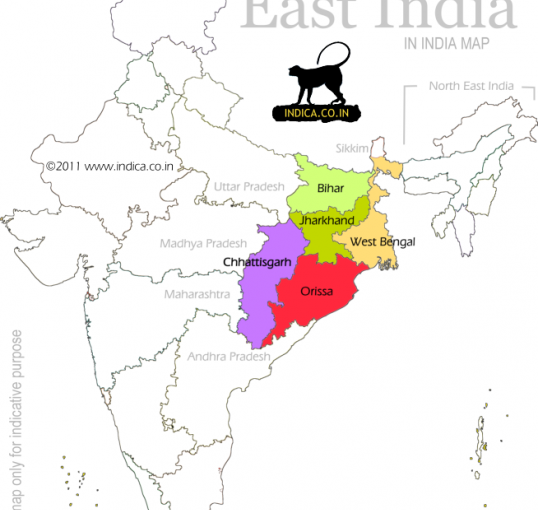
The Saffron Block
The map of East India has changed colour. Bihar fell to the NDA in November 2025 with 202 of 243 seats, and Samrat Choudhary now sits as the first BJP Chief Minister Bihar has ever had. Odisha went saffron in 2024 under Mohan Charan Majhi. On 4 May 2026 Mamata Banerjee lost Bengal after fifteen years; the BJP took 206 seats and will form its first government in Kolkata. Himanta Biswa Sarma returned in Assam with 82 seats, a two-thirds majority and a third consecutive term. The old Bengal Presidency, once the largest province of British India, is now a single saffron block.
This is the completion, by ballot, of a partition the British attempted by map.
1905
In 1905 Curzon split Bengal. The eastern half was to be Muslim and centred on Dhaka; the western half was to be joined to Bihar and Orissa, which made the Bengalis a linguistic minority in their own province. The Bengali Hindu elite, the bhadralok who ran Bengal’s commerce and letters, fought it bitterly. They did not want to be drowned by Bihari and Oriya numbers. In 1911 the British relented and reunited Bengal.
The Biharis, for their part, had spent two decades campaigning to escape Bengali domination. The 1912 reorganisation that gave them their own province, jointly with Orissa, was their reward.
Linguistic identity then was the prime axis. Hindu and Muslim mattered, but not as much as Bengali, Bihari, Oriya.
The Historical Axis Flipped
A century on, that axis has flipped. The Bengali, the Bihari, the Oriya and the Assamese are voting as Hindus, and they are voting for the same party. The two-nation theory, which Bengal once threw off, is doing its work the long way round.
Hindi,, Hindu, Hindustan
The vehicle of this consolidation is Hindi. As Girmit has succinctly put it in the Comment Boards, Hindutva is in large part the advance of Hindi.
It is as much a hindi-language supremacist,gangetic culture centric, and anti-communist party hence the original slogan , “hindi, hindu, hindustan”
Khariboli, the Delhi dialect, took its prestige from the Delhi Sultanate. Modern standard Hindi is a saffronised, sanskritised, sanitised register of Urdu, stripped of its Persian and refilled from a dictionary. It is a formal tongue, not a poetic one. The poetry stayed with Urdu, which is why Bollywood still sings ghazals and qawwalis when it wants to move you. But the formal register travels well. It carries the news, the bureaucracy, the school examination, and now the vote.
East India was always linguistically apart. Bengali, Assamese, Odia, Magahi, Maithili and Bhojpuri are Magadhan languages, descended from a common eastern Prakrit and written for centuries in their own scripts. They are closer to one another than any of them is to Khariboli. Bihar was the first to be Hindified, because Bihar’s literate classes had already adopted Hindi as a second tongue and surrendered Maithili and Bhojpuri to the village. Odisha and Assam followed by ballot. Bengal, the last holdout of vernacular pride, has now joined them.
Bengal
The Bengal vote was not won on language. It was won on demography. The BJP ran the campaign on illegal immigration and the slow demographic shift of the eastern districts, and within minutes of the result Bengal-born Syama Prasad Mookerjee was being invoked from every BJP podium in the country. Mookerjee is exactly the through-line. He is the figure who carried Bengali Hindu anxiety from 1905 into the post-independence era, who founded the party that became the BJP, and whose ghost has now finally taken Calcutta. The bhadralok of 1905 fought to preserve Bengali. Their grandchildren have voted to preserve something else.
The Vindhyas Hold
Compare the south. On the same counting day, Vijay’s TVK delivered a stunning upset in Tamil Nadu. Dravidian politics remains inscrutable to the BJP because Tamil identity is still primarily linguistic and still anti-Hindi. Kerala went UDF again. The Vindhyas hold. North of them identity is consolidating around religion; south of them it is still organised around language.
The British plans of 1905 had not been undone so much as deferred. The map drawn by Curzon and erased by Hardinge has now been redrawn by the electorate.
Hindu East India votes as one bloc; Muslim East Bengal long ago departed as Bangladesh; the Bengali bhadralok of 1905 would not recognise the political map their grandchildren have produced.
A Coda, centuries in the making
We make no judgment here, only an observation. Politics is a dynamic field, not a static one. Identity grows and recedes with the salience of its rivals. As the Muslim share of the eastern population rises, the Hindu pulse hardens, and a plural Hinduism, the only kind that ever really existed, gives way to a homogenised one. It is precisely the homogeneity that Hindi enables.
Curzon would have understood the result; he anticipated it by a century and a bit.
BJP has won multiple times in Karnataka.
They have decent presence in Telangana and get it with some effort.
Kerala they are in the WB 2016 phase.
BJP aren’t in power there – until they are.
Odisha barely has any Muslims nor does Arunachal.
Even Bihar/Jharkhand not particularly high and BJP has formed governments there.
Extrapolating Assam/West Bengal to rest of East India would be wrong.
This is the homogenization of India. The United States of India under Modi. LKY did it with tiny SG and violence. Modi doing it with arithmetic ably helped by an increasingly belligerent minority hell bent on deidentifying as Indian especially where they are ~30-40% of the population. The backlash was inevitable.
Vijay’s victory has heralded a post-Dravidian era. The BJP must be thrilled. TN has been a tough one.
While in some parts Muslim conflict does play a part, reality is that the BJP wins because it just does a decent job. Nothing flash but simple things like access to water, roads, sanitation etc have improved massively under the BJP. And for a developing country like India, it is a huge thing.
The BJP keeps winning/has won in states that have hardly any Muslims including Odisha, Arunachal and Himachal.
All these states have anxieties regarding minorities especially muslims minorities.
Arunachal and odisha have both seen violence wrt to the possibility of growing muslims whether this be true or not.
So has himachal. These are all economic and cultural anxieties that are intertwined with one another
Them getting into power in those states has nothing to do with Muslims.
Arunachal outsiders cannot even buy property so they don’t have “anxieties” regarding “Muslim outsiders”.
Oh undoubtedly. Agree completely. We need a couple of decades under the BJP to get out of the one step forward two steps backward style “development” that was a Congress hallmark.
Hoping Yogi is next though I feel UP needs him more for another decade or so. Luckily age is on his side.
Fadnavis is really cleaning up maximum city.
The BJP wins because of a combination of anti-Muslim sentiments, upper-caste feudal impulses, and natural opportunistic bandwagoning onto the new cultural establishment politics. That is all.
Not really. They win in states where there are hardy any Muslims or “upper castes” like Arunachal Pradesh, Jharkhand, Chattisgarh etc.
This myopia towards what the BJP actually is is what leaves people Pikachu faced when they sweep election after election.
Jhrkahand? Where a video was posted that painted all muslims as infiltrators that the EC had to delete.
Where they were trying to paint inter religious marriages as a threat to tribal identity?
And where the presence of christians from tribal heritage is regularly called an existential threat? I remember the election from Chhatisgarh where both the national parties were trying to blame the others for the growth of christians.
Look, the ruling party wins because it focuses on a lot of visible develop,welfarism, charisma of the PM but communal poloarization is absolutely part of the arsenal as well and used in most states.
I mean, it’s not like “muh development” is mutually exclusive of any of these other factors. This is just bog-standard theocratic fascism infused with some vaguely populist economic rhetoric.
Except for the fact that “muh development” is real.
You being an “ex Hindu” might have your own biases but BJP wins in non Hindu seats as well.
Idk, just sounds to me like you want to vote for fascists and get brownie points from liberals. One look at IndiaSpeaks tells me everything I need to know about the caliber of intellect that votes for the bhaji pao party.
It sounds wrong then.
And I think you get an idea of the “caliber of intellect” of people who take Reddit as the benchmark of the broader Indian population.
Social media might not say everything, but it doesn’t say nothing either. If you met 20 self-proclaimed “Barack Obama voters” online, and 8 of the 20 started talking to you about “ZOG” and the “JQ”, and another 4 started talking about how autism is caused by the MMR vaccine, you’d start to wonder if there might be something wrong with Obama voters.
Considering this social media platform is used by less than 5% of India’s users, a smaller minority of which is active users and not just accounts and an even smaller minority part of this subreddit, it does say nothing.
The USA is different. Internet penetration and literacy are way higher.
Reddit is a very very small echo chamber, especially in the context of India.
I think social media content gives us a decent idea of the mindset of the urban general category, maybe not as much for other segments of Indian society though. Realistically though the views of the former are the ones that define the Indian cultural mainstream and which upwardly mobile segments of other communities will naturally emulate given the incentives of the current environment.
>I think social media content gives us a decent idea of the mindset of the urban general category,
Utter balderdash. Looking at ‘social media’ for the US you would think the entire country is a bunch of inward looking bigots. Which is simply not the case.
The far more likely Occam’s Razor explanation is that there are a lot of people in both countries very thinly veiling the actual reality of their deranged and bigoted views.
Errr.. this is exactly how the US is, especially in the flyover states.
Vivek Ramaswamy won the Ohio GOP gubernatorial nomination with 85.4% of the vote, soundly defeating Casey Putsch.
If you go by X, this is impossible.
Being overly confident of your personal ‘hot take’ is an indicator of non-seriousness.
But then again, when someone chooses ‘based’ as part of their handle…
If anything, your view is far more preposterous. What about the current social, cultural, and political behaviors of the urban general category suggests that they are in any way progressive on caste issues, secularism, etc.? Get real, the urban general category online is semi-feudal human refuse because the urban general category in real life is semi-feudal human refuse. What is with Hindu UCs and their refusal to ever take any responsibility for their collective flaws? Just because your bhaji pao-loving GC friends are too cowardly to call someone a “Chamar” in real life, says nothing about what sort of lowlife feral scum such people are. Bugger off with the fascist apologia.
Realistically though the views of the former are the ones that define the Indian cultural mainstream and which upwardly mobile segments of other communities will naturally emulate given the incentives of the current environment.
Yes, because it is the urban general category that is asking for more reservations across the board and freebies politics that now seems to be deciding factor in almost all elections.
One could say the same thing about R/India on Reddit from the other side as well btw. Not like the other side is covering itself in free speech and high intellect glory.
Just a side clarification needed :
Does Vijay’s party has quite a few RSS members? Internet has some comments.
How is this a homogenization? Many Indians are still diverse in many aspects and even among bjp voters saying that hindu pride or fear of muslims is driving this consolidation is a stretch. Many with good options will ditch the bjp
For starters most Indian muslims do identify as Indians, do partake in this country’s culture and seek to be part of the mainstream. Just because someone does not say BMKJ or Vande Matram does not make them less patriotic when many of those who do say these also break the law, many times. You also need to take into account that all instances of ‘muslims deidentifying’ are either individual chosen instead of cases thst disproved this thesis or manipulated in some way
Anyways there is nothing that prevents muslims and other of using the same social media to clear up misconceptions by dedicating resources to it nor alternative rising when this one bow in the quiver is no longer effective.
Anyways there is nothing that prevents muslims and other of using the same social media to clear up misconceptions by dedicating resources to it nor alternative rising when this one bow in the quiver is no longer effective.
Makes one wonder why this hasn’t happened in almost 12 years of the so called oppressive majoritarian govt? If anything, I see Muslims increasingly moving to their end of the extreme.
Because progress is not linear, many muslim leaders themselves dont understand social media or even know about the things that are said against them. Even people who are chronically online seem to be unaware of the fact thst a lot of whst we see is curated and should be taken with a pinch of salt when you try to generalise.
And have you not considered that the only reason you see muslims move one way and not thr other is because that iswhat is promoted? Not saying that muslims are becoming liberal, but that the majoroty are a bunch of nobodies who cant hurt a fly even when in a group.
I mean a political homogenization. We are way too diverse in all other parameters. Political instability via innumerable parties at the state level has contributed to derailing the overall growth of the country as a whole.
What good political options exist today as a reasonable alternative to the BJP?
I don’t deny that many Indian Muslims are proudly Indian. Unfortunately I see a difference between an individual reaction vs a mob reaction. Whether we like it or not, Indian Muslims tend to ghettoize and give in to mob mentality far more than any other community w/o even assessing the facts on the ground. This ghettoization is wrongly attributed to the majoritarian impulse. Au contraire, it is due to the rapid Arabiazation and thereby self-imposed isolation of the Indian Muslim that has resulted in these crossroads. Until a few decades ago, could we even tell the difference between a common Hindu and a Muslim? This attempt to conspicuously identify as the “other” and behave like some Arabs condescending upon the rest of us heathens has complicated any assimilation that was already underway. If this attitude persists, they will continue to stay isolated in the ghettos of the next century while the rest of India moves on. The smarter ones will hop onto the ship of prosperity, the ones stuck in 7th century Arabia will be left behind. A brutal survival of the fittest test.
My reply to you has apparently gone to spam!
XTM requesting comment approval.
OK, seems my reply just vanished.
A complete political consolidation under the BJP is what I meant. We are too diverse for homogenization à la China or Singapore or even the US.
Smaller parties at the regional level create more uncertainty given the election cycles to result in any kind of genuine progress. Indian crab mentality is best seen here. A consolidation under the BJP in my opinion will allow for many such unnecessary roadblocks to be overcome ushering in faster economic progress.
Yes, we need a good alternative to the BJP. A rejeuvanated Congress (- the Gandhis) would have been good, especially if they moved Centre-left instead of Commie left as they present currently under forever “youth” leader.
Whether we like it or not, Indian Muslims rapidly Arabized and thereby ghettoized. Individual and mob mentality in this community manifests in the worst form of anti-State and anti-Hindu violence. India will leave behind those who continue to live in the ghettos of the next century. Alienating themselves from the mainstream to stay true to a 7th century ideology hasn’t really worked out for most. High time they figure they’re better off assimilated like any other religious minority and move together with the rest of us.
I like Amana and Khalid and Ibn Khaldun Bharati as well. There was an enquiry minded path even in Islam which was gradually muffled unfortunately. What makes you say Bharati isn’t an IM?
We are very sorry about your reply vanishing.
No worries. I tried editing it twice, maybe that’s why it glitched.
We found it! Dug deeper into the spam folder (very rarely do comments going there).
Perhaps reflect on Authorship when you can 🙂
Will do 🙂
//Smaller parties at the regional level create more uncertainty given the election cycles to result in any kind of genuine progress. Indian crab mentality is best seen here. A consolidation under the BJP in my opinion will allow for many such unnecessary roadblocks to be overcome ushering in faster economic progress.//
Except that many south indian states jave done extremely well with regional parties and are the powerhouse of the Indian union. Even during coalition governments Indias growth rate was good. Failures of regional parties in thr north are largely due to their own failures to take down remaining vestiges of feudalism and lack of respect for democratic culture. This is why even states like MP and Rajasthan still have social and economic issues even despite being ruled by national parties.
//Whether we like it or not, Indian Muslims rapidly Arabized and thereby ghettoized. Individual and mob mentality in this community manifests in the worst form of anti-State and anti-Hindu violence. India will leave behind those who continue to live in the ghettos of the next century. Alienating themselves from the mainstream to stay true to a 7th century ideology hasn’t really worked out for most. High time they figure they’re better off assimilated like any other religious minority and move together with the rest of us.//
This arabization is the handiwork of the greater expansion of tablighi jaamat, and other maudadi derived social movements. Greater adoption of Arabic ideals a function of Arabic identity being central to early islam where their standard for piety and prosperity is located. Not that there are no wahabbis in India but this is largely among the elite ot those with significant exposure to the gulf( which is why you mentioned one cannot tell them.apart as even the elites jumped on the revivalist track)
Furthermore, many muslims dont think about hindus nor do they care about them, some like their counterparts in the right wing of other religions are obsessed with bringing down others but most are not. The violence against the state has only been seen in Kashmir where Pakistan is able to turn grievance against India into justification for insurgency but not elsewhere where such kind of responses are few and far between( we only have muslims joining Al Queda or Isis in small.numbers)
Since india in general is a segregated community, and many Indians dont want to live with others, with attempts of even muslims who want to be part of the mainstream being met with disgust, there is little interaction between communities at large, this is why incidents that are personal disputes erupt and take communal color, local grievances thst have been magnified and amplified through social media is the reason behind much anti hindu, anti christian and anti muslim violence in India. Maybe if attempts to live in cosmopolitan areas were not opposed or certain peoples presence would not bring down an areas property values we will see less violence
//I like Amana and Khalid and Ibn Khaldun Bharati as well. There was an enquiry minded path even in Islam which was gradually muffled unfortunately. What makes you say Bharati isn’t an IM//
Many of his articles, that present a monolithic view of muslims eerily similar to that of the right in India. His weird AMU article that seems to suggest that secularism was concocted to preserve the privelge of mullahs, when I learnt about the Indian origin of many revivalist movements him going on and on about Indianization when much of the Islamic movements predominant in India are Indian. With Amana you get the feeling that this is a person who knows the community, as people, you dont get this feeling from Bharti.
Seeing some of the ex muslims in India and how they at times even platform people who are prejudiced to muslims as people, he may be an Indian M but an ex Muslim, a rather preivelged one at that, who does not know much beyond the wahhabi movement thst he may have been born in. But overall, not someone I would look to for insight on Indian muslims.
another very good comment.
I think you’ve gone and done a population averaged approach on the point about the states economic progress. You have set aside the variability that has held many States backwards due to political instability. Not to mention multiple other variables at play. Does the data support your hypothesis? I have found that in many cases, our pre-conceived notions find something to be definitively true when paradoxically, the data suggests otherwise.
India’s growth rate was stagnating, we were constantly punching under our weight in no small part bogged down by the political system.
Not joining Al Qaeda or ISIS isn’t a badge of honour. The recent TCS case is such an obvious counter to your point of the average Muslim not bothering about the average Hindu. At the lower socio-economic stratas, Hindus and Muslims do live literally in each other’s faces. The gradual cycle of fear and violence unleashed by a section of the IM community has resulted in a gradual separation even at a lower socio-economic level. Plenty of examples from UP and WB in recent times. So, no I disagree that this issue is not attributable to the inherent nature of that ideology. A Malaysian friend (non-Malay) says this same situation repeats in Malaysia.
IKB may be an ex-Muslim. I find his arguments legitimate. In fact, do read Hamid Dalwai’s readings. Its tragic he passed early. If anything, people like IKB, Amana are trying their best to shine light on the price the IM community has paid by going down the regressive cubby hole. I don’t always agree with Amana’s pov, but she’s always sincere in her argument as is IKB.
//I think you’ve gone and done a population averaged approach on the point about the states economic progress. You have set aside the variability that has held many States backwards due to political instability. Not to mention multiple other variables at play. Does the data support your hypothesis? I have found that in many cases, our pre-conceived notions find something to be definitively true when paradoxically, the data suggests otherwise.//
Most of the variable holding a state back have less to do with whether a party is state based party or a national party and more with the social conditions, the CPI-M was a national party at its zenith when it controlled Bengal, Tripura and Kerala. Madhya Preadhes has been ruled by national parties as well. Both have been left behind by Tamil Nadu which has been governed only by state based parties. Anyways there is no way of making a correlation between growth and partys national character. It is not like we are living upto our potential even now, most of the bad news is just not covered unlike it was when UPA and governments before it were ruling.
//Not joining Al Qaeda or ISIS isn’t a badge of honour. The recent TCS case is such an obvious counter to your point of the average Muslim not bothering about the average Hindu. At the lower socio-economic stratas, Hindus and Muslims do live literally in each other’s faces. The gradual cycle of fear and violence unleashed by a section of the IM community has resulted in a gradual separation even at a lower socio-economic level. Plenty of examples from UP and WB in recent times. So, no I disagree that this issue is not attributable to the inherent nature of that ideology. A Malaysian friend (non-Malay) says this same situation repeats in Malaysia.//
The problem with choosing individual examples like the TCS case, and the odd muslim who joins ISIS, is that we can all bring up counters from multiple comminities. When I brought up Salims case from Maharashtra I was apparently whitewashing, but there is no shortage of example to prove that certain other communities also have cultures that push them towards violence and that much of this is without provacation from the eventual victims. The very fact that some muslim causing violence is enough to justify violence on muslims who are not linked with the original provocateur, sometime with preparations that take months of planning, are enough to destroy the notion that this is something unique to muslims themselves. The social system and way we live in this country promotes distrust that turns individual acts of violence, into communal disturbances.
If this is something foundational, how come Indonesia does not suffer from the same problems or Azerbaijan, Senegal, and a host of other muslim majority countries? At the end of the day Islam is a culture more than ideology and changes with time and space. Ignoring conditions of the past 100 years that can be understood and worked with, in favour of saying it is an ideological problem only makes the issues worse.
//IKB may be an ex-Muslim. I find his arguments legitimate. In fact, do read Hamid Dalwai’s readings. Its tragic he passed early. If anything, people like IKB, Amana are trying their best to shine light on the price the IM community has paid by going down the regressive cubby hole. I don’t always agree with Amana’s pov, but she’s always sincere in her argument as is IKB.//
IKB, maybe sincere, but does not seem to have any space for appreciation for muslim community and its cultural values as it exists today. In his view, the community is one that is full of faults that needs to continually change itself to be suitable to others. Sincerity does not excuse what in my view is pandering to reactionary elements of other communities, in the guise of giving critique. Whatever you may say about Amana, you at least get a sense that she genuinely wishes that community progresses while maintaining its uniqueness, no such thing from IKB.
**IKB, maybe sincere, but does not seem to have any space for appreciation for muslim community and its cultural values as it exists today. In his view, the community is one that is full of faults that needs to continually change itself to be suitable to others**
The truth is bitter. Somebody has to show the mirror to a regressive mindset that has not evolved in centuries. Ultimately, it is their loss if they don’t evolve. Survival of the fittest. Debating here doesn’t change ground realities.
The Bohra community is an example of evolution over time along with the recognition to live alongside others.
Bhaichara isn’t a one-way street. Works both ways.
Btw, this is true for any ideology that is stuck in a regressive mindset. Somebody has to be the reformer.
**If this is something foundational, how come Indonesia does not suffer from the same problems or Azerbaijan, Senegal, and a host of other muslim majority countries? At the end of the day Islam is a culture more than ideology and changes with time and space. Ignoring conditions of the past 100 years that can be understood and worked with, in favour of saying it is an ideological problem only makes the issues worse.**
How do you know it doesn’t? Indonesia and Malaysia are increasingly going down the same cubby hole. Bali locals complained quite a few years back at the aggressive proselytization launched by the dominant religious group. Java too was not as hardline. Just because its not in mainstream media doesn’t mean it isn’t happening. Don’t even get into Africa.
Afghanistan wouldn’t have been in its current pathetic state had the Cassandras of Doom not been dismissed. Or do you wish to wait for that irreversible point to come?
**The problem with choosing individual examples like the TCS case, and the odd muslim who joins ISIS, is that we can all bring up counters from multiple comminities. When I brought up Salims case from Maharashtra I was apparently whitewashing, but there is no shortage of example to prove that certain other communities also have cultures that push them towards violence and that much of this is without provacation from the eventual victims**
I can’t believe you’re again drawing a false equivalence between violence in a murder case and the systematic targeting of Hindu women with a motive to demean, convert and enslave. Remarkable! Heard of the Ajmer Dargah sex enslavement which continued precisely because voices like yours downplayed the fanatical religious angle? Why India, heard of the Rotherham grooming scandal? You cannot keep monkey balancing when something so inherently rotten is happening.
//I can’t believe you’re again drawing a false equivalence between violence in a murder case and the systematic targeting of Hindu women with a motive to demean, convert and enslave. Remarkable! Heard of the Ajmer Dargah sex enslavement which continued precisely because voices like yours downplayed the fanatical religious angle? Why India, heard of the Rotherham grooming scandal? You cannot keep monkey balancing when something so inherently rotten is happening.//
The violence in that murder case was driven by systematic dehumanization and demonization of muslim males, that you are at least implying is an intrinsic characteristic of Islam. Even in UK, it is white people who are biggest perpetrator of sexual crime and the catholic church is known for such things all over the world, pointing out that similar actions are seen across cultures and that if there are cultural causes behind why white people commit sexual crimes, there also have to be cultural reasons behind why muslims also commit similar crimes.
It is many secualr women NGOs who helped the victims in the first place dont know what you are talking about.
//The truth is bitter. Somebody has to show the mirror to a regressive mindset that has not evolved in centuries. Ultimately, it is their loss if they don’t evolve. Survival of the fittest. Debating here doesn’t change ground realities.
The Bohra community is an example of evolution over time along with the recognition to live alongside others.
Bhaichara isn’t a one-way street. Works both ways.
Btw, this is true for any ideology that is stuck in a regressive mindset. Somebody has to be the reformer.//
A reformer would not act as if muslims, especially Ajlaf and Arzal muslims, are not disproportionate victims of justice and stereotyping. He would criticize this, while still chiding Ashrafs from claiming victimhood on their behalf, no such articles or condemnation of stereotyping of Tablighi Jamat as carriers or inquiry into the what is being shown on social media that people like Shambulal Regar kill muslims and broadcasst it from his end.
Furthermore as a student of Islamic history, he should know that culture has a big role in how Islamic belief and practice is formulated, using his own personal experience or trends from the last 200 years to claim only a literalist understanding is a sign of devotion and those who do violence in its name are as authentic as they come, is not criticism, it is stereotyping that only enables the local muslim vegetable seller or the local Imam, who in all likelihood dont have a simplistic understanding due to their life experience, to be targets of violence. If one wants to be called a reformer or critique, it should be reflective of how beliefs are actually made. If a muslim cannot relate this to their own life experience, and it is only people of other religions who praise this kind of critique it is not reform.
//How do you know it doesn’t? Indonesia and Malaysia are increasingly going down the same cubby hole. Bali locals complained quite a few years back at the aggressive proselytization launched by the dominant religious group. Java too was not as hardline. Just because its not in mainstream media doesn’t mean it isn’t happening. Don’t even get into Africa.
Afghanistan wouldn’t have been in its current pathetic state had the Cassandras of Doom not been dismissed. Or do you wish to wait for that irreversible point to come?//
I do make it a point to actually look into countrys all over the world and get as holistic an understanding as possible, secularism is not in any threat in these two countries and whatever imposition there is, is largely on muslims themselves, not other religions. There is nothing stopping hindus from spreading their religion and we have seen several high profile conversions like Sukarnos daughter also converting, and while there are bureucratic hurdles to convert for normal people, it is not unlike India where religious conversion itself gets great scrutinity except in case of dominant religion.
Afghanistan is a case of all other social instituions being destroyed in cold war except the taliban.
Okay, I think I am going on a weird comment streak and losing my mind. So, I have a weird tin foil theory; it is going to be long, and it is going to sound like bullshit, but please bear with me. Here is my tin foil hat theory: Hindi is the Prakrit of the modern age, and it is destined to follow the same path as Prakrit. To explain what I am trying to say, I am going to talk about my favorite book about Prakrit: “Language of the Snakes Prakrit, Sanskrit, and the Language Order of Premodern India” by Andrew Olett.
I am going to start this “theory” with a barely legible explanation of the book. Basically, the author talks about the development of the Prakrit language and its position within the linguistic hierarchy of ancient India. Specifically, he was looking at how it interacted with other languages like Sanskrit and vernacular languages like Dimgal. The story begins when Ashoka institutes Prakrit as a court language and uses it to communicate his messages, which made the language closely interrelated to royalty and power.
After the fall of the Mauryan empire, Prakrit was eventually adopted by the Satavahana empire and was closely interlinked with the royal court to the extent that it was used in a propagandized manner to show the superiority of the king. In fact, out of all the Satvahanna inscriptions, almost the majority of them are primarily done in Prakrit as opposed to Sanskrit. In fact, what was quite fascinating about this choice comes from the fact that the foreign Scythian Western Satrap kingdom in Gujarat used Sanskrit as the primary court language of power. Even more unique is the fact that the mainly Sanskrit inscriptions from the Satvahanna came from the period of close ties with the Saka kingdom, hell, they even have Sanskrit-Prakrit hybrid inscriptions at one point. As I have indirectly pointed out, the Satvahannas and the Indo-Saka go to war, and you can guess who came out on top. Sakas defeated the Satvahannas and eventually kick-started what Sheldon Pollock would call “the Sanskrit Cosmopolis”, but that didn’t mean the Prakrit fully vanished.
In the next phase, a three-fold language system developed over time: Sanskrit as the language of the elite, Vernacular dialects of Prakrit (that became vernacular languages over time) became the language of the people, and Prakrit became the Language of specificity. In simple terms, Prakrit was seen as the softer language in contrast to Sanskrit, and it was used for specific forms of literature like Sattakas, alongside serving as the main language of specific religious groups like the Jains. Prakrit lived on as this in-between, never truly the elite language and never truly the people’s language.
Over time, the category of Prakrit started to become more of a name given to the “natural” language of the land and one defined by specific literary traditions as well as stylistic features. Mind Prakrit still had complete works on its lexicon and structure written about the language, but it became more about style and way of writing. Gradually, many vernacular languages like Dimgal started to imitate the features of Prakrit, its style of diction, and even the status as the “natural” or “people’s language” to the point that they started calling Dimgal “Prakrit”. What’s even more wild would be the fact that even Dravidian languages like Kannada were called “Prakrit”, not because it was Prakrit, but rather due to the fact that it imitates Prakritic features. Naturally, Prakrit was displaced overtime by the vernaculars and later languages like Hindavi.
Now, you might be wondering, how does it relate to Hindi? Well, I think (this is my opinion, and it can be wrong) that Hindi is going through the exact same process. It is not the language of the elite since English fills that role perfectly, and it was promoted by a foreign people, just like Sanskrit with the Sakas and Persian under the Turks. It’s not really the language of the land, that would be vernaculars like Bhojpuri or Tamil. I believe even the normal (lower-class, non-urban, etc.) people in the “Hindi” belt seem to blend Hindi into their traditional vernacular. For example, I remember this person from Patna on an online forum mentioned in his family and friend group, they speak Maghi blended with Hindi and English words. This is actually very similar to the tri-language fold mentioned by Dan-din and the early writer. Sanskrit (English in modern sense) is the elite rough language, Prakrit (Hindi) is the softer counterpart, and vernacular like Apabhramsa (Maghi) is a mix of the first two languages.
Hindi is a language of specificity, used in specific circumstances and places for specific purposes, like being a lingua franca or a film language, etc. It defined specific stylistic choices like being more Sanskritized than Urdu or occasionally blending English words, as was common between Sanskrit and Prakrit. People also seem to code-switch between English and Hindi quite often, as it is common with Prakrit. Just look at the Hybrid language of Satvahanna or the scene in the play Mrcchakatika where Vasantasena (the female lead) switches from Prakrit to Sanskrit to show a shift in tone of her speech. Hell, Prakrit wasn’t fully accepted in the South, where the dynamic mainly moved between Dravidian vernacular and Sanskrit, similar to Tamil and English dynamics.
Even the religious dynamic was there with Prakrit and Sanskrit; Jains explicitly favored Maharasthri Prakrit and Hindu writer favored Sanskrit for their theological writings, they did occasionally cross-pollinate nonetheless, similar to Urdu and Hindi. Most Hindi speaker don’t speak their pure form and use Urdu or regional words, similar to how Prakrit was never in a pure form. A good example is Palitta’s Tarangavati, which was originally in Prakrit with a bunch of regional vernacular thrown in, and it fell out of popularity since no one could understand the vernacular. Ironically, a later author wrote a summary under the name Tarangavatisara that removed the vernacular words but preserved the rest of the Prakrit words.
This might be the “future” of Hindi. It loses a sense of self and morphs into a specific set of conventions that is gradually subsumed by the regional vernacular who start calling themselves as “Hindi” like Dimgal calling itself “Prakrit”. I don’t think the Hindification or English domination narrative is as straight forward as we would like to believe and there might be an older trend just repeating itself as was the case Prakrit.
P.S. I believe a similar dynamic existed in the Medieval period with Persian taking the place of Sanskrit, Braj and Urdu being the middle language (Braj leaning more to the Hindu Rajput side and Urdu leaning more to Mughal side of things. The vernaculars like Bhojpuri being the language of the land.
God this was long and lacks consistency. My apologies again for the length.
Fascinating read, FlyDie! I think you are on to something. I wonder if this process of admixture (if I can use that term) between language also tracks or is in some way correlated to the rise and decline of kingdoms that dominate most of the landmass?
Oh, sorry, I only noticed your comment quite late. For your question, I would argue that certain linguistic practices are deeply tied to certain empires, and the inevitable fall causes them to lose popularity. A good example is the hybrid Sanskrit-prakrit writing that the Satvahanna used in a few of their inscription wasn’t used in the same manner again. Also, some of these admixtures for specific languages, like certain strands of Northwestern Prakrit, getting displaced by Dingal, can be associated with the gradual growth of Rajput power since Dingal was a major part of Rajput writing and oral tradition.
Also, empires are needed to maintain the linguistic integrity of languages and admixture. A good example would be the Paisaci language that was often referred to by different authors as the ghoulish language or some old language from the North West near Kashmir. According to Andre Olett, Paisaci was actually a middle Indic language closer to Pali, and it was used in the Indo-Saka kingdom around the turn of the Millennia. What was unique was the fact that this Middle Indic was formed as a result of the Saka people bringing influences from their original Saka language while writing and speaking Prakrit. Over time, later writers couldn’t understand certain parts of this Middle Indic since the language fell out of popularity after the fall of the Indo-Saka kingdom. Over time, people misinterpreted this language as some form of ghoulish/old tongue; they even made a new vocabulary and structure for the language.
Basically, empires are needed for maintaining different language traditions and admixture, or they gradually change over time as a result of cultural drift.
Thank you! Very insightful. You’ve given me a full weekend worth of looking up stuff.
So where does Pali the Language of Asoka and Buddhism fall into this theory
Relegated to the dustbin of Indian history like Asoka and Buddhism
The lion capital of Asoka is literally the emblem of India.
And Bodh Gaya is a UNESCO World Heritage Site.
Words of S. Radhakrishnan at the first meeting of the Constituent Assembly Debates available here https://www.constitutionofindia.net/debates/14-aug-1947/
“Pandit Jawaharlal Nehru referred to the great contribution which this country will make to the promotion of world peace and the welfare at mankind. The Chakra, the Asokan wheel, which is there in the Bag embodies for us a great idea, Asoka, the greatest of our emperors, look at the words of H. G. Wells regarding him “Highnesses, Magnificence’s, Excellencies, Serenities, Majesties – among them all, he shines alone. a star-Asoka the greatest of all monarchs.” He cut into rock his message for the healing of discords. If there are differences, the way in which you can solve them is by promoting concord. Concord is the only way by which we can get rid of differences. There is no other method which is open to us.”
Sbarrkum is a pathological India hater so he will fail to recognize that while a name like Ashoka’s got buried over more than 2 millennia (along with countless others no doubt), it is the modern Indian Republic that has again restored his glory.
Of course, the project to reinstate Ashoka as the greatest Indian emperor also suits the BJP’s politics with SC communities, notwithstanding the serious questions that have emerged about his supposed Buddhist pacifist phase.
How can someone who is clearly not a child have such a massive blindspot on their own bias.
Asoka and Buddhism is ‘relegated to the dustbin of Indian history’?
I am sorry, I noticed it quite late. Firstly, Magadhi Prakrit was the language of Ashoka’s court, while Pali was a later language that was formed by merging and Sanskritizing multiple Prakrit languages. When the Mauryan Empire fell and the linguistic patterns shifted, Magadhi Prakrit entered a phase of cultural drift over time. At the end of this drift, it gradually transformed into the Abahatta language, which was the forefather of most eastern Gangetic languages like Bengali, Odia, Assamese, etc. The most well-known text available today in Abahatta is the Caryapada, a collection of Varya Buddhist poems.
Ashoka wasn’t forgotten in any shape or form. The 8th-century writer Vakpati, in his poem (Gaudavaho), references Kautilya and describes his patron (Yasovarman of Kannauj) as living a similar life. Visakadhatta, the author of Mudrarakshasa (a play set in the Mauryan period around Chandragupta’s reign), lived in the Maukhari dynasty in the 5th century. So the Mauryan empire was clearly remembered 900 years after its death. When Kalhana in the 12th century refers to Ashoka, that is where the problems with the memory of the Mauryan empire begin. Kalhana (I believe) mislabeled Ashoka, and most of the information seems to be inaccurate or scrambled, since you know it’s been more than 1300 years since the death of the empire, so it’s only natural that people start forgetting things. I mean, people forgot the Gupta empire and the Kushan more quickly (even though they were more recent) than Ashoka, despite how much they influenced the subcontinent. So he wasn’t thrown into the dustbin; a lot of things happened over a 1000 years to make people forget.
We are living your comments
Lovely lovely comment – shall repost this as it deserves wider readership.
Except for Bengal and to a certain extent Odisha, there is no guarantee that this kind of political consolidation will last. If we are talking pure numbers, a lot of people in the states you mentioned did not vote for the BJP.
Odishas:
BJD: 40.22%
BJP: 40.07%
And given the large population of hindus it shows Odia Asmita still exists.
Bengal:
No numbers yet but it is split 41% among both, and even if this is just a third of hindus if we assume all muslims voted for tmc. It is still a huge number and many amongst bjps 40% may not necessarily be voting out of concern for muslims.
Assam:
This is probably the only state where muslim anxieties play a major role.
Bihar:
Bjp: 20.08%
JDU:19.25%
LJP:4.97%
RJD:23.00%
Congress:9.47%
It is unclear how many voted for religion as caste is still a big factor in bihar but the numbers itself dont show a huge consolidation in favor of any one particular grouping.
Finally as TVK has shown us a credible opposition can unseat even the most seemingly entrenched grouping. Also just because muslims are seen as a threat today does not mean that this will be true forever, even within thr next 10 years dedicating a fraction of resource that are spent in constructing mosque like that babri Masjid mosque can have a big impact on curtailing anti muslim narratives within India.
Except for Bengal and to a certain extent Odisha, there is no guarantee that this kind of political consolidation will last.
Totally agree with you. Every election leads to people making grand theories about long term group consciousness etc when the truth is that the Indian voter is actually very tactical and votes for whomever they think is the best in specific context leading up to that election. Also Hindu consolidation isn’t a one-way street (unlike Muslim consolidation) as we saw in GE 2024.
…even within thr next 10 years dedicating a fraction of resource that are spent in constructing mosque like that babri Masjid mosque can have a big impact on curtailing anti muslim narratives within India.
I admire your optimism and I hope this happens but we all know it most likely won’t. Even highly educated Muslims pander to their extremists and are increasingly found to be involved in terrorist or other hateful activities (Delhi blast and TCS being 2 prominent examples from just the last 6 odd months). The only Muslims I see making an effort are the sub-altern Pasmandas like Amana Begum Ansari or ibn Khaldun Bharti but even here the exception proves the rule and their influence is meagre.
Surprised you read Amana Begum Ansaris article on the Print ( or watch her channel) and still think that muslim consolidation is a one way street. The thing that she stresses is that muslims are not homogenous and furthermore, the beneficiaries of muslim consolidation have been either middle caste led parties or parties like congress or tmc. AIMIM would not be a marginal player if muslim consolidation actually was towards muslims, even Nitish Kumar and tdp get muslim votes. Even the BJP gets muslim votes so what consolidation are we talking about. Also Ibm Khaldun Bharti is not a muslim, and some of his articles , like the one that makes it look like secularism was made to benefit mullahs at aligarh rather than them benefitting from it slightly less than liberal hindus and middle caste parties,make me think he was possible never one to begin with.
//Even highly educated Muslims pander to their extremists and are increasingly found to be involved in terrorist or other hateful activities (Delhi blast and TCS being 2 prominent examples from just the last 6 odd months).//
Even the rapist of bilkis bano were educated, where individualism is weak and governments are susceptible to dominant class and community interests, education means little when it comes to having either a broad mind or empathy
There are tons of educated muslims, like the founder of lulu group, Prestige group, many environmentalists and conservators, the doctor who saved children in gorakhpur, dr Zayed Kasoor Kasim and many others. You should wonder why exactly is social media is promoting the cases of educated muslims you brought up and not the ones I found with a single google search.
Conversely, why are we not talking about the education level of those individuals who tried to poison a schools water supply to remove the muslim headmaster, and many others like them.
We don’t see it in spam?
[…] X.T.M on The Hindification of East India […]