Review: The Medici Boy-Art and Homoeroticism in Renaissance Florence

Another great read for Pride Month.  I am a big fan of historical fiction, particularly those books set in Renaissance Italy. 

Renaissance Florence was a period of great artistic ferment. Under the patronage of the Medici family, artists such as Donatello, Michelangelo and Leonardo produced great works of painting and sculpture. Among the best known of these works are the sculptures of David produced by Donatello (c. 1440s) and Michelangelo ( 1501-1504).

John L’Heureux’s novel The Medici Boy focuses on the creation of Donatello’s David (the titular “Medici boy”). The story is narrated by Luca Mattei, a former monk who works as Donatello’s apprentice. Luca becomes jealous of his foster brother, Agnolo, who serves as Donatello’s inspiration for David and later becomes his lover. Donatello’s relationship with Agnolo serves as the major plot complication since Agnolo is repeatedly denounced as a sodomite. His illegal activities also threaten to bring down Donatello and through him his patron and friend, Cosimo de’ Medici.

The rest of the review can be read on Substack.  For a woman’s perspective on the Medici, see this review of Maggie O’Farrell’s The Marriage Portrait, which is inspired by the marriage and possible murder of Lucrezia de’Medici (1545-1561) at the hands of her husband Alfonso II d’Este, Duke of Ferrara. This alleged murder also served as the inspiration for Robert Browning’s poem “My Last Duchess“–itself a classic of English Literature.

Note: Modern historians believe that Lucrezia died of pulmonary tuberculosis


The joy of watching Vaibhav Sooryavanshi

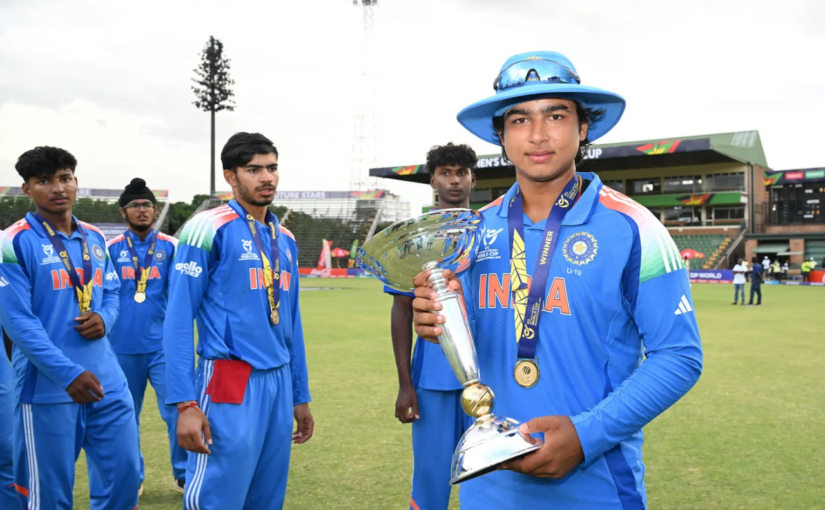
After the twin pleasures of the Indian cricket team’s campaign in the T20 World Cup in February and early March and Dhurandhar: the Revenge in late March, the thing that has given me a lot of joy throughout the months of April and May is watching Vaibhav Sooryavanshi’s batting in the IPL.

As I write this, he has been selected for the Ireland and England tours in late June-July, becoming the youngest Indian to get an international callup ever, surpassing the great Sachin Tendulkar. He also won the IPL MVP award along with the Emerging Player Award (usually people win them years apart, not in the same year) along with a variety of other awards. This follows the U-19 World Cup in February where he was Man of the Match in the final as well as Man of the Tournament.

And it is not just me, but the entire cricketing world which has been set aflutter by his exploits. His extremely fast pace of play (even compared to some of the fastest players in the world) plus his insane shot making and bat swing have made him a fan favourite already.

Continue reading The joy of watching Vaibhav Sooryavanshi

Is Kabir Right?

Kabir’s claim, is that much of the Saffroniate comes to Brown Pundits for one purpose: to litigate Pakistan, and to litigate the Muslim. Take that fixture away and the room goes quiet. The post on Hindustani classical music sinks without a ripple. The translated short story draws three comments and dies. Only the threads that arm the two camps against each other run to hundred+.

Is he right?

Continue reading Is Kabir Right?

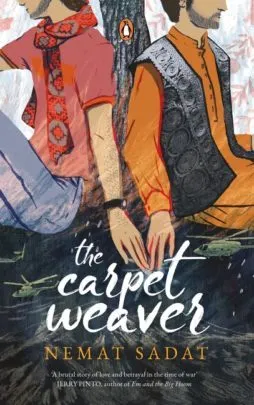
Review: The Carpet Weaver by Nemat Sadat

Since it is Pride month, I am sharing an excerpt from my review here.  This novel is about Afghanistan by an Afghan writer, so it hopefully adds to the conversation on that topic as well. In general, I think there needs to be more discussion on BP about non-normative sexualities. 

The Carpet Weaver, Nemat Sadat’s debut novel, is the story of a young Afghan man coming to terms with his sexuality amid a backdrop of civil war and political unrest in 1970s and ‘80s Afghanistan.As one of the few South Asian novels featuring homosexuality as a central theme, it is an important book. However, the plot could fairly be called cliched. Certainly, readers of Khaled Hosseini’s The Kite Runner would find much that is familiar in this novel.

The rest of the review can be found on Substack.  Also see my review of Khaled Alesmael’s novel Selamlik.


The Patriarchy Survives Everything

The day before yesterday, we published a general interest piece on the Philippine birth rate. Within a day it had drawn over a hundred comments and stopped being about the Philippines at all. It became, in turn, a debate on female autonomy, a referendum on Islam, a quarrel about civility, and a meditation on why human beings have stopped reproducing themselves. This is what Brown Pundits does that almost no other space on the internet can do, and it is worth pausing to say why, and to say plainly where we stand.

The diagnosis and the cure

Qureishi proposed, with complete seriousness, that the only solution to collapsing birth rates is to restrict female access to contraception, higher education, employment, and political representation. We disagree with every word of that cure. Restricting half of humanity from education and public life is functional enslavement, whatever euphemism of “policy” it travels under, and we said so in the thread.

The ecumene does not breed any longer

But we will not pretend the diagnosis is wrong merely because the doctor is. Birth rates are plunging everywhere, faster than any demographer predicted, and the $300 billion South Korea spent on subsidies did not move the needle. Q is right that this is not a money problem. He is wrong about what kind of problem it is.

The fashionable answer is that women got free and chose otherwise. Our answer is the opposite: everyone got less free, and women are simply the first to act on it. People are voting with their wombs. They are refusing to manufacture children for a world whose only offer is endless consumption, a working (waged?) life that begins at twenty-five and ends at sixty-five, and a retirement of warehoused loneliness. Marx called the failure to see one’s own condition false consciousness. The modern consumer is the Ye Olde Peasant with better teeth and a credit card, and somewhere the peasant knows it.

On the day of the trillionaire

Continue reading The Patriarchy Survives Everything

Open Thread: India, Israel, US & Iran

What is going on? We haven’t been following the Middle East for the past month and a half. India-US relations seem to be shakier?

The Philippines Birth Rate Crash

Precedent. Every Brown Pundits post, new ones included, must be at least 70 percent original to BP. Reposts from other sites are allowed, but the reposted portion must not exceed 30 percent of the post.


The Philippines has just recorded one of the fastest fertility declines in modern history, and almost nobody saw it coming.

In 1993 the average Filipino woman had 4.1 children. By 1998 it was 3.9, by 2013 around 3.0, and by 2017 it was 2.7. Then it fell off a cliff. The 2025 National Demographic and Health Survey put the figure at 1.7, well below the 2.1 a population needs to replace itself. That is a 37 percent drop in about eight years, the steepest the country has ever recorded. In the early 1950s, Filipino women were having more than seven children each.

At 1.7 the Philippines is not yet as low as East Asia. It still sits above Japan at 1.2 and well above South Korea at 0.8. What unsettles demographers is not the level but the speed, and the direction, which is the same one every developed Asian society has already taken.

Why nobody expected it

Continue reading The Philippines Birth Rate Crash

Architecture of belonging

There is a lot of debate taking place in the digital space regarding the safety of women in public spaces. Here, I am sharing an old opinion piece published in The News International on this issue.


Walk through any major city in Pakistan, and you’ll find that urban spaces speak a masculine language – the result of a parochial, patriarchal project sustained over centuries.

From dimly lit streets and poorly maintained sidewalks to male-dominated public transport and unwelcoming parks, our cities have long been built for and around men. This isn’t by accident; it’s the result of decades of planning that excluded the voices and needs of women, girls and gender-diverse individuals.

Unfortunately, Pakistan’s urban centres (Karachi, Lahore, Islamabad, Peshawar, and Quetta, etc) have ample room for improvement. Despite women making up nearly half the population, their visibility in public and economic life remains limited.

Continue reading Architecture of belonging

Review: Medusa of the Roses by Navid Sinaki

Since Iran is in the news, I’m sharing this review of a novel categorized as “queer Iranian noir”. 

Navid Sinaki’s debut novel Medusa of the Roses (Grove Atlantic 2024) falls into quite a rare genre: Queer Iranian Noir. Noir fiction is a subgenre of crime fiction and has been characterized by author and academic Megan Abbott as follows: “In noir, everyone is fallen, and right and wrong are not clearly defined and maybe not even attainable” (Literary Hub 2018). James M. Cain’s 1934 novel The Postman Always Rings Twice is usually identified as a classic example of the genre.  Sinaki directly references this novel and even borrows some plot elements from it. In Cain’s novel, the protagonist and her lover scheme to murder her husband so they can be together.  Similarly, Sinaki’s queer protagonists scheme to murder the wife of one of them.

Sinaki’s novel focuses on the relationship between Anjir and Zal, two men who have been lovers since they were teenagers.  At the beginning of the story, Zal has been injured in a gaybashing incident–he was with someone other than Anjir. Shortly afterwards, he disappears and much of the novel concerns Anjir trying to locate him. Anjir also plans to get gender reassignment surgery and live as a woman–not because he has gender dysphoria but because while Iranian law punishes homosexuality with death, the government allows people to surgically transition to another gender.  Before Zal’s accident, the two men came up with a plan to murder Zal’s wife. After Anjir’s gender reassignment, the two would be able to marry. Continue reading Review: Medusa of the Roses by Navid Sinaki

Brown Pundits