
I’ve been following the usual commentary, the BP quadrant: Indosauras, Nivedita, Kabir. And I read Kabir’s offhand remark that the Ramayana “didn’t resonate” the way the Iliad or Odyssey did. That casual dismissal is telling.
The Ramayana is not just literature, it is scripture, memory, and civilization encoded in verse. It has shaped the moral and cultural landscape of over a billion people for millennia. To compare it, then downplay it and to do so so glibly reveals less about the text and more about one’s own civilizational estrangement.
Let’s be honest: that kind of language would never be used for the Quran or Islamic texts. And the fact that it is used for Hindu epics by brown intellectuals raised in the shadows of colonial categories says everything about how deeply colonized the Pakistani mind remains. Pakistan is, in truth, an Urdufied Punjab insufficiently imagined, a fragment that lost its civilizational compass in the act of imagining itself apart. The fact that the Ramayan being Pakistani heritage is such a novelty speaks volumes.
Today I sat at Stratford Westfield, eating Dubai Hot Chocolate ice cream, and the man next to me clearly Pakistani asked me, in Urdu, “if I was in the queue?” His wife spoke Punjabi-inflected Urdu. It struck me how London has become the real unifying Punjab. Ten percent of Britain is now Desi. And outside of the subcontinent, the fractures of 1947 heal in ways that remain impossible back home.
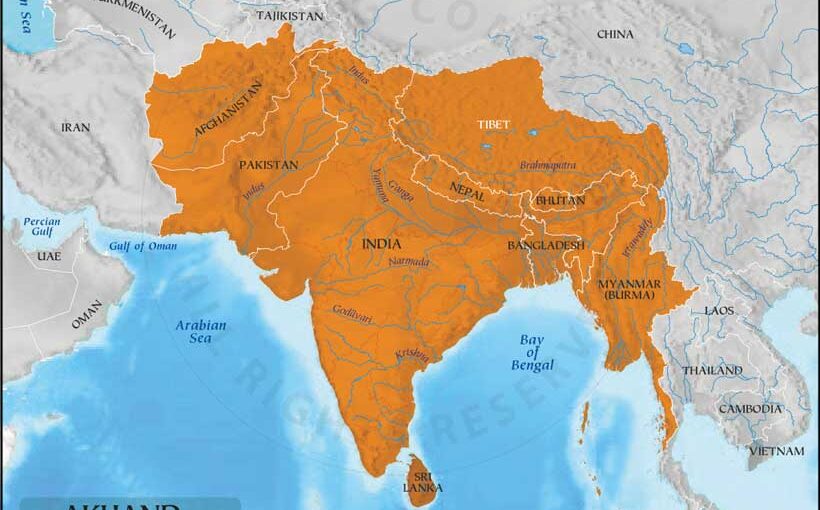
We speak of South Asia. But the term is bureaucratic; no one identifies with it. India is real. Bharat is civilizational. Aryavarta stretches from the Hindu Kush to the Indian Ocean — just as France is the Hexagon, Bharat is the Triangle. Partition clipped its wings, but its soul remains intact.
And look at the reality today: Indian Muslims are thriving in the mainstream. The title song of the upcoming film Sarai — written, composed, and directed by three Muslims: Ishaq, Fahim, and Arsalan. The leading lyricist is Javed Akhtar. This is a country that refused bitterness. A country whose largest minority chose Partition, and yet was never cast out, a unique precedent and testament the pluralism of Dharma.
Bharat needs no validation. It doesn’t need the approval of its neighbours or the heirs of partitioned imagination. It only needs to walk — and it is flying. Toward its own authenticity, on its own terms. And the world is watching.
The Ramayana is scripture for Hindus. For everyone else, it is considered Literature or mythology. This is not particularly controversial.
Non-Muslims do consider the Quran to be an example of Arabic Literature. I’m not offended by that. I don’t expect them to consider it as the literal word of God since that is not part of their religious belief.
The Bible (King James Version) is taught as a supreme example of English Literature. When I was taking AP English Literature, we were asked to read and annotate the Bible as part of our summer reading.
As for my own opinions, I freely admit my preference for The Iliad and The Odyssey. This is a literary judgement and as someone who has actually studied Literature (unlike others on this blog) I am fully entitled to it. If you want to call me deracinated or whatever that’s fine. I am quite happy to defend my preference for the Western Canon with argument.
“No one identities with South Asia”– I do. I am Pakistani-American and South Asian. There are plenty of other people who call themselves South Asian American etc.
India didn’t “cast out” its Muslims because Pandit Nehru believed in India as a country of all its citizens. That was a very admirable vision.
The map you have used with this post is quite problematic because it implies that India has a territorial claim on Pakistan and Bangladesh. Even poor Afghanistan wasn’t spared (Afghanistan was not part of British India). The map even claims Tibet. Don’t let the People’s Republic of China see it!
With all due respect XTM, but this entire post smacks of soft Hindutva.
Do you believe that Iliad & Odyssey are better reads than the Holy Quran etc?
I don’t see that there was anything to get offended about in what I said. We are all entitled to our literary preferences.
I’m not particularly religious and have never read the Quran all the way through. It is considered to be a classic of Arabic Literature even by non-Muslims though.
Personally, since I don’t read Arabic whatever little I read of the Quran as a child (at my grandmother’s insistence) really didn’t do very much for me. One can of course read it in English translation, but for someone who’s not all that religious reading about God’s commandments etc is not particularly interesting.
So “civilizationally Indian” means giving primacy to Hindu culture? Obviously, that’s a very problematic notion for Indian minorities. That attitude is precisely why Pakistan and Bangladesh opted out of “India” upon decolonization.
If you don’t see how problematic a map is that shows India laying claim to Afghanistan and Tibet is, I don’t know what to tell you. The other countries in South Asia are (rightfully) sensitive about our territorial integrity.
Please go and tell an Afghan his land belongs to India and see the reaction you get. I guarantee you it’s not going to be pleasant for you.
Hindu Kush is the boundary alas
This is not a particularly controversial point: This map that you have used de-legitimizes other South Asian nation-states. That’s why we find it offensive. We should ask Sbarrkum what he feels about Sri Lanka being included as part of “Akhand Bharat”. Should be interesting to say the least.
Afghanistan to this day claims parts of Pakistan (KPK etc). So I guarantee that they are not going to respond pleasantly to being told that their country is part of “Akhand Bharat”.
It really shouldn’t be too much for all of us to agree to accept the boundaries of our modern nation-states.
Yes recovering our voice so to speak
XTM you might be interested in this review I wrote of Leela’s Book— a modern reworking of The Mahabharata. This was published on BP way back in 2018.
https://www.brownpundits.com/2018/04/22/leelas-book-a-review/
few random thoughts:
i) one should agree that ramayana does not mean much to pakistanis as they have lost touch with the population believing in these stories.same in afghanistan, and partially in bangladesh.
ii) ramayana is still relevant to people till bali as they are in touch with its story and characters etc. after all buddha it seems had claimed to be a decendent of rama.
iii) once in a diplomatic bungle, india had sided with vietnam against cambodia. the combodians chastened indians saying that they were the last outpost of indic thought and that vietnamese were ‘chinese’ !!!
iv) the sanatani hindus lost in the peripheries of their spread as buddhism had taken roots both in afghanistan and bengal. the same applies to some extent in tamil nadu and kerala w.r.t christianity.
v) the percentage of schedule castes to the general population is highest in punjab and west bengal.
Like I’ve said above (maybe it was on another thread), I’m not trying to tell anyone what they should and should not relate to. The vast majority of Pakistanis are Muslim and as such do not relate to any Hindu mythology. Society has only become more conservative and Orthodox over the years.
Still, the play seems to have gotten an overwhelmingly positive reaction. No one was protesting in the streets that Hindu mythology was being staged in Karachi.
This whole post was written in reaction to a comment I made that having read The Ramayana I prefer the Greek epics. I still don’t see what is offensive in that statement since it simply expresses a personal literary preference.
One doesn’t expect Indians to be deeply moved by Arab history or mythology. So the reverse should also apply.
The Ramayana does not mean much in Sri Lanka to both Sinhalese and Tamils. Everyone knows the story, thats about it.
Even Ravana is not a “God” in SL. In Kerala Ravana is a God.
There is a place in the hill country called Seethe Eliya. Meaning cold open plain. Now it its spelled Sita Eliya and the local recent Indian Tamils consider it to be where Sita was held captive. The Indian govt also built a big Hindu Kovil there. So coupled with another place called Ravana Ella (waterfall) about 50km away SL has Ravana Trails. Gullible Tourist expeditions to various places where Rama and Sita have supposed to have stayed. Also a place in the deep south Rumassala supposed to be rock that Hanuman dropped.
I’m interested in your comments on the map heading this post that claims Sri Lanka as part of “Akhand Bharat” 🙂
? I don’t remember ever encountering this Buddha as a descendent of Rama. Maybe some strange Buddhist retrofit.
The Buddha is always the Sakhya Muni, and the Sakhyas are a semi republican confederacy of lower himalayan tribes. Aryan more by cultural integration than blood.
Rama however is uber Aryan. Surya vamsha Ikshavaku dynasty, the Chakravarti emperor satpurusha.
Interestingly post the Buddha and during the time of Ashoka the sakhyas are revered as the highest caste of the country as vedic Hinduism is superceded by Buddhism countrywide.
The religious movements of India prior to Islam deserves a good series on brown pundits.
So many practices (such as vegetarianism) are Jain/Buddhist influenced and there is so much retro fitting of custom via oral traditions. The uncovering of this I feel has a vital role in challenging Hindu orthodoxies.
I’ll try to put something out.
absolutely I would love to read that series.
[…] Indosaurus on Bharat Needs No Validation […]