
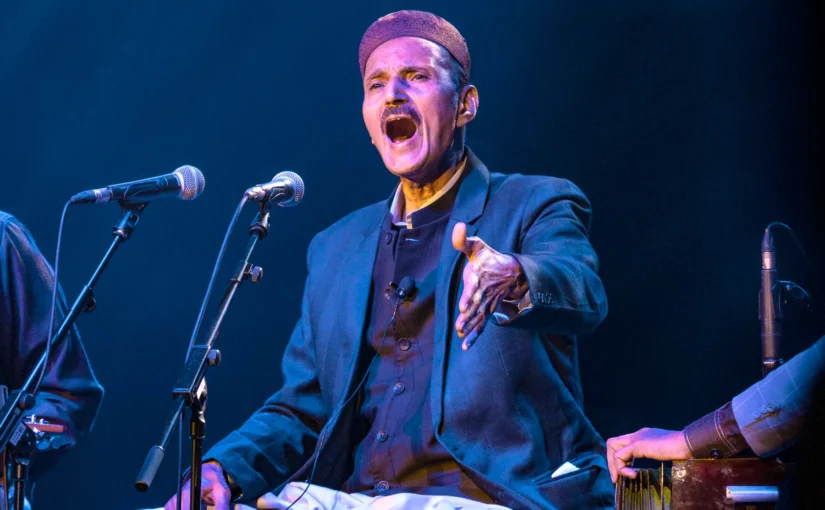
By Syed Hasnain Nawab in DAWN
[Note: Ustaad Naseeruddin Saami and his sons–The Saami Brothers– won the Patron’s Award at the 2025 Aga Khan Music Awards, held in London on November 22]
Hailing from Delhi’s famed Qawwal Bachcha gharana [musical lineage], Jaan traces his musical ancestry back to the likes of the 19th century Delhi gharana luminary Tanras Khan and Mian Saamat bin Ibrahim — with the latter being the principal disciple of Amir Khusrau. As the Saamis put it, their ancestors were chosen not by happenstance but by what the family believes to be Divine designation, stating, “Knowledge is given to whoever has a right to it, who deserves it. This is chosen and sent by God.”
In this vein, Jaan sees himself and his sons not simply as musicians but as carriers of a spiritual directive. Traditionally, these gharanas have maintained and safeguarded their expansive knowledge by transmitting centuries’ worth of musical heritage and experimentation seena-ba-seena [from ustaad to pupil].
And:
Alongside their performances, the Saamis have also started a khayaal residency at their rented homes in Brooklyn and the Bronx, which is now entering its second year in the US and hosts about 15 to 20 students from across the US and Canada. Their students lovingly call the Saami home ‘Ustaad Ghar.’ Conceived by Zeb Bangash, Jaan’s officiated student, the residency first launched in Lahore and has been supported in all its iterations by the USbased Centre for Cultural Vibrancy.
“There is a wide variety of people interested in learning from the Saami family through their residencies, classes and live programmes,” Nermeen says.
“Many musicians, especially those interested in microtones, grasp its subtlety.
We have opera singers, sound therapists, yoga practitioners and instrumentalists.”
She continues: “Their home is everyone’s first stop on Eid or birthdays.
For many New Yorkers, the ustaads’ home has become their home — a community shaped by the same warmth and continuity their Sufiancestors once cultivated around their music.”
And at the centre of it all, quietly but powerfully present, is Jaan. Rauf says, “He [Jaan] watches over the music with a discerning eye, stepping in only when his guidance is most needed. Though his primary focus remains on his own performances, he is shaping the next generation, ensuring that the traditions he has guarded continue to thrive.”

Naseeruddin Saami is a fine singer indeed! Although the whole ““the last living master of the 49-note microtonal scale” is nonsense. There are no 49 microtones as you well know, and also there are better khyal singers in India – mostly Bengali, Maharashtrian and Dharwad Hindus with a handful of Muslim families – probably 100 or so are well known enough to make a comfortable living and a handful are moderately famous like Kaushiki Chakraborty or Pt Venkatesh Kumar. Luckily they don’t need to go to the US to make a living.
I wrote an entire thesis on the decline of Hindustani classical music in Pakistan. You aren’t telling me anything I don’t already know.
That’s why he settled in the US. Of course, it’s a great loss for Pakistan.
I don’t usually like to categorize khayal singers by religion. But it’s very interesting that you didn’t mention Ustad Rashid Khan or Begum Parveen Sultana.
As for Kaushiki Chakraborthy, her father was taught by Ustad Munawar Ali Khan.
Of course no doubt every single Indian singer owes their lineage to an Ustad – and they boast about their gharana as well, this is not hidden. But the decline in Muslim influence is genuine
Rashid Khan is sadly no more :-(. Beyond the Agra lineage (Waseem Ahmed Khan) there I really no top level khyal Ustad today. Perhaps a few young singers from the remnants of Agra/Rampur/Patiala gharanas will rise to the top.
And anyway my main point is that Ustad Naseeruddin Sami is not “the last living master”.
Sure, “the last living master” is an exaggeration written by the DAWN journalist. Our classical musicians love boasting about their lineages.
even those in Pakistan?
who are the original Ustads
“Original” is complicated and disputed. Restricting to khyal, and the major lineages:
Apart from the list of names, we can say that virtually all these Ustads came from a small area around the Ganga-Yamuna Doab, say within 100kms of Delhi. They were almost all converts to Shia Islam. They all trace their origins back to known Hindu court musicians (eg. Gopal Nayak, Sujan Singh) or wandering saint musicians (eg. Swami Haridas). Like Tansen himself, they were originally Hindu but by 1700 we can say most important singers in North India were Muslim. Many of their families are linked by complex webs of inter-marriage and teaching.
Even after converting to Islam (and no doubt many of them were genuinely devout) many continued to sing in Hindu temples and all of them sang compositions praising Hindu gods and goddesses. However there is a massive influence of Sufi music and themes starting 1700 which remains a major pillar of the musical form.
Note that while every single major khyal gharana today has links to the Muslim Ustads, many traditions and families have died out in India (Sikandra, Hapur, Khurja, the original Delhi of Tanras Khan). To generalize, all of those did not teach outside the family (particularly talented Hindus) are now dead.
This sounds hyper-Islamicate tbf ..
It’s like Nargis, Sanjay Dutt’s mother, daughter of converts who went back to Hinduism..
But it’s like even though th current modality is Hindu; the base layer is profoundly impact by Islamicate
Btw you know a lot – u should write for BP!
this feels a little odd; Kabir is a musicologist
I’m pointing out mistakes in the dawn article, not what Kabir wrote
ah sorry
wow just listened to the music; it’s ethereal !!