
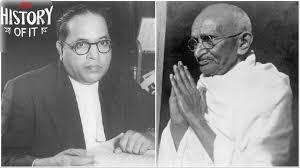
A Precedent Post on Gandhi, Ambedkar, and the Authority to Speak
Kabir is right to push back on the deliberately provocative, “pure evil.” It misses what QeA & Nehru were and what Gandhi & Ambedkar were.
This post sets four Precedents.
One. QeA and Nehru were men of state. Neither evil, neither saint. To be evaluated by the standards appropriate to men who build and run states.
Two. Gandhi was a man of Dharma. He is a saint. Comparing him with QeA and Nehru on their terms is a category error.
Three. Ambedkar is the fourth figure. Not a man of state in the QeA or Nehru sense; not a man of Dharma in the Gandhian sense. He is a constitutional saint, in the Mahatma’s register.
Nehru and QeA may be criticised. They may not be disrespected. Gandhi and Ambedkar are a different order. Discussion of them on this blog proceeds from profound respect for their achievement: the redemption of the soul of India after a thousand years of slavery.
*Thousand years of slavery is not Precedent but rhetorical flourish. It is worth noting that all of the Pakistani commentators on BP would be subordinated “Hindustani Muslims” in the hierarchical world of the Mughals, who explicitly favoured foreign-born Turani and Irani nobles over the converted Indian majority.
Four. SD is not to be quoted on this blog. Initials only where strictly necessary. Reasons at section XII.
Part I. The Distinction
I. The Man of State
The modern state is a Westphalian inheritance: territory, a monopoly of violence, legal personality. A man of state operates inside that frame. He does not step outside it.
QeA was a man of state. He was perhaps the finest constitutional negotiator the subcontinent produced in the twentieth century. He read the Government of India Act the way a master reads a score. In his Fourteen Points of 1929, drafted in response to the Nehru Report’s dismissal of the Muslim minority, he foresaw with brutal clarity that a Westminster majority in a plural society could become a permanent tyranny once the demographic count was fixed.
According to Mohammad Ali Jinnah, “The Committee has adopted a narrow minded policy to ruin the political future of the Muslims. I regret to declare that the report is extremely ambiguous and does not deserve to be implemented.”
There is a reason Pakistanis venerate him to the extent they do. Without QeA, the Muslims of the subcontinent would have remained a set of regional identities & class interests: Punjabi, United Provinces aristocrats, Bengali. He forged a single Islamicate identity out of them and politicised it into a state. In the history of the Ummah, and indeed the world, this is almost unique.
The Two Nation Theory was not his starting point. In 1916, at Lucknow, Sarojini Naidu called him the Ambassador of Hindu-Muslim Unity, and the phrase was earned. He reached for the Two Nation Theory two decades later, when the softer constitutional instruments had been closed off by Congress intransigence and Viceregal haste.
The tragedy of QeA is that the state he called into being never settled its founding question. A secular Muslim who ate pork and drank whisky summoned an Islamic state and then, on 11 August 1947, tried to unsummon it in a speech that Pakistan has spent the rest of its history editing out of its school curriculum. The confusion was structural from day one. It is structural still.
II. The Architect and the Scaffold
Nehru was a man of state of a different temperament. Harrow, Cambridge, Inner Temple. Fabian socialist. Scientific temper. Where QeA built a state around a community, Nehru built one around an idea: that a civilisation as old as India could be poured into a parliamentary republic and would accept the mould. It largely did. We owe him this.
Nehru’s achievement is that the Indian state has never collapsed. That is not small in the decolonised world. Compare Iraq. Compare Syria.
But Nehru’s state was a scaffolding for a civilisation he could not fully articulate in its own terms. He was too English to be Hindu, and too Hindu to be English. Hindustani, the composite register actually spoken from Lahore to Patna, was legislated into a Sanskritised Hindi that no street in the subcontinent had ever used. The imaginative vocabulary of the Republic, tryst, destiny, secular, socialist, reached its people through English rather than through any of the subcontinent’s own tongues. The highest articulations of the state required a translation.
He bequeathed an India that works administratively and stutters civilisationally. The Hindutva reaction of the last thirty years is the bill coming in.
Both men operated inside the same frame, the nation-state. Able men, educated men, consequential men. Men.
III. The Man of Dharma
Gandhi was not operating inside that frame. Dharma is older than the state. Older than the Mughals, the Delhi Sultanate, the Mauryas. It predates the Westphalian settlement by two and a half millennia. Dharma is the order of right conduct, right relation, right ordering of self to cosmos. The state can be its instrument, its obstacle, or indifferent. It cannot substitute for it.
Gandhi refused every office. He was never Prime Minister, never a formal Viceregal interlocutor, never elected to anything of consequence after the early Congress years. A barrister who had argued at the Bar in London dressed himself in a loincloth and made the charkha a political sacrament. The loincloth was a theological instrument, linking the body of the Mahatma to the bodies of the poorest through the simplest technology available. A man of state wears the sherwani, the suit, the uniform. A man of Dharma does not.
Satyagraha is not non-violence in the weak Western sense. It is soul-force: the insistence that the truth of one’s cause is sufficient to overcome the falsehood of the opponent’s, without destroying the opponent. Theology, not tactic. Satyagraha only works if the practitioner is willing to die and the opponent is not willing to kill an undefended man. When those conditions failed at Partition, satyagraha could not stop the killing. It never promised to. It promised to bear witness to the wrongness of the killing. These are different things.
IV. Dharma Is Not Only Hindu
The frame is civilisational, not sectarian. Every living tradition in the region has produced the same distinction. The commentariat should see the Precedent in its own inheritance before accepting or rejecting it in Gandhi’s.
The Buddha walked away from a throne. The entire structure of the Dhamma begins in the refusal of statecraft as the frame for the spiritual life. Ashoka, the one ruler who tried to be both man of state and man of Dhamma, is remembered for the tension that ran through him, not its resolution.
In the Persianate register, the pattern is sharper. Mansur al-Hallaj was executed by the Abbasid state in 922 for the statement Ana’l-Haqq, “I am the Truth.” The state did not kill him because it disbelieved him. It killed him because a man who is the Truth cannot be a subject. Al-Hallaj is the patron of every man of Dharma in the Islamicate tradition. The statesmen who executed him sit in the same category as Godse.
Guru Nanak was contained by no polity he passed through. Kabir (the Saint) refused Hindu and Muslim patronage alike. Shah Abdul Latif Bhittai sang in Sindhi a Dharma the Mughals and their successors could not recruit. The Bahá’í tradition, which is this writer’s tradition, is explicit: Bahá’u’lláh was exiled from every state that encountered him, founded none, and the administrative order of the Great Faith rests on the refusal of clerical and sovereign authority.
The distinction between man of state and man of Dharma is a universal feature of the civilisational inheritance of this region, recognised in every tradition that has produced saints. Gandhi’s Dharma is Hindu in idiom. It is not exclusively Hindu in substance. A Muslim commenter should locate al-Hallaj, Bhittai, or Kabir in the same category and recognise the claim for what it is.
The Inner Temple trains men to be men of state. It does not train them to recognise a man of Dharma when he shows up in a loincloth.
Part II. Gandhi Is a Special Case
V. Bengal, or the Single Man Who Stopped a War
In August 1947 Calcutta was the killing ground everyone expected. The Great Killings of the previous August (caused by QeA’s Direct Action Day) had left the city marinated in blood. Punjab was in open pogrom. Every serious observer expected Bengal to be much worse.
It was not, because Gandhi was there.
On 13 August 1947 Gandhi arrived at Hyderi Manzil, a derelict house in Beliaghata, a Muslim quarter that Hindu mobs were preparing to attack. He brought no troops, no police. He brought Suhrawardy, the former Chief Minister blamed for Direct Action Day a year earlier, and sat with him in a house without electricity or running water. He fasted. He met the mobs. He told the Hindus of Beliaghata he would die there before they harmed their Muslim neighbours.
Mountbatten called him a one-man boundary force. The phrase is exact. Fifty thousand British and Indian troops held the line in Punjab and lost the line. One seventy-seven year old man, unarmed, held Bengal.
On 15 August, while Nehru gave the Tryst with Destiny speech in Delhi, Gandhi was in Beliaghata, fasting. On the day of his own victory, the Mahatma was absent from the ceremony of the state.
VI. The Premiership He Was Offered, the Partition He Opposed
Gandhi was the only figure of national stature who opposed Partition to the end. By early 1947 Nehru had accepted it. Patel had calculated that a smaller governable India beat a larger ungovernable one. Congress had internalised the inevitability. QeA had demanded it, obtained it, and was moving to Karachi.
Gandhi alone refused. His April 1947 proposal to Mountbatten was to offer QeA the premiership of a united India. The whole country. Let the Muslim League form the Government. Hindus would serve under Muslim leadership if that was the price of keeping the subcontinent whole.
Nehru rejected it. Patel rejected it. Congress rejected it. QeA understood what was being offered and found it impossible to accept on his own terms. Mountbatten filed it away as an eccentricity.
Partition is presented as a tragedy without authors. It was not. Nehru, Patel, QeA, and Mountbatten all wanted it, each for their own reasons. Gandhi did not. The men of state made the state. The man of Dharma opposed the making. He was outvoted, not outargued.
VII. The Fast for the Enemy Nation
In January 1948 Gandhi undertook his final completed fast. The proximate cause was communal violence in Delhi. The deeper cause was the Government of India’s refusal to release fifty-five crore rupees, Pakistan’s share of the sterling balances under Partition. Patel had withheld the payment on the grounds that Pakistan was using it to fund the tribal raid on Kashmir.
Gandhi fasted until the Government of India, led by his own protege, released the money to the state that had just attacked Kashmir.
Read that sentence again. The Mahatma of India fasted on behalf of Pakistan, against his own Prime Minister and Home Minister, to force the Indian state to honour its contractual obligation to the enemy nation. He did this while Muslim Indians were being killed in Delhi, three weeks before his own assassination.
This is the act for which he was shot.
VIII. Why Only Gandhi Was Killed
QeA died in bed of tuberculosis on 11 September 1948. Nehru died in office on 27 May 1964. Patel died in Bombay on 15 December 1950. Gandhi was shot in the chest at 5:17 pm on 30 January 1948 by a man who had read him carefully and despised what he read.
Godse did not kill Gandhi because Gandhi was a Hindu saint. Godse killed Gandhi because Gandhi’s Dharma extended to Muslims and to Pakistan, and the Hindu state forming around him could not tolerate a saint whose ethics crossed the border. This is in Godse’s own defence at trial. He was clear. He was literate. He was not mad.
Men of state can be outvoted, out-negotiated, or waited out. A man of Dharma has to be killed.
The bullet was the recognition that Dharma could not be shouted down. It had to be shot. The Mahatma’s value to the Indian state begins at 5:17 pm on 30 January 1948. Before that hour he was a problem. After that hour he was a stamp.
Part III. The Other Exception
IX. Ambedkar, the Constitutional Saint
There is one more figure. Ambedkar.
Ambedkar was not a man of state in the QeA or Nehru sense. He did not build a state around a community or an idea. He drafted the document that allowed the state Nehru inherited to function. He did this as a Dalit, in a Congress machine that distrusted him, for a majority that had oppressed his caste for a thousand years.
He is also not a man of Dharma in the Gandhian sense. His disagreement with Gandhi on caste was substantive, permanent, and right on most of the substance. He never performed sainthood. He wore Savile Row. He quoted Dewey. He converted to Buddhism in 1956 and took five hundred thousand Dalits with him. A saint’s act, performed without the idiom of sainthood.
Ambedkar translated Dharma into constitutional law. He is a constitutional saint. A different kind of saint, a kind the subcontinent had never previously produced.
The Indian Constitution of 1950 is a sparkling piece of civilisational work. It has been amended. It has been stretched. In seventy-six years it has not been meaningfully violated. The Emergency of 1975 was a test, and the Constitution survived. The document held because Ambedkar had built it to hold.
X. Why Pakistan’s Constitution Did Not Hold
The comparison is unavoidable. Pakistan has had three constitutions and broken all of them. 1956. 1962. 1973. Military coups in 1958, 1977, and 1999. Judicial murders of Prime Ministers. The sitting Prime Minister is in jail as this post is written.
Pakistan began life with more industrial base, more arable land, more military inheritance, and arguably more administrative talent per capita than India. Eighty years on, the measure of Pakistani success is survival. That is the measure of a low power. India’s measure is constitutional continuity. The difference is not geography or demography. India had an Ambedkar. Pakistan did not.
QeA was a lawyer. Ambedkar was a constitutional architect. Not the same category.
Part IV. Authority and Line
XI. The Precedent Position
This blog holds the following positions on these four figures. Precedent. Not up for relitigation in comment threads.
Gandhi is a saint. The Mahatma. Not to be compared to QeA or Nehru on their terms.
Ambedkar is a constitutional saint. The fourth figure, in the register of the Mahatma, not of QeA and Nehru.
QeA is a man of state. Not evil, not a monster, not a bigot. The finest constitutional negotiator of his generation; the state he built has spent seventy-eight years unable to settle its founding question.
Nehru is a man of state. Visionary Architect of an Indian state that has not collapsed. His civilisational register was too thin; the reaction of the last three decades is the bill coming in.
XII. Who Reads the Subcontinent
The frame across Sections I through XI is civilisational: men of state, men of Dharma, and constitutional saints are not interchangeable categories. The same frame applies, in a lower register, to those who write about the subcontinent. The question of who reads the subcontinent, from what seat, and on what authority, is the question the four figures raise from within. The men of state built the states. The man of Dharma refused them. The constitutional saint disciplined them.
In December 2025 this blog engaged SD on a speculative claim that Indian rock-cut architecture, specifically the Barabar caves, derives from Lycian funerary models via Alexander’s march. The critique was narrow and factual. The Barabar caves are not tombs. The transmission mechanism is undemonstrated. The routing through Greece and Alexander was gratuitous where an Achaemenid frame was already available.
SD’s reply was a bibliography and a “Happy reading” sign-off. While we received it, the public text was being quietly amended in line with our objections, without acknowledgment. When we documented the edits, the defence shifted from Greek transmission to Achaemenid transmission, with the authority to explain India still in the same hands.
This operation has a name. Correct the record quietly. Lecture the critic loudly. Keep the chair.
The chair is the point. A Western author of the relevant pedigree is granted interpretive authority over the subcontinent by default, and the default is expected to survive his own factual errors. The grant is colonial in origin and postcolonial in form. It softens the accent. It adds the footnote. It retains the hierarchy.
SD is not to be quoted on this blog. Initials only where strictly necessary. His work is not to be cited as authority. This is not personal. It follows from everything above. The subcontinent has produced its own founders, saints, and drafters of law. It will produce its own interpreters.
Commenters who defend SD, or who argue that South Asian critics must first “earn academic credentials in the humanities” before contesting a Western author, will have those comments removed. The authority to speak about the subcontinent does not come from a chair in London. It comes from the subcontinent. That is not gatekeeping. It is editorial line.
XIII. On the Editorial “We” and Why Precedents Exist
Kishore has asked why this blog uses the plural. Not arrogance, not a royal we. It is the house voice of the masthead, and Precedents speak for the site. The line is the “we”.
Precedent Posts exist so the blog does not relitigate settled positions in every thread. Sacred geography established the founder-institutional distinction. Op Sindoor established that the operation was not a Pakistani defeat. Precedents can also be reversed in well-thought out posts like G.L’s seminal Dhurandhar post. This post establishes four. Precedents are not the suppression of debate. They are the grounds on which serious debate becomes possible. Fifteen years on, the vitality of this space is the record.
The wound of 1947 has not closed. The subcontinent inherited two states and lost the Mahatma and, in time, the constitutional saint as well. The states continue. The saints do not. They were men. He was Mahatma, the Great Soul of Mankind (who appear once every few Generations or so). Ambedkar sat beside him, in a register of his own.
//Without QeA, the Muslims of the subcontinent would have remained a set of regional identities & class interests: Punjabi, United Provinces aristocrats, Bengali. He forged a single Islamicate identity out of them and politicised it into a state. In the history of the Ummah, and indeed the world, this is almost unique.//
While unique is this a good thing though? Would Muslim interests have been served better through non Islamic identities and ethnic identities rather than a religious identity. Would a muslim have had a better life by fighting for it with a Hindu or Sikh or christian or jain than with a muslim from the other side of the subcontinent.
We can compare to christians in India who are equally widespread and divided by caste, ethnicity, sect and class. Even with acknowledging troubling trends thst sometime result in riots and social boycott, the prominence of other identities relative to their religion has enabled them to pursue their own interests in a much better manner than muslims. We can see this in higher literacy, greater focus on education amongst christians, presence of significant christians in the middle class and as a result benefitting from the growth India has experienced
Being cognizant of caste, has allowed greater integration in the ambedkarite movements and ambedkars ideals to seep into consciousness unlike with a muslims whete caste issues have not been acknowledged properly.
Where christians are a total majority as in many states in the northeast they have managed to secure their own control over the resources and lands beneath their feet, considering thst some of the insurgencies in places like this were ongoing before kashmiri militancy this is not a small feat. And it is not like the christians in northeast have not been xenophobic to both mainland hindus and Sikhs but even other christian tribes either
Finally the result of the elite being where they are aince centuries and not being displaced is not only do they benefit from Indias growth but also are much able to combat instances of religious violence meted out on christians elsewhere in the country. Having close social and cultural ties also means that even begrudgingly christians are forced to confront instances of religious discrimination from their side.
https://mattersindia.com/2017/10/bishops-denounce-burning-of-hindu-deities-in-mizoram/
Would a muslim community defined by caste , ethnicity and class have been better able to confront the issues facing them? The case of christians shows that other than nukes the subcontinental muslims seem to have gotten a raw deal.
_/He bequeathed an India that works administratively and stutters civilisationally. The Hindutva reaction of the last thirty years is the bill coming in.//
If India stuttered civilizationally it is only because the state that Nehru created lacked capacity to fulfill its duties, not entirely his fault though. We did not lack a civilizational mooring. What we did lack I feel is a broader perspective on the possibilities, and limitations. Nehru should have focused more on confronting the acrimony thst British colonisation created and even deal with any intellectual thoughts that promoted this acrimony. This refusal to do so is why we are having many problems todsy.
I dont think that we will be solving the second problem anytime soon though.
The highest quality of life enjoyed by Muslims in the subcontinent is in Kerala.
Decent representation in both politics and media as well as the highest education/income levels by Muslims anywhere else in South Asia.
With all due respect, the demographics of Indian Muslims and Christians are not comparable.
Muslims are approximately 15% of the Indian population.
Christians are approximately 2.3% to 2.4% of India’s population.
There was no question of Indian Christians defining themselves as a “nation” and advocating for a separate nation-state.
This is a great post.
I would also add Maulana Azad to this. See the following:
https://kabiraltaf.substack.com/p/review-the-muslim-secular-parity
Two points:
1) You referred to Imran Khan as the “sitting Prime Minister”. This is factually untrue. An election was held in 2024. IK was already in jail and not a candidate. He was removed through a no-confidence motion in 2022. We can disagree about IK but he is not the “sitting Prime Minister”.
2) I don’t agree with you about SD but I will honor the editorial line not to quote him. The broader point remains valid though. If South Asians (not just Indians) are so busy being engineers and computer scientists–not without reason– then we cannot complain when our history is interpreted by those who do earn degrees in History etc.
Also I just want to clarify if the ban on SD applies to WD as well?
Also the mockery of South Asians being “computer scientists” and “engineers” stem from a place of feudal privilege.
South Asia is a very impoverished land, mostly due to the actions of SD’s countrymen.
A life in the arts is a privilege for the rich, especially doing research in some foreign land.
First worlders will always dominate arts (and sports) due to this.
East Asians also had to grind away in the less glamorous fields before they could focus on art/sports.
Within a South Asian context, India being richer does better than Pakistan in these fields.
Considering India is growing faster, Pakistanis shouldn’t complain if some Indian SD in the future starts writing books on Pakistan while they are becoming engineers.
For a more recent example, Pakistanis shouldn’t complain about the Dhurandhar movies. If Pakistanis are so busy being engineers, people who hone their craft in film will be the ones making movies on Pakistan.
Indian nationalists love making the same critiques about Pakistan that triggers them when foreigners do the same to them. Funnily enough had SD said something negative about Pakistan you guys would be quoting him ad nauseam as Indians have done so with other western critics of Pakistan.
“Considering India is growing faster, Pakistanis shouldn’t complain if some Indian SD in the future starts writing books on Pakistan while they are becoming engineers.
For a more recent example, Pakistanis shouldn’t complain about the Dhurandhar movies. If Pakistanis are so busy being engineers, people who hone their craft in film will be the ones making movies on Pakistan.”
That’s what Indians have been doing for decades – several books, articles, podcasts, movies, social media content made about Pakistan. It has nothing to do with Indians being better than art than us, it’s just that it’s a one sided obsession. Dhurandar is one of several dozens of movies made about Pakistan, this is not a new trend – It’s a symptom of a deep rot in Indian society.
I think you are a bit confused about what my comment is regarding.
SD’s issue is not that he said anything “negative” about India as you are insinuating but due to the resources available to him but not to most Indians, told an “Indian” story via his narrative.
Pakistani film fans always desired to make a gangster movie on Lyari (similar to RGV/Kashyap in Bollywood) but due to lack of funds/technical ability in Pakistan, that movie ended up being an Indian movie weaved into an Indian narrative.
Pakistanis’ frustration with Dhurandhar is not that it an Indian-Pakistan movie (of which there are many) but it is a “Pakistani” movie and “their” narrative which was co-opted by Indians.
Also I disagree the obsession is one-sided.
Pakistan makes plenty of media about India.
Issue is that it’s just not good and even Pakistanis don’t see it.
Jahannum Ba’raasta Jannat came out recently and clips are already going viral on X.
Has some sadhvi RAW agent lol.
Someone said – YRF makes better ISI propaganda than ISI
“Skill issue” like the kids say
Good post.
I just want to address this criticism that i am “mocking” South Asians for being computer scientists and engineers:
There is nothing wrong with being an engineer. My own father was trained primarily in engineering–though he went on to get a PhD in Economics. My mother is a medical doctor–as are many others in my family.
I will note that prior to becoming a civil servant my paternal grandfather obtained a Master’s Degree in English Literature. This was back in the 1930s.
Doctors, engineers and scientists are very much needed in any society. However, the fact remains that when South Asians don’t go into the Humanities, they shouldn’t complain when Europeans shape the narratives regarding our countries.
WD explored Urdu and Persian documents in the Delhi archives that Indians hadn’t looked at since 1857.
All I am advocating is a healthy respect for academics. Someone with a doctorate in a particular field is inherently more credible than a random person on the internet. This doesn’t mean that they are above criticism simply that such criticism must cite sources.