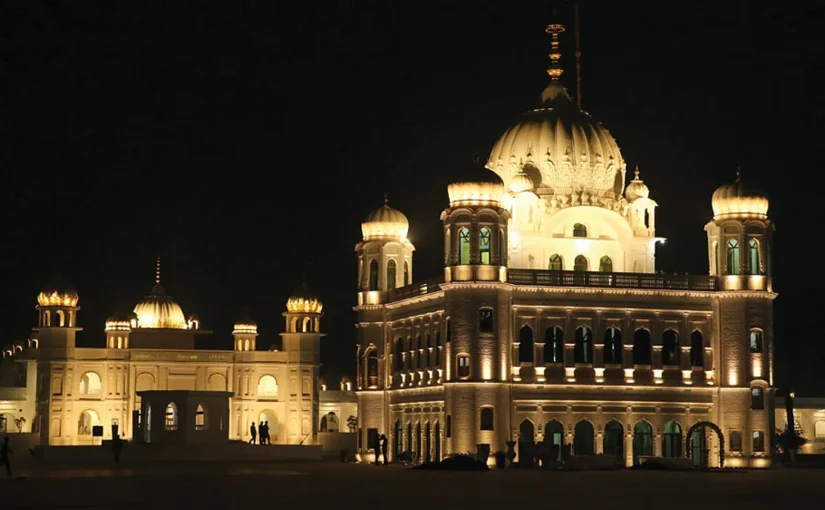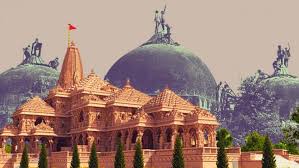
You Cannot Demolish His Mosque and Claim His High Culture

A precedent post on hybridity, custodial duty, and the elites who want it both ways

The argument running through the recent threads is sharper than the usual India versus Pakistan braggadocio. It is a claim about high culture itself. A civilisation cannot demolish a man’s mosque and claim his high culture in the same breath. The two moves cancel. The elites on both sides of the 1947 line have been performing both moves for eighty years, and the contradiction is now visible.

What high culture is

High culture is the foundational settlement of values, ordinarily anchored in religion, that a civilisation runs on. It can be syncretic in formation. Plural ownership is harder to sustain, and most attempts eventually close into a single settlement or fracture into rival ones; some imperial frames (Ottoman, Mughal, the Republic of India itself) did hold the tension for longer than the simple model would predict. The point is not that plurality is impossible. The point is that plurality is unstable, and the instability is what generates events like 1992.

England is the cleanest worked example of closure. The English high culture is a hybridisation of Anglo-Saxon, Anglo-Norman, and an absorbed Celtic remainder. Scotland and Wales sit inside the matrix without breaking it. The hybridisation closed; one settlement emerged.

Ireland is the test case in the negative. The same Anglophone substrate produced a different high culture in the Catholic south, and in the Catholic pockets of the north, because religion did the foundational work and religion would not blend. Two islands, one language family, two high cultures. Language is the medium. Religion is the substrate.

Ludwig von Mises, in Nation, State, and Economy, argued the related half. The nation is a speech community, but the speech community is shaped by what the school teaches and what the church says. Plattdeutsch villages on the Dutch border could have gone either way two centuries ago; the descendants would now be just as good Hollanders or just as good Germans, depending only on where the school and the church sat. Language carries national consciousness. The religious settlement decides which language wins.

Notre Dame: The custodial bargain Continue reading You Cannot Demolish His Mosque and Claim His High Culture

Gurdaspur and Siliguri: The Two Necks That Held

A precedent post on Pakistan’s self-exile from the subcontinent, and the geography that outlasted it

This is not anti-Pakistan polemic. Pakistan can flourish in the role she has chosen, and may continue to do so (Pakistan’s pivotal role in the US-Iran war is, on any honest reading, a legitimisation win for the current hybrid government)). The point being made here is structural, not personal.

Pakistanis are a subset of the British Raj’s Muslim population. As Punjabis, as inheritors of the Mughal cultural complex (alas one cannot destroy his Masjid and simultaneously claim to be his heir), as native carriers of the Hindustani register that becomes Urdu under one stylisation and Hindi under another, they began with a favoured position inside the subcontinent. They have traded it for a subordinate position inside the wider Muslim world. The internal hierarchies of the Islamicate, where Pakistanis rank against Arabs, Turks, and Persians, are dense and unflattering and deserve their own treatment another day.

The cause of the trade, in the end, is theological. The subcontinent runs on iconographic generosity, painted shrines, sung saints, plural deities, devotional excess. Strict iconophobia cannot live inside that civilization without breaking it. Pakistan chose the stricter line in 1947 and has progressively tightened it since. The Urdu denial, the recent insistence in some Pakistani quarters that Urdu is not really an Indian language, is the cleanest evidence of the opt-out.

Irreducibly Indo-Persian

Continue reading Gurdaspur and Siliguri: The Two Necks That Held

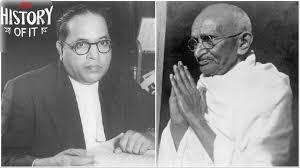
Men of State, and the Great Mahatma

A Precedent Post on Gandhi, Ambedkar, and the Authority to Speak

Kabir is right to push back on the deliberately provocative, “pure evil.” It misses what QeA & Nehru were and what Gandhi & Ambedkar were.

This post sets four Precedents.

One. QeA and Nehru were men of state. Neither evil, neither saint. To be evaluated by the standards appropriate to men who build and run states.

Two. Gandhi was a man of Dharma. He is a saint. Comparing him with QeA and Nehru on their terms is a category error.

Three. Ambedkar is the fourth figure. Not a man of state in the QeA or Nehru sense; not a man of Dharma in the Gandhian sense. He is a constitutional saint, in the Mahatma’s register.

Nehru and QeA may be criticised. They may not be disrespected. Gandhi and Ambedkar are a different order. Discussion of them on this blog proceeds from profound respect for their achievement: the redemption of the soul of India after a thousand years of slavery.

*Thousand years of slavery is not Precedent but rhetorical flourish. It is worth noting that all of the Pakistani commentators on BP would be subordinated “Hindustani Muslims” in the hierarchical world of the Mughals, who explicitly favoured foreign-born Turani and Irani nobles over the converted Indian majority.

Four. SD is not to be quoted on this blog. Initials only where strictly necessary. Reasons at section XII.

Part I. The Distinction

I. The Man of State

The modern state is a Westphalian inheritance: territory, a monopoly of violence, legal personality. A man of state operates inside that frame. He does not step outside it.

QeA was a man of state. He was perhaps the finest constitutional negotiator the subcontinent produced in the twentieth century. He read the Government of India Act the way a master reads a score. In his Fourteen Points of 1929, drafted in response to the Nehru Report’s dismissal of the Muslim minority, he foresaw with brutal clarity that a Westminster majority in a plural society could become a permanent tyranny once the demographic count was fixed.

According to Mohammad Ali Jinnah, “The Committee has adopted a narrow minded policy to ruin the political future of the Muslims. I regret to declare that the report is extremely ambiguous and does not deserve to be implemented.”

There is a reason Pakistanis venerate him to the extent they do. Without QeA, the Muslims of the subcontinent would have remained a set of regional identities & class interests: Punjabi, United Provinces aristocrats, Bengali. He forged a single Islamicate identity out of them and politicised it into a state. In the history of the Ummah, and indeed the world, this is almost unique.

The Two Nation Theory was not his starting point. In 1916, at Lucknow, Sarojini Naidu called him the Ambassador of Hindu-Muslim Unity, and the phrase was earned. He reached for the Two Nation Theory two decades later, when the softer constitutional instruments had been closed off by Congress intransigence and Viceregal haste.

The tragedy of QeA is that the state he called into being never settled its founding question. A secular Muslim who ate pork and drank whisky summoned an Islamic state and then, on 11 August 1947, tried to unsummon it in a speech that Pakistan has spent the rest of its history editing out of its school curriculum. The confusion was structural from day one. It is structural still.

II. The Architect and the Scaffold

Nehru was a man of state of a different temperament. Harrow, Cambridge, Inner Temple. Fabian socialist. Scientific temper. Where QeA built a state around a community, Nehru built one around an idea: that a civilisation as old as India could be poured into a parliamentary republic and would accept the mould. It largely did. We owe him this.

Continue reading Men of State, and the Great Mahatma

Founder Sites and Institutional Sites: A Note on Sikh Sacred Geography

This post is to be treated as Precedent on two matters.

First, on moderation

We have been alerted by Hamza that a number of Pakistani commentators on this site have been using anti-Dravidian racialised language against South Indian communities. This will not be tolerated on Brown Pundits.

Any comment that uses racialised language against Dravidian, Tamil, or South Indian communities will be removed, and the offending commenter will have twenty comments removed instantly as an automatic fine. There is no warning phase.

This is personal as well as editorial. DLV’s family was driven out of Sindh by Muhajirs at Partition. It was the Dravidians and the Tamils of Chennai who welcomed them, gave them a second home, and treated them as their own. Any racialised language against those communities on this site will be met with the full weight of the moderation tools available.

To Kabir’s credit, as far as we are aware, he is the only regular Pakistani voice on this blog who has never used racialised language of any kind, even in sharp disagreement. He remains institutional and high-minded even when the argument turns to nuclear rattling. He does not share in the wider Desi pathology with regards to skin colour and race, and that exception is worth naming. It may be the American side of him. Whatever the source, it is the standard this site expects of every commenter, Pakistani, Indian, Bangladeshi, or otherwise.

Second, on substance

The post below establishes a framework for how this site will discuss the sacred geographies of Partition going forward. The recent Kabir-Kishore exchange on Sikh holy places, is the occasion, but the framework is intended to apply across all such disputes: Hindu sites in Pakistan, Muslim sites in India, Sikh sites on both sides of the Wagah, Buddhist sites across the subcontinent. Future BP posts on sacred geography should refer back to the founder-institutional distinction laid out here.


Founder Sites and Institutional Sites: A Note on Sikh Sacred Geography

A recent exchange on this site sets out two claims about Sikh holy places. The first says Sikhs lost most of their sacred sites to Pakistan in 1947. The second calls that claim nonsense. Both are right, and the disagreement turns on a distinction neither has named: founder sites versus institutional sites.

The Pakistan-side Holy Sites

Continue reading Founder Sites and Institutional Sites: A Note on Sikh Sacred Geography

Brown Pundits