TM Krishna & Harsh Mander on Tamil Nadu’s resistance of the RSS

This podcast is part of Season 2 of “Partitions of the Heart”.  “Saffron Siege” runs from 17 September to 3 December 2025, with a new episode releasing every Wednesday.

In this episode, musician and political commentator T M Krishna speaks to Harsh Mander about Tamil Nadu’s long history of social movements that has led to this resistance. They examine how the state’s linguistic and language-based faith traditions have stood as a bulwark against the RSS’s attempts at homogenisation under a Hindutva umbrella. Krishna points out the multiple streams of religious influence on arts in India, especially in music, and how the RSS has tried to deny this past in service of the ideological project. “Carnatic music is symbolic of something for the RSS. It is symbolic of that puritanical and cultural superiority… Homogenisation, or rather a linearisation, of that is convenient for them.”


Why Ladakh is angry with the Modi government

On the latest episode of Scroll Adda, Sajjad Kargili–one of Ladakh’s most popular leaders and a part of the delegation that is negotiating with the Modi government–speaks to Shoaib Daniyal to explain why Ladakhis are so angry with Delhi.  Sajjad speaks about the “colonial treatement” that Ladakh is receiving from Delhi.

Sajjad notes that Muslims are 46% of Ladakh’s population while Buddhists are 40%.  Muslims are concentrated in  Kargil district while Buddhists are concentrated in Leh district.

Review: The Muslim Secular: Parity and the Politics of India’s Partition by Amar Sohal

Since Partition is a popular topic here on BP, I am posting this review from my Substack.  Amar Sohal’s book is important because it focuses on three Muslim politicians who did not support the Muslim League’s vision: Maulana Azad, Sheikh Abdullah and Abdul Ghaffar Khan.  Thus, the book foregrounds a vision that is an alternative from those of Indian and Pakistani nationalisms.

Historians of the politics leading up to the Partition of British India usually focus on the Indian National Congress and the Muslim League. To an extent, this is understandable–along with the colonial power, the Congress and League were largely responsible for the decision to partition British India into the sovereign nation-states of India and Pakistan. This historiography is largely focused on judging which of these two parties was most responsible for the lack of compromise that led to the ethnic cleansing of August 1947 and to decades of antagonism between (the now nuclear armed) states of India and Pakistan. Ayesha Jalal’s The Sole Spokesman: Jinnah, the Muslim League and the Demand for Pakistan can be considered a representative work of this school of historiography.

Amar Sohal’s book The Muslim Secular: Parity and the Politics of India’s Partition attempts a very different task. Based on his DPhil thesis at Oxford, the book examines three comparatively lesser-known thinker-politicians of late colonial British India: Maulana Azad, Sheikh Abdullah, and Abdul Ghaffar Khan. While unequivocally Muslim, all three of these figures aligned their politics with the Indian National Congress’s vision of a united India. As Sohal writes in his “Introduction”:

My endeavour, then, is to escape, as far as possible, from the long shadow cast on modern Indian history writing by Britain’s dramatic withdrawal and the minutiae of the Partition negotiations. Rather than rehash that familiar tale, I want to contribute instead to the burgeoning field of Indian and global political thought by unearthing a forgotten argument for integrationist nationalism and shared sovereignty. And this is significant because ideas (and not only transitory interests) mould the narrative of history, and ultimately survive it to speak to the epochs that follow. The subjects of my investigation were some of India’s foremost politicians…. So like other intellectual historians of India and the Global South that have engaged with this anti-colonial moment, here my task is ‘to reconstruct these “politicians” as thinkers and their words as concepts that were central to the making of political thought’. (Sohal 2-3)

Continue reading Review: The Muslim Secular: Parity and the Politics of India’s Partition by Amar Sohal

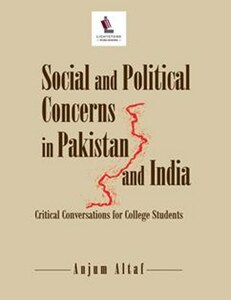
Review–Social and Political Concerns in Pakistan and India:Critical Conversations for College Students

Sharing this review of Dr. Anjum Altaf’s book Social and Political Concerns in Pakistan and India: Critical Conversations for College Students.  The book is a collection of essays originally published as blog posts on The South Asian Idea.    The mission of the blog was:

The South Asian Idea is a resource for learning, not a source of expert opinion. The posts on the blog are intended as starting points for classroom discussions and the position at the end of the discussion could be completely at odds with the starting point. Thus the blog simulates a learning process and does not offer a final product. The reader is invited to join the process to help improve our understanding of important contemporary issues.

The heyday of the blog was from around 2008- 2018.  It hosts hundreds of essays about issues relevant to South Asians–many of them about Partition, Hindutva, Pakistan etc.   At a time when Indians and Pakistanis are barely able to interact in a civilized manner (as we have seen on this blog), it is a record of an earlier time when the hope for better relations still seemed possible.  It is also an example of the work that goes into running and moderating a blog aimed at teaching people how to argue well about humanities subjects.

Here are an excerpt from the review in DAWN:

All in all, Altaf’s tome deserves praise for courageously, convincingly and argumentatively questioning the dictatorship of mainstream discourses. Fanaticism has reduced the Indian Subcontinent to an Absurdistan. Altaf’s book shows that a patient argumentation in the tradition of Enlightenment is the only way to reverse the course.

Here’s a link to the post mentioned in the review (entitled “The Road to Partition”)

Currently, the book is only available in Pakistan. However, it is available on Kindle for those in India.


Open Thread

Post about whatever you find interesting.

Here is an insightful interview between Karan Thapar and Shyam Saran (former Foreign Secretary) focusing on Indo-US relations

Check out this clip from Pakistan Idol. This is a just a teaser of highlights from the Lahore audition round.  I believe that the contestants were told they could not sing Indian songs, which seems to be primarily a way to avoid everyone defaulting to Bollywood (There is also probably a patriotic angle).  After all, we have our own great composers and singers such as Medhi Hassan, Farida Khanum, Noor Jehan, and Nusrat Fateh Ali Khan.  At the level of classical music, the tradition is obviously part of a shared culture.

There is a lot of musical talent in Pakistan and proper training would help to nurture it.  However, with all the other issues that the country is facing, art and culture have never really been a priority.  Finally, as a classically-trained musician myself, it is my firm belief that one cannot be successful in any kind of music without a firm foundation in Hindustani classical (which was the case with the greats such as Medhi Hassan, Madam Noor Jehan, and Farida Khanum).  India has obviously owned this culture much more than Pakistan–the reasons behind this are the subject of my dissertation.

My singing featured on Khaliq Chishti Podcast

In the spirit of a palate cleanser, I am sharing this musical performance.  I was featured on Khaliq Chishti’s podcast (he runs a recording studio in Lahore).  I performed Raga Rageshri and a Dadra in Raga Desh (“Cha Rahee Kali Ghata” which was originally sung by Begum Akhtar).  Tabla is by Iftikhar Joseph.

I also want to use this opportunity to respond a bit to the recent post that argued that India and Pakistan are only linked by violence.  I am a singer of Hindustani classical music and an ethnomusicologist. Hindustani classical music is obviously part of the shared Indo-Islamic culture that links North India, Pakistan and Bangladesh.  Eight decades of separation, wars and political tensions have not managed to completely destroy this common culture. This very fact goes to disprove the argument that the ONLY link between India and Pakistan is violence.

Indians are fond of Pakistani dramas. Fawad Khan is very popular in India.  A new season of Pakistan Idol has recently started airing (Fawad is one of the judges along with Rahat Fateh Ali Khan) and I dare say Indians would be watching on YouTube.  I have seen comments on Insta from Indians expressing their appreciation for Pakistani music.  Pakistanis obviously watch Indian Idol.

My book–A New Explanation for the Decline of Hindustani Music in Pakistan (Aks Publications Lahore 2024)–was recently profiled on Scroll.in. Do read it if you are interested.  Currently, the book is only available in Pakistan but we are working on publishing an Indian edition soon.  One of the side effects of the bad relations between India and Pakistan is that books cannot travel across the border.


Review: Desertion by Abdulrazak Gurnah

From my Substack: 

When Abdulrazak Gurnah won the Nobel Prize for Literature in 2021, he was comparatively little-known. I must confess that I had never heard of him. This is despite the fact that I am an ardent fan of English literature and am also deeply interested in issues of colonialism. I have read most of the fiction concerned with British colonialism in South Asia including Rushdie’s Midnight’s Children, Scott’s The Raj Quartet and Forster’s A Passage to India. Perhaps part of the reason that I was not familiar with Gurnah’s work was that I have not focused much on Africa as a region (except for North Africa, which can be said to be more of an extension of the Arab world than the African continent proper). However, even within the domain of African fiction, Gurnah is an author that is unfamiliar to most readers. For example, school curricula in the US often include Chinua Achebe’s Things Fall Apart and Alan Paton’s Cry, the Beloved Country. I very much doubt that any curricula so far has included Gurnah’s works. Hopefully, that will change now that he has received the Nobel Prize.

Gurnah is a British citizen of Zanzibari origin. He grew up at a time when Zanzibar was a British protectorate separate from the colony of Tanganyika. After both colonies achieved independence, a revolution overthrew the Arab elite in Zanzibar and the region later merged with Tanganyika to form Tanzania. Gurnah had left to study in the UK before this revolution broke out and he describes himself as a refugee. He completed his Phd in Literature and served as a Professor at the University of Kent, from which he recently retired. His academic work deals with postcolonial literature, including that of Rushdie. Continue reading Review: Desertion by Abdulrazak Gurnah

Review: The Music Room by Namita Devidayal

From my Substack:

Namita Devidayal’s memoir The Music Room is a chronicle of her relationship with her guru Dhondutai Kulkarni (1927-2014). The book describes Devidayal’s initiation into Hindustani classical music as a reluctant ten-year-old from Bombay’s upper-middle class. Along with describing her growing appreciation for Dhondutai and the music that she imparts to her, the narrative also tells the story of two other important figures in Hindustani music: Ustad Alladiya Khan (1855-1946)–the founder of the Jaipur-Atrauli gharana–and Keserbai Kerkar (1892-1977)–one of the most famous khayal singers of the 20th century. Through telling the stories of these individuals, Devidayal elucidates several important themes such as communalism and “Hinduization” of music as well as the place of women in classical music.

Devidayal describes the process through which Hindustani music became communalized and “Hinduized”. Though Dhondutai is extremely proud of the musical legacy passed on to her by Alladiya Khan Sahib’s family, she still expresses some bigoted views about Muslims. When pressed on this by Devidayal, Dhondutai attempts to square the circle by telling her that Ustad Alladiya Khan was not a real Muslim since he was (allegedly) descended from a Brahmin singer who had been forced to convert to Islam by a Muslim king. She also notes that he always wore the caste thread usually worn by Brahmins. This story allows Dhondutai to hold the belief that Hindustani classical music is essentially Hindu despite the fact that many of the most prominent gharanas had Muslim founders. Dhondutai’s prejudices connect back to the broader process through which–during the colonial period– Hindustani music was “Hinduized” by reformers such as Pandit Bhatkhande and Pandit Paluskar. Bhatkhande wanted to create a “national music” and believed that Hindustani music had been degraded by Muslims and dancing girls and needed to be rescued from both. This process has been extensively discussed by Janaki Bakhle in her book Two Men and Music: Nationalism in the Making of an Indian Classical Tradition. Unfortunately, while most ethnomusicologists agree that Hindustani music is a syncretic tradition, many (on both sides of the India-Pakistan border) persist in claiming it for one or the other religion. Continue reading Review: The Music Room by Namita Devidayal

Review: A Return to Self: Excursions in Exile by Aatish Taseer

From my Substack:

Aatish Taseer begins his new essay collection A Return to Self: Excursions in Exile (Catapult 2025) by recounting the Indian government’s 2019 cancellation of his Overseas Citizenship of India (OCI). The pretext for this decision was that Taseer had concealed the Pakistani origin of his father (the late Salman Taseer, a former Governor of Punjab who was assassinated by his own bodyguard after calling for Pakistan’s blasphemy laws to be amended). However, Taseer believes that the real reason that his OCI was canceled was that he had written a critical article about Prime Minister Modi entitled “India’s Divider in Chief”. He writes: “In one stroke, Modi’s government cut me off from the country I had written and thought about my whole life, and where all the people I grew up with still lived.”

Later in the “Introduction”, Taseer describes the impact that this decision had on him and how it led to the essays contained in the book under review:

If these essays feel like a return to self, it is because they represent the return of my natural curiosities and, dare I say it, cosmopolitanism, after the long night of cutting away parts of myself in order to better fit back into Indian life. They are a response to the illusion of the idea of home. The strand of elation that runs through them is the simple joy of being out in the world, free of the pressures of belonging. Perhaps there could not have been any other response, given that my country, my material, my world in India,had been snatched from me. I grew up in what felt to me like the crucible of all anxieties related to belonging. Those anxieties run through these essays, but they are also a tribute to the individual. After all the wringing of wrists, the stewing over questions of place, of feeling myself forever betwixt and between, I woke up one day to find the bars of my prison had magically disappeared, and, far from being scared, I felt a new vein of intellectual curiosity had opened for me. With the idea of home gone, I stepped out into the world again.

Continue reading Review: A Return to Self: Excursions in Exile by Aatish Taseer

Review: Shattered Lands: Five Partitions and the Making of Modern Asia by Sam Dalrymple

From my Substack:

When South Asians speak of “Partition” they are usually referring to the 1947 partition of British India that created the nation-states of India and Pakistan. This partition involved the division of the provinces of Punjab and Bengal on the basis of religious demographics and led to some of the worst ethnic cleansing of the 20th century. It is estimated that between 200,000 to 2 million people were killed and 12 to 20 million people were displaced. The word “partition” may also remind Pakistanis of the 1971 secession of East Pakistan (what Bangladeshis refer to as the “liberation” of Bangladesh). However, as Sam Dalrymple argues in his new book Shattered Lands: Five Partitions and the Making of Modern Asia (William Collins 2025), the British Indian Empire actually spanned a much greater geographical extent than today’s India, Pakistan and Bangladesh, including areas such as Aden (in today’s Yemen) and Burma. In his “Introduction” he writes:

The collapse of the Indian Empire has remarkably never been told as a single story. With every division archives were scattered across twelve nation states– thirteen if we include Britain. Subsequent divisions between the ‘Middle East’, ‘South Asia’ and ‘Southeast Asia’ crystallised after the Second World War. Each Partition is now studied by a different group of scholars and the ties that once linked a quarter of the world lie forgotten… This book, for the first time, presents the whole story of how the Indian Empire was unmade. How a single, sprawling dominion became twelve modern nations. How maps were redrawn in boardrooms and on battlefields, by politicians in London and revolutionaries in Delhi, by kings in remote palaces and soldiers in trenches. (Dalrymple 8)

Continue reading Review: Shattered Lands: Five Partitions and the Making of Modern Asia by Sam Dalrymple

Brown Pundits