The small, dark godown abutting M Dharmambigai’s large home with a larger courtyard in Kottur, a village 15 km to the south of Pollachi town in Tamil Nadu, has never housed stock so precious.
The value of gunny bags of cocoa beans stacked unevenly, without a great deal of care, is currently more than Rs 12 lakh and almost guaranteed to go up to Rs 15 lakh soon.
The lottery of climate change is such that the misery of farmers in one country is an opportunity to make windfall gains for others in a different continent.
The price of cocoa beans, the primary raw material for chocolate, has more than tripled in the last year. In March 2024 alone, it rose from $7100 a ton to $10455. In fact, chocolate prices now trade higher than industrial metals such as copper.
Can Indian cocoa farmers like her take advantage of rising global cocoa prices?
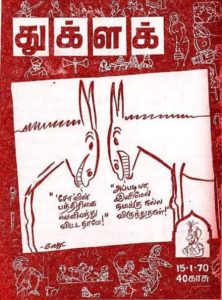
The late “Cho” Ramaswamy was a Indian actor, comedian, editor, political satirist, playwright, film director , Member of Parliament and lawyer . in 1970 he had an argument with his friends who dared him to start a magazine and to win the bet , he launched a political magazine that turned 54 this year. The first issue had this iconic cartoon where one donkey says to the other ” Looks like this Cho fellow has launched a magazine” and the other replies “Great , we will have a feast then!”. The cartoon donkeys make their appearance once in a few years while all of us readers have been reading Thuglaq for decades !
I happened to attend the 54th annual meet of Thuglaq, the one-of-a-kind event where the entire rank and file of the magazine meet with its readers, on Pongal day ,as it always happens. This unique practice was started by Cho and after his death in 2016, S. Gurumurthy, the Chartered Accountant, Journalist and RSS Idealogue has been successfully running the magazine while maintaining such traditions as well. Cho, while his sympathies for the right wing and Modi was always transparent , also was known for changing his views as the situation on the ground demanded and did not hesitate to critique even sharply the parties he supported. He was famously responsible for the TMC (Tamil Manila Congress – Moopanar and P.C Chidambaram led) formation and TMC – DMK alliance and helped in shaping the BJP-DMK Alliance during Vajpayee’s time as well when he went against his childhood friend Jayalalitha. Under Gurumurthy, while Thuglaq retains most of the founding tenets of the magazine, discussing mostly only politics and a sliver of spirituality, the irrepressible and at times irreverent humor of Cho is definitely missing. Gurumurthy seems to have almost made it a dry right leaning political magazine to the mild disappointment of long-time readers like me.
In spite of the strong shift to the right, Gurumurthy has retained and even strengthened some unique features of Thuglaq. One being inviting political leaders of all hues including the ones he opposes like DMK, Congress, Communists to share their experiences and points of view in the magazine. And to continue and strengthen this annual unique event on Pongal day when the Editor of the magazine and his entire staff meet and interact with all the readers and invite political leaders to address and interact with the audience as well. Who’s who of Indian politics have attended these meetings – Advani, Modi and most of the BJP Leaders, the erstwhile Janata leaders like VP Singh, senior communist leaders and Tamil Nadu leaders across political parties.
For this year’s event, the two main guests were Shashi Tharoor from Congress and K Annamalai, the firebrand BJP Tamil Nadu Chief. Sadly, since Annamalai was coming in from a meeting at Delhi, his flight was delayed and by the time he entered the Music Academy Hall, Shashi had finished his speech and had left. The program began the way it always does, with the editor introducing the entire staff of the magazine on stage starting from the veteran reporters like Ramesh whom most of Tamil Nadu knows to the attenders. This is again a unique gesture that surely must be appreciated. Then selected readers from the audience come to the stage and make their comments, queries and criticisms to which Gurumurthy replies. This year, apart from the regular questions about state and national politics , there were a few questions and concerns regarding the Maldives standoff and Guru gave his opinion and also deferred to the veteran diplomat and politician and ex Minister that Shashi is and requested him to give his point of view when his turn came. The audience as expected was mostly sympathetic to BJP’s cause.
Shashi spoke well, noting down all the key concerns and objections raised by the audience against Congress and addressed them valiantly. He also accused Modi government of subsidizing North at the cost of the South, lamented the subjugation of federalism and also explained the Maldives situation in an objective way without blaming the BJP government but cautioning it to be careful not to push Maldives into the axis of China. Ram temple issue being a topical one, he took it head on saying that he will visit the temple but not on the 22nd as he has in any case not been invited and would not want to go even if he were as he felt it was made into a political event. This caused some unrest in the audience as it did when he was overly critical of Modi. Overall, it was a measured speech, fully knowing it was a partisan audience who were against his world view, Shashi Tharoor, I felt stood his ground gracefully. It was comforting to see Gurumurthy come up to the stage after and admonishing the audience for interrupting Tharoor’s speech, commenting that since Dr Shashi Tharoor maintained the decorum of the forum, it behooves the audience too to do the same even if they believe he is all wrong.
Then came the star of the show, Annamalai who has caught the imagination of the public in the state especially those who desire an alternative to the Dravidian parties. His was a systematic take down of the DMK, its history and all that he felt was wrongs done by them. He also attempted to answer all the criticisms laid by Dr Tharoor, replying to the preferential treatment to the North charge, gave a population-based defense of the budget allocations favoring the North. He explained the BJP’s plans for the south and Tamil Nadu in particular. Gurumurthy too jumped on to the same North – South subject later and gave a historical perspective based on argument that the north suffered more from the partition which at least I could not buy fully.
A few broad inferences for me from the event
For Congress, it appears as though this boycotting of hostile TV Channels and media is a petulant and self-defeating act. I too cannot stand some of these loud TV Channels and can understand the reasoning but if one is running a political party, surely one needs a thicker skin and like Shashi Tharoor showed, one can hold their point of view even among a partisan hostile crowd and come out with head held high! I overheard a lot of the audience commenting that “Tharoor is a good leader but will he survive in the Congress”. It is up to the Congress to convince people of that and give such leaders more responsibilities and have them engage with people more.
For BJP, this preferential treatment of North over South and the damage to the federal structure narrative is hitting home to the audiences in this part of the world and even to those who are favorably disposed towards it. The narratives countering it, the ones I heard from Annamalai and Gurumurthy were not entirely convincing. There have been other arguments on this subject which have featured in BP Podcasts by folks like Maneesh about Freight Equalization policies and such which seems to have some merit in them but are seldom heard here. Are those too nuanced and complex arguments, am not sure but the ones that I listened to now still leave me with the feeling that we in the south have been hard done by both the Congress and more so by the BJP Government.
Interacting with the audience live, especially if it is a large one and answering them impromptu seems to be a rare occurrence and should be celebrated more. The audience too needs to learn to respect the speaker and not jeer if an opposing point is presented. The audience in this event have been that historically and when they went a bit haywire, they were immediately pulled up. Politicians, those who are well qualified (Please note I do not say educated!) and passionate about a subject can still convey their stances without resorting to name calling and hyperbole. Both Shashi Tharoor and Annamalai were strong but objective and respectful in their speeches.
The argumentative Indian can also be objective and respectful and can engage in constructive dialogue and achieve much more!