Pakistan vs Tehreek e Taliban, Dr Hamid Hussain’s view

From Dr Hamid Hussain. As usual, he has some interesting tidbits about who did what, even if you disagree with his analysis. I am also attaching a later exchange between Dr Hussain and a British analyst.

Questions from a senior Pakistani army officer and my response to them. First segment carries his views and the second segment mine.
…………………………………………………………………………
Dear Hamid, AOA.

Thank you for sharing your usual rational and pragmatic analysis.

The reasons put forward by former intelligence officer about rapprochement with TTP are both concocted and devoid of logic. In the past also there have been many abortive deals with TTP, which have never worked.

TTA (Afghan Taliban) & TTP (Pakistani Taliban) have always collaborated with each other, at least, in sharing intelligence . Both are Deobandis and have elements in each, which have come from the other. The public opinion in Pakistan resents this deal because of the loss of thousands of lives and APS (Public School), Peshawar tragedy. There is definite proof of RAW & Afghan intelligence masterminding most incidents in Pakistan (for sure Kamra & Mehran bases). Pakistan has even presented these evidence dossiers to UN Secy Gen. What moral justification or credibility we have then to strike a deal with a terrorist organisation both from international and domestic perspectives?

Even if there is a deal, what stops TTP or even Taliban to launch a terrorist attack inside Pakistan and blame it on a splinter group of TTP? The critical question is of funding . TTP were foreign funded for the acts at the behest of sponsors. If they are unable to undertake these terrorist acts, how would they be sustained, recruited and pay to the members?

If you link the TTP deal with TLP (Tehreek-e-Labbaik Pakistan), for a temporary truce we have lost the war.

Best Regards, Army Officer

…………………………………………………………………………………….
24 December 2021

Thanks, Sir, for your insight.  Sorry for the delayed response as I am busy with many chores and some hectic travels.

TTA & TTP:  You have highlighted the ideological, infrastructure, recruitment and financial relationships between two entities.  The problem for the Pakistan army was perception management for both domestic & foreign audiences.  It was supporting TTA but fighting TTP, therefore, it tried to convince the Pakistani public that the two entities were different although privately there were concerns about symbiotic relationship between the two. Hope was that with TTA having a major say in running Afghanistan (no one expected that Taliban will walk over after making a deal with US) will be able to rein in TTP.  My view was that it was a wrong assumption and lack of grasp of recent Afghan history despite deep involvement. Continue reading Pakistan vs Tehreek e Taliban, Dr Hamid Hussain’s view

Punjabi Short Story by Nadir Ali

As many of you know by now, I am colonel Nadir Ali’s son; many of you know him because of his speech and interview about Bangladesh, but that was not a subject he usually talked about. What he DID talk about and write about for 40 years was Punjabi literature and Punjabi culture and his contribution to it was to write dozens of short stories set in various Punjabi settings. Many of these were published in two short story collections (Kahani kara and Kahani praga), one of which won a National book award, but both of which are now out of print. But Sucheet Kitab Ghar in Lahore has published ALL his writings in one large edition of their magazine “Pancham”.   I managed to catch Covid and am laid up in quarantine (I had only mild symptoms, am fully vaccinated) so decided to translate some of his stories into English. My first attempt follows. The original Punjabi version I will post as screenshots at the end of this post. The full text of Kahani Kara can also be found as a PDF on scribd here.

Grapes

I had been feverish since morning but by the afternoon it was really burning up. Amma had been with me since morning and it was very late when she finally left to take food to the men in the fields; she dragged my cot to the shade of the chinaberry in the lower courtyard and left me there. The fever raged and I was too far gone to get up from the cot. The chinaberry provided little shade, but I was too weak to get up and go inside; I had recurrent cramps and a sinking feeling in my heart. When will this suffering end? In my feverish imagination, I felt as if everything in the house was about to attack me. We had one pillow in the house and whoever felt most needy could use it. The smell of every family member had sunk into that pillow, which seemed to consist of two uneven lumps of cotton wool. I threw my head on it one way, then another, but without relief. I turned from facing the hand pump to face the empty kitchen and thought for a moment that I had found relief, but it was fleeting. Kitchens are for fortunate people. Our whole house had nothing in it, what to speak of the kitchen. In the evening my mother would borrow a glowing lump of coal from the neighbors and start the fire, but what was there to cook? Everyday we got the same chickpeas; even turnips seemed to be a luxury now! Continue reading Punjabi Short Story by Nadir Ali

Is There a Method to Erdogan’s Madness?

Pakistani economist DMKM (he tweets as @2paisay) tries to find out why Erdogan is keeping interest rates low in Turkey. Add your thoughts in the comments. Original article is on his blog here

TL;DR – The answer to the questions posed in the title/subtitle is “I don’t know”.


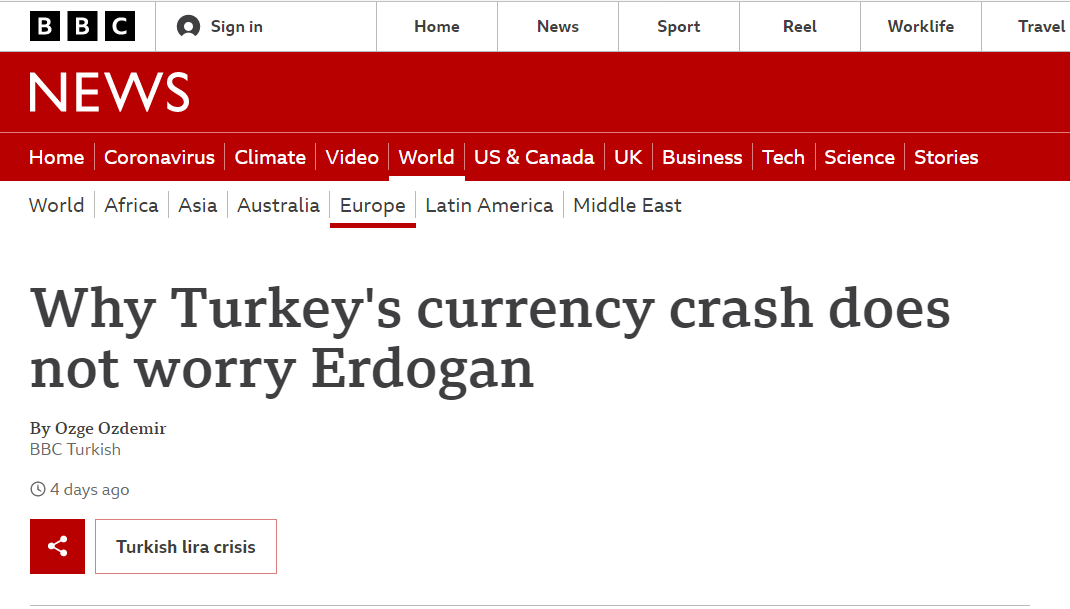
Someone sent me the below BBC article.

I read the article keenly, hoping to find the answer to the question posed in the title of the report, but I couldn’t. It is a very good question: what is Erdoğan really trying to achieve?

Keeping the interest rate low is severely affecting the Turkish currency. The value of the Turkish Lira has almost halved since Jan 2021. It was around 7 Turkish Lira to a dollar, and now it is almost 14 Turkish Lira to a dollar. That is a huge decline in less than a year.

Turkey’s youth compare their living standards with those in other countries and do not like what they see.

“For a young person in the US or Europe, it’s easy to buy an iPhone with their salary,” says one 18-year-old. “Even if I work for months and months, I cannot afford it. I don’t deserve that.”

This generation is poised to play an important role in politics in Turkey, ruled by Mr Erdogan’s Justice and Development Party (AKP) since 2002.

Almost nine million Turks born since the late 1990s will be eligible to vote in the next election in 2023 and that could spell trouble for the AKP.


What reason does Erdogan provide for the low rates? Continue reading Is There a Method to Erdogan’s Madness?

Capsule Review: The Verge, by Patrick Wyman


The verge is a short and very readable account of an early phase in the rise of modern Europe, from 1490 to 1530 or so. Wyman has selected a cast of characters including Columbus, Ferdinand and Isabella, Martin Luther, the banker Jacob Fugger, various printers, Emperor Charles V and Suleyman the magnificent; and he uses their stories to weave a story of how the foundations of modern Europe (and by extension, of modernity itself) were laid by the fortuitous intersection of many small and big changes. The invention of printing, the rise of modern finance, the rise of professional military men, the reformation, all these played a role in creating the modern states of Western Europe; states that soon outclassed all competitors and eventually dominated the entire globe. If there is one factor that gets star billing in this book, it is the financial innovations that allowed Western European monarchies to tap more capital in more innovative ways, but the whole point is that no one magic factor drove the great divergence; many different factors came together to set the stage for it. The book is very well written and Wyman has a eye for interesting anecdotes and factoids that keep the reader engaged and interested. Well worth a read.

If you are interested in learning more, Razib Khan has a good review in the National Review: https://www.nationalreview.com/2021/0… (less)

Capsule Review: The Jewish Brigade

The Jewish Brigade is a graphic novel from Dead Reckoning, a division of the Naval Institute Press. It is the (fictional) story of two soldiers in the Jewish Brigade of the British army, an actual unit that was raised in 1944 and that fought for a few months in Italy before the war ended. After service in occupied Europe for a while, the brigade was disbanded in 1946. Some of its members helped organize assistance for Jewish holocaust survivors in Europe, including arranging travel to Palestine for some of them. Many of these volunteers ended up in the Haganah and the Jewish army that fought the first Arab-Israeli war in 1948. The author has used this historical background to create the 3 stories that make up this graphic novel.

In the first two, our heroes are members of the Jewish Brigade in occupied Europe immediately after the end of the war in May 1945; as they search for their own kin and run into other survivors they witness fresh horrors as Jews who survived the holocaust sometimes face a hostile reception from their old neighbors and remain in danger of being killed by random Nazis, anti-semites and sundry violent thugs who roam war ravaged Europe at this point. Our heroes help some survivors, face new tragedies and even execute (without trial of course) some Nazis in the hellscape that is postwar central Europe. The book does a great job of reminding us that for many people the war did not end in May 1945 and many violent and cruel tragedies took place as the “unfinished business” of mankind’s greatest war slowly wound down.

The book is a work of fiction of course, and it is undoubtedly also a work of propaganda, with strong Zionist undertones. In the third section, set in Palestine, the propaganda becomes even more strident and one-sided (the heroes are Jews, the villains are Arabs and British officials who fail to support the Zionist project) and if that sort of thing turn you off, then this may not be the book for you. On the other hand, if you want to get a good introduction to the chaos that followed the war and the many gruesome and violent tragedies that happened well after the war was officially over, this is not a bad place to start.

The art work and writing are quite good, but the story is not always easy to follow and some characters appear and then disappear without the reader finding out what happened to them. The three pieces are loosely connected, but can be read separately and will still work. Overall, well worth a read, as long as you keep in mind that it IS propaganda, even if it is mostly on the side of the good guys.

(I got this book as a review copy from Dead Reckoning).

David Berlinski Reviews Pankaj Mishra

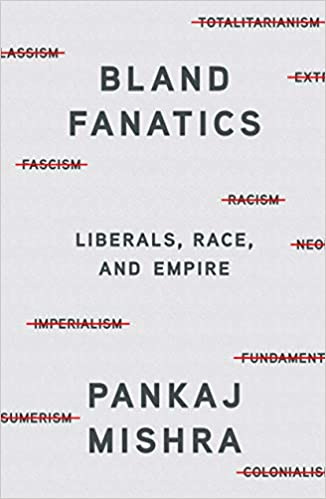
I have been too busy (or wasting too much time on twitter) to write much, but I think we should promote some essays from other sites when they look interesting. Here is one I saw today: David Berlinski reviews Pankaj Mishra’s latest book of essays.   You can read it in full on this link.  

(my own, less erudite and much more rant-like takedown of Mishra and his brand of “tailor made for Western and Westernized Liberals” shtick can be found here) (my own summary of Pankaj in that rant: With Pankaj, the safest bet is that he is “not even wrong”. Good for virtue signaling. Useless for any other purpose.) You can also read a review of sorts I wrote about Pankaj in 2014 that also tries to clarify where I am coming from in this topic)

Bland Fanatics: Liberals, Race, and Empire - Mishra, Pankaj - Livres -  Amazon.fr

A few excerpts: 

PANKAJ MISHRA is an Indian journalist, novelist, and travel writer; he is widely appreciated as a scold.1 Written between 2008 and just the other day, the sixteen essays comprising Bland Fanatics were published variously in The GuardianThe London Review of Books, the New YorkerThe New York Times, and The New York Review of Books.2 Readers seeking ideological exuberance must look elsewhere. The essays are themselves unified by a common rhetorical strategy, if not a common rhetorical subject, in which Mishra reveals that he knows something that others do not. “It had long been clear to me,” he writes, “that Western ideologues during the Cold War absurdly prettified the rise of the ‘democratic’ West.”3

What I didn’t realise until I started to inhabit the knowledge ecosystems of London and New York is how evasions and suppressions had resulted, over time, in a massive store of defective knowledge about the West and the non-West alike. Simple-minded and misleading ideas and assumptions, drawn from this blinkered history, had come to shape the speeches of Western statesmen, think tank reports and newspaper editorials, while supplying fuel to countless log-rolling columnists, television pundits and terrorism experts.4

Living on hot air, logrolling columnists, like certain abstemious yogis, do not generally require fuel, although they may require logs; and a knowledge ecosystem suggests nothing so much as a child’s terrarium: wood, water, weeds, worms. Never mind. Readers will get the point. They could hardly miss it. In hanging around London and New York, Mishra encountered a good many dopes.

No doubt…

… THE ESSAYS IN Bland Fanatics, if intelligent and brisk, are also imperfectly argued and badly written. Realities are brutal, falsehoods blatant, notions reek, prejudices are entrenchedbinaries pop up here and there (eager, I am sure, to escape gender confinement), crime rates skyrocket, adventurers are bumptious, history is blinkered, delusions climax, despotisms are ruthless, and, if breasts are not being bared, chests, at least, are being thumped.6 Mishra is also a writer unwilling to savor the niceties of attribution. The wonderful phrase “closing time in the garden of the West” appears three times in two essays, welcome relief from the clump of Mishra’s habitual clichés. It is due to Cyril Connolly.7 That “every document of civilization is also a document of barbarism” is due, in turn, to Walter Benjamin.8 Mishra has appropriated the phrase and its mistranslation into English.

Continue reading David Berlinski Reviews Pankaj Mishra

Pankaj Mishra and His Discontents

This was an old post i wrote in 2014, still in our archive, but hard to find and not properly formatted, so I am reposting today).

Pankaj has an op-ed in the NY Times. Friend Sardul Minhas prodded me to say something about it, but I was short of time and just gave some general comments about the Pankajist worldview and it’s discontents. These comments are quick and off the cuff, so almost as superficial as Pankaj Bhayia’s op-ed, but they sort of add to my earlier longer rant about his book, and my earlier article about Pankaj and Arundhati Roy. Read them all and you will start to see what I mean (or at least, where I am coming from). Trust me 🙂 

Before I go on, let me say that India hypernationalism is at least as real as Pakistani or American or Chinese hypernationalism and can be almost equally crazy. Like those hypernationalisms, it is mostly held in check by real-life constraints and need not trigger world war three, but world war three is not inconceivable. Shit happens. So I do not mean to imply that all is well and will forever remain well in the Indian subcontinent with the BJP in power (and of course anyone who says all was well before the BJP came to power must be joking). But I do think some of the doom and gloom is overdone and a lot of it is just hyperventilation that provides no good analysis as to why this phenomena has grown, what it may become, and what can be done to moderate or counter it’s possible excesses…in short, i dont think there is nothing to fear, but I do think that the Pankajist worldview is neither an adequate analysis, nor a rational prescription for it’s cure.

Pankaj seems to believe (or knows it is fashionable to believe) that the worship of strength and material progress is a serious mistake and therefore all of recent Western history (with its abundant displays of strength and material/organizational progress, however defined) was a very bad thing. But he also believes the equally fashionable meme that the weak should “stand up for their rights” and fight back and defeat the strong….since I have not seen any evidence to suggest that he has some well-developed theory of Gandhian resistance, how is this circle to be squared? Given belief A, belief B requires the acquisition of strength and at least some material/organizational progress (how else will anyone be able to overcome the amoral West?) but it so happens that the constituency of “strength and material/organizational progress” in India is one that Pankaj cannot afford to be associated with. He has little trouble with non-Indian strength-worshippers like Jamaluddin Afghani (a minor and ineffectual fascist whom he portrayed, historically inaccurately, as one of the great exemplars of Asian resistance to Western domination), but in India his home is in the liberal elite Left, and the “strength and progress” idea, while very much present in the traditional Left, is not one that the postmodern Left is comfortable with…besides, the strength part is now mostlymonopolized by the Hindutvadis, so there are problems with admiring Indian anti-Westernism and strength-worship that do not arise for Pankaj when he is talking about Muslims or Chinese who want to become strong like the West. Incidentally, Japan remains a sore spot of Pankaj; perhaps because of his initial Leftist orientation or because the rise of Japan does not fit his preferred picture of “East tries to Westernize and falls flat on face”, he completely skipped Japan when discussing his version of the rise of Asia from the ruins of Empire. Anyway, given these ideological limitations, what is to be done? His options include:

  1. Westernization has been and forever will be a disaster for non-Western nations. The apparent weakness of “Eastern” nations is actually strength; a sign of moral superiority, closer to nature, deeply rooted, psychologically sound, more humane etc etc. Gandhi had some such beliefs. Of course Gandhi also believed that if we stick to our (moral) strengths, we can “defeat” the apparently stronger West. But this defeat will not look like the usual victory and defeat looks in war. Valid or not, this would be a relatively consistent (and very attractive) set of beliefs. But many elements of this system are anathema for the Left (like Gandhi’s embrace of the people’s ancient religon and religious myths, his lack of interest in physical strength, and his un-Marxist view of history), so Pankaj cannot comfortably take a Gandhian position against the West (though he can say patronizing nice things about it).
  2. Westernization has been and forever will be a disaster for non-Western nations. They must find their own unique way forward. They have unique cultures and cultural strengths and these are embedded in their language, their culture, their myths, their religions… and they must build from these, etc. But this is what a lot of the Hindu right is saying, so it certainly cannot be Pankaj’s choice either.
  3. Or Pankaj can drop the whole Eurocentric post-Marxist framework and start from scratch. He might then find that “Westernization” is not so exclusively Western. A lot of it is just progress in human knowledge (always incomplete and prone to errors) and any individual or group can acquire and make use of past discoveries in human knowledge, whether they happen to have been made in Europe or Central Asia or Japan, and build on those…. that maybe the flaws we see in the West are not that foreign either, but are human characteristics, and their larger organized expressions (armies, conquests, wars, colonization, cultural and literal genocides, megalomaniacs, liars) are not really some unique and novel Western invention…. If strength and scientific progress are diseases, then we are all prone to falling victim to their allure….and so on. But that would be such a departure from the postcolonialist postmodern post-marxist universe in which Pankaj operates, its not really a choice either. What if his audience no longer buys his op-eds?

It’s a tough place to be in.  Hence the confusion.
btw, he started with Naipaul, betting that his audience would have little or no clue about Naipaul’s actual views about Indian history and the rise of the BJP. I think this move shows Pankaj is not dumb and he sometimes takes risks. Those are worthy qualities 😉
Or it may mean that Naipaul’s earlier expression of admiration for Pankaj (as a literary critic) has created a soft spot. Human nature being what it is…

I initially posted these thoughts as a facebook comment and asked some questions on 3quarksdaily (where Pankaj’s article was up on the blog). One of the responses (from someone named Sundar) was as follows:
I doubt if I fit the profile of Pankaj’s intended readership, but here goes:
I think the Indian left (and Pankaj in particular) has become irrelevant. The Left parties have been decimated even in their citadel of West Bengal, where they had unleashed a reign of terror for 25 years. (If you think that is an exaggeration, you should learn more about life in Rural West Bengal). It is another matter that the TMC is continuing their tactics.
Intellectually, the left has been in shock since their utopias of Russia and China have moved on. Hence their desperate attempt to use any issue they can get their hands on: Environment, Caste etc. Their last gasp was their infiltration of the centrist Congress party via Sonia Gandhi’s unconstitutional NAC.
They are terrified that Modi has put together a workable coalition of various caste groups which aims to control parliament for the foreseeable future. They don’t know how to deal with Modi: he comes from the very groups that they claim to represent. But he represents a new kind of India, one which does not want handouts from elite controlled parties.
Whether Modi’s electoral coalition will hold in the next Lok Sabha elections, I don’t know. But if it does, the India left’s worst nightmare will come to pass: A world where they are simply irrelevant. A Bourgeois India that hasn’t heard of Pankaj Mishra and his ilk. And doesn’t care.

My answer had some more questions, which I will post here in the hope that someone will attempt some answers:
I think you are right, though out of loyalty to my youthful ideals and deference to my friends /peer group I would assign a less positive valence to this decline and fall… Anyway, follow up questions : since higher education and public intellectuals in India share (consciously and unconsciously) many of the historic assumptions, ideals, paradigms etc of the Left, what does the  future hold in that area? Will they modify their beliefs and carry on? Will there be a circling of the wagons and a vicious fight with the newly powerful right, followed by an auto da fe? Will the crazier Hindutva historians replace our familiar Marxist intellectuals as most of my friends seem to fear? And will all this play any role in “real life”? 
Inquiring minds want to know 🙂

Finally, a word from my better half (who has higher IQ and EQ): I must not just criticize Mishra. I must also say what he would be good at; so here goes: I think he would be an excellent literary critic if he could just give up his urge to push his (fashionable, but ultimately irrelevant) political agenda in every thing he writes. I know, “the personal is political” and all that, but comrade, that too may just be fashionable claptrap. Take a deep breath. Let go…

PS: Given the current political conflicts within India (with which I have only an outsider’s connection), it is inevitable that an attack on Pankaj will get positive responses from his supposed ideological opponents in the BJP (I say “supposed” because Pankaj actually shares their emotional antipathy towards the West and has some sympathy for their counterparts in other Asian countries, just not in India itself). Just to keep things clear, I am mostly Left-of-Center in my politics and extremely left of center on most social issues (though somewhat right of center on state intervention in social issues, whatever). I do hope a left-of-center alternative survives and thrives in Indian politics, not just because my own inclinations (mostly) lie that way but because the total dominance of any one ideology is always a problem. Best to have some balance and some competition. Finally, I do realize that all who identify as leftists are not as Eurocentric/Europhobic and confused as Pankaj. 
Oh, and about the Hindutvadis, I think there are some obvious problem areas in their quest to become the leaders of resurgent and powerful India: I am saying nothing original if I say that the “Muslim question” is one of them. In my case, the concern is not that they will try to “Indianize” Islam well beyond what current Indian Muslim leaders would consider desirable… I think that is the eventual fate of Indian Islam and I see no great reason to abhor that possibility. My concern is that they will mess up the “soft landing” that is the “desirable option” in this process. i.e. I think a soft landing is possible (and desirable) but the way the BJP has evolved, they may not be the best people to achieve it. More on that some other day, but I do want to add that to me this is not a specifically “Muslim” concern. It is an Indian concern. In numbers, in solidarity, in civilizational consciousness, in cultural contribution, etc Indian Muslims are not an insignificant component of India. A “hard landing” would hurt everyone and the outcome is by no means guaranteed to be in the Hindutvadi’s favor. Softer approaches would work better for everyone, not just for the Muslims. Fascist tendencies and mob action are other obvious problems but are by no means a BJP monopoly (see West Bengal for details) but a BJP-specific (much less serious) area of concern is the large mass of pseudoscientific nonsense that has accreted around the crazier edges of the Hindutva brand. While I think the actual “real world” significance of that mass of craziness is sometimes exaggerated by liberal/Westernized/agnostic/atheist observers, it is not necessary trivial.  I quote Prime Minister sahib: “We worship Lord Ganesh. There must have been some plastic surgeon at that time who got an elephant’s head on the body of a human being and began the practice of plastic surgery – See more at: http://indianexpress.com/article/india/india-others/pm-takes-leaf-from-batra-book-mahabharat-genetics-lord-ganesha-surgery/99/#sthash.mRlrMYpm.dpuf “
I really dont think modern Indian medicine will be easily derailed by such flights of fancy, but ….There. That should do it 🙂

Post-post script: Friend Shivam Vij posted Guardian’s piece about Modi making his Hindutva pseudosciency remarks and I told him its funny, but may not necessarily be too consequential. Many friends seemed to find that surprising. Why not consequential? he is saying an elephant head was transplanted on a human, literally. That’s crazy. Well, yes, it is, but if we go by that, we would lose our shit everytime some leader says he believes in the talking snake or the flying horse or whatever. The silliness is not the problem. Or at least, its not NECESSARILY a big problem. The same people who believe in flying horses and talking snakes are very rational and clever in matters closer to our own lives. So the problem is not necessarily the silliness of the belief. Its the fact that PM sahib chose to express it on such an occasion and in such a context, indicating a certain mixing of knowledge streams best left unmixed…and the implication that such hindutvadi pseudoscience may then be forced on people in real life settings, maybe even in Medical schools and in the All India Institute of Medical Sciences. Now in a democracy that is certainly a possibility and a scary one. But a reasonably competent elite can erect filters and keep the ship on near-even keel even in a democracy.
Is the Indian elite competent enough.
I guess we will find out. 

Browncast: Ambassador Kamran Shafi on Benazir, Nawaz Sharif, Military Rule, etc

Another BP Podcast is up. You can listen on LibsynAppleSpotify, and Stitcher (and a variety of other platforms). Probably the easiest way to keep up the podcast since we don’t have a regular schedule is to subscribe to one of the links above!

In this episode I (Omar) talk to Major Kamran Shafi, who served in the army, then became a columnist, served as Benazir Bhutto’s press secretary and after another long stint as a columnist, served as ambassdor to Havana, Cuba. He looks back at these years and what may lie ahead.

Pos tscript: Ambassador Shafi sent in a short voice message to add to the above. It is an episode in Benazir’s first term when she was being constantly harassed by the “establishment” and Kamran Shafi advised her to resign and go to Larkana..

Kamran Shafi: Outsiders Can Help by Dealing with the Elected Government - YouTube

Major Amin; a few words on Pakistan, Afghanistan and China

Another BP Podcast is up. You can listen on LibsynAppleSpotify, and Stitcher (and a variety of other platforms). Probably the easiest way to keep up the podcast since we don’t have a regular schedule is to subscribe to one of the links above!

Last time we interviewed Major Amin just after the fiasco of the American withdrawal from Afghanistan. That was a relatively substantive interviey w (you can listen to it at this link: Major Amin on the age of strategic anarchy) and proved extremely popular, so there was a lot of demand to invite Major Amin back for an update. I caught up with the Major in a less than sober mood initially (some of you may have heard that recording) when he expressed his disappointment with how badly things are going in his homeland in somewhat colorful language, but at his request we have now redone this interview (the exact same questions) in a more sober tone. Enjoy.

Book Review: Rivals by Dr Saad Shafqat

Rivals: Saad Shafqat: Bloomsbury India

A review I wrote for India Today a few months ago.

Rivals is the third book and second novel from the pen of Dr Saad Shafqat, professor of neurology at the Agha Khan Hospital and Medical School in Karachi. He started writing with pieces about cricket and is the proud author of Javed Miandad’s autobiography (“cutting edge”) as well as a previous medical thriller (“breath of death”). This book is set in the same “Avicenna University Hospital” (a thinly disguised version of the author’s actual place of work) as his first novel, but the main protagonist in this one is not terrorists or terrorist hunters but doctors competing for a prestigious department chairmanship.
The book opens with Dr Tanya Shah at her morning constitutional and the author is clearly familiar with the world of Karachi’s rich and famous. As she puts on her Maria B lawn suit and grabs her Luis Vuitton bucket bag and heads out to work, every detail is lovingly described; Unfortunately, another character is also at his morning constitutional at exactly the same time, shaving his pubes and underarms so that he can be in a state of ritual purity when he meets his 72 virgins. Yes, there is a suicide bombing in chapter 2, but while it will play a bit of a role in the drama that unfolds later, this is not really a book about Islamist terrorists or their victims. It is a book about Dr Tanya Shah and her colleague Dr Hammad Khan, professor of ophthalmology and her rival in the race to become Avicenna’s next chief of surgery. Dr Hammad plots sexual escapades with medical reps and underhand maneuvers to undermine Dr Shah’s candidacy with his hangers on while sipping cocktails at an elite club, while a “white tiger” type ambulance driver and a bomb victim’s poor mother add some working-class spice to the mix. There is also a lot of medical excitement (operating room, trauma surgery, that sort of thing) that is well written and interesting.

The book is generally well written and is a fun and easy read, but the characters are not fully developed and promising detours frequently fade out without getting anywhere genuinely exciting. Still, it is set in Karachi and anyone with any connection to the medical world will find many familiar sights and sounds and depictions to keep him interested. And while there is a suicide bombing and some run ins with poor people, the book cannot be accused of relying on either poverty porn or Jihad-mongering for cheap thrills. Instead, Dr Shafqat stays mostly with the world he knows well and avoids any temptation to crudely take notice of how westernized and “un-Islamic” it is. These doctors are worrying about publications, presentations, trainees, committee meetings, departmental politics and sexual scandals and their stories hold no grand political lessons and attempt to correct no terrible historical crimes. That at least is refreshing. Overall, a fun read, but one is left with the feeling that it could have been better.


Brown Pundits