Saffron on the outside, woke on the inside


Every few weeks or so I “get into it” with parts of Hindutva Twitter. Some parts of Hindutva Twitter I’m quite friendly with. Other parts, not so much. There is the weird incel-like “Trad Twitter” faction…that always ends up to be strange perverts. But I don’t want to focus on them.

Rather, I want to highlight what I feel is descriptively a fact that though Hindutva and “Woke” factions are opposed in a theoretical sense, the former draws on the style of “thinking” of the latter quite a bit. E.g., the emphasis on many Hindutva sectors on feeling, the lack of humor, and, identitarianism.
The identitarianism is straightforward. Despite the fact that I’m an atheist they regularly accuse me of being a Muslim. In some cases, this is an honest false positive. Look at my name! In other cases, they assume since I’m making fun of them, I must be a secret sulla with Muhammad or whoever. I’m against them, so I’m for their enemies, or with their enemies. Sometimes they revert to forms of racism (e.g., they are upper-caste Punjabis, so genetically superior, despite being J1 Dasyus!). The ultimate takeaway is the fixation on the group and historical identity, rather than updating to individual identity. 

Remember when Ayanna Pressley said someone had to be “politically black” to be black? A sort of primitive identitarianism has taken root amongst Woke people where individual views are derived from group identity, and individual views can negate one’s group identity because the two are so closely tied.

Second, the lack of humor. On my Twitter posts, I engage in a lot of prodding and poking at Hindu shibboleths as well as synthesizing it with absurd genetic points. The whole performance is ludicrous…but some portions of Hindutva Twitter find it problematic. OK, they wouldn’t say “problematic,” but it’s the same reaction. Woke ideology is a form of secular sacredness. Similarly, Hindutva Twitter has sacred cows which I gore now and then. Sometimes people react back playfully…but other times, they don’t get the joke, and when others point out that it’s a joke, they refuse to believe it’s a joke and move to identitarianism. That is, the joke is fake, and I’m actually a Muslim.

A truncated and shriveled sense of humor is common on the modern Woke Left (google Social Justice Comedy; it’s like Communist opera). It is also a feature of very religious Muslims and Christians. A portion of Hindutva Twitter suffers from this.

The last to me is the most important, the emphasis on feeling. This is a personal bias, as I’m a bit “dead on the inside,” so have always been weak on the feels. I hurt the feelings of these people, making fun of them, mocking them, and making light of their culture. I’m a bit of an online barbarian, like the scorpion, I’m going to sting. A portion of Hindutva Twitter can’t understand that my behavior isn’t due to the fact that I hate Hindus, but because I’m an unfeeling asshole. I’m R1a1a-Z93 and U2b. Those who know what this means know that I was born to be a lord over you Dasyus!

There are more than 1 billion Hindus in the world. India is 80% Hindu. This emphasis on feeling, on hurt pride, is classic “wounded civilization” stuff. Hindutva cannot realize whatever its ambitions are until it looks forward, positively, and without concern for feeling, into the future. Woke ideology is deeply regressive, despite its adherence to the label of progressive. Its fixation on “white supremacy” and “colonialism” looks backward, not forward.

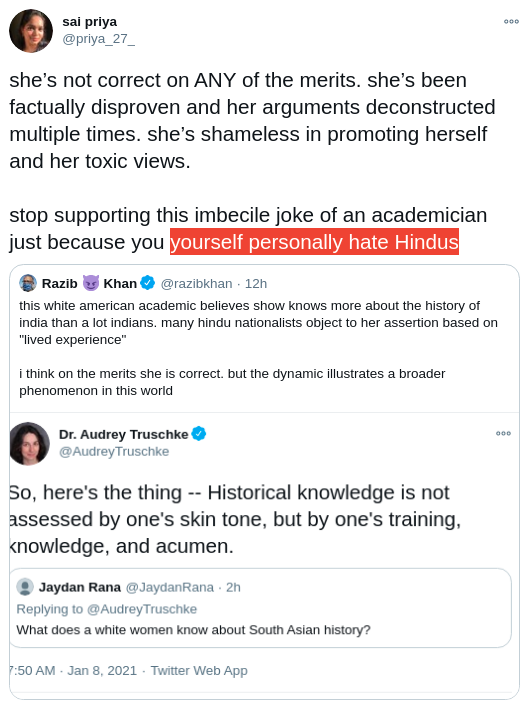
All this goes back to Audrey Truschke. My point is that Truschke point in the generality is correct. Indians should object to her scholarship, not to her person. Truschke herself is a hypocrite about this, getting into ideological food fights, and bringing her gender into the discussion. But Hindu nationalists who engage in “Woke Olympics” can only win by hamstringing their own attempts to fashion a positive identity. Woke Olympics is the to maximal oppression and lack of self-respect and dignity.

To end the Kali Yuga you can’t use the tools of the Kali Yuga.
Open Thread – 01/02/2021 – Brown Pundits

Here is hoping for a better 2021!

Lots of questions about this tweet. I like Niraj Rai and Gyaneshwer Chaubey personally. But, I’m pretty skeptical of how people are interpreting this. My own views are pretty straightforward, and outlined in my post the “Aryan Integration Theory”.

I believe that about 14% of the total ancestry in South Asia derives from the Central Asian steppe ~3,500 years ago. These people derive from a “reflux” migration from Central Europe of a Corded Ware related people (“Battle Axe Culture”).* The fraction is higher in Pakistan, 20-30%. Much lower in southern India, ~5% or so (excepting Brahmins). Whenever this is a “massive migration” is up to you to interpret.

I do think they brought R1a and lots of aspects of Indian culture, such as Indo-European language. On the other hand, most of the ancestry and a lot of the culture was “indigenous.” The Indic culture we see in the Iron Age is clearly a synthesis, which was present even in the Vedic corpus.

Also, in the annals of self-promotion, I had some free posts on my Substack before Christmas:

The Age of Genetic Engineering Begins

The Original Chinese Man

Applying IQ to IQ

Your Roots are Showing

In Gods We Trusted

* Something I point out to people is that this assumes that the steppe people arrived from Khorasan unmixed. If the Indo-Aryans who arrived in the Punjabs already mixed with Iranian peoples in their sojourn then the fraction is an underestimate, though I doubt it is 2-fold.

The massive Indian migration to Southeast Asian


Over at my other weblog I put up a post, Indian Ancestry In Southeast Asia Is Older Than Statistical Genetic Tests Suggest. If you look at two populations in Southeast Asia and find one has Indian ancestry you often can’t find the admixture older than 1000 A.D. (in peninsular Malaysia there is more recent intermarriage between Muslim Indians and Malays too). This seems far too recent. My explanation is simple: these dates reflect the assimilation of a hybrid Indian-Southeast Asian population across much of Southeast Asia. I have done the analyses myself, and in Cambodia, I get dates around 1000 A.D. Cambodia is not close to India and there isn’t evidence of a large Diaspora in recorded history. But, we know that Hinduism was a major influence in the region, and the Vietnamese Cham are still predominantly Hindu.

The kingdom of Funan, known mostly from Chinese accounts, flourished in Cambodia for the first five centuries of the common era or so. There is an inscription in Sanskrit from the region dated to the 5th century A.D. that refers to the moon of the Kauṇḍinya line (… kauṇḍi[n]ya[vaṅ]śaśaśinā …) and chief “of a realm wrested from the mud”. The text is in the Grantha script.

Further west, Dvaravati also had a strong Indic influence, no later than the 5th century A.D.

The genetic results indicate on the order of 10-20% of the ancestry of people in central Thailand is broadly Indian. This is not a trivial fraction. Who were these people? How early did they come?

On a minor editorial note, I’ll observe there is lots of discussion about possible Indian gene flow to the north and west (into Iran and Turan), but the data on Southeast Asia is clear and of greater magnitude. But there is far less discussion and exploration of this.

BP Unlurk Thread

In the post where I allude to “10 years of BP” someone mentioned old comments pre-2014 (I do have those posts in tables I need to load up). That suggests to me that some few of the readers here date to the beginning and transitioned to the blogspot site and back again.

So here is an unlurk thread where you can tell us who you are. Are you Indian? Are you a techie? What is your caste/jati? The usual.

Open Thread – 12/26/2020 – Brown Pundits

Brown Pundit emeritus Zach pointed out on Twitter that BP launched at the end of 2010. A lot has changed. At BP and the world.
There is actually MySQL table data with archives back to 2010. I should resurrect those at some point.

A lot has changed in the last 10 years. The biggest thing is the size of the brown faction on the internet is now huge. About as many Indians read this website as Americans.

Sign-up for my Substack!

The price-point for paid subscription to my new newsletter is too high for most Indians (well, Americans perhaps?). So I am not asking for paid sign-ups as much as encouraging people to do a free sign-up. The reason is two-fold.

First, I’m going to put out a reasonable amount of free content. You can see that this week where I put out 5 posts.

Second, I want more sign-ups from India, because one of the areas I plan on covering in my Substack into the 2020’s is the America-India relationship and India’s future prospects. I’m personally interested, and honestly, I think there are some business opportunities I want to explore. So I would appreciate sign-ups as I want to build up that relationship.

(if you don’t know what Substack is, here’s an article)

Indian Americans are exceptional; no shit sherlock

The Atlantic has a piece up, The Truth Behind Indian American Exceptionalism Many of us are unaware of the special circumstances that eased our entry into American life—and of the bonds, we share with other nonwhite groups. I’m really curious what The Atlantic paid for this piece because it’s a husk of prose that just mixes and matches cliches and random facts into the sausage casing of a social justice narrative.

The author is “Senior reporter with WNYC’s Race & Justice Unit,” which suggests to me they aren’t very smart because obsessive fixation with “social justice” indicates you are stupid. Also, they state that “I don’t recall hearing the name Dalip Singh Saund until I was in my 30s.” If you don’t know that name, and you are Indian American, you are probably not very smart or intellectually curious. I knew Singh’s name when I was sixteen as I was interested in political history.

Open Thread – 12/19/2020 – Brown Pundits

We’re going to have Glenn Loury on on this Sunday’s Browncast. It was a fun conversation. Already up for patrons, and I also cross-posted to my Substack, because I think it’s such an interesting conversation.

Loury is one of the most important public intellectuals alive today. He speaks for many, many, people. Many people in science who are not on the far Left follow his work closely because he knocks down the shibboleths of preference falsification. If you can, I recommend anyone to be a patron of the Glenn Show.

On caste and a new Hinduism

Some of my Hindu American friends online engage in a defense of attacks on Hinduism by denying the necessary connection between caste and Hinduism. Since religion is made by men, this is true on the face of it. There is nothing necessary in any religion.

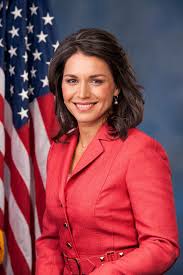
But, Hinduism is a religion strongly associated with the Indian subcontinent. Far more than Islam is necessarily associated with Arabia! (the greatest doctors of Islam were not Arabs, but more often Persians!) And caste is strongly associated with the Indian subcontinent. This is not a transitive relation, but the affinity is clear. It has hard to think about Hinduism without caste and jati, though it is possible (e.g., Tulsi Gabbard is a devout Hindu, but not Indian, while some Muslim Indians have their own forms of endogamous caste, despite not being Hindu).

Untouchable

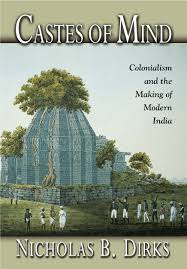
Is this just a historical coincidence? Like many, I have read Nicholas Dirks’ Castes of Mind. Though Dirks acknowledges the ancient origins of varna and jatis, he puts great emphasis on the rationalization of the system under the British. Additionally, he points out the rise and fall of jats. The Indian landscape is communally fluid in its hierarchy.

This is plausible. But I do not believe it is true on a deep and fundamental level. I have come to this conclusion because genetics is so striking.

  1. Though the correlation is not perfect, within regions there is a strong association between “steppe” ancestry and caste status (more steppe means higher status)
  2. Dalits in the South have almost no steppe. The non-Dalit but non-Brahmins have some. In the north, Dalits in Uttar Pradesh have the least steppe, and in some ways are genetically closer to Dalits in Tamil Nadu than non-Dalits in Uttar Pradesh.
  3. There are clear indications of 1,500 of endogamy in a village in Andhra Pradesh (elsewhere too).

When I first stumbled onto these facts they were shocking and bizarre. Totally unexpected. I assumed some caste stratification, but this was ridiculous.

These are the reasons that though I believe the new modern Hindus do sincerely abhor caste and jati, it is sometimes hard to take their protestations that the connection between caste and Hinduism is incidental. You are {{{Brahmin}}}, the product of several thousands of years of endogamy written all over your genes, the scion of the priestly caste of Hinduism, protest that caste and jati have nothing to do with the religion! Except that the priestly castes seem to be amongst the most punctilious adherents to endogamy of all!

So what’s the future? As an atheist of Muslim familial background I have some advice: make Hinduism less Indian, because that is the fundamental issue. Hinduism evolved organically within the Indian subcontinent with jati and varna, and like intertwined siblings growing up in the same house, there are some shared characteristics. Grow up. Leave the house. Be your own person.

Brown Pundits