Amy Wax on “Asians”

Amy Wax Redux – Another round in the immigration and culture debate. Glenn Loury hosts a debate that has gotten some attention because Amy Wax said something in relation to “Asians.” Her interlocutor is an East Asian American, and Wax’s original comments were particularly targeted at Indian women. So this has spun a bit out of control.

I’ll say some quick things.

In Amy’s favor:

– Many people have noticed the overrepresentation of “market-dominant minorities” in particular activist groups, and the visible presence of South Asian (Indian, Bangladeshi and Pakistani) women is hard not to notice. Joe Biden’s statement that “Indians taking over” reflect Indian American power in Democratic politics in particular.

– Nations have a right to determine what they want to be. At least in theory. This is most explicit in Israel, founded as a homeland for the Jews. Hindu nationalists want India as a homeland for Hindus. While many Muslims view Muslim-majority nations as societies organized around Islam, and so they believe law and tradition should favor that religion. In the USA this was clear as well, with a 1790 law that allowed only for the naturalization of whites, later expanded to blacks and eventually other non-white races. The National Origins Act of 1924 aimed to keep the US a mostly Northwest European nation. And so forth.

The idea that America, or any nation, exists simply as an institutional transaction device between consenting adults and organizations that are bounded by particular borders is not realistic, though sometimes open and open borders adjacent people talk like that. American is a nation. A people. It will change. But how?

– Americans are going to be uncomfortable when “visible minorities” take all leadership roles due to their educational success. That’s a fact. I think people should get over it though. But that’s my opinion. Most people care a lot more about race and visible phenotype than I do from what I can tell.

– Immigrants bring their culture. Their culture impacts our culture. Sometimes good, sometimes bad. We can make decisions.

Against Amy:

– She talks about it like a Boomer who doesn’t really understand the landscape. She was born in the early 1950s in a black and white America, so when talking about Asians and Latinx she’s encountering new things to her experience.

– She elides in a sloppy way different groups of Asians. Indian Americans are politically very different than Vietnamese Americans. They are socially very different. Arguably Amy should want more Vietnamese Americans, who lean Republican and are educationally more similar to the average American. 30-40% of Vietnamese are also Catholic. Who are these “Asians” she speaks of? Not people she knows personally from what I can tell (I’ve met Amy, she’s charming and blunt at the same time), so she should read more stats.

– She elides the distinctions even among “Indians.” Most of the obnoxious woke Indians are 1.5 and 2nd generation people born and raised in the US. And yet 90% of Indian Americans are foreign-born immigrants, more than 50% arriving after 2000. Perhaps these new immigrants will also have woke children, or perhaps they won’t.

– Amy’s generalizations of Asian, and Indian, cultures is weird, and not too scholarly. If she’s going to offend (I know about this), you need to know your shit.
On the Hindu contradiction of intents

A few days ago some Indian politician was making the case for ghar wapsi (conversion of non-Hindus of Hindu ancestral background to Hinduism). Of course, he had to withdraw the comments due to an uproar. Myself, I’m American, and people convert from religion to religion all the time. It’s a bit tasteless for a public official to engage in this, but it happens.

India’s a different country, so I understand that this official had to be prudent.

That being said, these calls to bring non-Hindus back into the fold are in my opinion kind of a joke. Yes, if someone is born a Hindu, or if someone’s family converted a generation ago, perhaps ghar wapsi is feasible. One can slip back into the social network that one was born into, or that is accessible in cultural memory. But outside of particular sects, like Hari Krishna, Hinduism is too “community-oriented” a religion to accept large numbers of converts. Perhaps if a whole community converts back all at once, that’s possible then, but there won’t be the low-level social-network-based conversions that drive a lot of the constant defection or adoption (e.g., it is well known among Mormons that most converts come through friendship networks between Mormons and non-Mormons, as well as marriages between Mormons and non-Mormons, not door to door conversion).

Calls for ghar wapsi are just rhetorical. If large numbers of Indian Muslims began to convert to Hinduism would they be accepted with open arms? I doubt it. The social system is just not set up for that (again, outside of sectarians like Hare Krishna).

Consider the fact that on social media Hindu nationalists (some) routinely refer to me as a Muslim. I am not someone to patrol what terms people use to refer to me as (you can use any pronoun, I don’t care), but it seems weird to call me a Muslim when I’m an atheist that has drawn and posted a photo of a drawing of Muhammad getting sodomized by a camel (on this weblog), something most Hindu nationalists would never do out of religiosity or cowardice. But it’s not about my identity (I don’t socialize with any Muslims nor do my children even know anything about the religion, so I’m not one of those “atheist Muslims”), it’s about the fact that many Hindus reflexively view religion as ascriptive. Something like race, an identity that you’re born with.

With that in mind, Hindus should work on their birthrate. Most Indian Muslims that convert to Hinduism will have Muslims who hate him, and Hindus who will still think of them as Muslim.

Note: Obviously, my generalizations apply to a particularly low IQ set. I actually know Hindu nationalists or fellow travelers in that movement who don’t have this sort of collective/ethnic mentality. But it’s a minority position from what I can tell.

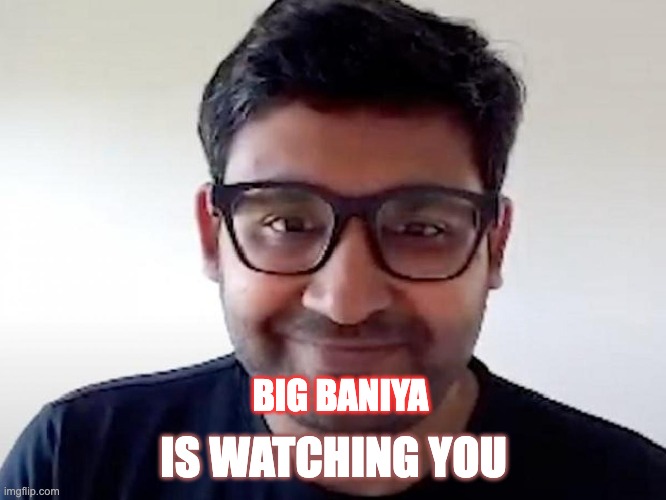
I for one welcome our new Brown overlords!


Amy Wax is on Glenn Loury’s show going off on Asian immigrants, and to a great extent, Indian American women who play the whole woke game.

First, I myself have written about the representation of Indians/browns among woke activist types. Amy is reflecting a descriptive reality; don’t deny it, it’s true. Though this is especially prevalent among the 1.5 and 2nd generation, there are some immigrants getting in on the game too (though proportionately far less).

Second, I know Amy a bit personally. We’ve met and hung out in real life at a conference. She’s clearly familiar with my work.

Third, to be candid, Amy is a Boomer, and her comments, observations, and sensibilities reflect her generation. If you listen to her earlier conversations she operates in a world of racial black-white dichotomies, which is the world she came up in. She’s trying to integrate other groups, but these are not people she necessarily grew up with, and she’s trying to understand them.

Fourth, don’t doubt her intelligence. She graduated summa in biological sciences and has an M.D. and a J.D.

Finally, to be honest, I find a lot of her structural analysis here kind of lacking, and I think Glenn made some good points. Some of her talking points, like the idea that Indians are conformist and subservient to power, are pretty widely disseminated on the dissident right, but let’s just say a lot of these observations don’t come from a place of detached analysis, as opposed to emotive reaction and fear. Unfortunately, I think Glenn’s suggestion that Indian Americans are just assimilating, very well, to professional-managerial-class norms, is spot on.

All of that being said, no matter what you think of Amy’s analysis between observation and conclusion, I think her endcaps are probably correct. As I noted above, the description rings true. There are these brown cadres everywhere, with fancy degrees and upper-middle-class upbringings, decrying America as a white supremacist terror regime. It’s embarrassing, offensive, and cringe. And, I also don’t think America as a whole will tolerate rule by a brown-faced elite with exotic names and mostly non-Christian religion. Yes, I can see an Indian American President. Until recently, the Supreme Court had three Jewish Justices (with RBG gone and ACB replacing her it’s Jewish to Catholic now). Imagine if there were three Indian Americans. Not sure the populace would be happy seeing those faces all the time and knowing how different they were than the rest of America.

A new way to say generic “Brown People”

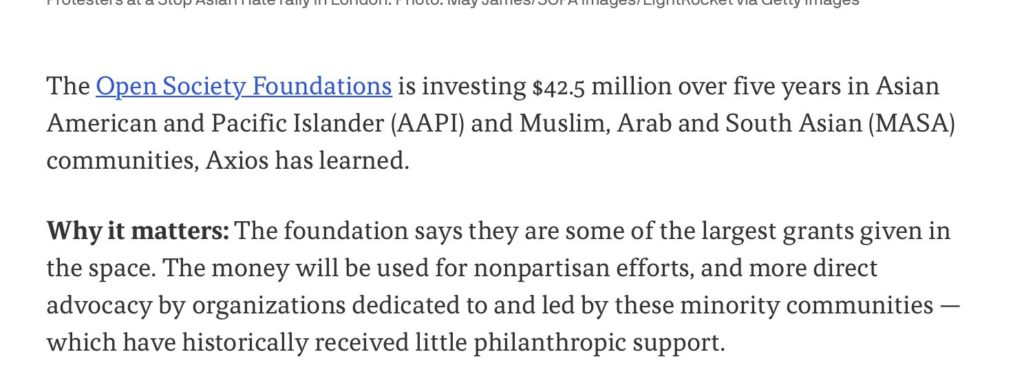
They call it “MASA,” for “Muslim, Arab and South Asian.”

So this is a category that includes Norwegian converts to Islam, Assyrian Christians, and Bhutanese Buddhists.

Also, “South Asians” are now part of two overlapping acronym communities, as we’re already “AAPI.”

Caste in America

UC Davis quietly added caste to its anti-discrimination policy. Will it cause others to do the same?

Yes, it will. American liberals will now start talking incessantly about caste. Some notes

– <1% of Indian Americans are Dalits from surveys I have seen

– 30-40% of 1.5 and 2nd gen. Indian Americans out marry racially. Most do not, in my experience, in-marry in terms of jati when they marry other Indian Americans

– 25% of Indian Americans are Brahmin, but they are not wealthier or more educated than other groups on the whole. The richest Indian Americans seem to have names like Agrawal from what I have seen in private data

South Asian ancestry in Tajikistan

Genetic continuity of Indo-Iranian speakers since the Iron Age in southern Central Asia:

To model Tajiks, all 2-ways admixture models were excluded and we obtained one 3-ways admixture model (p-value = 0.49) implying around 17% ancestry from XiongNu, almost 75% ancestry from Turkmenistan_IA, and around 8% ancestry from a South Asian individual (Indian_GreatAndaman_100BP) representing a deep ancestry in South Asia.

Finally, we used DATES18 206 to estimate the number of generations since the admixture events. We  obtained 35±15 generations for the admixture between Turkmenistan_IA and XiongNu-like populations at the origins of the Yaghnobis, i.e. an admixture event dating back to ~1019±447 years ago considering 29 years per generation. For Tajiks (TJE, TJY, TJA) we obtained dates from ~ 546 ±138 years ago (18.8± 4.7 generations) to ~ 907 ± 617 years ago (31.2 ± 21.3 generations) for the West/East admixture. We also obtained a date of ~944 ±300 years ago for the admixture with the South Asian population.

Looks like most of the admixture from the Indian subcontinent dates to the period around 1000 AD, when the Ghaznavids were enslaving large numbers of Indians. This ancestry shows up in Afghanistan and eastern Iran.

The Sintashta horses!

The origins and spread of domestic horses from the Western Eurasian steppes:

Domestication of horses fundamentally transformed long-range mobility and warfare1. However, modern domesticated breeds do not descend from the earliest domestic horse lineage associated with archaeological evidence of bridling, milking and corralling…at Botai, Central Asia around 3500 BC3. Other longstanding candidate regions for horse domestication, such as Iberia5 and Anatolia6, have also recently been challenged. Thus, the genetic, geographic and temporal origins of modern domestic horses have remained unknown. Here we pinpoint the Western Eurasian steppes, especially the lower Volga-Don region, as the homeland of modern domestic horses. Furthermore, we map the population changes accompanying domestication from 273 ancient horse genomes. This reveals that modern domestic horses ultimately replaced almost all other local populations as they expanded rapidly across Eurasia from about 2000 BC, synchronously with equestrian material culture, including Sintashta spoke-wheeled chariots. We find that equestrianism involved strong selection for critical locomotor and behavioural adaptations at the GSDMC and ZFPM1 genes. Our results reject the commonly held association7 between horseback riding and the massive expansion of Yamnaya steppe pastoralists into Europe around 3000 BC driving the spread of Indo-European languages. This contrasts with the scenario in Asia where Indo-Iranian languages, chariots and horses spread together, following the early second millennium BC Sintashta culture.

The paper is open access. Basically the Sintashta seem to have triggered the equine revolution across Eurasia.

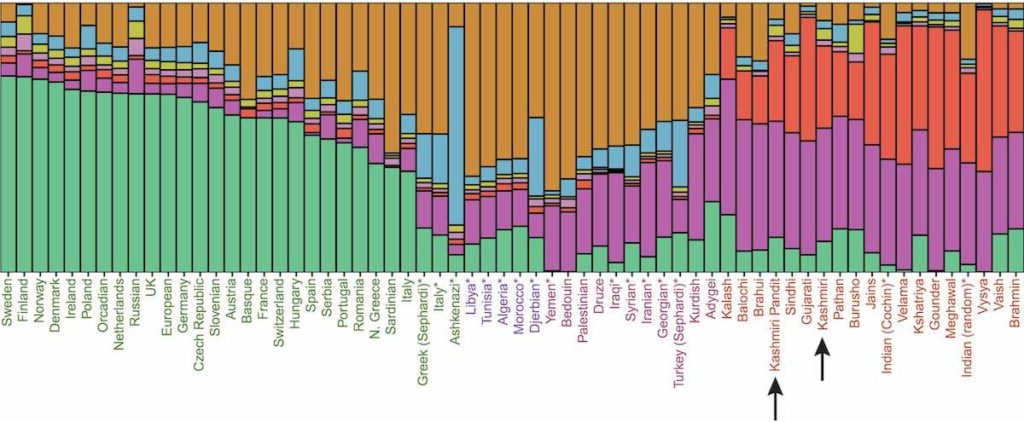
Kashmiris are just generic North Indians, and there is no difference between Pandits and Muslim Kashmiris


Since people ask me this I have to post this now and then. We have genetic data. So in short order

1) Kashmiris are like other people in the Northwest of India. They are not enriched in steppe ancestry, at least compared to many Punjabis or Brahmins from the Gangetic plain

2) There is no genetic difference I can see between Pandits and Kashmiri Muslims, indicating to me that one distinctive aspect of the Vale of Kashmir in comparison to the rest of the Indian subcontinent is that it does not exhibit the jati-varna structure common across the subcontinent

3) Some researchers and genetic genealogists have found some Tibetan admixture at low levels among Kashmiri Muslims and Pandits

4) It is probably correct that elite Muslims have low levels of Central Asian and Iranian ancestry, though that’s harder to detect than Tibetan background

Brown Pundits