
Please keep the other posts on topic. Use this for talking about whatever you want to talk about.
Please note our podcast, Twitter, and RSS feed. Also, our Patreon.
The shadow of peasant past: Seven generations of inequality persistence in Northern Sweden:
We use administrative data linked to parish records from NorthernSweden to study multigenerational inequality in education, occupations, and wealth from historical to contemporary times. Our data cover seven generations and allows us to follow ancestors of individuals living in Sweden around the new millennium back more than 200 years, covering the mid-18thcentury to the 21st century. In our sample of around 75,000 traceable descendants, we analyze (a) up to 5thcousin correlations and (b) dynastic correlations over seven generations based on aggregations of ancestors’ social class/status. With both approaches, we find that past generations structure life chances many generations later, even though mobility is very high. The persistence we find using cousin and dynastic correlations is much higher compared to a simple Markov model limited to sequential parent-child transfers, but we also find that direct ancestor associations are very small. This suggests that there is a weak but constant kinship influence that attenuates slowly over generation.
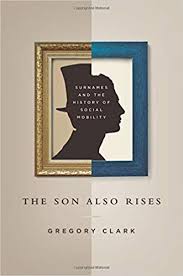 These results align with Gregory Clark’s work in The Son Also Rises: Surnames and the History of Social Mobility. Last summer Clark told me that he is done with a draft of a new book that confirms and extends the data and argument from The Son Also Rises: though generational mobility is high in the short term, there is a long term persistence of social and economic status across lineages.
To me, the most striking element of Clark’s data is the persistence of Normans in the British elite. Though 0.30% of the British population at most, they were 16% of the student body at Oxbridge in the 12th-century. The proportion of Norman surnames at Oxbridge did not converge to the population proportion until the late 20th-century! This means it took nearly 1,000 years for Normans to regress (they are still over-represented in the British officer corps).
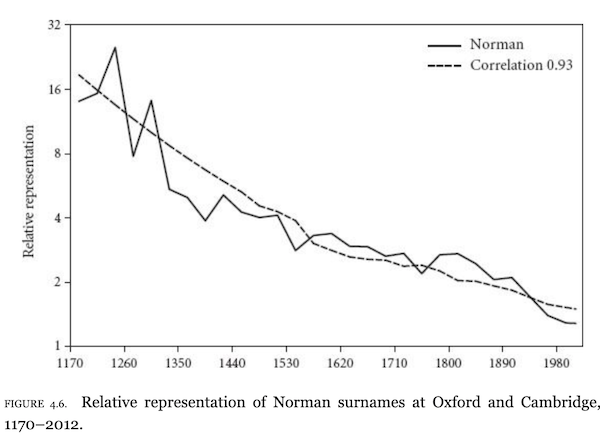 This tells us that social mobility over the generations is a thing. But, it also tells us that social mobility converges very slowly. This is intuitively surprising because single generation-to-generation changes in status are so extreme that one would predict the converge would happen much faster. Often one sees generation-to-generation correlations of income on the order of 0.50. But Clark’s data suggests that the systematic biases across many generations of status are such that the correlation would be closer to 0.90 to explain these results without an underlying phenomenon.
Why is this relevant? Clark had more access to surname information from Europe. But his data now extends internationally, and Clark claimed that this pattern is a cross-societal, and, the “intergenerational correlation” is very high. This includes India (in fact, some of the material in The Son Also Rises indicates that the correlation is higher in India than elsewhere).
This is the context where we have to understand comments like this:
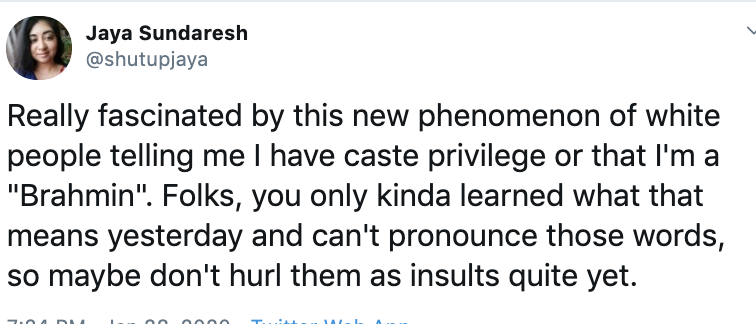
There are two major dimensions to understand this.
When people are beating you down for being a “terrorist” it doesn’t matter if you are a Brahmin or Dalit, a Hindu, Muslim or Sikh. North Indian or South Indian. Light-skinned or dark-skinned. All that matters is that you are brown. There are some people who are white-passing or black-passing among subcontinental origin individuals, but these are the small minority.
Insofar as “white supremacy” is what you think determines the lot of non-white peoples in the United States, talk of caste privilege seems quite silly. It is correct that Indian Americans tend to come from “upper castes” and the socio-economic elite. But what if you think that the only thing relevant about an Indian American with a Ph.D. is that they are a “person of color” (or as they say now a “black and brown body”)? Then that caste/class privilege really doesn’t matter in this country. All that matters is what white people think about you.
But I think this view is wrong. No one in the United States cares you are an Iyer. But what Greg Clark’s data suggest is that it’s not just your name, it’s not just what other people think of you Your inherited “capital” matters. A very dark-skinned Nasrani from a line of doctors may not be comparable to the descendants of slaves and farm laborers. It’s not because they’re Nasrani. It’s because they’re the descendants of doctors.
In Vox, Asian American racism is the unfunny joke the comedy world needs to reckon with. The piece is ho-hum. It could have been written by some sort of software program, as it leverages every quasi-academic intellectual construct about Asian Americans.
What I would like to see more in the media is the voice of the Korean American Christian pastor and the Indian American tech-bro. They exist. And there are a lot more of them than there are post-colonial theorists.
(I was in a very liberal [pierced people] cafe in Austin once when they were talking about Indians…and I realized the conversation stopped as people looked sideways at me, so I get what the author is saying)
 Going back twenty years I have been fascinated by “alternative history” science fiction. This is often termed “Uchronia.” If you want to explore this genre, I suggest the Uchronia website.
Probably the biggest breakout into “mainstream” science fiction of this sort of work is Kim Stanley Robinson’s The Years of Rice and Salt. Here the “Point of Departure,” where history forks from our timeline, is the Black Death. White Christian Europeans go extinct, with small groups getting absorbed by expanding West Asian and North African Muslims. Eventually, Europe becomes one of the outposts of the Near Eastern Islamic civilization. The world becomes defined by a “Cold War” between a Chinese-led bloc, and an Islamic-led bloc, with the Indian subcontinent, split between the two (though leaning toward the Chinese-led bloc).
The reason I’m bringing this up is that it presents a thought experiment: what if the Hindu Rajputs had managed to prevent the expansion of Turco-Muslim polities into the Indian subcontinent beyond the Sindh and parts of Punjab? If this had happened, the shock of the Mongol sweep south would probably be even more devastating for the Turco-Muslim polities of Persia and Central Asia (India being less of a fallback). One can imagine a scenario playing out where Islam and Muslims in the Indian subcontinent remain a small distinct minority, with higher concentrations in coastal areas impacted by trade. Islam would perhaps play the same role in India as it does in mainland Southeast Asia: a minority religion that serves mostly as an interface with the Indian Ocean trading network, rather than a religion of a dominant ruling class.
A more interesting question is what are the cultural ramifications of this historical fork? A comment was made on this weblog stated that to a great extent it is hard to imagine North Indian culture without Muslim (so Turkic and Persian) influence. One may disagree with this comment, but it is not a crazy assertion.
But the question of the nature of the alternative history is interesting. Because it is a way one can get at an answer as to what a reconstructed Hindu identity which genuinely strips away Islamicate accretions would look like. Something some people do aspire to…
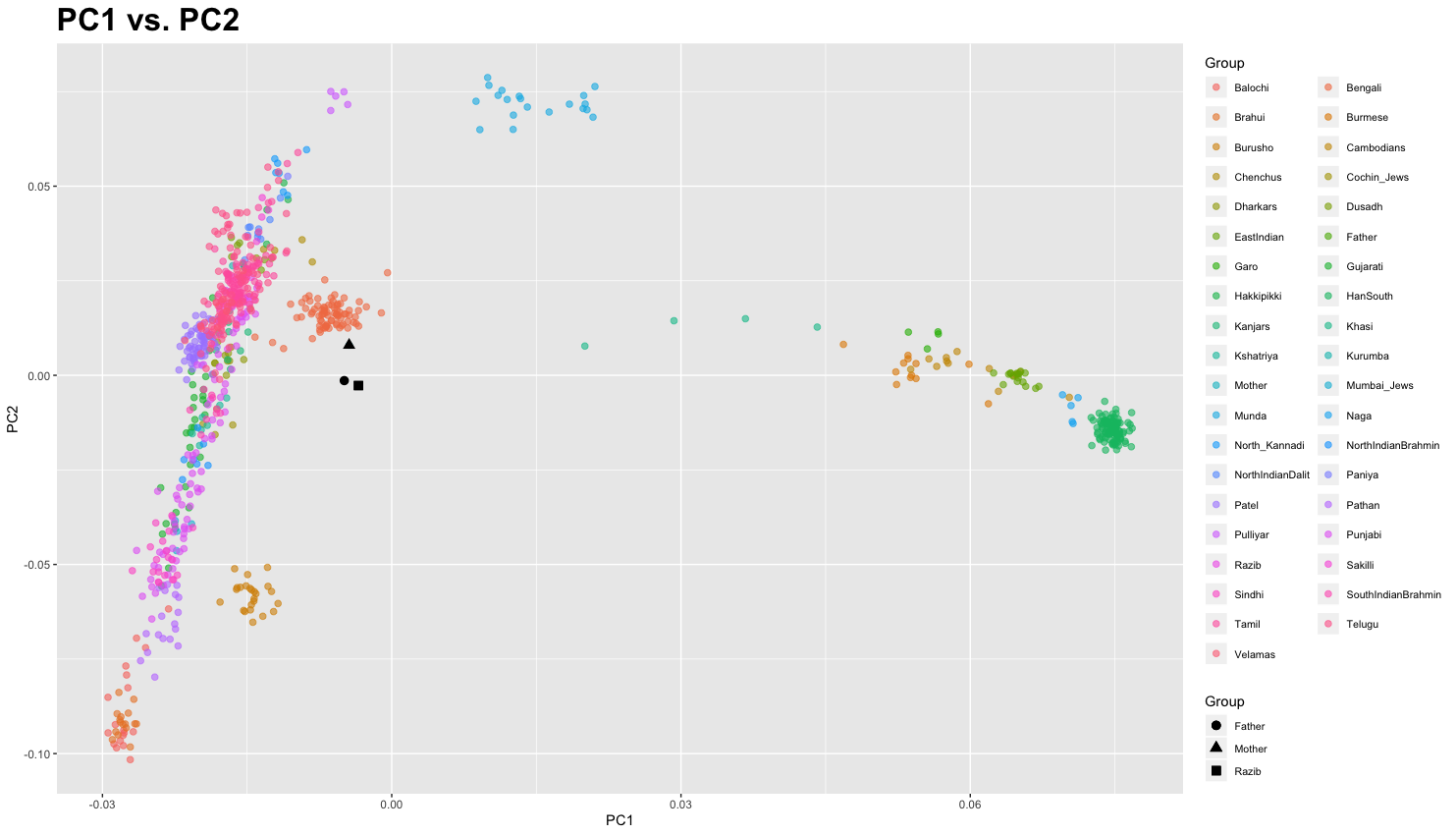
Using my own data to test some stuff, and I notice
1) My parents are both “outliers” from the Bangladeshis collected in Dhaka. Not too surprising, as my family is from low country Comilla, and more “East Asian” than usual.
2) My father is more “steppe shifted.” This always shows up in various analyses. And, it is not surprising. His maternal grandfather was from a Bengali Brahmin family (they all converted the previous generation).
3) Weirdly, I am quite near my father on this plot. Mendelian segregation I assume. I have a 23andMe and a SNP file generated from 30x WGS, and they land on the same spot. So it’s not some artifact.
Another month, another “Asian” grooming gang scandal. “Asian” usually, but not exclusively, seems to mean Pakistani British men.
A lot of the discussion around this issue centers on the perpetrators of the crimes. Their ethnoreligious distinctiveness. The cultural preconditions which allow for the development of these practices of abuse and exploitation as normative in certain circumstances and toward certain people (though the details differ, from what I know of South Asian communities, in general, there’s a fair amount of sexual abuse going on within the subculture that isn’t discovered because of norms of shame and concealment).
But, I want to focus on the victims. Whenever these stories surface the victims are invariably described as “troubled” and from “broken” homes. These were vulnerable children. Additionally, the powers that be did not see these girls as their girls. If gangs of Pakistani British men were abusing and raping the daughters of middle-class burghers, I am 100% sure that the police would pay immediate attention and follow-up on these cases no matter the sensitivities.
I think it is fine and important to highlight the subculture that fosters this sort of behavior through their assumptions about the sexual nature of non-South Asian women (e.g., I have had it explained to me by several men of Indian subcontinental origin whose tastes were toward the prurient that “our women are pure”). But these cases also illustrate stark class divides and the total lack of concern and interest by the bureaucratic and public service class toward individuals from the lower class.
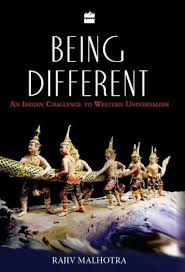 Having read a fair portion of Being Different: An Indian Challenge to Western Universalism, I can state now that it’s a book worth reading. The author, Rajiv Malhorta, expresses a distinctively Indian religio-cultural view coherently, clearly, and with a substantial foundation of scholarship.
In this way, I would suggest that Malhorta’s work is analogous to Tariq Ramadan’s exposition of a conservative Muslim world-view that is aware of, and engages with, Western values and traditions.
The main difference is that Ramadan’s work is more academic, which makes sense since he is trained as a classical European intellectual. In contrast, the main nagging issue I have with Malhotra’s work so far is that he regularly imputes elements of Western American Protestant culture and civilization to the Abrahamic traditions writ large. This makes sense since Malhotra’s biography suggests much of his adult life was in the United States. But whenever he writes “Judeo-Christian” about 75% of the time it makes more sense to write “American Protestant”, since that is really what the term is pointing to.
I assume that in the broad conclusions Malhotra and I come down on different positions. But the outlines of the methods and arguments he uses are quite familiar and intelligible, and that’s a nice change from other things that I have read.