Open Thread – 9/26/2020 – Brown Pundits


I have mixed feelings about casting Dev Patel as Gawain. Though my feelings are not strong, they are similar to my feelings about casting white actors as non-Europeans in the past: you get over it, but it takes away from verisimilitude.

Please make sure that you subscribe to the podcast (there are links to various platforms on the main website at the link). We don’t always post show-notes due to being busy.

Open Thread – 09/19/2020 – Brown Pundits

The comments are open(ish).

Finished India in the Persianate Age. This was a much more fluidly written book from Eaton than other stuff I’ve read from him, probably because the Mughal narrative “writes itself.” Recommended.

Probably will take reader advice and focus more on “primary sources” from now on. Though finding good translations is always an issue then…

Also, check out the podcast with Matt Yglesias. And another one with Anand Kadali on hunger in India.

About Brahmin Privilege: Education, Brits and Chitpavans

This post is result of some comments in the Open thread in response to Razib’s piece in Unherd. While i agree with core of Razib’s argument & and some comments, i feel there isnt enough nuance about Brahmin privilege that comes out in discussion these days. Some assertions of comparing Brahmins to White slave-owners  are too simplistic and even terribly wrong. (I dont imply Razib or others on BP made those)

The problem with simplistic narrative of Brahmin “privilege” is that it focuses on caste as a privilege while not focusing on concrete privileges which are often correlated with Varna in India. Following are the salient privileges of Indian public life

  • WEALTH including Lands – Moderately correlated with caste but with some mismatch. Most Brahmins who had lands, lost them in the Land reforms of 20th century though. (even though one supports the land reforms in principle the confiscation of land cannot be brushed aside)
  • EDUCATION – highly correlated with caste ; Brahmins score considerably higher on educational parameters for centuries. This post focuses on Education as a historic and inherited privilege.
  • CONNECTIONS – related to politics – here ordinary Brahmins aren’t necessary up in the top percentile.
  • URBAN BACKGROUND – (more Brahmins/UC are urban dweller though some continue living in rural backgrounds).
  • GENDER.

This post focuses on Educational attainments of Brahmins (particularly Chitpavans) in Pune region. The quotes and tables are from a booklet A survey of the Chitpavan Community in the pre colonial state

For the British, Education was an instrument of efficient colonization as seen from the words of Sir Erskine Perry,  the Governor of Bombay Province subsequent to Lord Elphinstone. He maintained

“Only the higher castes should be educated because of the limited facilities, therefore only limited members could be educated. These higher castes through their natural influence would affect an elevation of mental and moral condition of the masses. Four groups were identified under this category of high castes the military and administrative class of Landowners, Jagirdars, Chieftains, petty nobility and feudatories, wealthy traders and other commercial men; government employees; and Brahmins and other
higher writer castes”.’

The Maratha empire employed a number of upper castes (Brahmins, Kayasthas and some Marathas) in positions of administration and accounting. On arrival, the Brits picked these up as administrators, teachers, clerks etc. The literacy of the males of these subcastes in Bombay presidency was extremely high. Chitapavan males in a Pune Taluka are reported to have 90% literacy in late 19th century as compared to 11.9% in average males. This extreme bias cannot be explained without the Peshwai & the privileges the Chitpavans enjoyed because of it. 

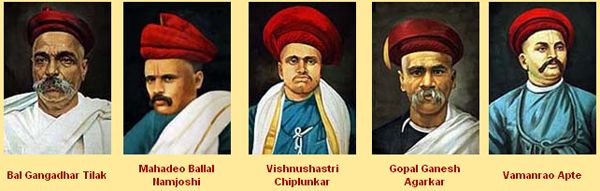
A variety of education institutes like Maharashtra education society, Deccan Education society started in Pune in the 19th century. Brahmins were the prime movers as well as the overwhelming beneficiaries of these institutions. Lets see a few examples:

Reports of the Poona Native Institution published from 1881 to 1933.
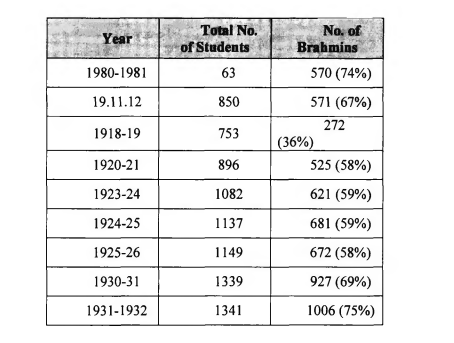
The data from Deccan Education society started by Tilak and Agarkar isnt much different. The report quotes

The annual report published in 1883 acknowledges the preponderence of brahmins amongst the students as well. “The characteristic feature of the school is that the largest number of boys belong to the higher and intelligent classes of the community.’When deposing before the Hunter Commission Annual Report of 1883,Deccan Education Society,Poona,1884 on Education, the representative of the society acknowledged that only 17 out of 582
students were nonbrahmin.
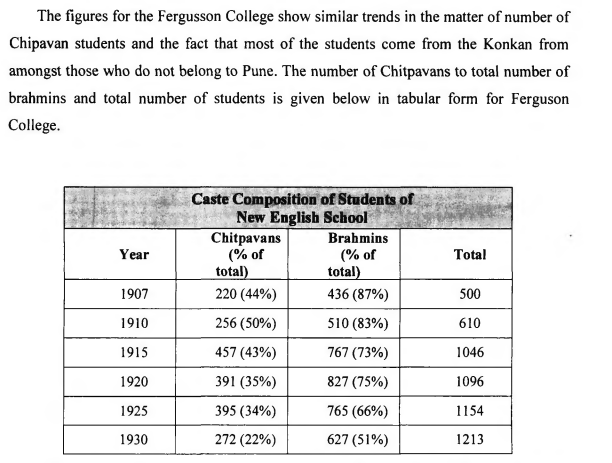
Lokmanya Tilak, the freedom fighter and founder of DES had this to say

Englishmen are and were averse to imparting any knowledge of a practical nature to subject races, they found that philosophy and theoretical science were  the safest subjects. It is hopeless to expect the artisan or the agriculturist to evince an interest in a form of education so far removed from his way of life, i.e is profession decided on the basis of caste for thousands of years. It is we think beyond the power of a dozen Educational Directors of the type of Mr. Lee Warner with all the encouragement by way of free studentships and scholarships which they can command, to infuse a love of western learning into the hearts of men who find themselves better off without knowing anything that our schools and colleges teach, than with it. If the brahmin under all kinds of difficulties strives to surpass his brethren of lower castes in intellectual attainments and tries to take up all the advantages and honours and emoluments to which these attainments qualify him, it is owing to the fact that the very traditions and obligations of his caste and the predispositions and capacities of his mind lead him in that direction. The very spirit of the caste system, the precarious conditions of life under a foreign rule, the indolent characteristic of the tropical world and the spirit of contentment infused into the heart of the Hindu by his religious faith all contribute towards the position of the Brahmin

My Two Cents:

Its fair to say that being born a Brahmin in India distinguishes you as a recipient of certain privileges. However we cant firmly gauge today how much those privileges

  • are the indirect result of ChaturVarna
  • are the result of amplification by the British (for their own colonial ends)
  • are direct result of active oppression of the subalterns
  • or something else entirely

While granting that these privileges exist and shape Indian life considerably, one mustn’t fall into the trap of seeing Brahmin privilege as the overwhelming or even the most consequential privilege of Indian society. Instances like the 1948 Anti Brahmin riots – typically underplayed in the Brahmin privilege narratives are still fresh in mind of thousands. Anti Brahmin rhetoric by political parties like NCP, DMK though not as viscous as rhetoric against some other communities is nonetheless non trivial.

There are and have been many other forces of nature and economy at work for centuries though it is fair to assume that these forces interacted with caste & varna.

 

Open Thread – 08/29/2020 – Brown Pundits

The usual. Like I said I’m moderating more, so watch yourself.

On Monday some of the BP crew (and my friend Josiah Neeley of Urbane Cowboys will be talking to Matthew Yglesias of Vox about his new book One Billion Americans: The Case for Thinking Bigger. Open to questions from the peanut gallery here too. I’ll probably also ask non-book questions toward the end of the hour.

Open Thread – 08/22/2020 – Brown Pundits

The usual.

But I’ll make a comment here. I am of the school that thinks facts matter a lot. Many of you trade in standard Hindu nationalist tropes and generalities about Islam. As someone who told Shadi Hamid on our interview, I am not a big personal fan of Islam, I don’t really mind people fearing Islam. I have personal experience of the religion after all.

But, facts matter. And a lot of the “facts” that get bandied about here are false.  I won’t tolerate that. There are two general categories I will point to:

1. First, people take traditional Muslim historiography at face value. You shouldn’t. This is like taking Christians at face value when they talk about the Four Gospels are pure positive history, when they were finally compiled and redacted decades later. Whether Muhammad exists is an empirical question in the same way that whether Jesus exists is an empirical question. As it happens, I’m modestly confident both figures existed in some form but were quite different from what Christians and Muslims depict them as (I do suspect that Josephus was a later interpolation).

The broader issue here is that Muslims on the whole have not gone through the modernist transition in regards to a critical-rationalist take on their religion. In Christianity, traditionalist-fundamentalists exist, but they have to take dialogue with modernists as a given. They exist in large part as reactions to modernism. This is not the case with Islam. Muslims accept that non-Muslims reject their religion, but within Islam, there is not a strong rationalist engagement with their texts that applies the sort of criticism than the Germans pioneered within Protestantism in the 19th century. That means they present a “unified face” about their early history which too many non-Muslims take for granted. Islam with all of its constitutive elements is not truly recognizable to us until about 850 A.D.*

2. Because this is a blog with a South Asian focus a lot of Hindu nationalist tropes and facts get presented at face value. I don’t really mind them as mythologies that give people succor or create their identity, but a lot of them have as much factual basis as a pagan Mecca: not much.

Most of the Hindu nationalist commenters do reflect a reality of “lived experience.” As someone who grew up around South Asian Muslims, I can admit they have total contempt on the whole (there are exceptions) for Hindus and their “bizarre” beliefs. But, as someone who is personally anti-Islam and literally tolerant of diverse views, many people from Hindu backgrounds of all ideologies have told me what they really think of Muslims, and the contempt is returned.

My issue is always when people turn their personal experiences into deep historical insights. Do not do that if you don’t enjoy me jumping down your throat, because if I’m not busy, I will do so.

More broadly, lots of Indian readers would benefit from reading more history. Especially non-Indian history. A broad cross-cultural perspective is essential, so do more!

For the curious here are a few books:

China: A New History
History of Rome
A History of the Byzantine State and Society
A History of the Arab Peoples: Updated Edition

* The Shia-Sunni split starts to become discernible in a way we’d recognize, Hadith culture is already on track to marginalize the “philosophers” and Hellenists, and the ulema centered around madrassas spread from the east to the west.

Open Thread – 08/15/2020 – Brown Pundits

Dog days of summer..

One of the things with Indian American analysis of Indian culture/politics is the unselfconscious filtering of it through an American lens, rather than Indian. It’s annoying to listen to news shows where they interview an Indian American about Indian culture, and the interviewer and guest proceed to discuss Indian culture through the lens of American concerns, without ever acknowledging what’s going on. To give an example, talking about ‘colorism’, but immediately pivoting to anti-blackness.

Why Hinduism is not inchoate paganism

An individual, who I have come to conclude is a troll after further comments (they are banned), mentioned offhand that Hinduism and/or Hindu identity is reactive Islam and the British, and that its origins are in the 19th century. This is a common assertion and presented recently by one of our podcast guests. I myself have entertained it in the past. It’s not prima facie crazy.

But I have come to conclude that this is not the right way to think about it. Or, more precisely, it misleads people on the nature of the dynamic of Indian religious identity and its deep origins. This is why I think Hindus themselves self-labeling ‘polytheists’ or ‘pagan’ can mislead people. Not because these are offensive terms. People can refer to themselves however they want. But these terms have particular relational resonances with other groups, periods, and peoples.

One can point to al-Biruni’s external observations about Indian religion, or Shijavi’s personal opinions in his correspondence, to make a case for Hinduism and Hindu identity (using both terms to avoid troll-semantic ripostes) being older than the 19th century. But this is not the argument that is strongest to me. I have spent many years and books reading about the cross-cultural emergence of religious identity, and its change, in places as diverse as Classical Rome, post-Arab conquest Iran, and 7th century Japan, to name a few places. Many of these places and times had local religious cults and practices. In all of these places, they were assimilated and absorbed into the intrusive “meta-ethnic” religion. In Rome, Tibet, and Japan, the religion had major initial setbacks, but eventually, the meta-ethnic “higher religion” came back and captured the elite.

In the modern world, we see massive Christianization, and to a lesser extent Islamicization, in Sub-Saharan African. The traditional religions persist, in particular in West Africa, but history is clearly against them. Importantly, most of the religious change occurred after the end of colonialization.

The relevance of this is clear. The Indian subcontinent would be an exception for all these above cases if the vast majority of people were unintegrated animists with only local religious cults. The precedent from Europe and the world of Islam is that Brahmins and a few other pan-Indian groups (e.g., Jains) would persist as religious minorities, while the vast majority converted to the newly introduced meta-ethnic religion.

Continue reading Why Hinduism is not inchoate paganism

Open Thread – 08/08/2020 – Brown Pundits

I’m traveling with my family a lot this week. Please stay under the control, because if you get out of control I’ll be more kludgey in my response than usual.

Also, to be frank, I would appreciate it if every thread doesn’t devolve into arguments between guys you can imagine whacking off to physical anthropology image plates illustrating racial types from National Geographic in 1930. As they’d say in 1930, everyone beyond Calais is a wog.

Brown Pundits