
Please keep the other posts on topic. Use this for talking about whatever you want to talk about.
Please note our podcast, Twitter, and RSS feed. Also, our Patreon.
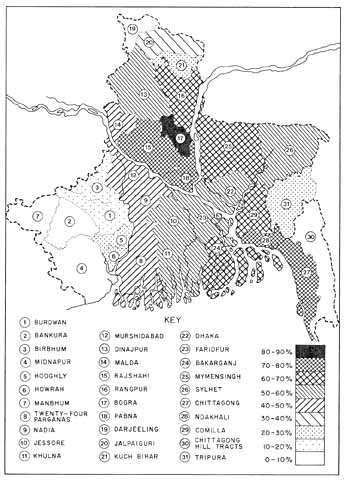 For me, Richard Eaton’s The Rise of Islam and the Bengal Frontier, 1204–1760, is the best analysis of the peculiar spatial distribution of religion in South Asia today. This is not because Eaton’s work is without flaw, or beyond reproach. It is because few have made as concerted an effort to analyze this issue in a dispassionate manner.
The map to the right shows the proportion of Muslims within united Bengal in ~1870 by region. The outlines of Bangladesh and West Bengal are already clear. That being said, one feature that seems clear is that the more marginal areas are curiously mostly Muslim (e.g., the far southeast). Eaton’s broad argument, following upon others, is a consequence of the fact that these areas came under intensive cultivation only during the Mughal period, and therefore under the aegis of Muslim elites. Therefore, the local peasantry took up a nominal Muslim identity as a matter of course. To reinforce the mechanism, Eaton points out that there are noted cases of villages founded by Hindu zamindars in the east where Hindu shrines were built, and the peasants nominally adhered to the sect of Hinduism professed by the zamindar.
The Rise of Islam and the Bengal Frontier, 1204–1760 is fully available online. I encourage you to read it. One thing that is now clearer to me again after reading it is that Islam as a religious identity of the peasantry of eastern Bengal is a notable feature only after the Mughal conquest of 1576. Visitors to Bengal from other regions before this date mention Muslims only as residents of cities and towns. Additionally, these Muslims often have some foreign connection, whether it be Afghan, Turk, or Persian. As far as the rural people go, none are mentioned as Muslim. Some of them described in eastern Bengal also seem likely to have been Tibeto-Burman in origin. They are described as “beardless”, and Muslim commentators assert they are neither the religion of India nor are they Muslims.
After 1600 visitors began to observe large numbers of Muslims in places such as the lands on either side of the Meghna river. In contrast, observers of the Hooghly basin note that all the inhabitants are Hindus (e.g., a Jesuit declares they are all “idolaters”).
In another paper Eaton analyzes Punjab. While the Islamicization of Bengal was driven by small mosques and shrines in newly founded hamlets, Eaton argues that in western Punjab Islamcization was driven by the transition of pastoralist Jatts to farming, and their settlement around charismatic Sufi shrines. But, he presents data that suggests that this process of Islamization was gradual and somewhat later than the present-day Muslims assert. Siyal Jatts of Jhang in northern Punjab assert they have been Muslim since 1250. But a record of names of notables from this community suggests this is unlikely.
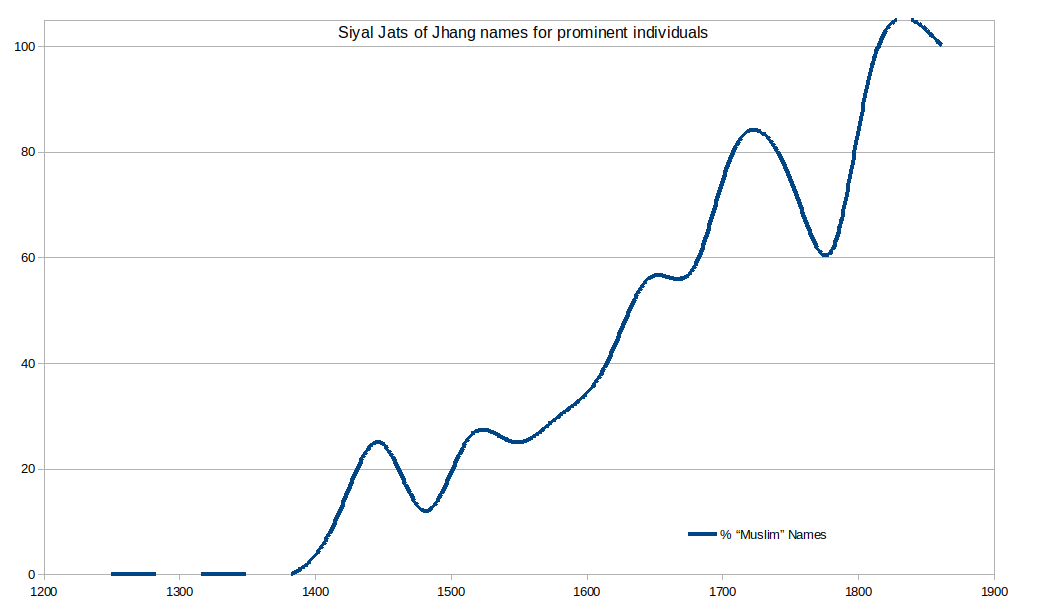
Islamicization began in the period between 1400 and 1500. But the shift from Punjabi names to self-conscious Muslim names did not complete in totality until 400 years had passed.
I ran some qpAdmin on some populations. In the table below if it’s empty, that means that the model isn’t very good with that population. In other cases, the model doesn’t work without a population. So, if you put East Asians into the model for most South Asians it kind of goes crazy…but without East Asians, Bengalis and Munda are not modeled too well.
I used the exact left and right populations as outlined in the Narasimhan et al. paper when possible. You can see that East Asians are part of the model for Bengalis, so they are removed from the “right” set of populations in that model.
My results are very close to Narasimhan et al. (the main difference is my reference set is slightly different than that of the Reich lab population). Additionally, please note my intuition is that this overestimates Sintashta ancestry by a few percent. That being said, take a look at the Ror (Jatt), Khamboj, and Brahmins from Uttar Pradesh. The Ror have more Indo-Aryan and more Andamanese than the Kamboj. The Uttar Pradesh Brahmin is about the same fraction Indo-Aryan as the Kamboj but has about ten times as much Andamese ancestry.
Continue reading Indus Valley, Sintashta, and Andamanese ancestry in select grioups
Brown Pundits favorite Kushal Mehra explains the National Register of Citizens (NRC) and Citizenship Amendment Act (CAA).
I don’t understand why the NRC and CAA are controversial among some. Can anyone explain this to me?
The shadow of peasant past: Seven generations of inequality persistence in Northern Sweden:
We use administrative data linked to parish records from NorthernSweden to study multigenerational inequality in education, occupations, and wealth from historical to contemporary times. Our data cover seven generations and allows us to follow ancestors of individuals living in Sweden around the new millennium back more than 200 years, covering the mid-18thcentury to the 21st century. In our sample of around 75,000 traceable descendants, we analyze (a) up to 5thcousin correlations and (b) dynastic correlations over seven generations based on aggregations of ancestors’ social class/status. With both approaches, we find that past generations structure life chances many generations later, even though mobility is very high. The persistence we find using cousin and dynastic correlations is much higher compared to a simple Markov model limited to sequential parent-child transfers, but we also find that direct ancestor associations are very small. This suggests that there is a weak but constant kinship influence that attenuates slowly over generation.
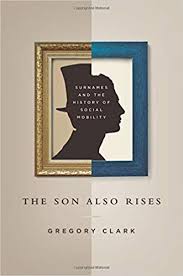 These results align with Gregory Clark’s work in The Son Also Rises: Surnames and the History of Social Mobility. Last summer Clark told me that he is done with a draft of a new book that confirms and extends the data and argument from The Son Also Rises: though generational mobility is high in the short term, there is a long term persistence of social and economic status across lineages.
To me, the most striking element of Clark’s data is the persistence of Normans in the British elite. Though 0.30% of the British population at most, they were 16% of the student body at Oxbridge in the 12th-century. The proportion of Norman surnames at Oxbridge did not converge to the population proportion until the late 20th-century! This means it took nearly 1,000 years for Normans to regress (they are still over-represented in the British officer corps).
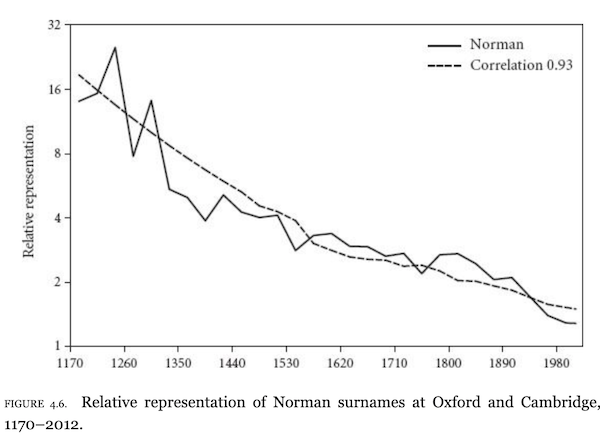 This tells us that social mobility over the generations is a thing. But, it also tells us that social mobility converges very slowly. This is intuitively surprising because single generation-to-generation changes in status are so extreme that one would predict the converge would happen much faster. Often one sees generation-to-generation correlations of income on the order of 0.50. But Clark’s data suggests that the systematic biases across many generations of status are such that the correlation would be closer to 0.90 to explain these results without an underlying phenomenon.
Why is this relevant? Clark had more access to surname information from Europe. But his data now extends internationally, and Clark claimed that this pattern is a cross-societal, and, the “intergenerational correlation” is very high. This includes India (in fact, some of the material in The Son Also Rises indicates that the correlation is higher in India than elsewhere).
This is the context where we have to understand comments like this:
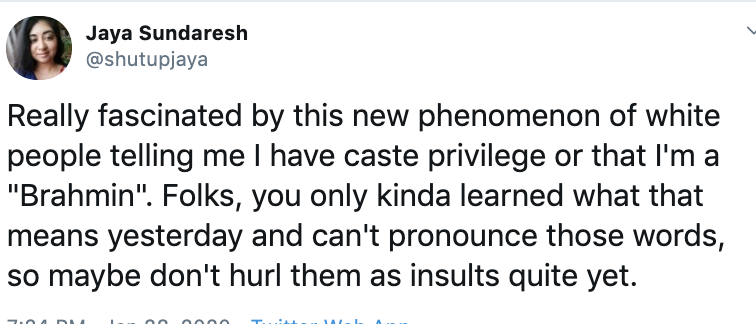
There are two major dimensions to understand this.
When people are beating you down for being a “terrorist” it doesn’t matter if you are a Brahmin or Dalit, a Hindu, Muslim or Sikh. North Indian or South Indian. Light-skinned or dark-skinned. All that matters is that you are brown. There are some people who are white-passing or black-passing among subcontinental origin individuals, but these are the small minority.
Insofar as “white supremacy” is what you think determines the lot of non-white peoples in the United States, talk of caste privilege seems quite silly. It is correct that Indian Americans tend to come from “upper castes” and the socio-economic elite. But what if you think that the only thing relevant about an Indian American with a Ph.D. is that they are a “person of color” (or as they say now a “black and brown body”)? Then that caste/class privilege really doesn’t matter in this country. All that matters is what white people think about you.
But I think this view is wrong. No one in the United States cares you are an Iyer. But what Greg Clark’s data suggest is that it’s not just your name, it’s not just what other people think of you Your inherited “capital” matters. A very dark-skinned Nasrani from a line of doctors may not be comparable to the descendants of slaves and farm laborers. It’s not because they’re Nasrani. It’s because they’re the descendants of doctors.
On August 15, 1947, an ancient civilization manifested into a new nation. Near the stroke of midnight, Jawaharlal Nehru, freedom fighter and India’s first Prime Minister, would make one the greatest speeches of the 20th century – “A Tryst With Destiny.”
One passage stands out the most which is integral in this piece:
“A moment comes, which comes, but rarely in history, when we step out from the old to the new, when an age ends, and when the soul of a nation, long suppressed, finds utterance.”
The idea of the soul, or Atman, has been a central topic in Indian philosophy. Most strands posit it as eternal, unchanging, and inherently good. Liberation is achieved when one identifies with the soul and disassociates with the body.
But what defines the soul of India?

Nehru tried to define this soul or “idea” of India in his book, The Discovery of India. Nehru idolized India’s diversity, tolerance, and tradition of pluralism. Most Indians today and in the past would agree with these values.
But problems arrived with the body of this newly born India state. Its hands were tied by excessive government regulations where profit was a plague, and a mercantile people’s instincts were silenced. The feet of the masses marched behind the banners of caste (for Hindus) and religion (for minorities) rather than behind the Indian tricolor or tiranga. The brain or “intellectuals” of India veered into a Red Sea where Marxists rewrote books to vilify India’s indigenous culture and deify its conquerors as civilizers of the heathen brown savage.
Post-colonial India became a state ruled by Brown Englishmen exploiting mass corruption while spitting on mass tradition. To maintain this equation, balance was achieved by pitting community against community; while feudal lords doled out sops and calculated political arithmetic. This all changed when a new variable entered the board – unity.
Ekam Sat Viprā Bahudhā Vadanti – Truth is one, the wise know it by many names.
— Rig Veda (1.164.46)
I’ve quoted the above several times before. The reason I do is because how integral this verse is in explaining India. Nehru’s idea of India indeed traces itself to this verse spoken thousands of years ago. However, what Nehru and his disciples did not acknowledge is that their “Idea of India’s” origin was rooted in this Vedic verse. They would think of any and every reason to explain India’s inherent diversity and tolerance other than its actual cause – the soul of India: Dharma.
Ekam Sat is the social contract of the Indian experience. As long as people abide by it, sectarian peace can prevail and has in India for millennia. When ideologies came that did not accept Ekam Sat, India has witnessed terrible bloodshed in the name of God or lack there of. This is not to say that India was some peaceful fantasy land for all of its history, but it is reasonable to say that inter-and intra-religious violence amongst Dharmic sects has been extremely minimal compared to its foreign analogues.
But how did this unity manifest itself in modern India – an India of hundreds of colonial and cultural divisions filled with struggle and strife?
Two currents would force the struggling streams of the Indian state into the beginnings of a singular and mighty river: saffronization and economic liberation.
It was in the late 1980s/early 1990s was when India’s reincarnation truly began.

The Shah Bano case and Kashmiri Pandit Exodus would enrage Hindus across the country with a culmination in the mob destruction of Babri Masjid – a mosque built over an ancient temple and one of Hinduism’s holiest sites, the birthplace of Ram.
Across the Arabian Sea, Saddam Hussein launched an invasion into Kuwait in 1990. Oil prices and India’s oil payments jettisoned while exports slumped with its balance sheet teetering. India was now forced into an IMF bailout conditioned on massive economic liberalization. The curse of the Kuwaiti invasion would turn into India’s blessing.
Political whirlwinds would give air to an upstart party in the BJP, which would grow in strength and numbers over the years. Reaching a zenith in 2014 with a massive victory of Prime Minister Modi, the BJP now began laying ground for a new India. On a foundation of welfare, infrastructure, and promotion of indigenous tradition, Modi would build the first pillars of rebirth in 2019 with an even greater mandate than prior.
Through this trident of tectonic maneuvers, Modi and the BJP signaled their intent to the world in 2019 – India would no longer sit by and be defined by haughty intellectuals or journalist editorials; India would define itself, and it was now defined by reclamation.
Amongst hyperventilating outlets publishing misinformation after mischaracterization, much of the international public has been caught dazed by what is happening in India. The BJP’s shambolic public relations department does not help either. In all 3 actions, India is placing primacy on indigenous tradition and history. It is addressing the festering scars that have been open since partition and caused by conflict from ages past.
Kashmir saw the removal of a temporary amendment, equality enforced amongst the populace, and a path for the resettlement of its original people who carried its indigenous traditions – the Kashmiri Pandits. BJP backed lawyers persuaded India’s Supreme Court into a balanced and just decision with the holy land of Ram Janmabhoomi rightly returned to its worshippers and an order for a mosque to be built at another location. While the CAA honored India’s storied legacy of giving refuge to the persecuted as well as addressed partition injustices all in one stroke.
And all of this has been massively popular in India, flabbergasting outside commentators. Why?
More than 271 million Indians were lifted out of poverty from 2006-2016. As Indians rose economically, they found new questions (and problems) for themselves. Indians are now introspecting on who they are and what defines them.
In Narendra Modi, they have found the Special One. His background, achievements, and character have captured the Indian imagination. He is an every man coming from humble roots who has given a precedent of defiance to those of doubt. Modi has not only given hope to the average Indian, but also a mirror.
He has laid out the corruption and hypocrisies of the old elites. His orations give the tales of an ancient people, speaking to the deep seated cultural trauma and perseverance of India. Modi’s Hindutva is breaking the Brown Englishman’s idols and killing its sacred cows, while reminding India of its old ideals and sanctity.

But the old elites also have an even more alarming fire at their doorstep – caste is breaking down.
With urbanization, increased economic mobility, and indeed with the strengthened of Hindutva, people are identifying as Indian or Hindu first rather than their caste like in the old days. Social media and the internet have broken the stranglehold of academia and mainstream media to deliver narratives that are much more in tune with reality today, history yesterday, and the future tomorrow. The carefully carved world of postcolonial India is crumbling to ashes. And the BJP is intent on dashing those ashes away as a preparation for reincarnation.
Jawaharlal Nehru’s “Idea of India” was only partially correct. India is not just the land of diversity and pluralism. India is the land of Dharma, of ancient traditions, and uniquely indigenous narratives. It is the land of Ram, of Krishna, of Buddha, of Mahavir, and of Nanak. It is the land of Chanakya, with a state that seeks to improve diplomacy and statecraft. It is the land of Yoga and meditation. It is the land of science and spirituality; of Aryabhatta and Aryavarta. It is a land of the Dharmachakra, where the wheel of change forever turns on the spokes of Dharmic virtues.
It is the land where the soul of a civilization, long suppressed, is reborn today in a new avatar.
India has reincarnated.
 An argument that emerges now and then on this website has to do with the nature of the ancestors of Indian (South Asian) Muslims. Where they Hindus? Much hinges on semantics. The term “Hindu” after all simply meant Indian in the days of yore, so by definition, they were.
On the other hand, Hindu today denotes a set of beliefs, practices, and identities, which exists at counterpoint with the confessions of Islam, sects like Jainism and Sikhism, and the dharmic world religion of Buddhism. To say that the ancestors of Muslims were Hindus may not give the correct impression due to the fact that that implies a level of fidelity to practices and beliefs which we today recognize as Hindu. Even setting aside the fact that substantial numbers may have been adherents of counter-cultural sects such as Buddhism, many of the threads of contemporary Hinduism developed in situ in the Indian subcontinent at the same time as many regions became predominantly Muslim.
And yet I think I have come to an elegant and accurate solution to this problem: those of us of Muslim origin or belief should simply admit that we were the descendants of idolators. Whether Buddhist, caste Hindu, or animistic peasant, from a Muslim perspective all these groups are idolators.