“I am human, and I think nothing human is alien to me.”
-Terrence
One of the strange things is the comments on this weblog make it seem like many more of the readers are South Asian than is really case (or care about the India-Pakistan conflict). I wish more of you would speak. I’m brown, but I speak on Chinese history. It’s my history too. In a cosmopolitan post-national world the global chattering class should consider Terrence’s insights and be less bashful.
I was overlooking Vidhi’s screen at the gym and saw the dance. Initially I thought Bharatanatyam (it didn’t have a title) is so elegant and mesmerising and I asked Vidhi, what it was.
She replied that it was a Kathak and I made a mini-rant about how India ignores Islamicate culture etc. Incidentally I only just learnt Vidhi had studied Katak and, surprisingly for someone from Chennai, not Bharatanatyam. Her mother (a Sindhi from the North) made the choice and chose accordingly. I’m trying to convince her to pick up Kathak again to offset the intensity of her research.
My point being is that while Kathak has distinctly Hindu/Indian origins; it is ultimately (like Hindustani music) a culmination of the Indo-Islamic culture (apparently Wajid Ali Shah was its finest patron).
One of the most interesting things I have experienced over the past 15 years or so interacting with young Indian Americans, usually of Hindu background, is the disjunction between the scripts that they are inculcated with in their education in broader society, and the quite nationalistic/parochial perspectives that are imparted to them by their parents.
You can say many things about me, but there isn’t much of a disjunction in what I will say you to privately about controversial topics and what I will say in public about controversial topics (the main skeptics of this view are some Hindu nationalists and Zionists, who are convinced that I’m an Islamic supremacist sleeper agent).
So, I when I began to spend some time around Indian Americans one of the peculiar things I was a bit surprised by his how different their extremely social justice Left external presentation could be from what they might say privately over some drinks, or if they perceived you to be an intimate acquaintance. Since my views on Islam were well known many of them felt quite free to openly state their privately skeptical views on the religion of Islam and the practices of Muslims, which reflected what their parents had told them, while in public these people might still denounce Islamophobia. People who would criticize caste privilege in public forums might still be privately smugly proud of their family’s caste background. And, the same people who might perceive American patriotism as to be jingoistic and declasse would express Indian nationalism that they had absorbed with their mother’s milk in private in the crassest of terms.
But there does come a time when you leave your parents’ home, and their influence. And I don’t interact much with Indian Americans on a day to day basis, but I do wonder if many progressive Indian Americans are bringing their two aspects into alignment, and shedding their private chauvinistic reflexes?
An analogy here might be young American Jews, who until recently were quite liberal in the American context, but might align with more ethnonationalist views in relation to Israel (even if they supported the Left parties in Israel, those parties are still more nationalistic than similar parties in the United States). Today the two views are coming into coherence, as most younger American Jews who are not orthodox are starting to distance themselves from Israel.
I was picking up the comment thread on the linguistics podcast. To my mind there are some inconsistencies about modern-day Pakistan:
(1.) Ever since MBQ conquered Sindh in 712; Sindh has remained under Muslim rule. When it did have local rule it was essentially a tussle between the Baloch and Muslim Rajputs, which has replicated itself to this day. Benazir Bhutto is of Rajput ancestry (Bhatt) while her husband Zardari is a Baloch. The Hindu minority were either merchants or serfs and as far as I know the caste Hindus of Sindh are a basically heteregenous lot (there is only one Brahmin surname among the Amils and the castes tends to have strong geographic regions).
(2.) As for Baluchistan and KPK; It’s basically seen the incursion of Iranian speakers the past millennia or so.
You can listen on Libsyn, iTunes, Spotify, and Stitcher. Probably the easiest way to keep up the podcast since we don’t have a regular schedule is to subscribe at one of the links above.
You can also support the podcast as a patron (the primary benefit now is that you get the podcasts considerably earlier than everyone else…).
I’m quite proud of this podcast since I was able to get some of the linguistic luminaries together. The topic was a broad overview of language in South Asia.
We were able to keep a very strong regional balance since TCW’s specialty is Dravidian. We touched on the role of Sanskrit and its prominence as a literary lingua franca until the late medieval period (until it was supplanted).
Incidentally, we didn’t talk all that much about Indian English instead we delved into the “dialects.” There seems to be a turning point in that the Subcontinent is consolidating linguistically among regional, national and religious lines with English emerging as the great neutral and prestige language.
We touched a fair bit on the specific languages of the Hindi belt but I guess for next time we will have to tackle those that are tangential to the Hindi language sphere like Punjabi, Bengali, and Marathi.
More than 137 people have been killed and more than 150 injured after coordinated bomb blasts hit a number of high-end hotels and churches in Sri Lanka on Sunday.
The blasts, reported to have occurred in the cities of Negombo, Batticalo and the capital Colombo, targeted at least three hotels and three churches as worshippers attended Easter services.
Bodies of the dead have been received at Colombo National Hospital, according to hospital sources. Most of those injured were also taken there, hospital officials said.
Please post updates in the comments.
Update: New York Times seems to be reporting Islamists.
One hundred years since the Amritsar massacre, probably among the worst violations in all of Britain's tenure in India and the phrases uttered still don't contain the word 'SORRY'. So much for the paragon of civility and refinement in the world. #shame
Martin may either be a surname or given name. Martin is a common given and family name in many languages and cultures. It comes from the Latin name Martinus, which is a late derived form of the name of the Roman god Mars, the protective godhead of the Latins, and therefore the god of war….
As a German surname, Luther is derived from a Germanic personal name compounded from the words liut, “people”, and heri, “army”. As a rare English surname, it means “lute player” (Hanks and Hodges 1988). Luther is also derived from the Greek name Eleutherius. Eleutherius is a cognate of the Greek word eleutheros (έλεύθερος) which means “free.”
I bring this up because it is curious and notable to me that apparently is common for converts to Christianity in India (I’m setting aside traditionally Christian groups such as Nasranis) to take a “Christian name”. One of the arguments is that you shouldn’t have names which refer to a pagan god. Someone should have told Martin Luther. The Anglo-Saxon kings retained the myth of descending from pagan German gods long after their Christianization (they obviously didn’t believe it literally, though they still refused to let go for the prestige).
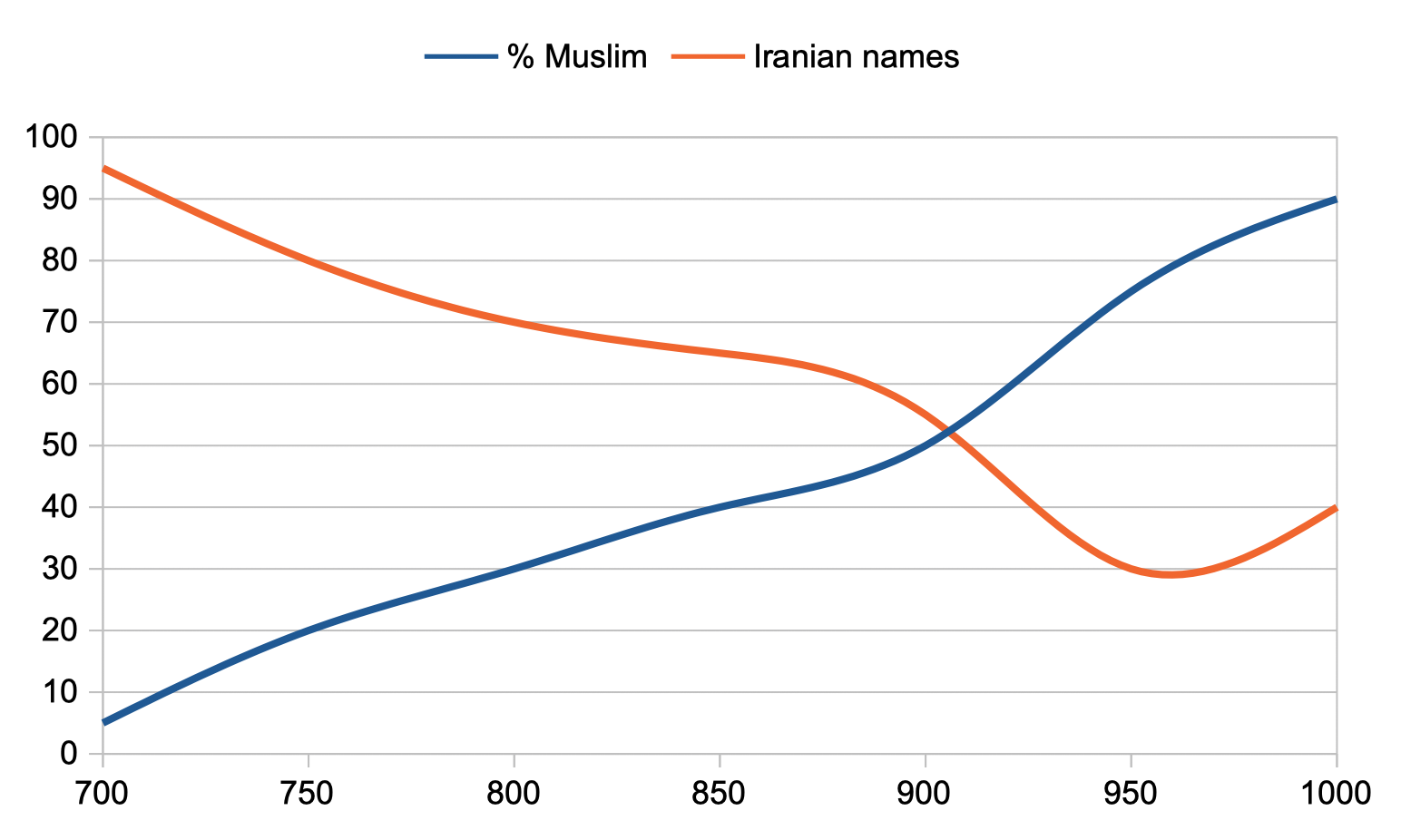
About ten years ago I read a book about the Islamicization of the core Muslim world. In particular, there was a curious feature of the process that occurred over three centuries in Iran. There was a chart of the form:
The records were clearly from sub-elite individuals. People from whom records remained due to their service or taxes paid. What one sees is that for several centuries the proportion of classical Iranian names drops as the number of local landlords who are non-Muslim drop….and then as the Muslims become overwhelming, there are individuals who are known to be Muslim who are being given classical Iranian names all of a sudden.
The link between being non-Muslim (generally Zoroastrian) in rural Iran among sub-elites and having an Iranian name disappeared when the number of non-Muslims declined to the point where they were not a major community (outside of isolated areas such as Yazd).
In a similar manner, Bangladeshi Muslims often have more ostentatiously Arabic names than Pakistani Muslims, who reflect more Iranian and Central Asian influence. The Bengali Muslim intelligentsia is a recent creation of late modernity, balancing its sincere religious beliefs with an ethnic identity distinct from the post-Mughal Islamicate culture further up the Gangetic plain and into Punjab (the Muslim elites of Mughal era Bengal did not speak Bengali as their high language, and the early Bengal Rennaissance was due to Hindu gentry). The extremely Arabic names are probably one way to emphasize one’s Muslim bonafide in a cheap manner.
My own children have conventionally Western forenames (though not generic ones). The reasoning is straightforward: they are being raised in a conventional white American milieu. I have no religious attachments obviously, nor am I passionately ethnic, outside of some food preferences. Their South Asian heritage is part of their past through me, but the future is different, and the names reflect that.
Going back to names…it’s ridiculous to say that they don’t indicate deep culture dynamics. The hyper-Muslim people in my family don’t make recourse to Bengali pet names. My father, whose father was an ulem, did not have such a pet name. As the lineage secularized, with my father, pet names in Bengali reappeared.
Since I am not a believer and am unlikely to passionately convert to some religion, I don’t know the motivations and psychology. And people are free to do what they want. But the idea that conversion to Christianity necessitates a name change seems ridiculous to me. The first Christian king of Sweden was Olof Skötkonung. The first Christian Roman Emperor was named Flavius Valerius Aurelius Constantinus Augustus from birth to death. Could think of a name more Scandinavian or Latin Classical?
Though it is common in the Islamic world to have distinct names rooted back to the Middle East (Indonesian Muslims being an exception), there is far less uniformity in Christianity. And yet many Christians adopt this pattern. Why? Similarly, white converts to Hinduism sometimes adopt Indian names. Why?
The post is not so much an argument for anything. But an observation that opens up a discussion….

 One of the most interesting things I have experienced over the past 15 years or so interacting with young Indian Americans, usually of Hindu background, is the disjunction between the scripts that they are inculcated with in their education in broader society, and the quite nationalistic/parochial perspectives that are imparted to them by their parents.