In the recent podcast and its follow-up post, an argument has been made that AIT/AMT or more specifically the steppe migration into South Asia in the 2nd millenium BC is already proven by genetics and that there is no hope for OIT. It has also been insinuated that OIT is being propogated more due to politics and that there is hardly any data or rationale behind it.
While in my two previous posts, I have shown data that supports OIT, I shall again breach this topic but I shall approach it in a different manner and also bring in a lot more data that I have not touched in my earlier posts.
I shall in this post, explain why AMT makes little sense. In the next post, I shall present archaeological and genetic data that supports OIT.
I see that a lot of people outside India can’t seem to get why Indians are so opposed to the AMT as apparently it is most ‘scientific’ and is supported by linguistics, archaeology and now genetics. Let me just put it in brief why Indians like me oppose AMT .
Many Hindus have grown up with stories from the Mahabharata, Ramayana and the various Puranas. They have been told that this is the history of their ancient forebears. Most Hindus believe that it is history and they grow up being proud of this great heritage. And this has been happening since millenia. It is since millenia that Indians have been growing up with the stories of the Ramayana, Mahabharata & Puranas and of other Vedic literature. They have in the ancient period even spread this knowledge across the vast expanse of SE Asia where the indigenous people still perform plays based on these Indian epics.
It is a well-known fact that the Puranas stop narrating history around the time when the Guptas were about to become the pre-eminent powers in South Asia i.e. around 2000 years ago. All the history narrated by Puranas is therefore of a period earlier than 2000 YBP. It is also well-known that without the help of the Puranas a lot of ancient Indian history would be still remain unknown. That the Puranas have historical information is unquestionable.
However, the Puranas date the ancient events it dates events like the ascension of Mahapadma Nanda, the Nanda emperor – a historical person, from the reference point of events mentioned in the Mahabharata like the birth of Parikshit who was born during the Great War of the epic.
The Mahabharata event is believed to have happened in the 32nd century BC and there is a very strong consistent tradition behind it. Astronomers such as Brahmagupta, for example, have said that there is a lapse of 3179 years between the Saka Era of 78 CE and the Kaliyuga Era. The Aihole inscription of the Chalukya Emperor Pulakeshin (who defeated Harshavardhana), dates the inscription in both the Saka & the Kaliyuga Era. Kalhana mentions it as well though he seems to have fallen into confusion between Kaliyuga Era and the period of the Pandavas.
All traditional histories, whether it be the very ancient narratives of the Puranas or it be Kalhana’s Rajataringini (of Kashmir) or be it the Gopala Rajavamshavali (of Nepal) date their histories in reference of the Era of the Pandavas and the Kaliyuga.
And if that is not enough, as per the Epics and the Puranas, there are scores of Kings and leaders who preceded the kings of the Mahabharata period. In the Suryavamsha (the Solar Lineage), there is a list of 95 successor kings from the time of the Great Father of All, Manu Vaivasvata. Manu or Manusha is cognate with the father of Germanic people, Mannus. Therefore even his name is of IE origin.
Megasthenes, around 320 BC, relates and Indian tradition, which is no longer extant, according to which 6451 years and 154 kings have elapsed between the 1st Indian king, whom Megasthenes calls Dionysus, and Sandrocottus or Chandragupta. This Dionysus was none other than Prthu Vainya, who is said to lived even earlier to Manu Vaivasvata in the 6th epoch, while Manu Vaivasvata is the father of all mankind in the 7th epoch. Manu Vaivasvata is also the same person who is known in the Semitic tradition as Noah or Nuh (Arabic).
So all of this gargantum ancient tradition which is believed to be several thousands of years old and which has been handed down to Indians for millenia is to be thrown away ? Based on what ? What exactly have the Europeans shown that disproves of discredits this ancient tradition ?
William Jones in the late 18th century, laid the groundwork to bring down the great antiquity claimed by the Indians for their own history. He did this guided by the very ‘scientific’ belief of the enlightened Europeans of his age that Earth was only 6000 years old, so how the hell can the Indians claim such absurdly ancient dates for their history !
So in William Jones’ time began the effort by the British to cram down all of the ancient history claimed by the Indians from the time of Manu, in a timeframe not older than 2000 BC. It is in following this great tradition set by Jones, that Max Muller pulled out the date of 1500 BCE for the arrival of the Aryans. Ofcourse, in all of the ancient Vedic and Puranic or Epic tradition, which talks of great ancient events and personalities of importance, there is never a single mention of Indo-Aryans coming into South Asia from Central Asia or from anywhere else. Their sacred home and their sacred places are all in South Asia.
So, you want the Indians to believe that all of their ancient historical traditions which they have been handed down from their forefathers for thousands of years are of exaggerated antiquity and that they are in actual fact of much later time period and whats more so, the progenitors of this great cultural tradition of yours only came to South Asia in 1500 BC. Before that they were not here and all of your tradition that claims otherwise is worthless. It also does not matter that there is no mention of such migration in Indian tradition anywhere.
One may accept such a extraordinary proposition if it was based on some concrete data such as archaeological evidence. But where was archaeology in the late 18th and most of the 19th century when these theories were proposed ? Even after that, where has archaeology produced evidence of Indo-Aryan migration into South Asia ?
According to JP Mallory, who along with David Anthony is the leading proponent of the steppe theory,
The archaeological evidence for an expansion from the steppelands across historical Iran and India varies from the extremely meagre to total absence: both the Anatolian and the Kurgan theory find it extraordinarily difficult to explain the expansion of the Indo- European languages over a vast area of urbanized Asian populations, approximately the same area as that of Europe.
And,
This is indeed the problem for both the Near Eastern and the Pontic-Caspian models and, following the logic of this analysis, the Bouckaert model appears to be in the same boat. All of these models apparently require the Indo-European languages (including their attendant agri- cultural vocabulary) to be superimposed/adopted by at least several major complex societies of Central Asia and the Indus… In any event, all three models require some form of major language shift despite there being no credible archaeological evidence to demonstrate, through elite dominance or any other mechanism, the type of language shift required to explain, for example, the arrival and dominance of the Indo- Aryans in India… But all theories must still explain why relatively advanced agrarian societies in greater Iran and India abandoned their own languages for those of later Neolithic or Bronze Age Indo- Iranian intruders.
An archaeological supplement with a recent aDNA paper informs us thus –
This survey of the archaeological and biological record of southern Central Asia yields four important findings. First, contacts between the sedentary food-producing populations of the Namazga culture populations residing in Kopet Dagh piedmont and Geokyur oasis of southern Turkmenistan who likely established the outpost at Sarazm had little to no contact with populations residing in the southern steppe zone. Second, contacts between Bronze Age steppe populations and NMG V and BMAC populations appears to have been one in which the dynamic of cultural influence was stronger on the side of the well-established sedentary food- producing populations, and this resulted in the partial assimilation of these initial newcomers to the region both culturally and, to a lesser degree, biologically as well. Third, not all of those who emigrated from the north turned to farming but may have continued a semi-nomadic existence in the highlands, which were unsuitable for the kind of intensive farming practiced in the BMAC homelands or in the regions of Khorezm. Fourth, if there was any Central Asian influence on South Asian populations, that influence likely long predated any development of Iranian, let alone Indo-Aryan, languages, and most likely occurred during the late NMG IV to early NMG V period (ca. 2800–2300 BCE) and even earlier during the Eneolithic from Kelteminar culture groups (4000–3500 BCE).
So we have zero archaeological evidence of the so-called steppe migration of Indo-Iranians into Iran & South Asia and even in Central Asia, the interactions between the steppe people and BMAC was such that the former were assimilated into the latter groups (which would have led to them adopting the BMAC language(s)), yet we are to accept that the whole region from Iran, Central Asia and South Asia having some of the most densely populated and advanced civilizations of their time, simply just switched over to the languages of the steppe nomads (who are archaeologically invisible) in such a comprehensive manner that not a trace of the earlier languages of these advanced civilizations exist and what is ubiquitous today all across this vast region is only the language of these invisible steppe nomads. How Incredible !
To give you a perspective, around the same time, the IE Hittites and Mitanni ruled over vast kingdoms in Anatolia & Syria respectively, and that too for many centuries. Where are these Indo-Europeans now in the Near East ? Not a trace of them exists. Yet in South Asia (where the civilizational expanse was much vaster than in the Near East), where the steppe nomads are not even archaeologically visible, we are to believe that the IVC language became invisible while the steppe language reigned supreme.
So we have no archaeological evidence of even a trace of migration from the steppe when we would require a very substantial migration from the steppe to make such a major cultural, religious and linguistic impact on the IVC to make them totally adopt the steppe language and forsake their own languages. And we do not even have any mention of a migration in any of the ancient Indian texts which on the contrary claim a much greater antiquity of IE culture and tradition within South Asia. So why should we people of South Asian origin be compelled to accept this hopeless theory ? There is very good reason to believe that our history is being misinterpreted and our real history is being robbed from us. So why should we lie down and let them walk all over us ?
It may be noted that the very reason the Europeans started archaeological digs in the late 18th & early 19th century in the Near East which lead to the discovery of the great Bronze age civilization of Mesopotamia & Egypt was the mention of ancient Great civilizations in the Bible. So the historical memory preserved in religious texts is very important and not to be dismissed lightly. Moreover, the Bible and Torah are Semitic books written originally in a Semitic language that preserved a memory of Semitic people in Bronze Age Near East. We now know that Semitic speakers were widespread in Bronze Age Near East.
Similarly, the historical memory from ancient Indian texts can help us a great deal in reconstructing the early history of Indian civilization. According to the Vedic literature, the Saraswati region around Haryana and parts of Western UP was the Vedic homeland, and we may note that some of the earliest Early & Pre-Harappan sites such as Kunal, Bhiranna, Farmana, Rakhigarhi etc are now known from Haryana. The fact that this ancient memory of Indian civilization is preserved in an IE language (Sanskrit) should also give a clue that IE languages have a deep history in South Asia intimately connected with the IVC. This is just plain common sense. Or else, we would have to argue that the deep history of Indian civilization was noted by the IVC inhabitants in a Dravidian or some other unknown language and then with the invasion of the Indo-Aryans, they translated that knowledge into Sanskrit which is a bit of a stretch and is also unsustainable because the earliest figures of Vedic literature such as Manu are also early father figures in other IE tradition such as Germanic.
Finally, it may be argued that however dicy the arguments of AMT are and however little evidence there is to support it through archaeology or Sanskrit texts, genetic data has still managed to prove AMT.
Well, that is also not really proven.
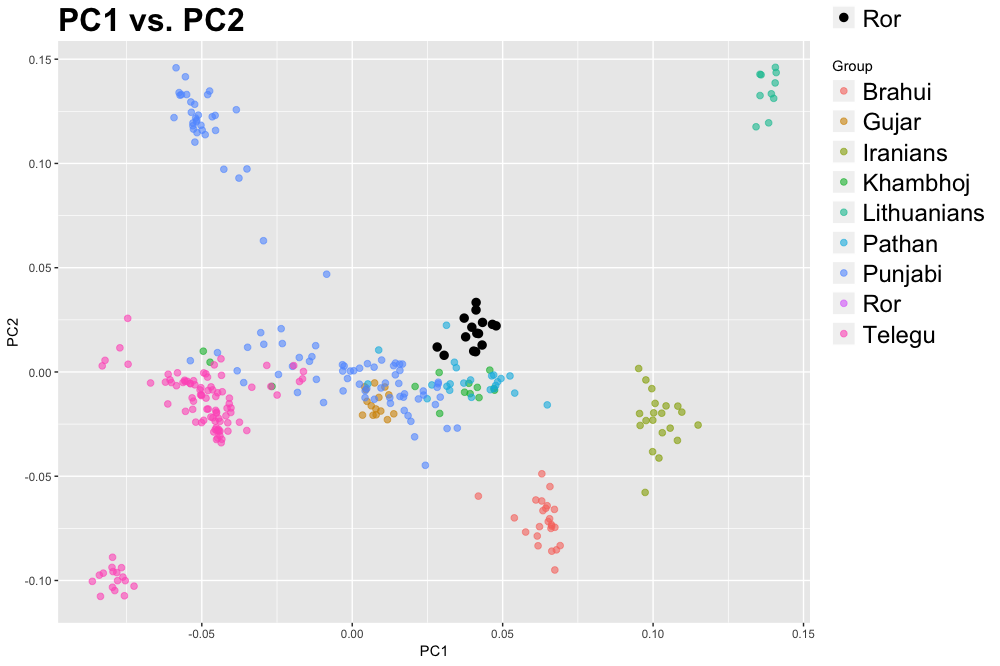
We have aDNA from South Asia (dozens of them) that date only from 1200 – 300 BC i.e. well after the so-called AMT and they are mostly from North Pakistan.
We only have 3 Bronze Age samples designated as Indus_Periphery and that too not from South Asia but from Eastern Iran and Central Asia.
These 3 samples do have steppe-related ancestry but they have it less as compared to the Swat samples and many of the modern IE speakers from South Asia.
It has not however been proved that Steppe_mlba related ancestry was absent in Indus_Periphery and came into South Asia only after 1500 BC. It has only been proved that steppe_mlba related ancestry is found in greater proportion among Swat samples and among many of the modern IE groups.
But how does that prove that the extra steppe-related ancestry only came from the Steppe_mlba ? Especially when the y-dna marker of steppe_mlba groups R1a-Z93 is so clearly lacking in all the Swat samples.
And by no stretch of imagination can be assume that the 3 Indus_periphery samples are an accurate representation of the enormous genetic diversity that would have existed in the Indus civilization. Yet the research explicitly makes this assumption that Indus_Periphery captures the genetic diversity of the IVC. However, realistically, in all likelihood, there would have groups in the Indus civilization whose steppe-related ancestry was much higher than those of Indus_periphery. Therefore unless we make sure that such is not the case, how can one argue that the extra steppe-related ancestry in modern South Asia and in ancient Swat was because of a steppe migration,
-a migration for which there is no archaeological evidence,
-there is lack of steppe marker R1a-Z93 in Swat.
There is also little genetic evidence of steppe impact on BMAC and of BMAC genetic impact on South Asians.
All things considered, there is every reason from Indians and South Asians in general to be very skeptical of the AMT.