
Category: Razib Khan
The emergence of South Asia in human geography
Why you are not as smart as you could be and why I am smarter than I should be
 Recently regular reader and commenter “ScorpionEater” said something to the effect of “why do you bring up non-Indian history/phenomena in conversations where we are talking about Indian history/phenomena?” The simple answer is that you can’t understand the history and culture of any particular place without understanding the history and culture of other places. Without a cross-cultural perspective, history becomes “just one damned thing after another.”
Perhaps the bigger problem is parochialism in general. As an American, I am aware of this problem firsthand. When the terrorist attacks on September 11th occurred many Americans expressed shock at the proposition that there could be anger and the United States of America abroad. The fact is that most people are stupid and ignorant and don’t know anything, and Americans in particular, in their continent-sized nation, are simply unaware of how they are perceived by other peoples.
Americans have a high self-regard and many blind spots. I was raised as a child to believe that the Revolutionary War was unreservedly good. But as Dr. Johnson observed, “How is it that we hear the loudest yelps for liberty among the drivers of Negroes?” Reality is more complex than our imaginings and myth-making.
With a substantial proportion of the readership from this website coming from India, parochialism has now reared its head differently. My personal experience with Indians has been with the cosmopolitan Diaspora. Indians in India seem somewhat different, and frankly, more like Americans in their self-regard and self-centeredness. India is after all a continent-sized country, with its own long history and cultural predilections.
Sometimes we don’t need to talk about it
In millennial media there is the “We Need to Talk About” genre of “think-piece.” Quite often it’s navel-gazing
On the hyphenated American…
First things first, my mother was shot during the Bangladesh Liberation War. Though, as upper-middle-class Muslims who tended toward being in technical professions (medicine, engineering, etc.) honestly I don’t think we bore the brunt of the violence (I qualify technical, because an uncle-in-law who comes from an artistic family had several relatives shot by the Pakistani army due to their possible propaganda creating skills).
I was born in Bangladesh. That being said, my parents spent more time as Pakistani citizens than Bangladeshi citizens. And they’ve spent the most time as American citizens. I grew up nearly my whole life in the United States of America.
When I was a kid people would often assume I was Arab, Iranian, or, most often, Indian. Sometimes I would correct them, and explain my family was from Bangladesh..but then I would have to explain what and where Bangladesh was. So often I would just let it stand, as “Indian” is good enough for government work.
That being said, some people have objected to my relaxed attitude on this. Mostly, these are Indians and Bangladeshis. People born and raised in India and Bangladesh. Though a few people I know from Nepal or Pakistan or Sri Lanka also are perplexed at my relaxed attitude toward national identity. I think the major issue is that as an American, there is clearly brown provenance to my origins, but the crystallizing national identities in the subcontinent are detached from my own family’s historical experience, which hasn’t experienced much of the last 40 years.
Of course religion and such matters. People of Muslim origin from the subcontinent who are irreligious are very different in their attitude toward being brown from people who are religious, and these are very different in their attitude toward those who are very very religious (in some ways, the irreligious and the very very religious are more similar than to the group in the middle).
The Indian caste of mind
 Because I’m am open-minded person many of my white liberal friends express to me their true views of Islam. Progressives do a lot of ‘solidarity’ with Muslims, but privately many think Islam is a regressive religion. Which, on the whole, is true.
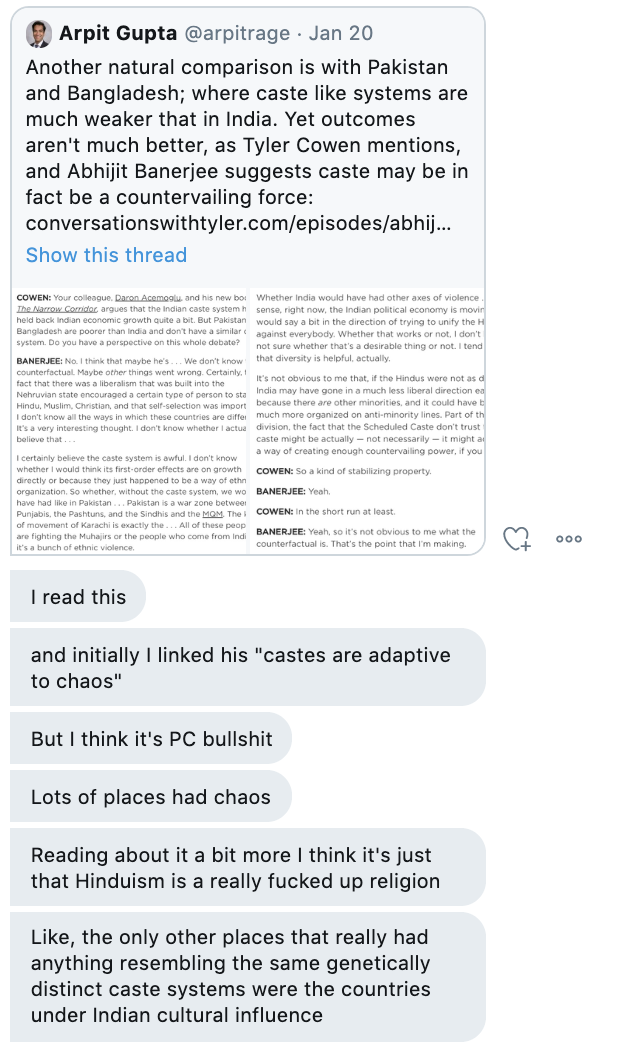
But this is a general phenomenon. People will tell me things they might not tell others because I don’t judge (unless they are stupid). A friend who is a big player in Democratic and progressive politics has been trying to get a sense of why India has caste, and other regions do not. I can’t give him a good explanation.
Ultimately though, he concludes from the existence of caste that Hinduism is a messed up religion
The time of the tribes cometh
Two leaders of Western European countries of Indian background?
The myth of Arabian paganism, and the Jewish-Christian origins of the Umayyads
Ibn al-Kalbi's 'Book of Idols' depicts 6th c. Arabia (excluding Yemen) as dominated by paganism. But what do the Arabic inscriptions of 6th century Arabia tell us? day 2 ~AA @safaitic pic.twitter.com/HkcleuU88g
— Tweeting Historians (@Tweetistorian) April 28, 2020
 Today on Twitter there was something interesting and edifying posted. The account about reported the finding that 6th century inscriptions of a religious character in Arabia seem invariably to be Christian, rather than pagan. This is interesting and surprising because Islamic tradition, and works such as the 8th century Book of Idols, allude to a 6th century Arabia which was aggressivley pagan. Islamic tradition speaks of the city of Mecca as a center of public elite paganism; a piligrimage site for Arabian pagans. This was the paganism that the prophet Muhammad rebuked and destroyed. The conventional narrative is that these newly converted Arabs burst out upon the world, conquering much of Byzantium, and swallowing Persia in toto.
Muslims believe that their religion is the primordial religion, the monotheism of Adam, the first man. Traditionally groups such as Christians and Jews were seem as reflecting some of that primordial religion, while