
Category: Uncategorized
China’s Israel
My friend Ammar wrote up this very informative article for The News on ChinPak relations:
In 1960, Zulfikar Ali Bhutto, Pakistan’s natty and cocky minister in President Ayub Khan’s cabinet, abstained from voting on, instead of voting against, China’s membership of the United Nations. Using his discretionary powers as head of his country’s delegation to the United Nations in New York, Bhutto, by abstaining, had sent a personal signal to China about his preferred direction for Pakistan’s foreign policy. However, his action elicited strong protest from Washington, Pakistan’s closest ally, and Bhutto’s discretionary powers were revoked by Pakistan’s foreign minister.
Hardly a decade after independence from the British, Pakistan, at that time, was firmly entrenched in the Washington camp as a member of anti-Communist blocs such as CENTO and SEATO. On the other hand, India and China, during the 1950s, enjoyed a close relationship as leading anti-colonial and non-aligned states equidistant, politically, from both Washington and Moscow. The winds of change began to blow in 1959 when Tibet crises erupted and led to a full-blown Indo-China war in 1962; it resulted in a humiliating defeat for India and provided an opportunity to Islamabad to improve relations with Beijing.
Six decades after Bhutto’s flirting with the Chinese at New York, the relationship between Pakistan and China has mutated into a reputed “all-weather” friendship; it also shows how strategic interests can successfully trump a bewildering array of cultural, economic, physical and security obstacles. It was the mutual hostility towards India, the common neighbour, which brought Pakistan and China together for the first time; over the decades, China has become Pakistan’s chief diplomatic partner, its main arms supplier, and the most trusted friend to whom it turns at the first whiff of trouble or peril.
Pakistan tried to play China card in 2011 after American raid on Abbottabad to capture Osama bin Laden. It is important to note that China, at that time, rebuffed Pakistan’s efforts and advised Islamabad to mend its relations with Washington.
In the coming decades, with the recently signed US $60 billion economic projects, known as China Pakistan Economic Corridor (CPEC), China is slated to become the principal financier of economic projects in Pakistan. CPEC has been touted as a game-changer and forms an integral part of China’s ‘One Belt One Road’ strategic vision for the region. Athough China’s relations with India, since the 1962 war, have improved significantly resulting in billions of dollars’ worth of trading deals, Chinese investment and interest in Pakistan’s economic projects form the centre-piece of its confident economic and strategic policy for the whole neighbourhood.
Apart from India, Pakistan’s nuclear programme and its relations with Washington, situation in Afghanistan, war on terror and against militants after 9/11 are other important areas on which Pakistan-China dialogue and cooperation have focused. In the early 1970s, Pakistan played the matchmaker role between Washington and Beijing when China became member of the United Nations and established diplomatic relations with the United States.
China sided with Pakistan during its two wars with India in 1965 and 1971 but did not intervene or open any front with India; Washington discontinued military aid to Pakistan in 1965 and failed to exert any meaningful pressure on Indira Gandhi in 1971 despite then recent and successful diplomatic efforts by Pakistan to bring Washington and Beijing closer to each other.
Pakistan was disappointed by the failure of both Chinese and Americans to come to its rescue in the 1971 war against India; both countries paraded their sympathies without offering much in material support to Pakistan who lost one-fifth of its territory and half its population in this catastrophic war. Pakistan realised the limits of diplomacy or military alliances, when it came to its two allies, and turned towards a strategic deterrent, the nuclear bomb option, to bolster its defense against traditional rival India.
Although China did not intervene during the 1971 war with India, it has emerged as the main arms supplier to Pakistan. More importantly, as Andrew Small argues in his book, it was in the realm of nuclear cooperation that Pakistan-China relationship bound forward and assumed a distinctive character of its own. Andrew Small has written a fascinating and compelling book titled The China-Pakistan Axis — Asia’s New Geopolitics.
Small has worked on Chinese foreign policy and economic issues in a number of capitals across the globe and is presently serving as a Transatlantic Fellow at the George Marshall Fund in Washington D.C. His book crackles with insight and information on topics such as Beijing’s extraordinary and essential support to Pakistan’s nuclear programme and defence planning, their strategic cooperation on India, the United States and Afghanistan, and the implications for counterterrorism efforts.
China, as a matter of its policy, has eschewed military or defense alliance with Pakistan but has whole-heartedly supported its hugger mugger efforts to acquire nuclear capability — the ultimate means of self-defense — and develop or upgrade ballistic missiles system. Pakistan, on its part, has also extended full support to China by readily giving access to western military equipment, including the American missiles which landed in Pakistan or the US Marines’ helicopter that crashed in Abbottabad in 2011 during the raid to capture Osama bin Laden, so that Chinese engineers can copy western military equipment through reverse engineering.
In 1966, a few months after the war with India, when Chinese Premier visited Pakistan he was cheered by jubilant crowds and welcomed by a phalanx of Pakistani officials in Lahore, prompting the US Consul General in the city to bemoan that “Pakistan is lost”. Decades later, China’s military chief General Xiong Guangkai, during his exhaustive parleys with his American counterparts, remarked that Pakistan is China’s Israel. China has also timed its missile sales to Pakistan, Washington noted, as a retaliatory move to US sales of F-16s to Taiwan in 1992.
Strategically, Beijing views Pakistan as a counter-balance to India but at the same time wants Pakistan-US relations to be robust as this places limits on the scope of US-India relations. It also means that Pakistan does not become an issue of tension in US-China ties and more importantly does not impact Sino-Pakistan security ties due to Washington’s pressure or sanctions.
After the Lal Masjid incident in 2007, terrorism in Pakistan assumed menacing proportions till Pakistan army cleared the militants from FATA and Swat following a series of failed agreements. China, as a matter of policy, has advised Pakistan to control and combat militancy which is a threat to both Pakistan’s society and state and can potentially derail Chinese growing investment in Pakistan’s economic projects.
More importantly, Pakistan has become the most dangerous overseas location for Chinese workers. China may have been sympathetic to the blowback argument used by Pakistan’s officials in the past to justify its reluctance to move decisively against militants but as China’s stake in Pakistan’s economy expands, Pakistan’s security apparatus will likely come under increasing Chinese pressure to step up its anti-militants drive.
On Afghanistan, a stable settlement, which also includes reconciliation with Taliban, is the preferred option for China who does not want Afghanistan to become a safe haven for Uygur militants, actively operating in China’s provinces, or descend into chaos so that it becomes a threat to China’s growing interests in the region. It is not in China’s interest that Washington should walk away immediately leaving Afghanistan without a workable solution and at the mercy of militants.
Despite military cooperation with Pakistan over the decades, China, during the Kargil war in 1999, coordinated its efforts with Washington and prodded Pakistan to de-escalate the situation by pulling back its forces from the theatre of war. However, in 2002, following attack on Indian Parliament, and later in 2008, in the aftermath of Mumbai attacks, China, in coordination with Washington and other Western capitals, exerted pressure on India to bring down the temperature as the situation had become quite tense and febrile on both occasions.
Small forcefully avers that if the US approach to India over the last decade has been one of de-hyphenation from Pakistan, China’s has been one of re-hyphenation. In response to US-India nuclear power deal, China has signed up new nuclear power plant agreements with Pakistan. China is heavily involved in developing Gwadar, Pakistan’s deep water port off the Balochistan coast. In 2015, Pakistan and China signed a US $5 billion deal for sale of eight Chinese submarines to Pakistan, making it the largest Chinese defense deal to date and facilitating Pakistan’s nuclear capability in the shape of sea-based deterrent.
There is a consensus on the side of Pakistan’s both civilian and military leadership to sign up to CPEC. If Pakistan’s relations with China were unaffected by Bhutto’s hanging in 1979, despite Chinese efforts to save him, it is quite certain that Pakistan-China relationship is not hostage to any political or military leader’s presence on the scene or staying in power of any specific political party in Pakistan.
Pakistan tried to play China card in 2011 after American raid on Abbottabad to capture Osama bin Laden. It is important to note that China, at that time, rebuffed Pakistan’s efforts and advised Islamabad to mend its relations with Washington. In the past, China has made limits of its support clear to Islamabad on different occasions. However, as Small argues, China’s increased investment and involvement, during the last decade, in Pakistan’s economic landscape and security deals might have changed the nature and calculus of Sino-Pakistan relationship.
China will increasingly defend Pakistan in face of future American pressure but at the same time will exert more pressure of its own to steer Pakistan towards a path which is economically beneficial but will place constraints on the free hand that Pakistan’s military and civilian elite has hitherto enjoyed in their decision-making.
Muslim aggression
We were walking the little doggo (who is mA a cutie & constantly admired) down the road and we crossed this Muslim couple. The couple got so anxious that the husband barked out “save your Dog.”
Now I have no idea what that actually meant except that he was a recent immigrant judging from his grasp of the language & dress.
What did shock me was his hubris; the fact that as a recent immigrant he found no need to understand the societal mores of a dog-loving society.
I’ve constantly seen this with hijabi Muslims that as soon as they see the doggo they start going into a panic. I blame lefty WASP liberals who make no attempt to encourage this angry population to integrate into the mainstream.
Race is not just skin color
“The southern Indians resemble the Ethiopians a good deal, and, are black of countenance, and their hair black also, only they are not as snub-nosed or so woolly-haired as the Ethiopians; but the northern Indians are most like the Egyptians in appearance.”
– Arrian
I might almost say that the same animals are to be found in India as in Aethiopia and Egypt, and that the Indian rivers have all the other river animals except the hippopotamus, although Onesicritus says that the hippopotamus is also to be found in India. As for the people of India, those in the south are like the Aethiopians in colour, although they are like the rest in respect to countenance and hair (for on account of the humidity of the air their hair does not curl), whereas those in the north are like the Egyptians.
-Strabo
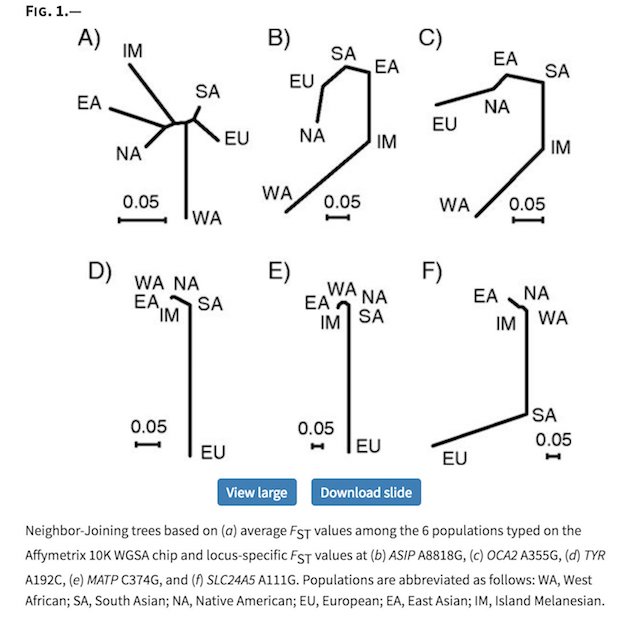
The plot above is from Genetic Evidence for the Convergent Evolution of Light Skin in Europeans and East Asians. It’s a 2007 paper. For those of you not versed in genetics, 10 years is like the difference between the First Age and Third Age on Middle Earth. For those of you not versed in Tolkien, 10 years is like the difference between Gupta India and Maratha India? I think?
Basically, the authors looked around the regions of the genome of loci known to be implicated in pigmentation variation in 2007, which mostly started from differences between Europeans and Africans. In the plot above you see pairwise genetic distances visualized in a neighbor-joining tree. The populations are:
SA = Asians, IM = Island Melanesians, WA = West Africans, EU = Europeans, EA = East Asians, and NA = Native Americans
What you see is that pigmentation loci are not phylogenetically very informative. Because of ascertainment bias in discovery Europeans are an out-group on many of the genes. But overall you see that the trees generated by a relationship on pigmentation genes do not conform to what we’d expect, where Africans are an outgroup to non-Africans. This is not surprising, as any given locus is not too phylogenetically informative. Additionally, pigmentation is a trait where selection has likely changed allele frequencies a lot, so it’s not a very good trait to look at to determine evolutionary relationships.

I bring this up because The New York Times and other publications are reporting on a new paper in Science, Loci associated with skin pigmentation identified in African populations, with headlines like Genes for Skin Color Rebut Dated Notions of Race, Researchers Say.
The Science paper is very interesting because it helps to make up for the long-term ascertainment bias in the literature, whereby European differences from other groups helped to discover pigmentation loci of interest. The big topline result is that there’s a lot of extant variation within Africans, and much of it is very old, pre-dating modern humans by hundreds of thousands of years, implying long-term balancing selection to maintain polymorphism.
Here’s a quote from The New York Times piece:
For centuries, skin color has held powerful social meaning — a defining characteristic of race, and a starting point for racism.
“If you ask somebody on the street, ‘What are the main differences between races?,’ they’re going to say skin color,” said Sarah A. Tishkoff, a geneticist at the University of Pennsylvania.
…The widespread distribution of these genes and their persistence over millenniums show that the old color lines are essentially meaningless, the scientists said. The research “dispels a biological concept of race,” Dr. Tishkoff said.
I can go along with all the sentences more or less except the last. Skin is the largest organ we have, and it’s pretty salient. West Asian Muslims regularly referred to Indians as “black” (early Islamic Arabs referred to the people of Sindh as “black crows”). They defined themselves as white (though contrasted their own olive complexion with ruddy Europeans). The Chinese referred to themselves as white, and Southeast Asians, such as the inhabitants of the ancient Cambodian kingdom of Funan, as black. Among South Asians, skin color is also very salient. During the period when Pakistan included a western and eastern half the West Pakistanis were known to refer to the Bengalis as blacks, while East Pakistanis who went to study in the West, like my father, were surprised that not all Pakistanis were white like Ayub Khan.

But racial perception and categorization are not identical with skin color. The ancients knew this intuitively, as the quotes from Arrian and Strabo above suggest. They were aware that South Asians were dark-skinned, but those in the north were lighter than those in the south, and that those in the south resembled Africans in the range of their complexion. But, they also knew that it was not difficult to distinguish a South Asian from an African in most cases, because South Asians have different hair forms and to some extent facial features, from Africans.
I know this myself personally. Living in almost white areas of the United States for most of my childhood I encountered some racism. My skin tone is within the range of African Americans. But when it came to racial slurs I was usually called “sand nigger”, or more sometimes “camel jockey.” Please note that the modifier sand. Even racists understood to distinguish people of similar hues who were clearly physically distinctive.
Conversely, African Americans did not usually recognize me as African American. Living in the Pacific Northwest there aren’t many non-whites. It’s also very rainy. Sometimes when I was wearing my Columbia jacket with hood black men walking from the other direction on the sidewalk would start to nod at me, assuming I was black. But mid-way through the nod as they approached me they recognized that despite my brown color I was not African American and would stop the motion and switch to a manner of distanced politeness as opposed to informal warmth.*
Finally, I also had East Asian friends who were very light-skinned. As light-skinned as any white person of Southern European heritage. That did not prevent racists from calling them “chinks” or (more rarely) “gooks.” These racists were seeing beyond the skin color.
If ancient authors from 2,000 years ago understood that race is more than skin color, and if genuine bigots understand race is more than skin color, I fail to understand why so often the public discourse in the United States acts as if race is just skin color. We know it’s not so.
The reason I’m posting this on Brown Pundits is that the focus on skin color made sense to me growing up in the United States, but as someone of South Asian ancestry I also knew it was not sufficient as a classifier. I knew when I was probably around five. Many South Asians see a huge range in skin color within their immediate families. That is, empirically the fact that there were large effect QTLs segregating within South Asians is obvious to any South Asian who grew up around South Asians.**
My mother is of light brown complexion. My father is of dark brown complexion. My mother’s complexion is fair enough that she is usually assumed to be Latina if she doesn’t speak (her accent is clearly South Asian), and in cases has been misjudged to be Southern European. My father, like his mother, is in contrast on the darker side. Their Bengali friends would joke that they were an interracial relationship.
My father’s father was very light skinned, and his mother was very dark skinned. Some of his siblings were dark, some of them were light, and some of them were between. One of my father’s brothers is basically a doppelganger of my father, except he is lighter skinned.
And yet there was never a question that both my parents were ethnically Bengali. They were both people with deep roots in Comilla in eastern Bengal. Now that I have their genotypes I can tell you that my parents are genetically clearly from the same region of Bengal; they cluster together even compared to other Bangladeshis. In fact, my father is more Indo-Aryan (every so slightly) shifted than my mother. I suspect it is through his mother, whose father was born into a family of recently converted Brahmins. It is clear that skin color is not predicting phylogeny in this case, and I am sure many South Asians intuitively grasp this because of the variation in complexion they see across their families, who are usually from the same sub-ethnic group in any case.***
A multiracial United States is going to be more complex world than the situation before 1965, when America’s racial consciousness was partitioned between black and white (notwithstanding Native Americans, Hispanos and other Latinos in the Southwest, and a residual of Asian Americans). But sometimes I feel the intellectual and cultural elite of this nation is stuck in the paradigm of 1964.
* I have a friend from Kerala in South India who has talked about being mistaken for being Ethiopian.
** I am the only South Asian my daughter has grown up around, and her complexion is far closer to her mother’s than my own. She did have a difficult time distinguishing me from black males in her early years because to her my dark-skin is very salient. When her mother asked her to give reasons why African American males might look different from her father, she immediately clued in on the hair and facial features.
*** Black Americans and Middle Easterners, and a whole host of other groups where pigmentation loci segregation in appreciable frequencies, can all see that differences in skin color do not necessarily denote differences in race, since there is so much intra-familial variation.
Home – Lost, Found and Imagined
One of Brown Pundit’s commentators, Ruchira, wrote a wonderful piece (titled similarly to this post) on her sadly discontinued still archived but profound blog, Accidental Blogger, in 2007 about being an NRI. It was really very well-written and I thought I would reproduce it here for its 10+ year anniversary. For someone like myself who has such diverse origins and is also “peripatetic” (it’s always nice to have to google words to refresh on their exact meaning); this piece really resonated with me.
This is one of the few personal essays Ruchira had written on her blog and her father-in-law, mentioned below, passed away last year in 2016. I have excerpted & italicized a particularly moving passage on him as he was a noted Urdu writer.
It is bittersweet that Urdu, an exalted melange borne of poets, warriors & nomads, is cursed to wrestle with death every few generations in the bloodiest of circumstances (1857, 1947, 1971). Truly a tongue more suited for war than peace, for pain than pleasure but then perhaps that is what makes it so achingly beautiful and ephemeral.
A noted Urdu writer, my father-in-law has written extensively on his experience and that of others during these traumatic times. One of his most acclaimed books tells the story of Indian Muslim refugees in Pakistan transforming their new domicile in Karachi into the Indian city of Lucknow from where they were displaced, brick by brick in their dreams. His literary account of the losses on both sides of the border vacillates between regret, fear and doubt – sometimes harshly critical, sometimes sadly sentimental and always nostalgic. Unlike my own family, my husband’s parents have visited Pakistan several times – until fairly recently. I have often wondered why my father-in-law couldn’t let go of the memories while my own parents were able to. Was it because he made the partition his literary genre and therefore it remained on his mind long afterwards or conversely, did he write about it because he couldn’t get over the loss? Could it be that the carnage he witnessed was so etched in his mind that he bears a far greater sense of betrayal? I don’t know.
All in all a very wonderful and lyrical piece, which I’m very happy to share below.
Home – Lost, Found and Imagined
More than twenty six years ago, I left New Delhi, India to follow my peripatetic husband on a journey that would take us across two new continents and four different cities. Until then my birthplace Delhi, was the only home I had known. Most of my family and all my friends lived there and frankly, I had never imagined leaving that comfortable zone of familiarity except for travel and tourism. In the years since the initial uprooting, the idea of home has undergone dramatic changes in my mind, as has the definition of comfort zone. What exactly is home for any one of us? Where the heart is or where the hearth is? Is it the place we ourselves grew up in or where we bring up our children? Do we define it by the food, the smells, the climate or the faces around us? Or is much of it in our minds?
For ages humans have left their homes in search of food and adventure, as also in fear. They have set down new roots in unfamiliar landscapes . Having done so, they have surely at one time or another reflected back on that decision and wondered if their lives were better or worse for having left. Good and bad fortunes are both ascribed to the decision to leave one’s homestead.
Severing ties with once familiar surroundings can come about in two ways – voluntarily and involuntarily. For some it is a deliberate choice of a new life in a new place. Others leave under the threat of natural or man made disasters. There is no doubt that the initial trauma and the feeling of helplessness is much greater for the latter group. But after years, when things have settled down and a modicum of normalcy returns, do things even out? Do those who are violently uprooted from their nests continue to pine for their loss longer and more keenly than those who leave peacefully? During WWII did European Jews fleeing the horror in their homeland miss Poland, Germany, Hungary and Lithuania once they found safe haven elsewhere? Or were they able to shed their attachment for the “home” that didn’t accord them dignity and provide sanctuary? Will Palestinian refugees ever accept a peace settlement with Israel without a “right of return” clause? Are displaced persons from war torn regions more or less nostalgic about their homes than immigrants such as myself who chose to relocate under placid circumstances? Or is it all in our head, how rooted or uprooted we feel in one place or another?
Both of my parents and my father- in-law lost their ancestral homes during the partition of India to what was to become Pakistan (east & west). My own parents came from the eastern wing of partitioned India which saw far less sustained violence than the western part to which my husband’s family belonged. My parents’ side of the family lost considerably more in material wealth and social standing than did my in-laws. Yet there was a dramatic difference in the way the two families chose to remember their loss. Although their circumstances had been seriously and even brutally altered, my parents and other close relatives went on to live reasonably comfortable lives in India, going about their business in a forward looking manner. They explained the partition in terms of politics, history and the perfidy of the British. Their progeny (me included), born in independent India in safe and peaceful circumstances heard their stories and in their imagination, often conjured up a sense of loss more wrenching than the refugees themselves felt. But that is always the peculiar burden of subsequent generations – to feel more helpless, more enraged and more emotionally bereft for the sufferings of their elders. The victims themselves who live through the terror and the humiliation manage to often remember their experience with aloofness and perhaps even triumph, looking back at discrete events which they managed to survive against all odds.
Like my family, my father-in-law too did well for himself in east Africa (he left India soon after the partition) and in India where he returned several years later. But to this day, he remains very sentimental about his interrupted life and his erstwhile home from where he and his family escaped with little more than the shirts on their backs. He witnessed widespread violence during the bloody mayhem that accompanied India’s wrenching territorial partition and population exchange. A noted Urdu writer, my father-in-law has written extensively on his experience and that of others during these traumatic times. One of his most acclaimed books tells the story of Indian Muslim refugees in Pakistan transforming their new domicile in Karachi into the Indian city of Lucknow from where they were displaced, brick by brick in their dreams. His literary account of the losses on both sides of the border vacillates between regret, fear and doubt – sometimes harshly critical, sometimes sadly sentimental and always nostalgic. Unlike my own family, my husband’s parents have visited Pakistan several times – until fairly recently. I have often wondered why my father-in-law couldn’t let go of the memories while my own parents were able to. Was it because he made the partition his literary genre and therefore it remained on his mind long afterwards or conversely, did he write about it because he couldn’t get over the loss? Could it be that the carnage he witnessed was so etched in his mind that he bears a far greater sense of betrayal? I don’t know.
Last month I came across the poem, “How Do You Like Austin?” by Maurice Leiter at Brian Leiter’s blog. It is apt to quote a few lines from the poem here.
How do you like your new home? …
But isn’t it different from New York?
I am different from them both.
Once the sightseeing is done,
There is really no place
That is not home.
After initial few years of slight disorientation (especially the two years in Germany), like Maurice Leiter, I too no longer fret about where “home” is. It now is a state of mind that transcends geography. I have found wonderful friends and a rhythm of life that I can enjoy almost everywhere I have lived. In the early days when I visited Delhi, I felt I was going “home.” Gradually as the years went by, the return flight to the US began to acquire the feel of “coming home.” Since the death of my parents, Delhi, which I still love to visit, feels less and less like the home I knew. Also, I am now much less connected to the political / social reality in India, a connection which for me, is vital to feeling at home. Delhi will never fully cease to be “home” for me – it is thoroughly integrated in my memory and my imagination. But “home” now no longer evokes a single concrete image as it did in my youth. Several others vie for that honor – places where I have been, where I am now … and hopefully also where I will be in the future. I can now go back and forth physically between these spaces at different times and emotionally inhabit them simultaneously. All feel equally comfortable and I don’t have the need to transpose one upon the other to create an illusion of the perfect “home.”
Life expectancy in South Asia
India is very heterogeneous. Nevertheless, the contrast between Assam and Bangladesh is very curious to me.
| 1 | Kerala | 74.9 | 74.0 |
| 2 | Delhi | 73.2 | – |
| 3 | Jammu and Kashmir | 72.6 | – |
| 4 | Uttarakhand | 71.7 | 60.0 |
| 5 | Himachal Pradesh | 71.6 | 67.0 |
| 5 | Punjab | 71.6 | 69.4 |
| 5 | Maharashtra | 71.6 | 67.2 |
| 8 | Tamil Nadu | 70.6 | 66.2 |
| 9 | West Bengal | 70.2 | 64.9 |
| 10 | Karnataka | 68.8 | 65.3 |
| 11 | Gujarat | 68.7 | 64.1 |
| 12 | Haryana | 68.6 | 66.2 |
| 13 | Andhra Pradesh (includes Telangana) | 68.5 | 64.4 |
| 14 | Bihar | 68.1 | 61.6 |
| * | India | 67.9 | 63.5 |
| 15 | Rajasthan | 67.7 | 62.0 |
| 16 | Jharkhand | 66.6 | 58.0 |
| 17 | Odisha | 65.8 | 59.6 |
| 18 | Chhattisgarh | 64.8 | 58.0 |
| 19 | Madhya Pradesh | 64.2 | 58.0 |
| 20 | Uttar Pradesh | 64.1 | 60.0 |
| 21 | Assam | 63.9 | 58.9 |
To be brown is to be a civilization
Though I often disagree with him, I do enjoy Zach’s perspective on things because they are different from mine, though we exhibit similarities (e.g., both of us generally align with the center-Right in Anglophone societies). Zach may be one of the first cosmopolitan desis in his pedigree; he, himself of part-Persian heritage, marrying a South Indian Sindhi, probably to raise a family in England. In contrast, I may be the last brown person in my pedigree for a while, fading into legend and myth (or infamy!).
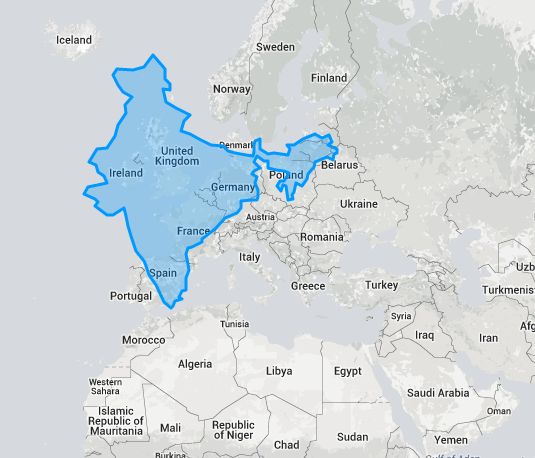
But one of the things I think is important to emphasize is South Asia is a civilizational entity straight-jacketed for historical reasons into a few nation-states. Though India and China are often compared together, they are totally incomparable insofar as the Han majority of China exhibit a racial and linguistic unity which South Asians do not (even though southeast Chinese dialects are unintelligible with Mandarin, the written language is the same).
By and large, I am predisposed to agree that someone like Zach is more prototypically South Asian than I am. Despite his religious heterodoxy his cultural rootedness in the Northwest quadrant of the subcontinent does put him at the “center of the action,” so to speak. In contrast, my own family’s recent origins are on the far eastern fringe of recognizably desi territory…. That is, my family is from the eastern portion of eastern Bengal (my grandmother was almost killed by the crazy elephant of the maharani of Tripura!). It’s interesting that 3,000 years after the emergence of Iron Age South Asian cultures the fulcrum of South Asian identity is where it began all those millennia ago (there was a period between the Mauryas and the Guptas when Bihar was the center).
Talking about what is more prototypically desi is like talking about what is more prototypically “European.” Being French or German is more prototypically European than being Albanian or Russian. We could argue why, but in your heart you know it’s true. There are definitions of Europeans which exclude Albanians and Russians (even though I’d disagree with those personally), but no plausible ones which exclude French and Germans.
Finally, I do think it indicates the limits and flexibility around race and brown identity. As Zach has said repeatedly he is very light-skinned (and part Iranian to boot). Myself, I don’t think anyone would describe me as either light-skinned or dark-skinned; I’m pretty much the average South Asian in complexion. Brown. Not light brown. Or dark brown. Literally just brown. But that doesn’t really weight much in terms of who is “more desi” or not. I have never watched a Bollywood film all the way through. That matters more.
Why Brown Pundits?
 This post is in response to Zach and Zimriel.
Why Brown Pundits? Why this blog? And why do I post here, as opposed to Gene Expression or Secular Right, or various other venues which I have access to?
To a great extent the origins of this blog for me go back to the early 2000s, when I began to have some discussions with a few South Asian friends/readers through carbon copy emails. Two of those individuals later went on to co-found the Sepia Munity weblog.
Growing up in an overwhelmingly white America my understanding of South Asians was parochial and superficial, or at least academic, until I entered adulthood. At that point I met various South Asian Americans, and formed some friendships of some durability, and began to see how they viewed the world. How their experiences differed from mine, and how they were similar.
There was, and is, a lot of diversity. But I didn’t see too much of my own perspective being represented. Books such as the Karma Of Brown Folk reflected what I think the most dominant and “hip” element of American South Asian subculture, which is culturally left-wing, and aspires toward what has become bracketed under the term “intersectional.”
I’m not saying that these people are the majority. Just that they vocal, and active, and the ones who are likely to agitate and organize around a South Asian American identity (as opposed to local particularistic identities, such as being a Tamil Brahmin, or a more general identity, such as being a liberal Democrat or conservative Republican).
This blog is a way to get some more heterodox and diverse views out there. For example, I am a libertarian leaning conservative who is an atheist, whose children are “white presenting” as they would say today. I am Bengali by birth and upbringing, but it is unlikely that my descendants will be Bengali in anything but distant lineage. That’s a statement of fact, and neither positive or negative. It probably influences my negative attitude toward fashionable anti-white poses struck by gentry left-wing American South Asians (poses struck in solidarity with other “PoC”), as anti-white prejudice impacts my family directly.
As for what I post here vs. what I post elsewhere: if I’m not aiming toward generality of inference or lesson I’ll post them here. A South Asian illustration of a general principle can be posted elsewhere, but sometimes issues and questions exhibit strong South Asian particularities, and they belong here.
What is Brown Pundits?
Even since I’ve relocated to the Shires and inspired by my wife’s intense focus on her PhD I’ve been trying to write a science fiction novel. It’s going well and it’s sort of something as a bucket list thing to do. One thing I’ve realised as a “writer” is that distractions are lethal.
Therefore virtually all of my activities have been trimmed down so that I can write more. However writing isn’t a linear activity; it’s not only related to time but inspiration.
At any rate how does this all relate to Brown Pundits? I was of course involved in the original Brown Pundits (in the winter 2010/spring 2011) but not so much in this reboot. It’s also difficult to actually pin down what Brown Pundits is about.
Do we talk cricket, no there’s cricinfo for that. Do we talk desi politics, there’s NDTV for that and we don’t really comment on films or popular culture (I watch Hindi films & Urdu drama but my commentaries on it never really get picked up). Also I don’t accept that Brown Pundit is a Sepia Mutiny successor.
The Devil wears Brown
I find the answer lies in the Devil Wears Prada. In one iconic scene an icy Meryl Streep lectures a dowdy Anne Hathaway about how MS’s Haute Couture decisions percolates through every pore and layer of fashion until it reaches to the bottom of Anne’s bargain basement collection.
BP in some ways is like that; we aren’t the High Culture of Brownitude (not by any stretch of the imagination) but the High Intellect of it. We won’t discuss Kashmir necessarily but rather the underlying pattern of conversion to Islam among Kashmiris and how that led to the situation that is today. We aren’t academic specialists by any means because we trade depth for breadth.
Of course each Punditeer has a different style; Razib is precise & knowledgeable, Omar has a ideo-political framework whereas I’m much more hazy and experiential. We also now have Slapstick with his interest in his Kashmiri Pandit history & politics.
I don’t know if I have given a clear definition but I would like to think the intellectual discourses we have here about South Asia and diaspora percolates, even in a tiny way to the rest of Desidom.
The Obliquity of Oriental Culture
I love the Tipping Point genre. I was recently reading Matthew Syed’s “Bounce” & I also enjoyed the Rational Optimist, Black Swan (which is tbh slightly different to the rest). However most of all Obliquity deeply impacted me.
I tend to be oblique, or indirect, in my aims & agenda. It’s something that’s perplexing for my wife, who is extraordinarily direct. That suits her in her academic career and cultural heritage, where Sindhis seem to wear their hearts on their sleeves.
Growing up I was deeply impacted by the very restrained mores of Irani Yazdi Baha’i culture (it’s a thing trust me & disproportionately influential in the South Asian Baha’i world). I always found desi culture much more emotional whereas ours was reserved (almost) to the point of being British, to this day I find emotional outbursts to be troubling and a personal failure (also for someone so chatty I find it difficult to discuss deep emotions).
Further to that is the distinction between the public face and the private one, again a relic of Persian culture. Now by Persian culture I have no idea whether it’s prevalent in the mainstream Iranian culture but rather in the diasporan pockets of Baha’i communities in the Gulf & South Asia. However ta’arof (the art of politeness) is a pretty universal thing among Persian speakers I imagine.
Ironically these Oriental cultural features, obliqueness, reservedness, class consciousness (that one I picked up from Pakistan which in the 90’s & naughties was positively Victorian in its class hierarchy), the private & public distinction were all cultural traits that hyper-accelerated my integration into Britain. Britain is a complex country and the class system is still very much a national feature; especially in the regions that I’m in (Oxbridge Formals sometimes feel straight out of Hogwarths).
For instance take the term “micro-aggression”; now I’m not exactly sure of what it means but I understand it to be a way of scoring racial points by white people in as subtle a way as possible. That’s basically Persian Baha’i culture because our Faith is so idealistic we can never be outright rude to one another so sometimes we manifest anger in very mundane, petty & hurtful ways.
My wife makes a good point that Pakistani & her Sindhi Bhaiband culture are very similar; there’s a love of socialising, glamour and opulence. It’s very very different to the sub-culture that I grew up in that preferred the under-stated and refined rather than scale or lavishness.
Brown Pundits becomes interesting to me personally when I need to reflect on my culture, on my mindset and whether it hinders me or aids me. I imagine if I had moved to the US instead of the UK I would have probably emphasised the more Pakistani-desi aspects of my heritage; the extroversion, the ebullience & conviviality (again I’m talking about the Karachi KGS sub-culture in Pakistan). In Britain however the haunting & melancholic tones of a lost Persia (Yazdi culture is a culture of mourning & redemption in the Faith) chime very very well here and sort of facilitated an interest in the rarer circles of British life.
I do find posh Britain to be a bit common & vulgar at times, especially when they are always trying to get sloshed/drunk (alas the English & their drink), but once one swims among the older generations there is a sense of artistic and aesthetic inclination coupled with a love of good conversation.
However nothing prepared me for my wife’s hugely superior approach she took to life in the West. Whereas I was always holding on to my idealised constructions of my heritage; she essentially junked that and showed me that even though I was a many-generationed Baha’i there was some ineffably Islamic bug about my mentality that hindered my full progression in the West.
Islamic cultures have this sort of puffed up pride because of their glory-days and Bahai’s too can sometimes have it because our Prophets were Persian. This unearned haughtiness makes us feel sometimes that the West is only technically and materially superior but nothing more. What my wife has shown me that Westerners have an extremely different, not so positive, impression of our cultures and that only through internalisation of this reality can one hope to truly compete in the West.
For all this time even though I commingled in White Society, in a variety echelons, I somehow stayed apart & alien to it because my own conception of my heritage bubbled me from truly intimate interactions. It’s only when I popped the bubble, thanks to my wife, did I truly join White Society and began to realise there are things like white privilege, micro-aggression and that white people behaved pretty much like much like ethnic people just much more subtly.
I also realised that when I went from being an exoticised & fascinating alien to be an actual member in England among the English that why so many immigrants prefer the ethnic enclave. The English are not racists but neither are they entirely welcoming. Brexit reflected that silent strain of superiority brought upon by Memories of the Empire.
If I wasn’t naturally very extroverted I would have retreated back to Londonistan a long time ago. My wife & I find ourselves in situations where we are the only dark-haired people in crowded room (it’s shocking how mono-ethnic social groups are in multi-cultural societies) and Society does see us as Sui generis.
- As an example we have the very un-Asian thing where we have a puppy (mA a beautiful one at that) as opposed to a child (Asians are more into kids, white people more into pets).
- My wife is more educated and accomplished than I am, which is rare in most couples but even more so in desi ones. We are in Oxbridge because of her.
- We live in the shires and not in the multi-ethnic urban zones.
- Even though I write on BP as Pakirani IRL I will usually call myself an Indian out of respect for my wife. The country that I cannot bear to see criticised/humiliated is India because I see it as an attack on my wife (irrational I know).
- Mind you this is very different to the BP banter where Internet Hindus wants to see me as this crazed Paki & I like to provoke them.
- For an Asian/Indian woman my wife has privileges and a voice that is rare even in emancipated Western cultures. As I said in my wedding speech I see my wife as an incarnation of Lakshmi (maybe a tad hyperbolic but YOLO).