AbdulMajeed Abid · February 18, 2021 · 16 comments
(A few additional comments added on 02/21/21)
COVID-19 is still a menace that is affecting thousands of people every day across the globe. However, vaccination and palliative therapies indicate that there is less of it ahead of us than behind us. I am training in pathology at a hospital in Texas and do not have the required qualifications to talk about the nitty gritty of COVID virus and its structure. However, I was involved in management of patients with COVID who were in intensive care and before that, in procuring convalescent plasma for COVID patients. I want to write about the policy and public health side of managing COVID and not the clinical perspective, which is not my primary specialty. This piece was inspired by two articles in the New Yorker, the first is a long-read from Lawrence Wright (here) and the second is from Charles Duhigg (here).
When news about COVID started trickling at the end of December 2019, I was not alarmed. I thought of SARS, Swine flu, Ebola and MERS, which were mostly containable viral diseases and their human impact was not global. I was at a conference in Dallas at the end of January, where a presentation was on memories of dealing with the first Ebola case in the US. I remember sitting in the back row of the auditorium and listening to the lengths that a particular hospital in Dallas went, to quarantine the said Ebola patient. By February, there was news of how Chinese state was hiding things about the mysterious viral infection and whistleblowers were shedding more light on the disease. It was in late January-early February that first cases of the mystery virus were discovered in Seattle suburbs and suppression of data/news about COVID started in the US (the Trump administration). I was at another conference in Los Angeles at the end of February and saw the news that cases of COVID had been diagnosed near San Francisco.
Upon my return to work in the first week of March, I was required by the hospital to report travel to the employee health clinic, which I did. Prior to arrival of COVID, I was going to travel to Ohio for an elective rotation and to New York to present at a conference. With COVID, all plans had to be cancelled. Since March of last year, COVID has affected millions of people across the globe and disrupted life as it used to be. One of my friends refers to any year before 2020 as “X years B.C.” (before COVID). Moving from my personal story to a bird’s eye view, what can we learn from COVID moving forward? I have tried to distill my thoughts about the pandemic, pandemic response and best practices.
Based on what we know now, here are a few things about COVID response, with relevant exceptions:
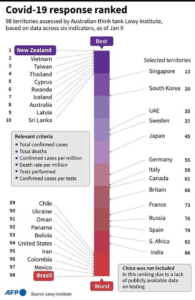
1. Island nations have generally done better, with exception of Britain and to an extent, Vietnam. At the start of the pandemic, there were fears that autocratic governments will prevail better because dictators don’t have to worry about human rights, laws or courts. That fear has not come true, generally. Australia, New Zealand, Taiwan, Sri Lanka or Vietnam are mostly democratic nations.
2. Things have been better when scientists and public health officials have been allowed to be at the forefront, except in the case of Sweden, where the top epidemiologist wanted to test his “herd immunity” theory. The New Yorker story from Charles Duhigg that I mention above, refers to a significant difference in COVID cases and deaths between New York, where politicians were at the forefront of COVID response, versus Washington state, where public health officials made the rules.
3. African nations have done better at managing COVID than most ‘first-world’ countries, in my opinion, due to their experience in dealing with Ebola, MERS and similar viral illnesses. There has been a recent second wave and a South-African variant that is more resistance to the mRNA vaccines than the OG COVID-19 or the UK variant. There was a recent story in the BBC about the second wave (here) and earlier, about the low rates of infection and mortality in the African continent (here).
4. It is incredibly hard to restrict what constitutes “daily life” even in the face of a deadly pandemic. Human beings are social animals and severing that connection from others, whether in form of closing offices or bars and restaurants, cannot be reliably depended on for long periods. Travel has become another necessity in this day and age, for business or pleasure. Airlines and the hospitality industry as a whole will be running losses for years to come. I traveled three times during the last year, twice domestically and once on an international route. I tried to be cautious and got tested before/after each of these journeys, which, admittedly is not a perfect way of being safe from COVID. There were multiple studies about spread of COVID on airplanes and I was constantly in fear of contracting it while flying, despite all precautionary measures.
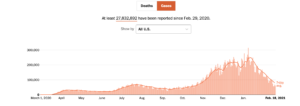
I do not frequent bars/clubs in general so i didn’t miss them much. However, I did miss spending time at the library and our nearby Barnes and Noble. If one were to look at the graphs of cases and deaths in the US, there are peaks around memorial day, 4th of July, Labor day, Halloween, Thanksgiving, Christmas and New Year. Around Christmas, close to a million people were flying every day in the U.S. Graphics from the Washington Post tracker.
5. China, not completely culpable but deserves blame for its early missteps and obfuscation (a la Great leap forward) when it comes to COVID. We still don’t know if COVID transmission started at a wet market or somewhere else. Wuhan is back to pre-COVID times while the rest of world keeps suffering. Chinese authorities have tried to strong arm the WHO and any outside effort to investigate the origin of transmission of COVID. I do not subscribe to the conspiracy theory that COVID is a “China virus” or that it was manufactured in a Chinese laboratory.
6. Vaccines. I consider the development of COVID vaccines a modern day miracle. The fastest that a vaccine had been previously prepared was close to three years. The severity of disease, mounting death rate and irresponsible behavior by the general public, made the timeline for introduction of a vaccine shorter than ever. Fortunately, the mRNA type platform vaccines had been in development for years and this was the right moment for them. The journey started in January 2020, when COVID genome was first shared by Chinese scientists and culminated in November/December 2020, when two major candidate vaccines was ready to be administered. Since mid-December, more than 73 million doses of either of these vaccines has been distributed in the US. This is a graphic from the Washington Post tracking vaccine distribution in the US:
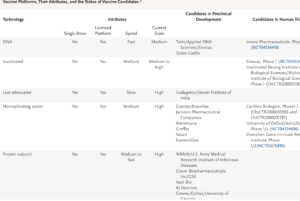
I got vaccinated in January and feel fortunate to have that immunity. However, the mRNA vaccines have a 66% response to the South-African variant (versus 90-95% against the OG COVID). The AstraZeneca vaccine has a 23% immune response to the South African variant. There is very little good data on vaccines developed by Russia, China and India. From what we know about their mechanisms of action, Russian vaccine is similar in mechanism to the AstraZeneca vaccine (uses inactivated Adenovirus), while the Chinese vaccine is based on inactivated virus and the Indian (serum institute version) uses live attenuated virus. Graphic from NEJM.
7. Viruses don’t care about state or national boundaries. The Sturgis motorcycle rally in South Dakota in August led to increased cases in neighboring Minnesota (here). A single conference in Boston in Feb 2020 lead to almost 300,000 cases (here). COVID has reached Antarctica, the last bastion of human presence without infection (here).
8. Disinformation spreads faster than the truth. The famous line that “A lie can travel halfway around the world before the truth can get its boots on” was truer during the COVID pandemic than any other modern peacetime event. Since I have a medical degree and had some exposure to COVID response, I was asked by many family members and friends from across the globe about various conspiracy theories circulating regarding COVID. The top hits included COVID vaccine altering your DNA, different cocktails for treating COVID (the whole hydroxychloroquine debacle), herd immunity, exaggerated vaccine side effects, masks, Vitamin D, COVID vs Flu, PCR vs rapid testing and their predictive values, various miracle cures etc. Many of these lies and misinformed views were spearheaded by medical personnel (doctors, nurses, nurse practitioners etc) which made it incredibly hard for a layperson to know what was the truth and what was just a fanciful conspiracy theory. To top it all off, many people initially (and still) refuse to believe that COVID is real.
9. Masks work but not all masks are the same. This is related to point 4 from earlier (human nature cannot be suppressed for long). It is hard to wear a mask all the time. I work at the hospital and that being a high-risk area, everyone has to be masked almost all the time. But, due to strict masking requirement, infection rate of workers (both medical and non-medical) at our hospital stayed less than 1% even when the infection rate was close to 10% in the community that we serve. N95s which should be worn by individuals who are at the highest risk of getting COVID provide better protection than a regular surgical mask (efficacy close to 65%), which is better than a regular cloth mask (efficacy less than 50% and needs to be washed regularly). I have seen innumerable number of people wearing their masks incorrectly (i.e. nose not covered) but I think that at least they are wearing a mask. One reason that east asian nations did better at controlling the pandemic is because mask-wearing is normalized at a larger societal level, compared to “freedom from tyranny” type attitudes seen in the US. According to estimates, if 90% people in the US had worn masks at the beginning of COVID, we could have averted millions of cases and thousands of deaths.
In Arizona, there were dramatic improvements in case numbers once mask mandates were enforced. (paper from CDC here).
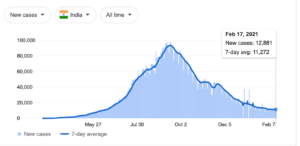
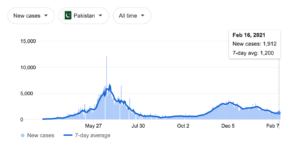
10. The curious case of Pakistan and India. Early in the pandemic, while COVID was running rampant through most of Europe, North America and South America, India and Pakistan had very few cases compared to their populations. While India has caught up with the rest of the world lately, Pakistan is still reporting less cases than any major city in the US per day. What is causing this divergence? There are many theories and until it is studied methodically, I don’t have a clear answer. Even people who got COVID in Pakistan, got a mild disease. Many people pointed to BCG vaccination as being semi-protective against COVID. Some commentators proposed immunity due to earlier sub-clinical viral infections. Are there genetic factors causing this? My hypothesis is that Pakistan is not as exposed to the outside world as lets say the United States is. Secondly, testing in Pakistan is at a much lower level than anywhere else. At one point last year, the state of Punjab, with a population larger than Germany, was doing close to 15,000 COVID tests a day. If you don’t test, you can’t diagnose. Cases in Pakistan and India, graphs from the Johns Hopkins dashboard.
11.Personal Responsibility. The mantra of personal responsibility has been used throughout the pandemic by mostly right-wing politicians, trying to avert blame from themselves, resulting in a terrible failure. Anyone who has ever worked in customer relations can tell you that most people don’t really care about other people (knowingly or unknowingly). Public health does not work that way. One can argue that even economics doesn’t work that way either, but that is a separate debate.
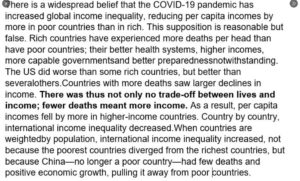
12. One heard the phrase “how many lives can you save by closing the economy” or variations of it since the early days of the pandemic. The lives versus economy rubric was debated over and over, without much evidence. Countries in the EU and Australia/NZ paid people to stay home. That approach is paying them off in the long run. In a paper titled “COVID-19 and global income equality” (here), Angus Deaton showed that saving lives has a positive impact on long-term economic outlook of a country.
13. Is the “office space” dead? Are we going to have a different economy after the pandemic? Would there be mass migration from major cities towards smaller towns and suburbs? I don’t have these answers as I am not an economist or a public planner. But these questions interest me and I am always trying to read about them.
14. Lastly, I cannot predict what is going to happen with COVID. When the pandemic started, my hope was that it would die down within six months. With a sharp decline in case numbers and increase in vaccinated individuals, I have hope that COVID would be under control by the end of the year. Would new variants disrupt this timeline and everyone will have to get a booster vaccine at some point in time? It is quite likely.
Omar Ali · February 18, 2021 · Comments Off on Capsule Review: Homeland Elegies by Ayad Akhtar
This is a very well written book and Ayad Akhtar has clearly come a long way from his debut novel (American Dervish) in terms of style and writing skill. The story is OK but did not really work for me. The book is said to be semi-autobiographical and I found that hard to get past. Is this his story or not? We are not supposed to ask that question, but somehow i kept getting stuck on it (perhaps because I have lived in Brookfield and have some vague notion of where he is from). But mostly I was disappointed by the narrator’s somewhat sophisticated but still very “inside the bubble wokeness”. He presents himself as someone willing to “go there” and talk about (and intelligently criticize/analyze) everything but it turns out that he is skeptical of everything but “super-elite wokeness”, which he seems to accept as just the not-so-simple truth about our world. I expect that well-off second generation desi kids will identify with a lot of what the narrator goes through (real or imagined) but that seems to be a rather narrow demographic. For the rest of us, the insights are less than advertised.
Still, he is, as you might expect from Ayad Akhtar, ready to get into hot topics (including Islam, oral sex, parent problems, racism) with all guns blazing, which can be fun. And his summary of partition and Pakistan is pretty good, and some of the other essay-like digressions (such as his explanation for the ills of late capitalism and what Robert Bork had to do with it) are also interesting; whether they are true (or useful) is not equally clear. if you are a second generation desi or are so intensely woke that think-pieces in “The Guardian” generally seem wise to you, then this is your book. But even if you are not, it is worth a quick read.
Many folks asked me about recent news item about conflict between two senior Indian army officers. It was simply personality clash & nothing significant. However, pedigree of both officers and some interesting historical facts were too tempting for the story teller like me.
Regards,
Hamid
Clash of Two Jats
Hamid Hussain
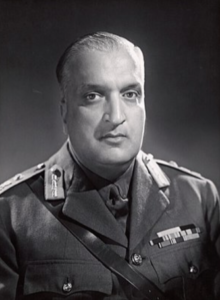
Recently, conflict between General Officer Commanding-in-Chief of South- Western Command (Sapta Shakti) of Indian army Lieutenant General Alok Singh Kler and his Chief of Staff (COS) Lieutenant General Kamal Kumar Repswal became public. Chief of Army Staff (COAS) General M. M. Naravane ordered a Court of Inquiry (COI) and Respwal was posted out as COS of Eastern Command. The nature of conflict is not clear, but some suggest that it relates to command decisions and administrative matters. There is no evidence that there was any financial irregularity or moral lapse. Continue reading Clash of two Jats in the Indian army
Whenever there is a debate on Kashmir, there is often a parallel drawn, particularly in Pakistan, between the accession of Junagadh to India, and the accession of Kashmir (also to India).
The narrative in Pakistan typically goes –
In the case of Kashmir, a predominantly Muslim state acceded to India, as its Maharaja was Hindu. While in Junagadh, India insisted on a plebiscite and eventual accession to India though its Muslim ruler had acceded to Pakistan.
While this criticism may seem superficially sound, it is very specious and misleading as it ignores how different the case of Junagadh was from that of Kashmir. It is worthwhile to reflect on the circumstances surrounding the accession of the two states.
A few things –
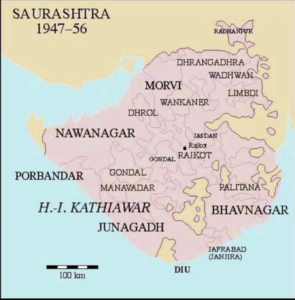
1. Junagadh was not contiguous at all with Pakistan. In contrast J&K in its entirety was contiguous with India. The Nawab’s accession to Pakistan was in violation of the contiguity principle. Here’s a map locating Junagadh in Southern Gujarat.
On the other hand, all of Jammu and Kashmir in its entirety was and is contiguous to the rest of India. So the “contiguity principle” was very much adhered to in the Maharaja’s accession to India
Image Source : wiki
2. Junagadh, with its population of 700K, was ~85% Hindu. The Nawab’s decision to accede to Pakistan was clearly in violation of the wishes of his subjects. In the plebiscite that succeeded the Nawab’s Pakistan accession, well over 95% of the voters chose to accede to India
In contrast, J&K was about 75% Muslim. Also unlike in Junagadh, where Hindus dominated the whole state, in J&K, the Muslim predominance was mainly in the Kashmir valley, while the Hindus were numerous in Jammu and Buddhists in Ladakh.
3. Junagadh’s Hindu population revolted strongly and vocally against the Muslim Nawab’s decision to accede to India. Close to 100K Hindus fled the state in the fall of 1947 as per VP Menon, leading to a near collapse of Kathiawar economy.
The plebiscite in Feb 1948 was prompted by this revolt against the Nawab’s decision. Which ofcourse settled the matter in favor of India. In contrast, in J&K, there was no major clamor among the Muslim population in favor of Pakistan. The major Muslim political body National Conference supported the Maharaja’s decision to accede to India notwithstanding its differences with the Hindu princely ruler. So it was a situation fundamentally different from that of Junagadh.
4. The Nawab of Junagadh unilaterally and hastily decided to join Pakistan, under the influence of his Dewan – Shahnawaz Bhutto (father of Pak PM Zulfikar Ali Bhutto) without even the common decency of letting the Indian govt know of the decision through proper channels.
In fact, Sardar Patel and VP Menon learnt about the decision through the media in late Aug 1947, and later got it confirmed by the Nawab. The Nawab had gone back on the word of his earlier Dewan Abdul Kadir, who had assured Gujarati press as late as April 1947, that the state won’t join Pakistan.
In sharp contrast to the indecent haste and reneging of promise by the Nawab, the Maharaja of Kashmir, Hari Singh, was deeply conscious of the fact that 70% of his subjects were Muslim. He did not accede to India in a hurry.
The accession happened only as late as 26 October 1947, following the invasion of Kashmir by “irregulars” and tribal militias sent from Pakistan. So Hari Singh’s sensitivity and judiciousness was tested to the limits and his hand was forced by Pakistan’s aggression.
5. Next, let’s examine the attitude of India and Pakistan in either case – radically different approaches.
In Junagadh, Muslim league politicians tried to “force” the hand of the Nawab through Shahnawaz, though the Nawab ruled over a Hindu province with no borders with mainland Pakistan.
While in the case of Kashmir, Sardar Patel and VP Menon assured Hari Singh throughout 1947 that they would be okay if he chose to accede to Pakistan. So the Indian attitude was a cool-headed dispassionate one that acknowledged whatever decision Hari Singh would take.
Pakistan in contrast tried to force the issue militarily in Kashmir, not just using its Army and its “irregular” agents, but by cutting off supplies and transport to Jammu from Pakistan, in an attempt to intimidate the Maharaja into acceding to Pakistan.
So these are five major ways in which the case of Junagadh differed from that of Kashmir. Clearly there is no parallel.
There is no ideological contradiction in the way India handled both cases. The Indian reaction was pragmatic and philosophically consistent.
References for the thread :
TCA Raghavan, The People Next Door: The Curious History of India’s Relations with Pakistan
In the first draft of this piece, it was mentioned that Hindus were predominant in Jammu in 1947. I have corrected this to “Hindus were numerous in Jammu”, though maybe not in a majority. The census numbers of 1941 are unreliable on account of WW2, and also the Jammu specific numbers may have been impacted in the course of 1947 on account of both the riots against Muslims in Oct 1947 and against Hindus / Sikhs in Mirpur / Rajouri the following month.
Also the % share of Muslims in the state of J&K has been edited from ~70% to ~75%, as the latter number is a fairer estimate based on 1931 census, while the former number stems from the 1961 census
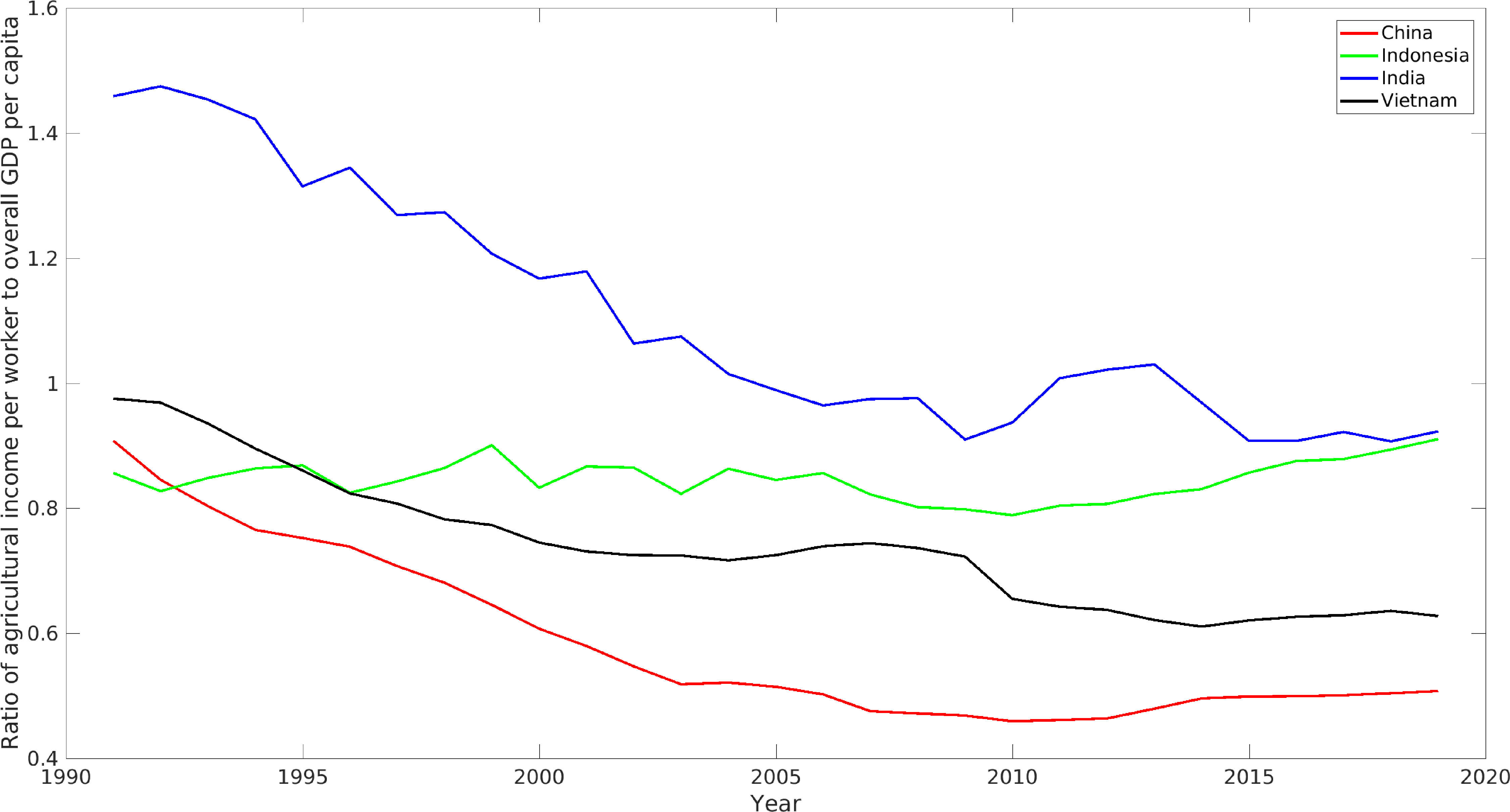
In its period of rapid economic growth, Indian democracy was successful in redistributing gains from urban centered, globalization led growth to the rural agrarian economy. The redistribution of available economic and administrative resources among competing groups is a primary concern of democratic politics. The situation is very different in non-democratic polities. In the figure below, we see that during globalization led growth, the ratio of per worker agrarian income to overall per capita GDP drops to less than a half in China and Vietnam, while it remained above or close to one in India and Indonesia. In other words, agrarian workers in one-party China and Vietnam became relatively poorer while their country became richer, agrarian workers in India and Indonesia did not incur a relative disadvantage.
Ratio of agricultural income per worker to overall GDP per capita for four Asian countries. In democratic, farmer majority India, the rural populace could always command a major share of the state’s redistributive efforts. After an initial decline from 1.4 to 1.0, the ratio in India stabilizes. In one-party China and Vietnam, the emphasis is on efficient agricultural production, not producers, and resources are invested heavily in urban areas.
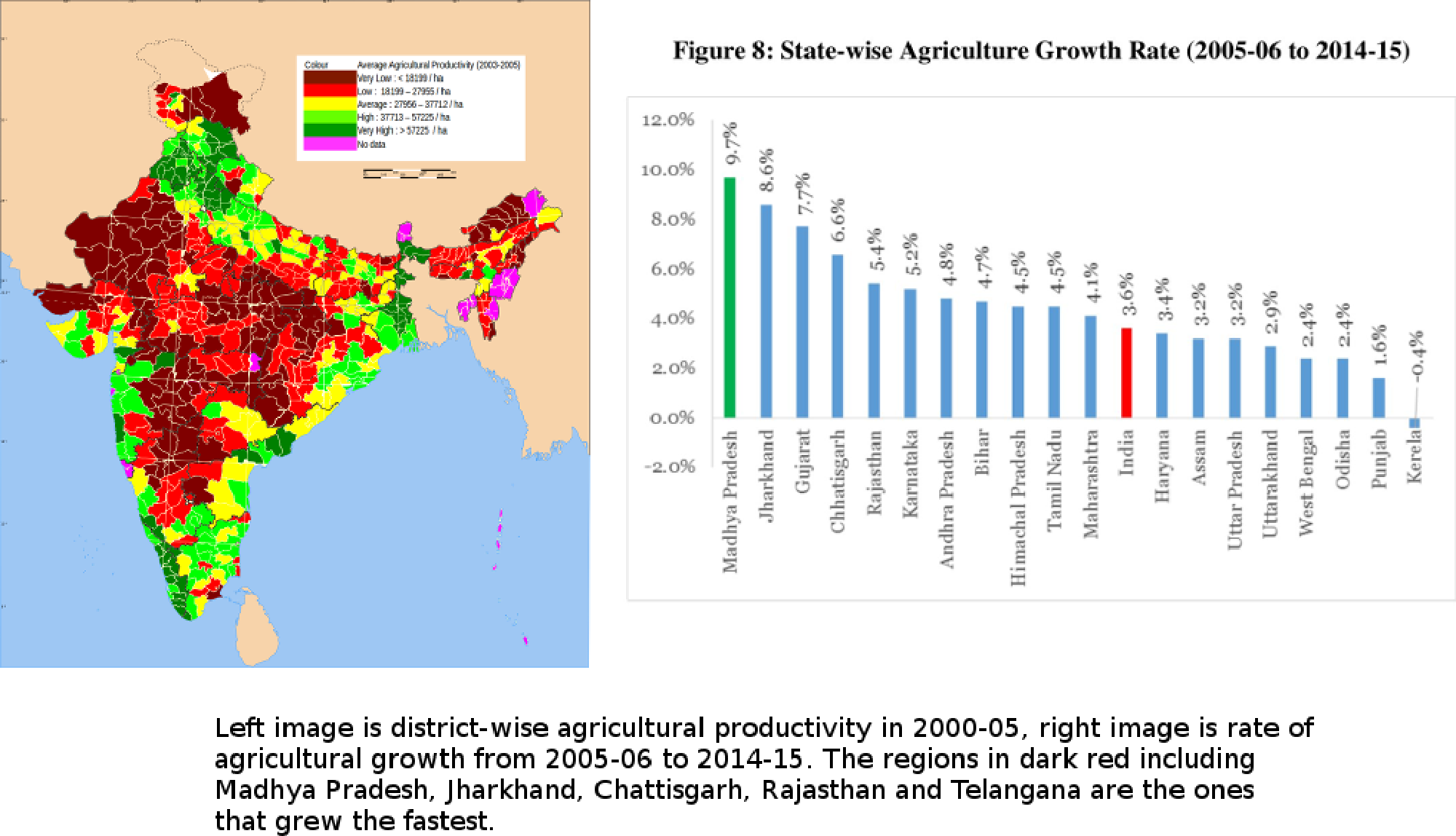
In India the vast rural population with more than a century long experience in political mobilization, has pushed governments to spend money in rural areas. Redistribution has occurred via irrigation projects, rural roads, NREGA, subsidies, loan waivers and recently, direct income transfers. Any negative externality arising from agrarian activity has been borne by urban residents (eg: Delhi smog) but farmers were not penalized. Aside from rural-urban dynamics, democratic redistribution has led to a spatial equalization of agricultural productivity across the country.
Left image is district wise agricultural productivity in 2005. Since then, as the right image shows, agricultural growth has been concentrated in the most backward areas (dark red on left). The primary drivers have been irrigation projects and rural roads.
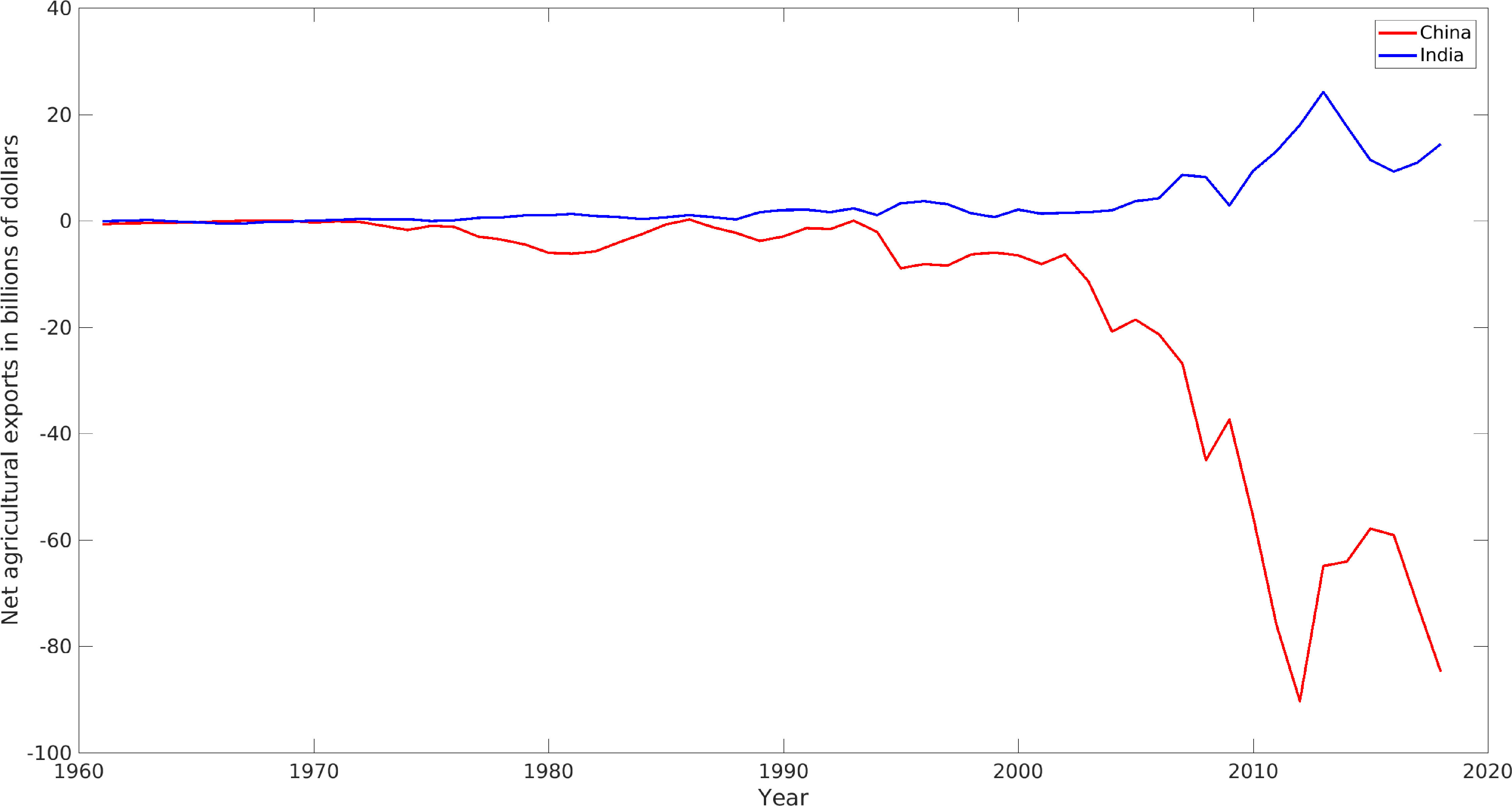
Though the condition of Indian cities is depressing, the upshot of a democracy dominated by the rural majority is comfortable food security. In fact, even though India’s use of pesticide is quite low by global standards, and its agricultural yields, cold-chain infrastructure sub-par, it has become a major net agricultural exporter. This is in huge contrast to China which has become a massive net importer of food. This is an important strategic advantage for India.
Net agricultural trade balance for India and China since 1961. China reverts to a net import situation as soon as its economy starts booming in the 1990s. in contrast India’s exports zoom in its period of economic growth.
There are signs, though, that India’s redistribution toolkit might be reaching the limits of its efficiency. Concurrently, a more reformist Indian government, awash with surplus grain, wants to re-orient farmers towards higher return crops or even an exit from farming. An urbanising electorate may also not be as willing to redistribute their hard earned tax monies towards their rural co-citizens.
The reorientation of the Punjab-Haryana farmer away from rice and wheat will require tact and persuasion, not ordinance fiat. The set patterns are very comfortable from the economic (MSP + diaspora remittances + armed forces recruitment) and psychological (we feed and secure the nation) perspective. The simple promise of higher incomes might not convince historically agrarian communities who havent fully embraced the money economy.
The Prime Minister has proven to be a masterful communicator. We have not yet seen the same skill in his dealings with the farmers. The approach there has oscillated between genuflection and disregard. The potential is there for the 200000 sq. km tract of well irrigated, fertile land in India’s north west to become the new California Central Valley (47,000 sq km). India can then become the land that greatly increases global access to premium agro-products like fresh, dry fruits and vegetarian protein. The latter (beef-mukt world) will also resonate with many urban supporters of the government and even the farmers themselves.
Centuries ago, the Mughal Prince, Dara Shikoh wrote a treatise on the similarities of Hinduism and Islam – Majma-ul-Bahrain or The Confluence of Two Seas. Wading through the songs of sages born on holy riverbanks, Dara discovered striking similarities in Vedic verses with his beloved Sufi stanzas. Dara attempted to bridge Indian and Arab minds to not only bring material peace to communities in strife but also achieve inner peace by uncovering a quintessential spiritual unity.
Dara’s quest would be cut short by his fanatic brother, Aurangzeb, who would usurp the throne and execute Dara for apostasy. A reign of religious terror followed as Aurangzeb’s extremism left permanent scars on the subcontinent until the sparks of saffron would strike back as the upstart Marathas upended the Mughals into obscurity.
Yet, this is just a part of a much more ancient interaction. Before Islam galloped across the world, Arabs were aware of the subcontinent, al-Hind, and an interesting set of interactions played out. There is no grand trend or narrative here, but I want to tell you the story of an Arabia before and after Islam and how it spoke to an India that was eternally Hindu.
This is an essay I first published on my Medium page
You can also follow me on Twitter if you’re interested!
_______________________________________________
What is Bengal?
The survival of Indic and Dharmic cultures into the 21st century is nothing short of a miracle. These are traditions that have overcome countless obstacles — some internal, others external — to ensure their survival into the modern age. They have constantly adapted to the different threats of different eras. They have dealt with the destructive and consumptive desire of Islam in the medieval ages (as it endeavored to turn India into Persia or Mesopotamia —another ancient civilization and culture forgotten to history), as well as the inquisitive and penetrating eye of western liberalism that came with British colonial rule, which posed many (justified) questions about the moralities and validity of Indic cultures and traditions. These indigenous cultures continue to adapt and evolve to ensure their survival in the modern age. The resilience of India’s indigenous cultures is something that every person who identifies with India should be proud of.
But the reality is, that these cultures and the people who used to follow them, haven’t survived all in one piece. In the rigorous process of history, Indian civilization and Dharma has been in retreat for hundreds of years, and has lost its left and right limbs (Punjab, Sindh, Bengal) as a result of this retreat. This is if we just restrict our imagination to the historical territorial boundaries of India. If we extend our sight to the cultural frontiers of India — through the proliferation of Hinduism and Buddhism — these frontiers can extend all the way from historical Afghanistan to historical Malaysia. Buddhism in itself is a curious piece of Indian history — and criminally under-appreciated and often forgotten. It is one of the four main independent religious traditions that have come up in India — along with Hinduism, Jainism and Sikhism. And even though Buddhism is India’s most successful “export” ever (although that is being changed in modern times with Yoga), we have almost no “ownership” over Buddhism and almost no authority to speak for it. It is a curious paradox of our history.
The reality for a non-Abrahamic, indigenous culture in the 21st century is that due to the nature of the world we live in, which is dominated by two Abrahamic religions that are based on revelation and obsessed with expansion and evangelization, the survival and propagation of these indigenous cultures cannot be taken for granted. In my opinion, there are perhaps very few places in India where the roots of Dharma are as threatened as in Bengal. More precisely, I am talking about West Bengal, the 37% of Bengal that still remains with us in the Indic fold. The conversation becomes much more complicated if we try to include all of Bengal in this story. I say this with full humility, as I am not a Bengali myself. But I have lived in Kolkata for more than two years and, as a student of history and political science, I have not been able to stop thinking about this curious part of the Indian subcontinent.
So what does the world see when it looks at Bengal? How do we understand its history, its culture and identity? A simple Google image search result tells us that when the world looks at Bengal, it sees this: [This is one of the first search results for Bengal in Google Images]
If you’re an American, you probably think of the Football team from Cincinnati
The logo of the Cincinnati Bengals
Most people, unless they are from the Indian subcontinent, rarely think of the land of Bengal when they hear the word. There isn’t a lot of curiosity for this most-fertile of regions, its culture, its tradition, or its history. This is sadly seen among India as well, especially in the political realm, where states like Uttar Pradesh and Maharashtra have historically dominated the discussion. However, I think that this topic, especially the history and culture of Bengal, deserves more discussion and attention. This dissatisfaction with the way Bengal is viewed by the world is what has driven me to write this article.
There are probably many factors that have contributed to the current predicament of how we see and understand Bengal today. The historical narrative of the land of Bengal is muddied and foggy. One gets the feeling that it has been purposefully obfuscated by our historians to avoid coming to terms with the history of Partition and the desire to uphold what I call the “Commandment of Communal Harmony”. This is a favorite technique of the modern Marxist Indian historians who, due to a combination of ideological leanings and political patronage (mainly by the Nehru-Vadra family and the Left parties) were given almost a free-hand in shaping India’s historical narrative in the post-Partipendence (Partition + Independence) period. To break through this fog, one must go back to primary sources and also realize that history is complex. Often, many different things are going on in the same society at the same time, and that usually, the accepted narrative of “history” (that is, for example, taught to us as History in our school textbooks) is decided for political or activist purposes. A lot of local history in India is also not available in English, but is rather recorded by local authors in their vernacular languages, something that makes it slightly tougher for English-speaking academics to access. For example, we must realize that the creation of the Indian Muslim League in Dhaka in 1906 is just as much the history of Bengal as the activities of Surendranath Banerjee, Swami Vivekananda or Aurobindo Ghosh that were part of the freedom struggle of India. One part of Bengal considers Huseyn Shaheed Suhrawardy as their hero, while the other considers Subhas Chandra Bose to be theirs. The stories of West Bengal and East Bengal are parallel stories in many regards and as such, lead to what psephologists call a “fractured mandate”, when it comes to being able to claim “ownership” over Bengali history and identity.
In this article, I am going to attempt to understand the history of Bengal through a Dharmic sense, and to think about a recipe for revival.
Bengal: A Fractured Land
Firstly, for those of us in India, it is important to realize that this is Bengal too. As is this. Bengali identity, history, language and culture is sadly not just ours to claim. We have to share this identity with a rather curious neighbor — one that has changed clothes thrice in the last 100+ years — First being known as East Bengal, then as East Pakistan, and now, Bangladesh. I prefer to call it East Bengal. You can see this in the results of a 2002 survey conducted by the British Broadcasting Corporation (BBC) about the Greatest Bengalis of all Time. The list is not topped by Tagore (although he does come second) or Bose (who comes fifth), but rather by Sheikh Mujibur Rahman, the founder of the current nation of Bangladesh. Huseyn Shaheed Suhrawardy, the man known in India as the “Butcher of Bengal” and someone who perpetrated attacks on his own Hindu citizens as the Prime Minister of undivided Bengal on Direct Action Day (16th August, 1946), stood 20th in this list. If that doesn’t tell you how distant the East Bengali mind is from the West Bengali mind, nothing will. And for me, it is a good embodiment of the problem that Bengal faces today: It is a fractured land with a fractured identity.
Bengal, before the 1947 Partition
The roots of this confusion are found in the history of the land that makes up undivided Bengal. Bengal suffered from almost uninterrupted Islamic rule from the 13th century onwards till basically the Battle of Buxar in 1764. Other parts of India suffered from this destruction as well, but many of these places resisted and fought-back, as one can see with the Marathas in Central India, the Vijayanagara Empire in the South, the Ahoms of Assam and Maharaja Ranjit Singh in Punjab. These other parts of the country saw twists and turns, where Dharma was able to resist and reassert itself, thereby undoing the demoralization and fear that Hindus (and Buddhists, Jains and Sikhs) must have lived through under the tyranny of Islamic rule, which came along with things like the Jizya tax. Nothing like this ever happened in Bengal. In places like Awadh and the parts of the country that today make up the states of U.P., Rajasthan and M.P., even though the people had to live under the thumb of Islamic rulers, they often had local, Indic rulers who still maintained local autonomy by accepting the suzerainty of the Islamic rulers in Delhi or Agra, and resisted the complete Islamization of the population of the Indian North. For example, an interesting counterfactual question could be asked: what would the religious demographics of Rajasthan be today, had the Rajput rulers not acted as a buffer to preserve their own faiths (and the faiths of their subjects), as they did by accepting the suzerainty of the Mughals? Would Rajasthan even be part of India today? Or would it have been another province of Pakistan, given that it is attached to Sindh, where this change in the demographics of the rural population did occur?
This is exactly what happened in Bengal for hundreds of years. There was no Indic resurgence akin to the Marathas or the Khalsa, and there were no truly powerful local rulers to act as shock-absorbers against the consumptive onslaught of Islam. I believe that this is why the software of Islam is so deep-rooted here, and why such a large percentage of the total Bengali population (that today make up West and East Bengal) left their ancient cultures and faiths and adopted a foreign faith in huge numbers, especially the peasantry of East Bengal. This phenomenon has been manifested very clearly in the creation of East Pakistan, and later, Bangladesh. My intention here is not to paint Islam as a villain in all this. Islam is what it is — an unavoidable political and social phenomenon. It, along with Christianity, is one of the most significant social forces in the last two millennia of history. It is rooted in territorial expansion, conversion of non-believers, a strong sense of homogenization and discipline, etc. Islam is a primary driving force of history (like Christianity and Capitalism) and over the centuries, it has swallowed-up many ancient and proud civilizations like Persia, Egypt, Mesopotamia, the Central Asian tribes, and of course, a significant chunk of India. But for whatever reason, it couldn’t completely dismantle the roots of Indic civilization. And as someone who is an inheritor of this resilient Indic tradition, I am interested in asking why we survived, while ancient Persia or Mesopotamia didn’t. And as such, I’m less concerned with Islam’s history around the world, and more with its history in India. Islam’s adventures in India are, for me, best understood as analogous to an incomplete hostile takeover by a foreign venture capitalist of home-grown firm. It was an incomplete conquest and it ran into the resilience of the indigenous Indian cultures.However, despite this overall resilience, some places, like Bengal got the full force of the medieval Islamic onslaught. The result is that in the worldwide Bengali speaking population, nearly 70% of the people are Muslims, and about 30% are Hindus. Bengali, Sindhi, Punjabi and Kashmiri Hindus (and followers of other Dharmic faiths) are unique in India because they are minority populations among their sub-group. Would East Bengal be a separate country today if a Bengali version of Shivaji had emerged to reassert the primacy of Indic civilization in this region? It’s a question worth pondering over…
When thinking about Indian civilization and its history, a question posed by economist Harsh Gupta is often tough to answer: “Why is it that persons from Jammu and persons from Tamil Nadu consider themselves to be part of the same country, but persons from West Bengal and those from Bangladesh consider themselves to be from different countries? In an academic sense, East Bengal is the biggest conundrum, and potential lesson, for those who care about the preservation and restoration of Indic civilization. Even more so than Punjab and Sindh (i.e. Pakistan), which were buffer regions between India and Afghanistan/Persia, and were therefore always going to be tricky to keep in the Dharmic fold. Unlike Punjab and Sindh, there was no Islamic nation on the border of Bengal. Dharma fell apart here on its own. If you care about the preservation of Bengali Hindu culture and Bengal’s Indic identity, the scale of our problem is summed-up by this unfortunate fact: If any foreigner today picks an individual out of a randomized sample of the worldwide Bengali population, the probability of that individual being a Hindu is rather small. Just based on the numbers alone, Dharma cannot claim to represent Bengali identity. At the same time, it’s also important to realize that the smarter sections of East Bengal’s population must understand this confusion too. Once you go beyond the ethnic cleansing of Hindus and Buddhists in East Bengal in 1947 and 1971, you will observe the countless Hindu and Buddhist sites which are peppered all over the country that today calls itself Bangladesh. These sites are a physical reminder of the unerasable Dharmic past and identity of the land of East Bengal, and that is why these sites are often the targets of attacks from Islamic extremists in this country.
Bengal, and Bengali identity, is fragmented. The populations of East and West Bengal are long-lost brothers and sisters, who have so much in common with each other. However, the chasm between them, due to the political and social outcome of demographic and religious changes, is also incredibly large. And this is a sobering fact.
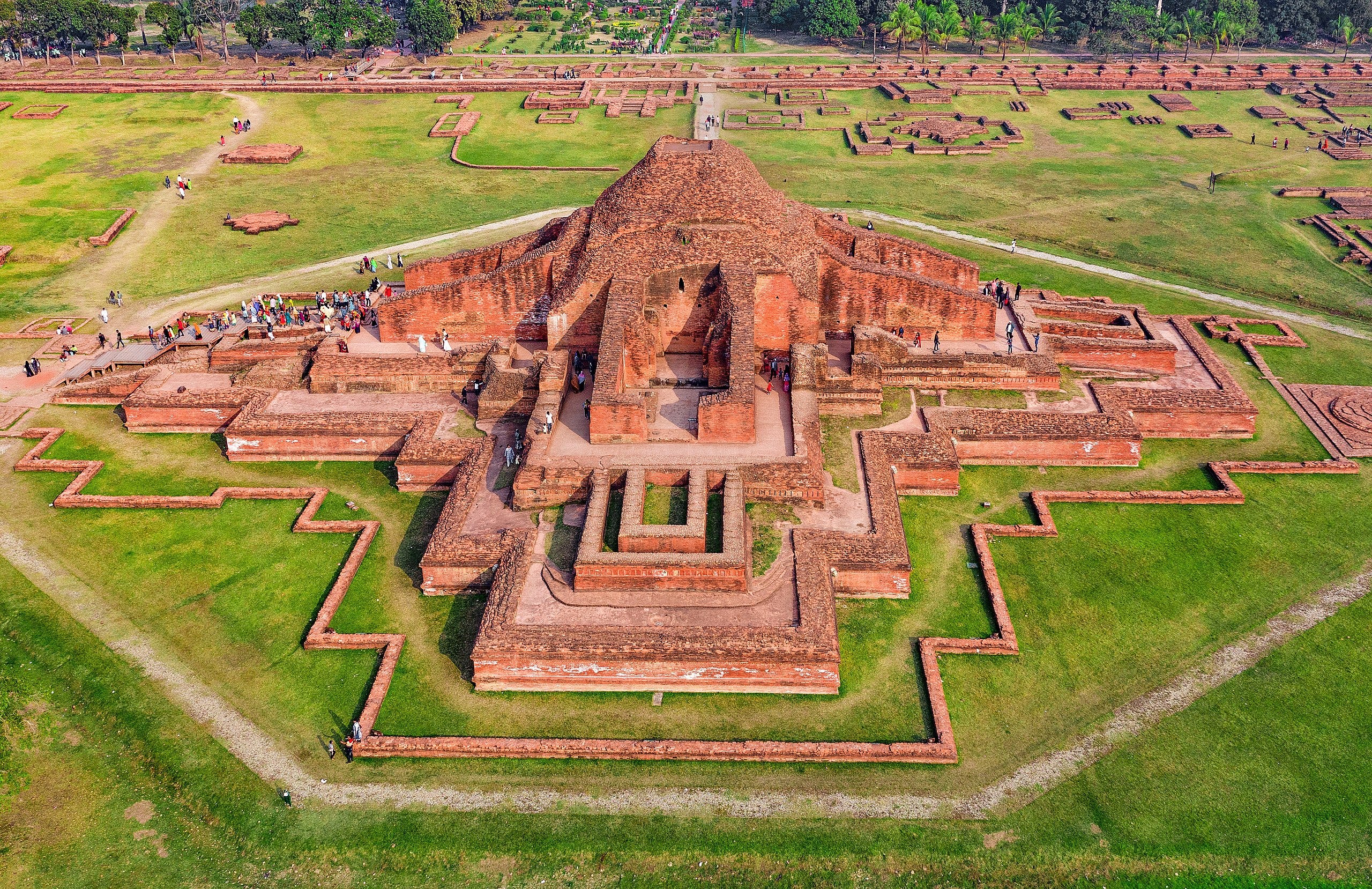
The Somapura Buddhist Mahavira in Paharpur, Bangladesh
But let’s go back to the medieval era for a bit. Not surprisingly, having had the freedom to do what they wanted, Islamic invaders like Bakhtiyar Khilji (who destroyed the world-famous ancient university of Nalanda and is largely considered responsible for the spread of Islam in Bengal) and later, the Governors appointed by the Sultans of Delhi and the Mughals, went about erasing any surviving aspect of ancient Bengal that they could find. This must have included Hindu and Buddhist religious sites, but also non-religious “secular structures” as well that must have existed in Bengal before the arrival of the medieval invaders. This can be demonstrated by the fact that unlike other parts of the country, Bengal doesn’t really have a modern city which can say that it has survived from ancient times (like Kashi in U.P. or Madurai in Tamil Nadu). Most surviving major cities in undivided Bengal (in 1947) were from the Mughal or post-Mughal era (Murshidabad, Dhaka) or the British colonial era (Kolkata).
More than anywhere in India, Ancient Bengal — its artistic and architectural style, its literature, its philosophy, its culture — has been systemically airbrushed from memory. In my two-three years here, I have almost never heard anyone bring up the famous Pala kings of ancient Bengal (who were Buddhists and ruled the current Bengal-Bihar area between the 8th-12th century) or the Sena kings who succeeded them (who were Hindu rulers and ruled between the 11th-12th century). When it comes to historical references, the story of Bengal in the public consciousness (or how it’s presented to us) seems to begin with the British travails against the Nawabs of Bengal. And there is a curious silence about the history of Bengal before the rule of Murshid Quli Khan (whose birth name was Surya Narayan Mishra), the first Nawab of Bengal .
The surviving ruins of the ancient Nalanda University, burnt by the invader Bakhtiyar Khilji
One of the famous cities of the Palas that lies in current-day West Bengal was the city of Gauda, which lies in the Nadia district. Its current dilapidated state is a good reflection of the severing of Ancient Bengal from its present psyche. Why do we not remember the great Gauda king Sashanka? Why does he not occupy the same space in the modern Bengali consciousness that King Harsha does for north India or Rajaraja Chola does in Southern India? Why is ancient Bengal such a distant and nebulous place in our minds?
An ancient Bengali structure in Gauda, Nadia, West Bengal
This amnesia is not only in the mind, but also gets reflected in the infrastructure and architectural style of the land that today makes up West Bengal, as represented by the dilapidated state of many ancient monuments in Bengal. I don’t think any other part of India has been as deprived of a connection to its ancient past as Bengal has.
The interesting thing about this is, that despite all this, the Bengali Hindu culture, in West Bengal and in other parts of India like Delhi, remains vibrant and strong. Many years of living in Kolkata and going to Durga Puja pandals has shown me that this is the case. Bengali Hindus wear their faith and culture on their sleeves, are passionately devoted to Maa Durga and Kali (and of course, as we found out in 2019, to Lord Ram too), and are extremely proud of their culture and language, as they should be. Everyone in India who is not Bengali knows that the Bengali language is among the sweetest sounding languages of India, with an almost musical quality to it that makes every sentence sound like the verse of a song. However, even though Bengali Hindus are still passionately committed to their culture, the actual land of Bengal (forget about East Bengal, I’m talking about the small fraction still left in India) — its infrastructure, its themes, its temples, etc. — increasingly looks less and less Indic. Most of the structures in West Bengal today reflect a lifeless, “secular” style, which does the job of physically erasing Dharmic identity in public spaces. This is the part of India, at least according to my anecdotal and personal experience, where you will find the fewest number of temples or Buddhist structures. This, predictably, has an effect on the resilience of Dharmic life and attitudes. Ceteris Paribus, the fewer Indic artistic and architectural elements in an area, the more distant Hindus feel from their culture. I have observed this in Kolkata, a city that has a strange architecture and style, which I feel is partly affected by its British roots and partly by Partition. Due to the 30+ years of Communist rule, there has also been a proliferation of lifeless, brutalist architecture all over Kolkata that our Comrades imported from their Soviet Masters. However, the strength and resilience of the Bengali Hindu mind becomes clear during the period of Durga Puja, where these same, architecturally lifeless streets get illuminated with light and color. In a sense, these lights represent a sprinkle of Dharma, so strongly present and preserved in the Bengali Hindu mind, over their “secular” and brutalist surroundings.
A street in Kolkata during Durga Puja
I have really learned to admire the spirit and liveliness of the Bengali Hindu mind over my two-plus years here, and it is no surprise to me that Bengal was the wellspring of new ideas and revolutionary fervor when it came to fighting British colonial rule. However, while I believe all these things to be true, I think they also hide a darker, more uncomfortable part of Bengal’s history.
The fact of the matter is that Dharma is losing the land of Bengal, if we haven’t already fully lost it. Just like Punjab, Sindh and Kashmir etc. were lost in the past. And this is not to say that just because a place becomes Muslim-majority, it gets to lost by Dharma. There are many places in India where the majority population is Muslim, but those places do not feel like Pakistan or Afghanistan. There is something more complex going on here, which I am not sure about, but I think it has something to do with the fact that most Indian Muslims, despite having changed their faiths, still consider themselves to be part of India’s civilizational history (which of course, they are), but those from Pakistan and Bangladesh, and sadly, most of them in Kashmir too, have severed their centuries-long connection to Indian history and the faiths of their ancestors. It doesn’t matter to them that they wear Hindu names like Bajwa, Sethi, Tikoo, Wani, etc. Their narrative is now the narrative of the Ummah. To fully understand this, one must realize that the Partition of India wasn’t just an act of dividing up territory and a partial population transfer, it was an irreversible act by Punjab, Bengal and Sindh, of permanently leaving one’s home — physically and psychologically. Think of it like new software being installed in the same old hardware. Those of us who still believe in Dharma must realize the sobering fact that if we go far back enough in history, our ancestors and the ancestors of these very people who are today working to destroy Dharma, prayed to the same Gods. We must come to realize what a grave sense of injustice it is against Dharma that the sons and daughters of this soil — our brothers and sisters — are at war with Dharma because of the Abrahamic software that has been imposed on them. For me, understanding and feeling this sense of loss is essential for anyone who wants to fight to preserve, protect and even reclaim Dharma and Dharmic lands.
So, where does that leave East Bengal?
It is undeniable that places like Pakistan and even Kashmir (which is still in India), despite being historically considered part of India, are today outwardly hostile to those who practice any Indic faiths, or even for that matter, a different faith like Christianity, Judaism or Zoroastrianism. It is simply not possible, in 2020, for a Hindu or Sikh go to Multan, or Rawalpindi, or Peshawar, or Anantnag, or Karachi, and live a life of dignity and respect. All of these places were historically home to many Hindus and Sikhs, have long and famous (but often forgotten) Indic histories, but today, no Hindu or Sikh would even think about settling there. Now, the question I have for my Bengali friends is, does the same also not apply to Dhaka and Chittagong?
The Gorakhnath Temple in Peshawar, Pakistan
Burying the Pain of Partition
This is something I’ve been ruminating about since I’ve been here in Kolkata. As a student of political science and history, I cannot help but ask these questions, even if they might make some people uncomfortable. They come to my mind even if I don’t want them to.
Why is it that Bengal and Hindu Bengalis have chosen to bury the memories of Partition so deeply into the ground? This is one of the only two states (if you don’t consider the unique case of Kashmir), along with Punjab, that suffered directly from Partition. Such a violent and seminal event usually becomes the very cornerstone of any society’s collective memory, and the society usually vows to “never forget”. The commitment to memory that is seen in the Jewish survivors of the Holocaust and their progeny is a good example of this. But this has not happened here in West Bengal. In fact, when someone like me, who is not from Bengal, tries to bring up these stories and talk about them, he is often met with a strange kind of silence. As if the Bengali Hindu knows what I’m saying is true, but would rather not talk about it. It looks to me like a case of a victim of trauma trying to forget about the atrocities committed against him, hoping that this would be the only way to move forward. But I do not think that is the correct approach. Many people talk about how Hindus should forgive and forget about these unpleasant events of the past. They say that there is no point in bringing up the dark memories of the ancient or medieval past. Leaving aside the fact that atrocities against Bengali Hindus were conducted as recently as 73 years ago during Partition, and then again, about fifty years ago, during the 1971 War (i.e. they are not ancient or medieval history), I believe no self-respecting society should just forget everything and offer unqualified, blanket forgiveness.
The horrors of Direct Action Day, instigated by the Muslim League on the Hindus of Calcutta and Dhaka
Firstly, I think that societies should never truly forget the past atrocities committed against them. Dealing with the past, the positives and the negatives, is a very important part of the story we tell ourselves about our own history. For example, the primacy of the discussion about caste discrimination among Hindus is a good example of our society trying to deal with its complicated past. These discussions are often a great source of rancor in our society, but we still must have them. We cannot ask the progeny of those who faced untouchability in their past to simply “move on” and “forgive and forget”. This is a mistake I have often made as an upper-caste Hindu who despises the caste system and the divisions and discrimination it has caused in my own community. I feel strongly that this system has divided brother from brother and has laid down the seeds of the subjugation that we suffered through the ages. It has allowed those who wanted to destroy us, to be able to use our own divisions against us. However, it took me a while to understand how insensitive the statement “I do not believe in caste” can be, especially when coming from an upper caste Hindu. Brilliant Dalit intellectuals like Guru Prakash Paswan have rightly pointed out that it is easy to say this when you have never been made to suffer or discriminated against for your caste, a phenomenon that is still regrettably common in India, especially in rural areas. My change of heart on this issue is, I feel, a good example of how honest discussions about the past can help foster unity in a society. The past, in a sense, flows into the present, and these disagreements can be a form of therapy for broader society. So yes, even if it is uncomfortable, even if it can seem like unfair historical baggage, I do not think any society should ever forget its past. Because those who do not learn from their own mistakes are doomed to repeat them.
Secondly, forgiveness is a more complex phenomenon. I do believe that even if a community should never forget the atrocities committed against it, it should eventually try to forgive, in the interests of moving-forward as a society. There is just one, small, problem here. Forgiveness is not, and cannot be, a one-way street. In particular, why should a community that has suffered atrocities in the past ever forgive the guilty party, if the latter has never asked for forgiveness and does not think that it did anything wrong? This is just my opinion, but I feel forgiveness granted without an apology is not that far from foolishness.
As far as I am aware, East Bengal has never apologized for the atrocities committed against Bengali Hindus in 1947 or in 1971. Yes, East Bengal has changed clothes since then — it has gone from being wanting to be known as “East Pakistan” to being called “Bangladesh” — but it has never acknowledged the atrocities of the Noakhali Genocide (a massacre where the majority of victims were Scheduled Caste Hindus) or Direct Action Day (in Calcutta and Dhaka). This shows that East Bengal is not just a place or a piece of land. It is a state of mind, a “Nazariya”. While Bangladesh has done well to recognize the atrocities of the Pakistani Army in 1971 against its own, mostly Muslim Bengali citizens, it has never acknowledged the fact that in 1971, the sentence “How many Hindus have you killed?” was used just as often by the Punjabi Pakistani Army as “How many Bengalis have you killed?” Indians and Hindu Bengalis should offer no forgiveness to East Bengal unless it specifically acknowledges the religious cleansing done in Bengal in 1947, 1971 and continued anti-Hindu incidents we still see in Bangladesh today. Bangladesh and East Bengali Muslims must also admit their role in the creation of Pakistan, the reduction of millions of East Bengali Hindus to the status of religious refugees in their own land, the crimes committed against Hindu Bengali women, the forced conversions, the destruction of temples, etc. They should offer an explicit and honest apology for all of these incidents of the past and promise to protect the tiny Hindu and Buddhist minority that still calls Bangladesh home today. They must also promise to stop the forced demographic changes in the Chittagong Hill Tracts and promise to protect the indigenous Chakma and Hajong populations of this area. Then, and only then, should we ever consider forgiving them.
For some reason, Bengali Hindus have an aversion (at least according to my experience) to talking about their own historical pain. Maybe this is a result of the desire to forget, maybe it is a result of the 30+ years of Communist rule in this state, that had an almost totalitarian reach in the schools, the universities, and the media, and led to an entire generation being raised in this mindset. Maybe it is also because many Bengalis, especially upper-caste Hindu Bengalis have migrated out of Bengal, either to other parts of India, or to the other countries (a phenomenon, which when taken with the infamous brain-drain from Bangladesh in the late 20th century, can be sadly called “Bengali flight”).
All of this, combined with massive demographic and religious changes in the last decade (in places like Malda, Murshidabad and Burdwan) due to unchecked illegal migration from Bangladesh, has put the state of West Bengal in a strange condition of unease. Add to this is the presence of a wrecking-ball politician like Mamata Banerjee and the arrival of the BJP into the state, and you almost have the making of a perfect storm.
So is there a way out? Maybe. But I have to say that I am pessimistic, given how things have played out in the Indian subcontinent in the past, even the recent past. Dharmic society has yet to emerge out of these civilizational battles — in Punjab, East Bengal or Kashmir — with a positive outcome. But we cannot give up. We must break this cycle of defeat and retreat.
Reviving Dharma in Bengal
There are many things that can be done to fix the current issues facing West Bengal. There are economic problems, political problems and even social problems. But I do not want to get into those issues. Whether it is the Citizenship (Amendment) Act or the National Register of Citizens, these purely political issues are not the focus of my article. Instead, all of the issues I have raised need to be addressed and countered at a deeper level. To solve many of these issues, I think we need to take a detour to the 19th century, and take inspiration from the phenomenon known as the Indian Renaissance.
It is not new knowledge to anyone who has studied modern Indian history that the Indian Renaissance of the 19th century was an almost uniquely Bengali phenomenon. Raja Ram Mohan Roy, K.C. Sen, Ishwar Chandra Vidyasagar, Debendranath Tagore, Bankim Chandra Chattopadhyay were the leading lights of the early 19th century revolution in Indian thought. These names were followed by brilliant figures like Ramakrishna Paramhans, Swami Vivekananda and of course, the illustrious Rabindranath Tagore. The names can go on and on. Bengal was a force of nature in the 19th century. And of course, it did not stop there. Even in the freedom movement, Bengal had a huge role to play. In the Indian National Congress (with prominent early leaders like S.N. Banerjee, A.M. Bose and Deshbandhu C.R Das), in the Revolutionary Movement (Aurobindo Ghosh, Rash Behari Bose, Surya Sen), the working-class and Communist movements (M.N. Roy), and then, right at the end, after a brief period of Gandhian dominance, Bengali excellence revealed itself again in the form of Subhas Chandra Bose. Even the current right-wing in Indian politics, represented by the BJP, owes its founding to the often-forgotten Syama Prasad Mookerjee.
In my opinion, however, the 19th century Indian Renaissance was incorrectly named. It was actually part of the European period of the Enlightenment, and was clearly inspired by Enlightenment ideas of liberalism, free speech, tolerance, reason, logic, etc. A more historically accurate term would be the Bengali/Indian Enlightenment.
We are all aware of the brilliance of the 19th century Indian Renaissance. At the same time, we must also realize that in this same period of elite Bengali brilliance, where the pot of incredible ideas was churning, the seeds of communal differences were being sown of across many different parts of Bengal (especially East Bengal), which would start the process that would culminate in the events of the 1947 Partition. So a re-evaluation of this period in Bengal’s history is necessary for us to get the full and accurate picture of what happened in Bengal. And this can only happen when the people of Bengal are ready for a more honest conversation about their own past and the true, complete, history of the land they call home. Any discussion about Bengali history will hit what I call the “East Bengal event horizon”, a point after which it becomes impossible to ignore the fractured nature of Bengal, its people and of its history and the role of Islam in forcing this fracture. Only after this point can truly honest conversations about Bengal and its history, happen. But this can wait for another moment. For the moment, let’s go back to the the 19th century.
I believe the solution to all the problems I have listed can be found in an actual artistic revolution in Bengal, like the European artistic renaissance of the 15th-16th century, to complement the rebirth of thought that took place in the 19th century. Even though thinkers like Ram Mohan Roy and I.C. Vidyasagar were able to introduce revolutionary ideas and undertake long-due social reforms in Hindu society, they were unable to produce the kind of physical changes in art and architecture seen in places like Florence, Rome and Bologna during the European Renaissance, because it was the British state that exercised political power. The Bengal Renaissance in this sense feels incomplete, having only witnessed the intellectual aspect and not the physical aspect. The European Renaissance was, as the name suggests, a period of artistic and architectural “rebirth” for European society. It flared up the spirits of the population of Europe, brought them out of the intellectual rut of the Dark Ages, and laid the groundwork for the Enlightenment to follow in the next 100–150 years. Something similar is needed in West Bengal.
The dome of the Cathedral in Florence, an iconic example of Renaissance architecture
A movement like this could also have a galvanizing effect on the rest of India as well. And it must come from Bengal, given the history of this land and its people in being the leading lights for so many national movements in the past. In a sense, as Indians across the country chase a civilizational identity, an answer to the question, “Who are we?”, we are demanding true freedom from our colonial past and the history and identity it has defined for us and allotted to us. We are trying to figure out our identity in our own words, learning to read our own history in “first-person” and telling a story of India that is true, and free from the invisible hand of deception of activist and colonial historians. In this flame for a civilizational freedom, it would only be fitting for the spark to come from Bengal. In India’s history, the road to civilizational recovery has often run through this area of Bengal, and for the sake of India and our indigenous identity, it must do so again in the future.
This artistic Renaissance in Bengal must focus specifically on architecture and physical construction, but of course, should not be limited to it. Ideally, it would proliferate in all matters of arts, music, literature, etc. But, given the unique challenges that West Bengal faces, I think the solution can be found in the construction of many, many new temples and Buddhist structures all over Bengal. Coming from other parts of the country, one quickly realizes that the number of temples here in West Bengal is very small. And this is of course most likely due to the historical destruction during the medieval period, but can also be due to other causes like neglect. What better way to resurrect the spirit of Dharma in Bengal and reclaim the narrative of Bengal back from East Bengal, than to physically build Hindu and Buddhist structures to connect the Bengali population back to its ancient past? It would be an act of physical, as well as psychological rebirth of the forgotten ancient Bengali past. An explicit act to connect the present with the past, in acknowledgement of the unbroken nature of Indian civilization. A Dharmic rebirth, or as the French might call it, a Renaissance.
Beating the Dharmic Retreat
It is my belief that there is a direct link between Hindu demoralization and the destruction of our sacred places by our medieval friends. When the Turks, Afghans and Persians were destroying Hindu and Jain Temples and Buddhist sites, they were not just doing what they thought was their religious duty. They were trying to break the spirit of Indic civilization by severing all connections to our past and by denying our own public spaces to us for our worship. They were trying to break the back of an ancient, proud and independent tradition and civilization. And to an extent, they succeeded. The areas that today make up Punjab, Sindh, Kashmir and East Bengal are monuments to their success. The playbook was similar to how Islam replaced the native, indigenous cultures of places like Persia, Egypt and Mesopotamia. For a new culture like Islam to take hold, the old needs to be destroyed, physically and intellectually. But Indian civilization was made of sterner stuff. When the invaders destroyed our temples and replaced them with tombs and mosques, Hindus, Buddhists and Jains (and later Sikhs) did not just give up the fight. Instead, denied the usage of public spaces to assert our faith, we looked inward into our own houses. In my opinion, nothing embodies this spirit more than the Puja Rooms one can find in every Hindu household all across India.
An example of a Puja Room that you will find in almost every Hindu household in India
It is perhaps the strongest symbol of Hindu resilience in the face of the unrelenting force of the medieval onslaught. And it was a silent revolution. It is a sign of our spirit that for every great Hindu public temple that these invaders destroyed or burned, thousands of new temples sprang up in Hindu houses across the country — from Lahore to Chittagong. In this sense, Hinduism is like a hydra. You can destroy one big temple, hoping to erase the indigenous and pagan identity of its followers, but thousands of smaller temples will spring up in its stead. And this happened in Hindu households rich or poor, big or small, in the north or the south. There are no people who embody this more than the Pakistani Hindu refugees in India, who live in places like Delhi. Having been completely ignored and failed by the Indian State, they live in shanty houses and slums. But even in these houses, you will find a temple room, or an idol, or a picture of God or Goddess. These people, in my opinion, are the greatest embodiments of the resilience of Dharma. And we as Hindus will do well to remember and embrace this aspect of our past.
A Hindu migrant from Pakistan
But while it was admirable, this phenomenon was also a sign of Hindu retreat. Closed-off from our public places of worship, forced to pay the Jizya, we looked inside our own houses to protect our identity and faith. It decentralized our faith and traditions (moving from the public sphere of temples to the private sphere of the home), making them more resilient but also ending up in the loss of the social aspect of religion, as manifested in the public sphere. It has made us good at surviving, but not good at thriving. We shirk away from public spaces and avoid exerting our religious identity in public, relegating it to the private sphere. This is embodied in the fact that today if you go to a Hindu temple, you do not talk to anyone who is there to worship with you. Instead, you go with your family, worship the deity, take the prasadam and leave. In this process, it is possible you may not talk or interact with even a single other person there. This has led to the loss of a sense of community, of a common brotherhood among Hindus. This decentralization was the need of the hour, and is one of the reasons why Hinduism — unlike Ancient Egypt or Mesopotamia — has lived to tell its tale, but it came at a cost.
Small roadside temples like this are peppered all across India
Restricted to our own houses, we developed an aversion to public construction of temples and other holy sites. And this created a vicious cycle. Because any person of any faith, no matter how strong the ideology is, also needs physical symbols of his faith in her surroundings to engender in her a sense of cultural belonging. And in the absence of such structures, she gets demoralized about her culture and faith. It is time we start building big again. In its darkest hours, Hinduism had to become the faith of Puja rooms, or of small, roadside temples under trees. This helped us survive in that period. But I feel that, despite “Independence”, mentally we are still living in that period. To break through this barrier, we need to build structures that any Hindu can feel proud of, that sing back to us our history and traditions every time we walk past them, and that gives the Hindu a sense of belonging to the public spaces again. Nowhere is this needed more urgently than in Bengal.
I can already sense the opposition coming from a section of people reading this: “Why not build schools and hospitals instead?” And to this, I would say, “Of course!” Let’s do that as well. But while constructing these schools, hospitals and other structures, let’s build in an architectural style that is uniquely Bengali — that I want to call the “Neo-Bengali” style — so that any person can look at buildings from Bengal and immediately identify where they are from — just like they can with classical European buildings. More broadly, we can extend this to an umbrella artistic revolution of a “Neo-Indic style”, to represent the diverse artistic and architectural style of different parts of India. An example of what can be considered a “signature style” is the Greco-Roman pillar, which is an instantly recognizable hallmark of Western European Architecture.
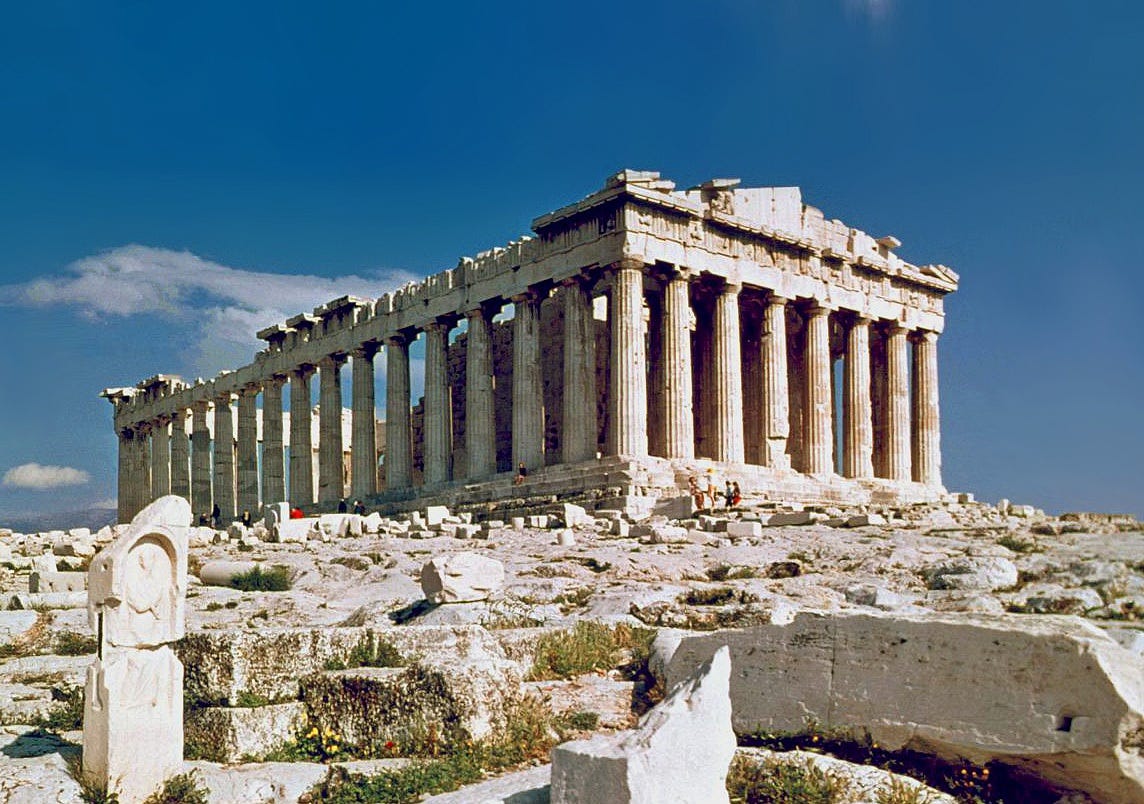
The Parthenon of Athens in Greece has been “kept alive” in modern times with structures like the White House of the United States of America, or even the British-built Raj Bhavan in Kolkata, West Bengal. These structures show an architectural and civilizational continuity through thousands of years, and act as “signatures” of Western civilization. They are an example of cultural and civilizational “rhyming”, and act as the thread of continuity for any civilization. What is stopping us from searching for our own signature styles?
The Parthenon in Athens, Greece
The White House in Washington, DC
The Raj Bhavan, previously the residence of the British Viceroy in Kolkata, India
Reclaiming the public space through architecture
So what should these Neo-Indic structures look like? I think this is a discussion that our society should be having every living day. There is no shortage of artistic creativity and splendor in India, and I think it just needs to be channeled in the right direction. This Neo-Indic style will also vary by region, but in Bengal, there is a style I have been able to find that fits the bill for what we’re looking for.
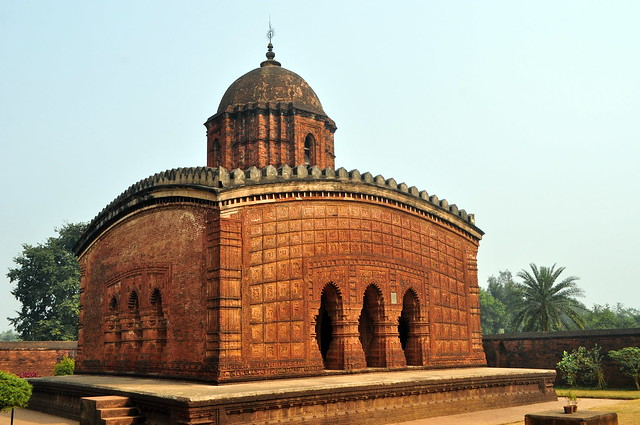
Even though there was no true, Indic resistance to Islamic rule in Bengal comparable to the Marathas or the Sikhs, there were some smaller kingdoms that managed to retain some autonomy and build Hindu temples in the midst of the onslaught of the medieval era. Among them were the Malla kings of Birbhum and Bishnupur, who, along with many other local Rajas and Ranis, built some beautiful temples in many parts of West Bengal. These temples have a beautiful, unique style to them and the Do-chala curved roof on which the dome sits is truly iconic. They are a strong retort to anyone who claims that there is no “Bengali” style of Temple building.
I think that these Terracotta structures should be used to develop a “Neo-Bengali” architectural style that can be used in buildings all across Bengal.
A Terracotta temple in Bishnupur, West Bengal
Similar temples in this style are found all over Bengal. Most of these structures are built in the “Pancharatna” (five pillars) and Navaratna (nine pillars) style, a style that is native to Bengal. The Malleshwar Shiva Temple in Chandrakona in Paschim Medinipur is another temple built in the same style. And there are many surviving Hindu temples in East Bengal too. Even here, the iconic curved roof is visible:
The Malleshwar Shiva Temple in Chandrakona, West Bengal
The Lalmai Chandi Temple in Comila, Bangladesh
An illustration of the Kalighat Mandir in Kolkata, where the iconic curved roof is also visible
Now, the funny thing is, that it seems like someone here in Bengal has definitely recognized the need for a temple revolution in Bengal. Given the fact that this is Bengal, that should not be surprising at all.
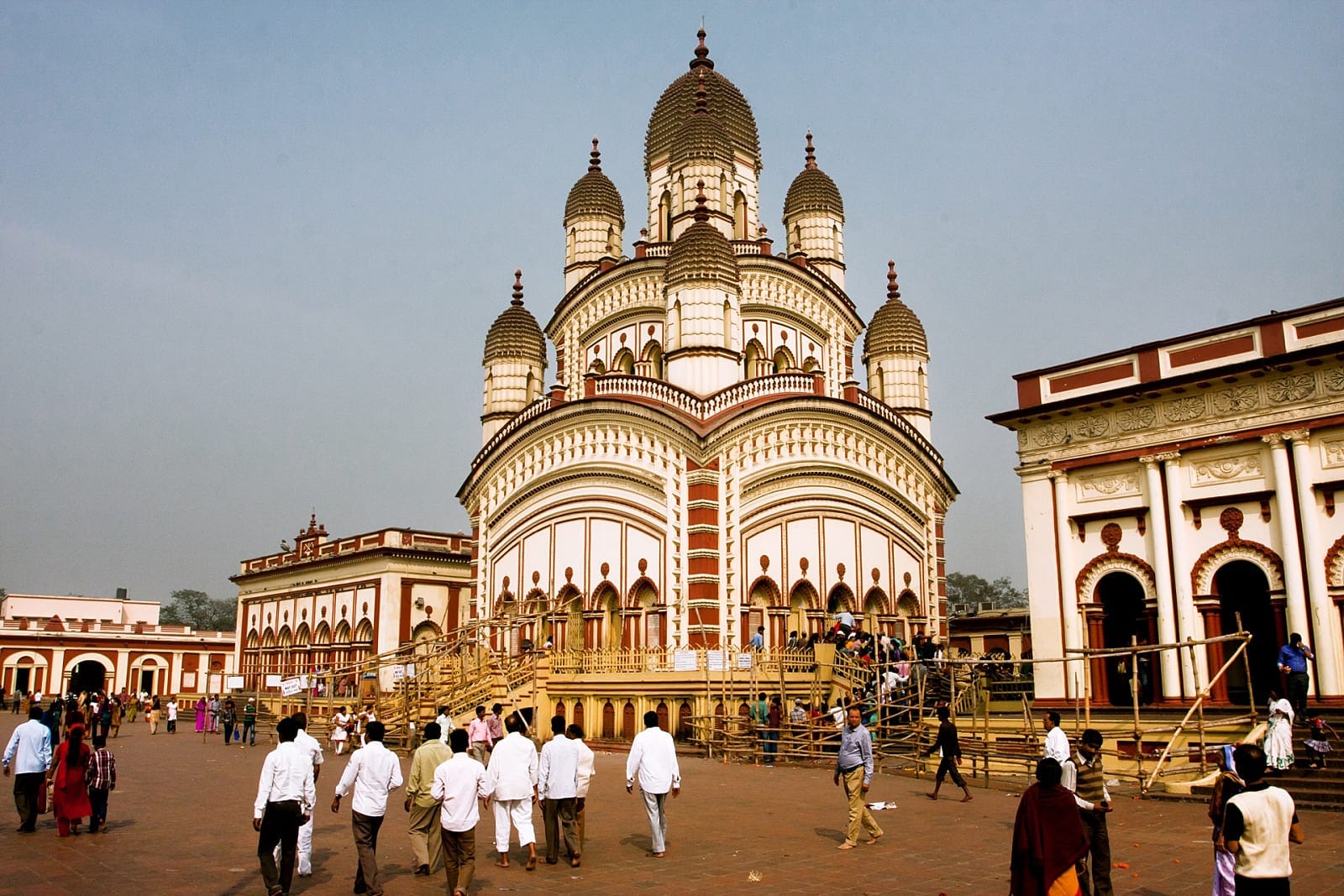
In 1855, Rani Rashmoni oversaw the building of a famous temple near Kolkata that was devoted to Maa Kali. And lo and behold, it is an example of exactly the kind of new temples I would like to see all over Bengal!
The Dakshineshwar Temple in Bengal
This is, of course, the famous Dakshineshwar Temple near Kolkata and if you look closely, especially in the roof of the temple, the Terracotta temples of Bishnupur will sing-out to you. This is a great example of Neo-Indic art, a structure that takes the best out of the old, and brings it into modern times. It creates a link to the past, while meeting us in the present. As a society, we must attempt to undertake a movement to build temples all over Bengal that are inspired by the look of the Dakshineshwar Temple. Not only that, the iconic Do-chala and Char-chala curved roof of these temples can even be used as a motif in normal structures like residential buildings, offices, schools, etc. A consistent architectural style can really add to the beauty of a place — as we see in Indian cities like Jaipur and Chandigarh — while a confused architectural style often leads to a confused identity — as is seen in Delhi (Lutyens vs. Old Delhi). And architectural beauty is a potent force for inspiring the people that live in that place.
A good example of what not to do is the structure being constructed by ISKCON in Mayapur, West Bengal. While ISKCON is doing many good things in working for the revival of the Hindu spirit in West Bengal, especially in the part of the state where Mayapur is located, the huge structure that it is building with the investment of millions dollars is sadly, a missed opportunity.
The proposed design of the under-construction temple in Mayapur
This structure, while aesthetically pleasing, is unfortunately very stylishly disconnected to Bengal and its history. In fact, this structure looks more like a Roman structure, similar to the Capitol Building in Washington, D.C. in the U.S. or even the Victoria Memorial in Kolkata. In my most charitable opinion, I find it to be artistically and stylistically confused, as if it is trying to straddle the line between the Indian and Western Greco-Roman style. And let me be clear, I am not completely opposed to such a fusion of styles. I think they can lead to some beautiful creations and structures. However, I see this new Temple being constructed in Mayapur as a missed opportunity. It seems to be a project being done with the best of intentions, and no one can doubt the commitment of ISKCON to the revival of Dharma, but it also seems to be missing the point a little. I cannot imagine how wonderful it would have been to instead have a structure that takes its inspiration from the Terracotta structures of Bishnupur and had the size and scale of this Temple being constructed in Mayapur. But oh well, at least ISKCON is trying to do the right thing here, even if I feel like they have missed a great opportunity to construct something that could be the crowning jewel in Neo-Bengali art. I must say, it is also possible that I am missing some context with this temple. Maybe it takes inspiration from a different Bengali form of architecture that I have simply not encountered. Maybe more thought has gone into it than I am realizing and this structure is trying to represent something I cannot comprehend. That could be the case, but I remain skeptical and am left rueing a missed opportunity.
An architectural movement across Bengal in this style, and of course, in Buddhist styles as well to honor the great Buddhist Pala kings of Bengal, is what I think Bengal needs right now. It would be a beautiful way to restore the physical presence and emotional spirit of Dharma all over Bengal. Because make no mistake about it, preserving Dharma in the little part of Bengal that we have left is absolutely essential to the survival of India. This is because India, in the last 70 years, has not only lost the territory and people of Punjab, Sindh, and a slightly smaller extent, Kashmir. We have also lost these places in a civilizational sense. These are all places with long Indic histories, are home to countless Indic shrines and monuments, had famous Indic rulers (like Kanishka in Kashmir, Raja Dahir in Sindh and Ranjit Singh in Punjab) and were home to large populations who considered themselves as a part of the Indian civilization and its history. But that connection has almost completely been severed in the last seventy years, forcefully and violently.
Regrettably, the same applies to Dhaka and Chittagong, places whose names ring loudly in our history but are today distant memories to us, with populations openly hostile to Indian civilization and Indic faiths. I do not think Indic civilization can survive the loss of the entirety of Bengal, and this is why it is so important to preserve Dharma in Bengal. To do this, we must attempt to bring about an architectural revolution in how structures are constructed in Bengal through the development of a unique, Neo-Bengali style, and construct hundreds of Temples and Buddhist sites. The hope is that this would lift the spirit of the land of Bengal and lead to another golden era for the state and its people.
The officials maintained that he had violated protocol and should have returned the remaining doses to the office or thrown them away, the doctor recalled. He also said that one of the officials startled him by questioning the lack of “equity” among those he had vaccinated.
“Are you suggesting that there were too many Indian names in that group?” Dr. Gokal said he asked.
Exactly, he said he was told.
…
On Jan. 21, about two weeks after the doctor’s termination, a friend called to say that a local reporter had just tweeted about him. At that very moment, one of his three children answered the door to bright lights and a thrust microphone. Shaken, the 16-year-old boy closed the door and said, “Dad, there are people out there with cameras.”
This was how Dr. Gokal learned that he had been charged with stealing vaccine doses.
Harris County’s district attorney, Kim Ogg, had just issued a news release that afternoon with the headline: “Fired Harris County Health Doctor Charged With Stealing Vial Of Covid-19 Vaccine.”
There is a lot of debate and argument on this weblog about Pakistan and India and the like. That’s because more than half the traffic on this site now comes from India. But this began as a Diasporic weblog, and in the Diaspora, especially in the USA, the gap between Pakistanis and Indians is much smaller. Dr. Gokal is viewed as “Indian.”
The second issue I think one might note is that these lawyers, with a passion for racial justice, ended up pinning something that was pretty invidious on this doctor driven by the moral panics of the era. As a conservative brown-skinned person I am on the receiving end of a lot of insults from woke white people. Many of my white friends, who observe the nature and the persistence of the insults, suspect that some of the attacks are probably driven by sublimated racial animus.
Where are we as “Asian Americans” in this country? The ruling elite of this country thinks we have “bad personalities“, all the better to exclude us from their institutions of power. There has long been a pattern of what are obviously “hate” crimes (mostly for fun and kicks, to be frank) against Asian Americans, in particular older ones, in urban areas. The perpetrators of these crimes are usually not white, and so the media and the cultural elite have not focused much energy on them. And now they are trying to blame COVID-19 and the Trump administration.
To brown Americans: we are not victims. Never forget. But, we are also outsiders. Never forget.
I am hosting a Clubhouse room this Friday, 9 PM CDT (8:30 AM in India on Saturday). The topic will be the genetics of India, and I’ll be talking about my two posts on Substack: