Book Review: A New Idea of India- Harsh Gupta & Rajeev Mantri

India in the last decade has been witness to a political churn, that has been accompanied by a loud and an energetic questioning of what we as a nation and a society stand for.
What is it that makes India and what does India stand for? The debates can be raging on social media and the electoral outcomes indicate that the debates are not just restricted to social media war rooms but are being waged on the streets too.
Harsh Gupta and Rajeev Mantri’s new book- A New Idea of India, comes across as an earnest attempt at answering the two questions.
Gupta and Mantri, start off their answers by placing the modern Indian state as an inheritor of an ancient civilizations and not a construct that the British left behind in 1947.
“India, that is Bharat” the authors claim, has roots in acceptance of pluralism that comes from a tradition of skepticism.
India has been an amalgam where diversity has thrived without a central controlling authority.
An Indian is one who retains the agency of questioning anything and anyone and this agency when extended to everyone is one of the ingredients for what makes up for India.
The Indian state should find its moors in this civilizational legacy and build a modern Indian state where primacy of individual rights is supreme.
This definition of India puts them on the opposite side of those who believe that India is an entity brought together for, and to be kept together by, a strong state that should strive to accommodate its religious and cultural diversity.
A state that acknowledges groups and subordinates the rights of the individuals to the rights of those groups.
The authors frame both these points of views, and then drive home the point how the latter view, one that evolved under and was nurtured by each succeeding government of the republic, has been detrimental to India’s economic growth and how the whole idea of making a community belong to a nation, instead of making individuals belong to a nation, has only led to deepening of fissures.
Since the republic has been mostly run Congress and the dynasty, Nehru and his clan end up with most of the blame.
The authors go on to present in detail how economic policy making that encourages government control, rent seeking and ignores markets have left India impoverished and how civil laws that are aimed at accommodating religious identities have led to resentment and are a recipe for social conflict.
The book does not merely enumerate what is wrong and who should be held responsible for it, the authors go on to present a way forward.
The solutions lie in building robust state capacity that allows for markets to efficiently operate and doing away with sectarian laws to enable social cohesion.
They claim that the Narendra Modi government has used the last six years to lay down the path on these lines. Be it laws the allow for efficient working of markets- IBC and GST, to improving last mile delivery via the JAM trinity and restructuring of the administrative frame work.
It is their opinion that although much needs to be done, the NDA 2 government is on its way to reshaping India, an India that will be economically strong and will be rooted in modern liberal values that are similar to ancient Indian wisdom.
As a long time, reader of Harsh and Rajeev’s newspaper columns, time for a disclosure: I have known Harsh personally for a few years now – I more often than not find myself on the same page as Harsh in our world views, the lucid writing and substantiations with facts and figures is not surprising.
The writing, even when covering philosophical foundation of their arguments is plain and simple.
I did find the book harsh on Nehru.
Nehru alas is now a figure in this country who is either worshipped or held responsible for everything that is wrong with present day India.
We analyze his legacy with benefits of hindsight. Nehru like all humans operated in the realms of his bounded rationality.
We must also not forget, specially those of us who repose all their faith in wisdom of the electorate, that Nehru was democratically elected.
Who is to say he did not represent how Indians wanted to see India as much as Indians of today want India to be shaped by Narendra Modi?
Similarly, the writers go easy on Modi, the litany of laws that they think are sectarian in nature, whose eradication they think is key to building social cohesion, they don’t ask why Mr. Modi has not done anything about them.
If Mr. Modi with all the political capital that he enjoys, can not come around to changing those laws, who is to say that he himself does not believe in them and as a democratically elected leader, his thinking represents our thinking.
As to his economic legacy, we will have to wait and see, in so far, his big calls have been a mixed bag.
The inflation targeting framework and fiscal conservatism have been disastrous for the economy in the short term, while we await to see the positive impact of the reforms that writers mention.
The book though is a much-needed addition to the discourse.
For those stuck in social media driven echo chambers, it will either be a worthy peep into what the other side thinks or a provide arguments to elaborate on one’s own world view.
It is a must read for those trying to make sense of this young and vibrant country, for the points that the writers make will, in the humble opinion of this reviewer, shape the future course of this country.


The Koran; a very short introduction

An old review I happened to revisit today. It was written for the Pakistani news-magazine Herald in 2002,  you can see a reference to “colonization of the Middle East” which indicates it was a different era and a different me 😉

The Koran (in the OUP “Very Short Introductions” series,) Oxford 2000.

The Koran: A Very Short Introduction (Very Short Introductions Book 13) by [Michael Cook]

Pious Muslims may feel that in the presence of the text and its commentaries, they do not need Professor Michael Cook’s “very short introduction” to the Koran. The pious may also wish to stay away because Professor Cook was once associated with the notorious “Hagarene hypothesis” (put forth in the 1977 book: Hagarism: The Making of the Islamic World by Patricia Crone and Michael Cook) though he has since backed away from some of the more extreme claims of that book. But “The Koran, a very short introduction” turns out to be a very witty and interesting book, full of insights that the most pious Muslim will find informative and stimulating. Continue reading The Koran; a very short introduction

Afghan Conundrum II

From Dr Hamid Hussain. As usual, he gives sensible advice, but it is not going to be heeded. On this issue, I think Major Amin is right, there will be a civil war, Pakistan will take sides, PTM will not be reconciled and will instead be further demonized, things will not get better.
I also hope I am wrong. (Omar Ali)

Dr Hamid Hussain’s post follows:

One can only highlight signposts of a complex issue. Following is one such exercise.

Hamid

Pakistan’s Afghan Conundrum

Hamid Hussain

“On earth, it’s hard and heaven is far away”.  Afghan proverb.

 Afghanistan is going through another transition with many uncertainties causing hope and fear.  Pakistan has a long history of involvement in Afghan affairs.  President Donald Trump tweeted on 08 October 2020 that all American troops will be home from Afghanistan by Christmas. This surprised everyone in Washington and Pentagon, State Department and Central Intelligence Agency (CIA) officials were scratching their heads and contemplating how one single tweet has undermined the bargaining position of United States.  This also sent shock waves in General Head Quarters (GHQ) of Pakistan army.  Prime Minister Imran Khan government is not even pretending to have any role in Afghan affairs and has handed the Afghan file to the army.  Imran Khan wrote an op-ed piece for Washington Post pleading Americans not to leave Afghanistan in haste for Pakistan fears it will face all the negative fallout. 

There will be review of Afghan policy with the arrival of new administration in Washington in January 2021. However, domestic issues will suck all the oxygen and it is not likely that new administration will be able to spend significant economic, military and political capital on a side show in Afghanistan. President Trump is now the wild card before President elect Joe Biden takes oath on 20 January 2021.  He can order complete withdrawal of American troops by the end of the year that can make any course correction for new administration very difficult. Pakistan’s hope is that new administration keeps current level of forces and economic lifeline to Afghan government until meaningful progress is made on intra-negotiations front. Continue reading Afghan Conundrum II

Correlating ancestral legends with Genetic data

I stumbled upon an interesting project to collect data on the Y-haplogroup from a section of the Indian population (brAhmaNas), and correlate it with the claims of descent from certain ancient sages by brahmins today.

Link to read up more –

I personally find it to be an intriguing idea. And worth investigating.

Some notes for the uninitiated on Gotra / Pravara

  1. A significant chunk of the Indian population has a Gotra record.
  2. Technically your Gotra records your male line of descent, though the individual after whom the Gotra is named need not necessarily be the earliest male ancestor of yours that you know of.
  3. Gotras are likelier to indicate a specific line of descent in the case of brahmins, where the Gotra/pravara record is more carefully preserved than among the rest of the Indo-Aryan population
  4. Pravaras are a set of 3 or 5 individuals – typically sages who feature in your male line of descent. These individuals may precede the sage mentioned in your Gotra, or succeed him.

Correlating Gotra information with Y-haplogroup data may give insights on whether there exist striking similarities between brahmins who share a certain Gotra.

An example of how Gotra / Pravaras look like –

My Gotra is vādoola. Legend has it that he was likely a sage in the late Vedic period, who cannot be located accurately. He has certain texts of the late Vedic tradition including a Shrauta sutra to his credit.

My Pravara is Bhārgava / vÄ«tahavya / savetasa : Among these three, BhRgu is actually not my biological ancestor. The latter two are. VÄ«tahavya was actually a king of the Heiheya dynasty who turned “brahmin” when he was residing in the Ashrama of sage Bhrigu.  So this particular clan that descends from vÄ«tahavya are Kshatriya-converts to Brahmin-hood, to put it crudely. Likely this legend dates to the middle Vedic period (1000 BCE) , or maybe earlier.

In this particular case, the Gotra RSi (vādoola) is actually a descendant of Vītahavya. So the gotra is not named after the earliest male ancestor that we know of.

Individuals belonging to this somewhat rare gotra are found largely in Tamil Nadu and Andhra today. Not elsewhere. It would be curious to see if the Y-chromosome data provides any commonalities among those who share this gotra.

Post-script : None of this should be seen as any kind of “supremacist” exercise. It is just one way of possibly validating traditional claims (which may be bogus for all you know) , though it is not likely to yield a conclusive narrative.

Open Thread, 11/14/2020 – Brown Pundits

I don’t know anything about Diwali, but Happy Holdidays! (I found out that it was Diwali this weekend from Twitter and the comments here).
A new podcast on the election results with Josiah Neeley and Richard Hanania. We get kind of spicey by the end, as I make fun of Richard making fun of Peter Turchin, and make a huge prediction about Hunter Biden’s future.

“The Buddhist Age”

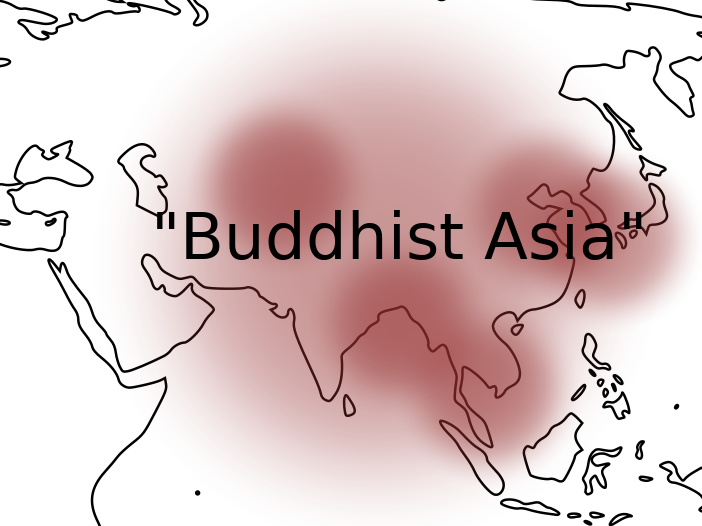
Civilizational affinities in 700 AD

I made an offhand comment on Twitter that I thought might be worth amplifying and elaborating. You can argue that to a great extent the period between 250 AD and 750 AD can be thought of as the “Buddhist Age” in Asia. The year 750 AD is easy as a cut off point, as the battle of Talas in 751 symbolizes the recession of Tang Chinese influence in Turanian Central Asia, and the inexorable advance of the Muslim Arabs. The year 250 is more vague, but it post-dates the collapse of the Han dynasty, and starts to see the ascension of Buddhism as a Chinese religion par excellence, rather than a marginal Indian cult.

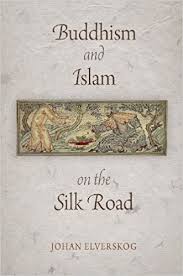
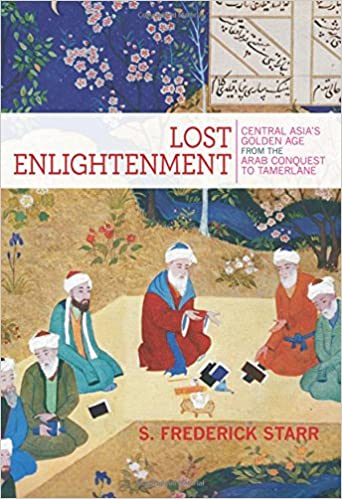
Let’s focus on the year 700. What’s going on? First, let’s acknowledge that Buddhism is in serious decline across the Indian subcontinent, though there are local pockets of strength, with a late Indian summer to come with the Pala Empire of Bengal in 750. Second, it was under threat across its East Iranian heartland. It is often forgotten that Buddhism and Zoroastrianism competed toe-to-toe as the religion of the elites across the East Iranian world, from modern-day Afghanistan to Khorasan and deep into Transoxiana. The book Buddhism and Islam on the Silk Road documents this interplay. Lost Enlightenment as well as Christopher I Beckwith’s book argues from the strong role of Turanian Buddhism in shaping Abbassid era Islam (e.g., viharas as models for madrassas and Turanian Buddhist textual culture as the seedbed for hadith).

in Japan Buddhism was taking root, while in Korea and much of China it was the dominant religion in 700 AD. Buddhism also had a thin, but detectable, impact across Southeast Asia, along with Indic culture more generally. Tibet was not as clearly associated with Buddhism in 700, but the religion had already been introduced and was making a cultural impact.

What does this have to do with “Brown Pundits”? Buddhism is the dominant vehicle of clear and obvious Indian cultural influence in the world. It is, arguably, the earliest of the great missionary religions to exist today. Though Buddhism never took root in the West, it was clearly known and a presence in the eastern Mediterranean during the Roman period in cosmopolitan ports such as Alexandria. Though Indian numerals are extremely consequential, they are a more bit-sized cultural element, which has been detached from their Indian matrix. In contrast, Buddha’s Indian origin is well known, and the influence of Buddhism is probably responsible for legends that are hard to explain such as the Indian princess who married into the Korean royal line and gave rise to a modern day Korean clan.

Browncast – Saagar Enjeti: An Indian-American Right Populist

Another BP Podcast is up. You can listen on Libsyn, Apple, Spotify,  and Stitcher (and a variety of other platforms). Probably the easiest way to keep up the podcast since we don’t have a regular schedule is to subscribe to one of the links above!

You can also support the podcast as a patron. The primary benefit now is that you get the podcasts considerably earlier than everyone else. This website isn’t about shaking the cup, but I have noticed that the number of patrons plateaued a long time ago.

This episode features Mukunda and Akshar talking to Saagar Enjeti, co-host of Rising on The Hill and host of The Realignment Podcast. We talk about Saagar’s come up and his political journey as we delve into the US election results, right populism, and an Indian-American’s place in all this.

Putting the Arnab storm in perspective

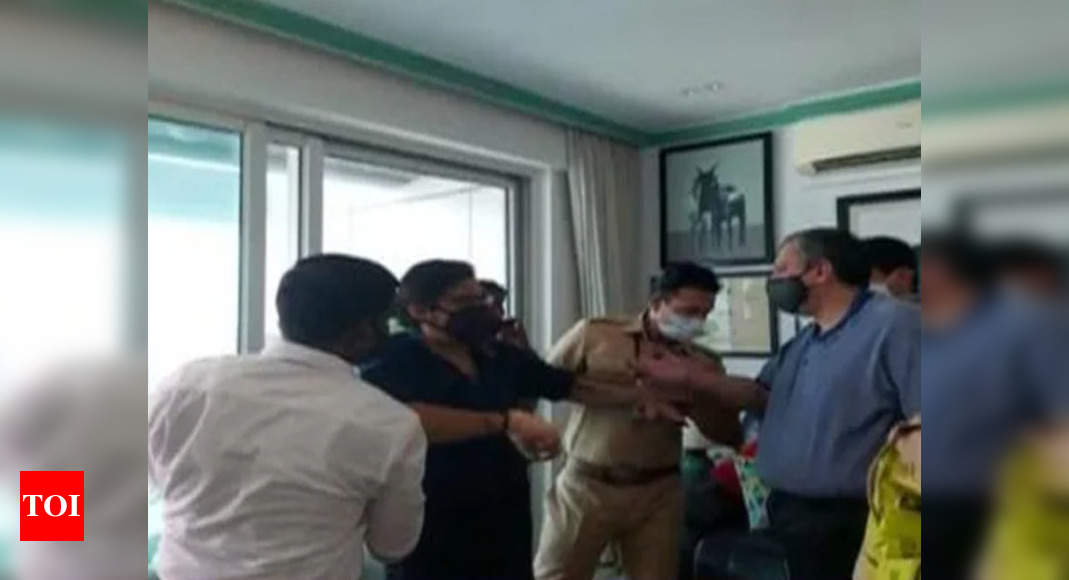
Yesterday morning Republic TV Host – Arnab Goswami was arrested in the early hours of the morning for a two-year-old suicide case. The arrest and especially the nature of his arrest created a mini storm on Twitter, with Hindutva twitter making it a FOE issue and a reflection “fascist” nature of Maharashtra government and some sections of Liberals seeing this arrest as Karma.

I would highly recommend Shekhar Gupta’s Cut The Clutter on this topic

Some of the criticism of Karma on Arnab appears fair if you look at the way Rhea Chakravarty was hounded by Arnab and journalists on his side of the political spectrum with Arnab as the ringleader. But it’s the Optics of the arrest and high handedness of the Maharashtra government (using encounter specialists for the arrest) needs to be called out. This comes a week or two after the arrest of Sameer Thakkar for “objectionable” tweets about Uddhav Thackeray and his son. That issue created some outrage on social media but nothing compared to the Arnab issue. Personally, I find such arbitrary arrests (Sameer Thakkar) that have been known to happen in India very frequently, more troubling than the arrest of Arnab Goswami. The arrest of Arnab is surprising due to his stature and popularity and not due to the arbitrariness of his arrest (which is actually banal in India).

Within hours the BJP big guns jumped into the fray with condemnations from Smriti Irani to S Jaishankar. Even comparisons of Emergency were made by Devendra Fadanvis. However one must point out that Hindutva twitter was unhappy with BJP’s response. They wanted a more violent defense of Arnab by BJP (what that would entail is best left to the imagination). However, hypocritically though not surprisingly – the same establishment is silent on the arrests of journalists, which have happened regularly for actually doing their job (in all states including a lot of BJP governed states). Hathras was a prime example where some arrests were made by UP police (the exhaustive list would be too damning). Similarly, the famous arrests of so-called “Urban Naxals” – especially Sudha Bharadwaj, are followed by their detainment for over 2 years without any solid proof coming up in the due process comes to mind. Recently, Dhaval Patel from Gujarat was arrested because he wrote a piece alleging Gujarat CM being replaced because of poor handling of the Covid crisis. He was released on bail after an order from the court. I can go on and on and keep on pointing cases of significantly worse handling of journalists by all states under all governments in India. Uttar Pradesh under Yogi is particularly harsh when it comes to handling journalists but no state passes the basic smell test when it comes to protecting freedom of expression.

Taking it to a next level, there are routine deaths of journalists when they report lesser-known criminals and politicians. The Sand Mafia, the Mining Mafia, the other lesser and greater known criminals (and politicians) are famous for threatening, killing, and killing entire families of journalists. I would like some documentation with trends of murders and mysterious deaths of journalists in India over the last 70 years (couldn’t find any on a cursory search).

My aim here is to not indulge in whataboutery but to put the Arnab arrest in perspective. It’s not an extraordinary event in itself, just it grabs so much space (even in NYT) because it is Arnab – the TRP king and apparent favorite of the BJP Regime. Press freedom in India has a long long way to go, but using this particular case to make that point is not a great idea. Where this case may affect a change(or escalation) is the interplay of journalism (or media) and politics in the future. Politically this moment might turn out to be a significant yardstick for future abuse of state power for politics. Shekhar Gupta alludes to it in the video, this may be a slippery slope leading to an escalation in vendetta politics across the country. The central government under BJP has till now troubled NDTV (with Tax fraud etc), the Wire, and all the usual suspects for 6 years now. But in no case was the action OPTICALLY as drastic as the arrest of Arnab. Maybe such drastic optics are where we are leading, whenever someone raises the level it’s fair to expect others to follow. With more and more public figures getting partisan (Kangana Ranaut, Bajaj, etc) could one expect politicians to attack them too? As was the case with Kangana? Probably. But that doesn’t bode well for either the debate or the partisanship.

Brown Pundits