
So what are the reasons for various differences statistically?
So what are the reasons for various differences statistically?
Bangladesh: Protests Erupt Over Rape Case:
Protests in Bangladesh erupted this week after a video of a group of men attacking, stripping, and sexually assaulting a woman went viral, Human Rights Watch said today. Protesters called for the resignation of Home Minister Asaduzzaman Khan Kamal over the government’s failure to address an alarming rise in sexual violence against women and girls.
Noakhali Gang Rape Victim: Delwar raped her several times before:
Our Noakhali correspondent’s personal office is in a computer market in Maizdee Old Bus Stand area. Over the last two days he has witnessed how the video spread over the whole market. It was played and replayed in public on computer screens as everyone crowded to perceive first-hand the horror inflicted on the woman.
“Bhaiya, do you have the video? I had it but it got deleted… I wanted to show it to someone,” said a computer businessman, approaching our correspondent, who declined to entertain the request.
Snippets of conversation overheard on the street also attest to how widespread the video has become. Two elderly men out on their evening stroll complained to each other, “The video keeps popping up on my mobile phone. This is so awkward, especially in front of the wife and kids…”
So perhaps a naive question: why are people sharing this video??? Every few years I hear about a gang-rape video coming out of MENA and South Asia, spreading virally. Why do people want to see this? It’s like sharing a video of a murder..
 Some cool podcasts will be posted soon. Already posted two on the Patron page, including a very cool one where Mukunda and Jahanarra talk to Michael Fortner. A professor at CUNY, Fortner is the author of Black Silent Majority: The Rockefeller Drug Laws and the Politics of Punishment.
I’ve also posted a podcast with Devang Mehta on what’s wrong with science, and how to fix it (also, some advice for Indians who might want to get into the world of Western academic science).
Also, I will probably post a few previews of a new podcast I’m starting (solo) for patrons. This is going to be part of my new substack newsletter. This weekend I’ll be talking to an old friend from grad school who snapped and turned against wokism last week (he was involved with BLM since 2015, and I just got off the phone with him and he told me things he’s seen in BLM up until this summer left him very jaded, suspicious, and skeptical).
Even though the comment thread on my previous blog post – Playing with Fire was the immediate trigger for me writing this post, but I have been meaning to wade into this topic for some time. History writing in India has been a controversial topic especially since the ascendency of Hindutva. NCERT books on history are often blamed for preventing the “Truth and Reconciliation” between the Hindus and Muslims. While these criticisms have some merit, I often feel they’re overstated and straw-manned. Left-Liberal historians – Messrs Romila Thapar, Irfan Habib, Satish Chandra has been the favorite punching bag of Hindutvavadis in general. A lot of times people get carried away in hubris while punching these histories. Generalizations and misrepresentation of writings of these historians are rife in the Hindutvavadis.
I will go through Medieval India by Satish Chandra (class 11 history), Romila Thapar’s Medieval India (class 7), and Medieval history book by Nios (by multiple authors).
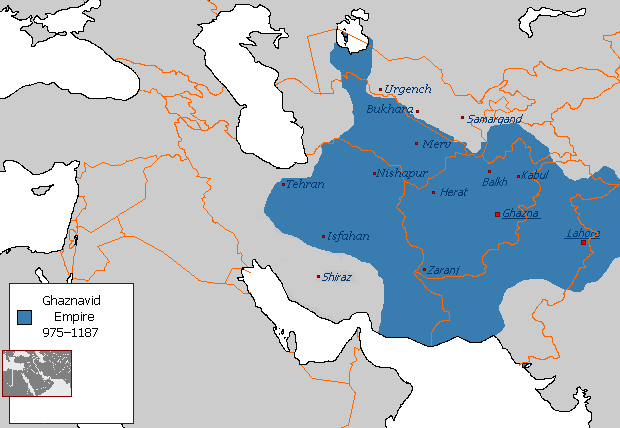
This piece focuses on the treatment given to Pre-Delhi Sultanate Muslim Invaders – the famous Ghazis of Islam. My recollection of textbooks is that the Mughals (except Babur and Aurangzeb) are glorified to a certain extent – especially Akbar, but none of the previous Muslim rulers are. I may be wrong – I am yet to read those chapters and will be posting about them later.
Mohammad Bin Qassim :
The Ummayad General doesn’t get much mention in these texts as by most accounts the Arab conquests of Sindh were at most localized events and did not have lasting consequences beyond Indus. Yet the one mention he gets in the Medieval history NCERT book isn’t something which appears positive.
Mahmud of Ghazni:
Mohammad Ghori:
Romila Thapar’s Medieval History is meant for 7th standard and hence doesn’t have the details seen in Satish Chandra’s 11th standard history book. Satish Chandra’s book captured a lot of facets of these invasions including religious. Reading these chapters, it is fair to conclude that none of these books glorify these early Muslim Ghazis. It can be fairly argued from Hindutva point of view, that Islam’s role in these conquests is understated (especially in Thapar’s Medieval History). But that book is meant for 12-year-old kids.
On the broader reading of history, I guess Islam is necessary but not sufficient in explaining the Turko-Afghan invasions of India in the 11th and 12 centuries.
Treatment of Delhi Sultans next.
Major Jaswant Singh (1938-2020), a former Indian army officer and distinguished parliamentarian and politician passed away recently. He served high office in the first BJP/NDA regime (1998-2004) and was, variously, the Defence, External Affairs and Finance Minister. Perhaps his most enduring legacy was his deft handling of India’s foreign policy in the aftermath of India’s nuclear tests in 1998. Most famously, his dialogues with the US Deputy Secretary of State Strobe Talbott helped cement Indo-US ties in the aftermath of the Cold War era.
There are some excellent obituaries- from allies, critics and rivals alike- which give us a good sense of the man and his persona. For me, the obituary that really struck a chord was the one by the senior Indian journalist Shekhar Gupta in his Cut the Clutter show. It is worth quoting him verbatim:
“Jaswant Singh was the last Indian liberal conservative… A conservative in the sense that he brought in a Hindu sensibility, a love for Indian culture. But liberal enough…to embrace everybody… and not interfere in anybody’s way of life and allow a healthy debate… he would have fitted the Swatantra Party very well and would have brought to it the one thing it seemed to lack in the 1950s and 60s: a strong appeal to nationalism”.
With Singh’s passing, it does feel that the last vestiges of the Vajpayee era are fading away. In his obituary for Singh, the journalist Saeed Naqvi, by no means a cheerleader for the BJP says that “Vajpayee’s was a cabinet of women and gentlemen, a few rotten apples notwithstanding.” Old fashioned virtues of moderation, decency and honour were valued by Vajpayee, and there was no one who epitomised old school more than Jaswant Singh. Through his career as a soldier and public servant and his sense of noblesse oblige, this thoroughbred Rajput proved to be a worthy Kshatriya by virtue of his karma. In that, he was not alone. Dr. Karan Singh of the Dogra dynasty of Jammu & Kashmir and Captain Amrinder Singh of the House of Patiala are others of his generation who come to mind, albeit with different political ideologies.
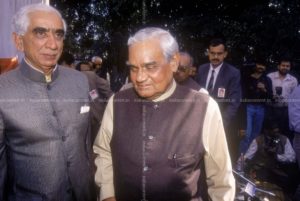
As a self-avowed liberal conservative, it is hard to not feel a tinge of sadness at this. One got the sense that men like Vajpayee and Singh were able to balance tradition and modernity: adept at blending the Burkean with the Vedantic, and equally well versed in the Bhagavad Gita and the Indian Constitution.
I could name half a dozen prominent BJP politicians in the Vajpayee years who could have identified as liberal conservatives. I struggle to name any noteworthy ones in the Modi-Shah BJP. The closest that comes to mind is the Odisha politician Baijayant Panda, but he is not prominent or important enough in the party. Others such as the former Maharastra Chief Minister Devendra Fadnavis or the current Madhya Pradesh Chief Minister Shivraj Chauhan had the potential to tailor their politics in this direction with the right backing and support. Unfortunately the signal from the leadership is that chest-thumping nationalism and ideological purity counts for more than moderation and compromise. Unlike a Jaswant Singh, these politicians do not have the intellectual courage or independence of spirt to breach the party line and chart their own path. It is a sad indictment on Indian politics, one that would have undoubtedly greatly depressed Jaswant Singh.
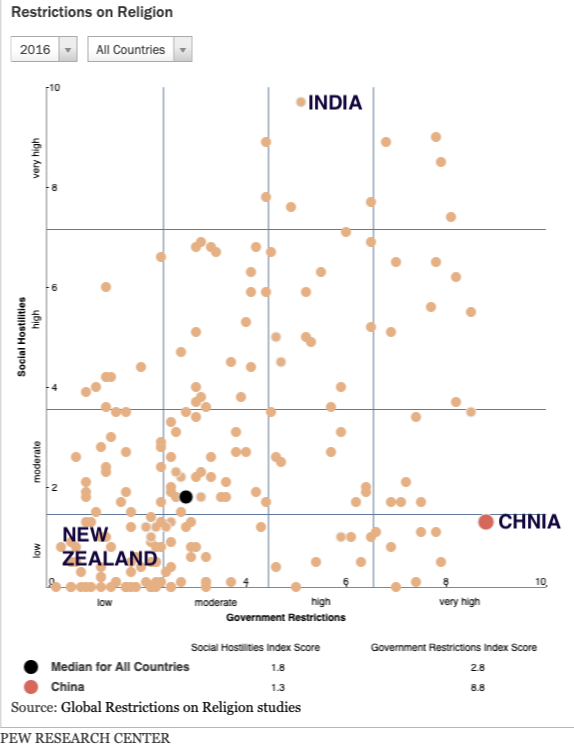
In our discussion on the podcast, Abhinav talked about China and India in relation to society vs. government. I stumbled on this chart from Pew that illustrates it.
China’s government controls religion much more than India’s government. But on a personal level, the Chinese have much more freedom in their religious identity. Indians are simply not equipped to understand how religion does not have corporate power as an identity in the same way in East Asia, which means the stakes for individual religious experimentation are far lower.
Recently came across this essay on Pocket, that was published in 2018 in the NY Review of Books:
https://getpocket.com/explore/item/who-killed-more-hitler-stalin-or-mao
Suhaib.
 This week two quick episodes with two sagacious repeat guests.
– With Jasper Gregory I revisit the situation in Vietnam. From coronavius, to BLM, to K-Pop.
– With Abhinav Prakash I discuss the Hathras rape, how it relates to caste politics in UP, and the various Dalit groups in that state.
You may notice a difference in sound quality. I decided to get a legitimate microphone. I think that will reduce the complaints about sound quality. Since it cost some money, I wouldn’t mind more Patreon subscriptions.
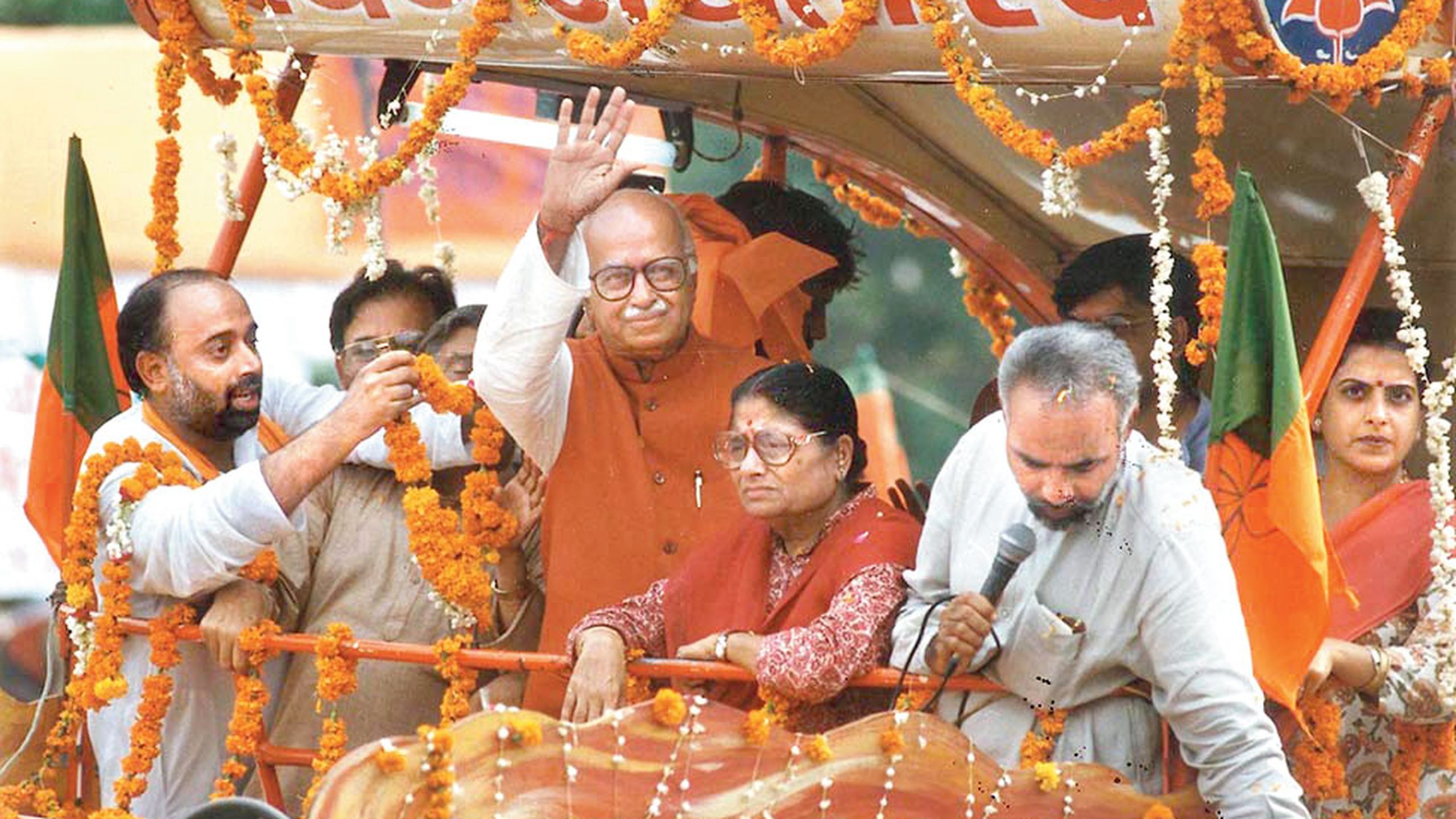
Unless you are living under a rock, you will have noticed the Babri demolition conspiracy verdict. All 32 accused including the firebrand Ashok Singhal and Uma Bharti were acquitted of the conspiracy charge. A conspiracy charge is notoriously difficult to prove in Indian court even with Political will, in this case from an objective perspective, the charge was unlikely to stick owing the excessive burden of proof required to prove conspiracy.
I came across this interview of Advani with Prannoy Roy from 2000.
After six years of Modi Shah, Advani appears like a fresh of breath air (to my liberal ears). Notwithstanding his role as the prime mover of the Ram Janmabhooni movement which left trails of blood across the country, Advani appears significantly liberal to my eyes in 2020. The willingness to talk to the enemy (as seen in a range of interviews given to aggressive media), comparatively more respect to democratic ethos and institutions, and an overall soft spoken-ness.
However, the interview leaves us with the question – Is Advani telling the truth?
There seem to be three potential chain of events which led to the culmination of the demolition of Babri Masjid.
If either of 2 and 3 is true, it is fair to say the BJP and Sangha Parivar leaders were playing with fire and when the fire got out of control it burned every one to a certain extent. Though today even if the fire was unintended, the fruits of the fire continue to be reaped.
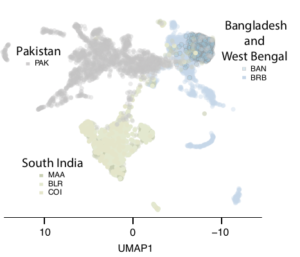 The Genomes Asia 100K has put their Indian paper out. It’s OK, and mostly focuses on the fact that Indians are enriched for inbreeding vis-a-vis other world populations. There are several layers to this. In some cases, as among South Indian Hindus and Muslims, there is cousin-marriage. But, in other cases, for example, Scheduled Castes and Scheduled Tribes, there seem to be extreme bottleneck effects due to delimited marriage networks. Finally, even among large population groups, such as Iyers, there seems to be some elevation of runs of homozygosity due to endogamy.
But that’s really not what I’m interested in. This preprint has a lot of Bengalis from Birbhum district in West Bengal of various castes. The UMAP (an advance over PCA in some ways) figures aren’t super informative, but you can see that their pooled sample recapitulates the Indian subcontinent. In fact, West Bengals on the whole are to the “west” of Bangladesh samples. Totally unsurprisingly.
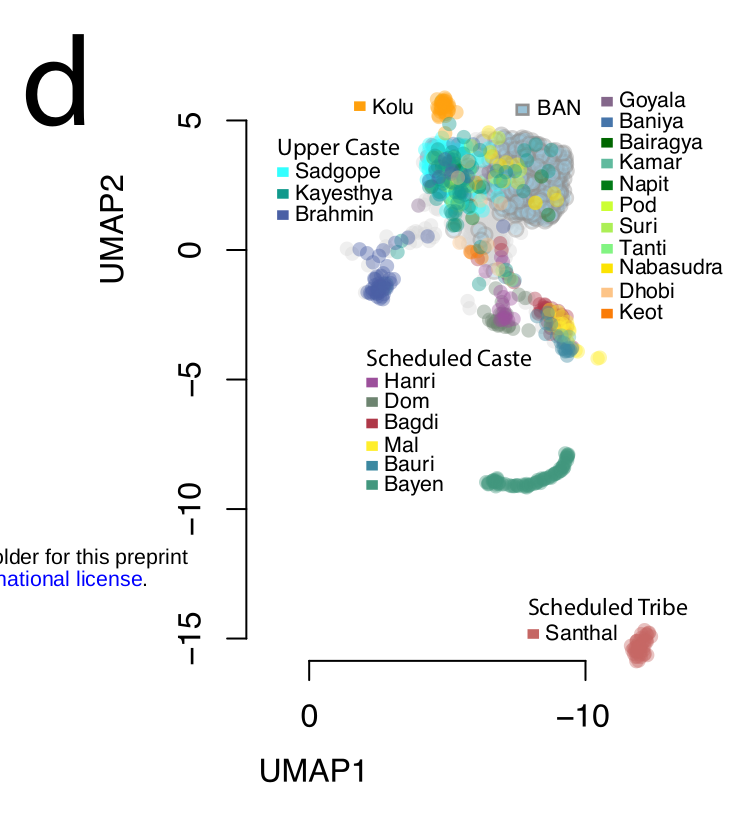
The main reason I’m putting this post up is the UMAP plot below. It’s hard to read (they will clean it up for final publication), and I don’t know all the castes (I’m assuming “Nabasudra” is a typo). But some things that jump out
1) Bengali Brahmins are distinct.
2) Kayastha are generic West Bengalis.
3) Some of the West Bengal samples are in the Bangladesh (collected from Dhaka) distribution. These are probably descendants of Bangal migrants from the east.
4) Some groups are very distinct. That’s partly due to strong endogamy, and in the case of Santhals high East Asian ancestry (they’re Munda). Other groups are less distinct. The “Namasudra” seem to be two groups. One overlaps with the main Bengali cluster (slight bias toward Bangladeshis), while a second group is shifted toward Scheduled Castes.
I assume readers can make more heads or tails of this, as I don’t know much about caste in West Bengal (and yes, the figure is very badly labeled/colored; this is a preprint)
Addendum: Not comments about Jatts please. I will delete them.