Open Thread – Brown Pundits

I did an episode on Big Brown Army a few days ago. The conversation revolved around being Christian (evangelical) and Indian, as well as what wokeness is doing to Christianity and Indians. The host of BBA, Decruz, is someone who I’ve known on and off for 15 years. We’ve both changed a lot, but stayed fundamentally similar.

Please remember to subscribe to ABCD Politics, the new podcast that I am doing with Surya Yalamanchilli.

I’m surprised how much you guys can be invested in Kashmir! That being said, the blow-up of the comments every week indicates perhaps Twitter is no longer so fun? I mean, 300+ comments on open threads are some serious discussion. Are blogs coming back?

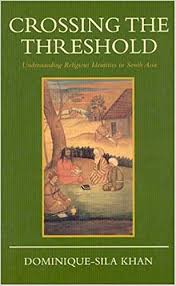
What’s the best history of India you guys have read? I know some people will get mad, but Romilla Thapar’s stuff is some of the most accessible and well-written in English. Tell me what’s better.

Maharashtra genetics

Novel insights on demographic history of tribal and caste groups from West Maharashtra (India) using genome-wide data (OA):

The South Asian subcontinent is characterized by a complex history of human migrations and population interactions. In this study, we used genome-wide data to provide novel insights on the demographic history and population relationships of six Indo-European populations from the Indian State of West Maharashtra. The samples correspond to two castes (Deshastha Brahmins and Kunbi Marathas) and four tribal groups (Kokana, Warli, Bhil and Pawara). We show that tribal groups have had much smaller effective population sizes than castes, and that genetic drift has had a higher impact in tribal populations. We also show clear affinities between the Bhil and Pawara tribes, and to a lesser extent, between the Warli and Kokana tribes. Our comparisons with available modern and ancient DNA datasets from South Asia indicate that the Brahmin caste has higher Ancient Iranian and Steppe pastoralist contributions than the Kunbi Marathas caste. Additionally, in contrast to the two castes, tribal groups have very high Ancient Ancestral South Indian (AASI) contributions. Indo-European tribal groups tend to have higher Steppe contributions than Dravidian tribal groups, providing further support for the hypothesis that Steppe pastoralists were the source of Indo-European languages in South Asia, as well as Europe.

Resilience in the face of religious change

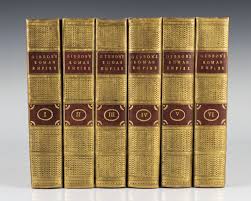
Recently my friend Josiah Neely mentioned offhand how in The Decline and Fall of the Roman Empire Gibbon argued that one reason paganism couldn’t reverse the tide of Christianity is that once a society or individual became Christian and ceased pagan practice, there wasn’t a good roadmap on how to reembrace the old traditions. In contrast, Christianity’s ideological content meant that even if there was a period of apostasy or public cessation of practice, ideological continuity could be maintained.

To be more explicit and extend the argument, I think the key is that there was a class of religious professionals who were devoted in a deep way to the ideological content of Christianity. If, as occurred in Britain and the Balkans, Christianity collapsed, they would endeavor to reconvert the populace, as they did.

There are other cases of this. Han Yu was a Confucian scholar who denounced Buddhism in the year 800 A.D. during the Tang dynasty. This period, between 600 and 900 A.D. was the “high water” point of public state Buddhism in China. But there always remained an alternative tradition of Chinese scholars and officials who were expositors Confucianism. Eventually, these people “recaptured” China during the Song dynasty for Confucianism, and Buddhism became a religion of the popular people and not the state.

As I said elsewhere, this may explain the persistence of Hinduism. Hinduism, like Greco-Roman paganism, is diverse and variegated. But unlike Greco-Roman paganism, there seems to have been a dynamic and reciprocal tension between philosophy and folk religion, mediated by Brahmins. Greco-Roman paganism was fundamentally an expression of ethnicity and identity. Tradition and custom. Greco-Roman metaphysics was the purview of secular philosophers. Hinduism is arguably more fused, and this may have given it more robustness.

Interview with Radcliffe

Cyril Radcliffe gets a lot of (mostly undeserved) flak from people anxious to find some scapegoat for the partition disaster. The following is an extract from Kuldip Nayar’s book “Scoop” (published originally by Scroll, India) that sheds some light on those times and Radcliffe’s role in them.

HOW A KNEE JERK DECISION LED TO MISERY FOR GENRATIONS

An excerpt from ‘Scoop’, in which the veteran journalist, who died on August 23, wrote about interviewing Cyril Radcliffe, Chairman of the Boundary Commission.

“I nearly gave you Lahore,” Lord Cyril Radcliffe, Chairman of the Boundary Commission, told me. “But then I realised that Pakistan would not have any large city. I had already earmarked Calcutta for India.”

Lahore had Hindus and Sikhs in a majority and way up in assets, he said. Yet he had no option because of paucity of big towns in Pakistan. The conversation took place at Radcliffe’s flat in London towards the later half of 1971. I had gone there to meet Lord Mountbatten, the last British Governor-General. I wanted to know how the boundary lines of India and Pakistan were drawn. Although the Boundary Commission had four more members – two from India, Mehar Chand Mahajan and Teja Singh, and two from Pakistan, Din Mohammed and Mohammed Munir – they were all serving judges.

Radcliffe was the one who made the decision because the Commission was divided, India’s members on one side and those from Pakistan on the other. What yardstick did he apply? I was keen to know. I found to my horror that Radcliffe had no fixed rules to go by when he drew the boundaries between India and Pakistan. He had gathered sufficient information by the time he came to demarcate the borders. Continue reading Interview with Radcliffe

Browncast Episode 108: Harsh Gupta on the India-China Conflict and Going Long India

Another BP Podcast is up. You can listen on LibsynAppleSpotify,  and Stitcher (and a variety of other platforms). Probably the easiest way to keep up the podcast since we don’t have a regular schedule is to subscribe to one of the links above!

You can also support the podcast as a patron. The primary benefit now is that you get the podcasts considerably earlier than everyone else. This website isn’t about shaking the cup, but I have noticed that the number of patrons plateaued a long time ago.

I would though appreciate more positive reviews! Alton Brown’s “Browncast” has 30 reviews on Stitcher alone! Help make us the biggest browncast! At least at some point.

Harsh Gupta | The Indian Express

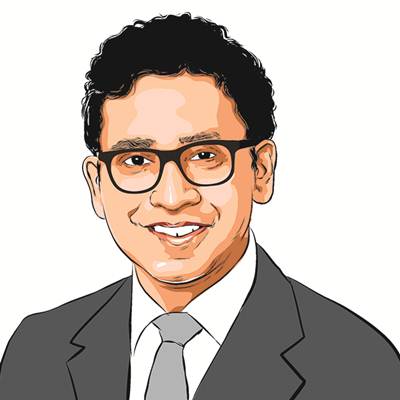
This episode features Omar, Mukunda, and Akshar talking to Harsh Gupta, an investor and author. We discuss the big picture geopolitics of the Galwan clash in Ladakh, Indian civilization, and why Harsh is going long on India. Some positive vibes in a trying time for many!


Browncast Episode 107: Kushal Mehra on religion

Another BP Podcast is up. You can listen on LibsynAppleSpotify,  and Stitcher (and a variety of other platforms). Probably the easiest way to keep up the podcast since we don’t have a regular schedule is to subscribe to one of the links above!

You can also support the podcast as a patron. The primary benefit now is that you get the podcasts considerably earlier than everyone else. This website isn’t about shaking the cup, but I have noticed that the number of patrons plateaued a long time ago.

In this episode Razib talks to Kushal Mehra about their views on religion. Kushal discusses his transition from being a New Atheist to a Carvaka, and the differences between Dharmic and Abrahamic religions in his view.

Open Thread – Brown Pundits

Talk about whatever you want.

One thing: most of your comments on “OIT” end up making me more skeptical of “OIT” (sometimes blog contributor JR is an exception insofar as he tends to present his arguments more tightly and offer plausible hypotheses). Half the time is spent in arguments that I don’t even necessarily hold. Anyway, just had to be honest about this.

The Crusades, Wootz/Damascus Steel, Pandanus and Dumbara Mats,

A post connecting three kinds of Pandanus, a beautiful blue flower, color of Buddhist priest Robes, Dumbara Mats, Wootz/Damascus Steel and Tenuous thoughts to the Crusades
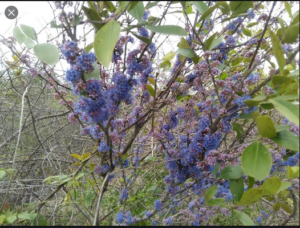

Sri Lanka has three kinds of Pandanus commonly known and used and a beautiful third plant, with beautiful blue flowers.

Rampe| රම්පෙ| Pandanus amaryllifolius
Kora-Kaha |කොරකහ| Memecylon umbellatum
Wetakeyiya | වැටකෙයියා| Pandanus kaida,
Dunukeiya |දුනුකෙයියා| Pandanus thwaitesii
Kora-Kaha |කොරකහ| Memecylon umbellatum

Rampe| රම්පෙ| Pandanus amaryllifolius

The most common and in home gardens. Used extensively in cooking in Sri Lanka and SE Asia. Most of the Sri Lankan dishes use these leaves for aroma along with curry leaves. In India it is called annapurna leaves; in Bangladesh, it is called pulao pata (পোলাও পাতা )

Wetakeyiya | වැටකෙයියා| Pandanus kaida

Grows by seaside. Long thin leaves compared to Dunukeiya (දුනුකෙයියා|). Used for mats mainly by sea side communities. During the 2004 Tsunami areas that had Wetakeyiya along the shore front were protected from the full impact. Post Tsunami many programes to plant and re plant Wetakeyiya along Sri Lankas sea side. (an Evaluation in 2010)

Dunukeiya |දුනුකෙයියා| Pandanus thwaitesii

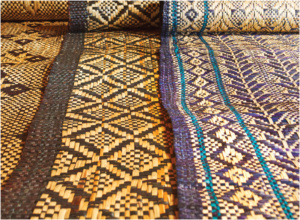
Grows by rivers, paddy fields, muddy areas. Leaves broad, used for mats called Dumbara mats. Wgasahantharindu has a nice description of the process to make the mats.
Paduru: Sri Lanka’s Magic Carpet 
Kora-Kaha |කොර-කාහ| Memecylon umbellatum
(Hindi : अंजन (Anjan) Tamil காயா (Kaya))

A tree with beautiful blue flowers. The Sinhalese name for the plant does not reflect the beautiful blue flower. More its practical side, the use of as a yellow dye. i.e. kaha කාහ means yellow

a) The leaves contain a yellow dye, a glucoside, which is used for dyeing the robes of Buddhist monks.
b) Also used for yellow colouring of reed (Dumbara) Mats
c) Historically, this plant was burnt as fuel in the production of Wootz steel also see    Eleventh-Century Pittsburgh in Sri Lanka

Note: Wiki says this tree is called Ironwood. It is NOT the Mesua ferrea, the Ceylon ironwood national tree of Sri Lanka

So to put it all together

A common home garden plant used for cooking (Rampe| රම්පෙ|Pandanus amaryllifolius)
Related to a plant that was/is Tsunami protection (Wetakeyiya | වැටකෙයියා|Pandanus kaida)
Related to both above used for Mats (Dunukeiya |දුනුකෙයියා| Pandanus thwaitesii)

The First Tenuous* to an unrelated plant, that connects to the above. Kora-Kaha |කොරකහ| Memecylon umbellatum

Yellow colouring from leaves used for mats made from Dunukeiya|
Buddhist priests robes are dyed by flower of Kora-Kaha
Mats used by Buddhist priests and lay people are dyed from the flower of Kora-Kaha

The Second Tenuous*, Use of Kora-Kaha for Wootz Steel/Damascus Steel.

Was there not enough Kora-Kaha trees to make Steel to fight the 12th Century South Invaders.

Or were the Sinhalese Kings busy exporting the Wootz steel/Damascus Steel to the Mid East and not enough steel to fight invaders (I dont think so, just a thought process).  The Mid East Saladin was busy fighting the Crusaders eg Richard the Lion Heart.

For the Sri Lankan readers, the 12th century was the decline of the Sinhalese polity in North and establishment of the Kalinga/Tamil polity in the North

*Tenuous as in without researched back evidence.

Expanding CAA

Expanding CAA (working evolving draft)


Would like to propose expanding CAA to include the following groups of muslims to:

  • get everyone’s feedback on what can practically pass the Indian Lokh Sabha quickly
  • see if several major Indian leaders will publicly endorse this

The following text will be continually edited based on feedback.

Proposing to expand CAA to include the following “AND ONLY THE FOLLOWING” groups of muslims IF AND ONLY IF they can prove persecution inside Bangladesh, Pakistan or Afghanistan:

  •  13 classes AND ONLY 13 CLASSES of Muraqabah Sufi muslims:
    • 3 classes of Muraqabah Irfan Sufi Shia muslims
      • Sixer Ishmaeli Muraqabah Irfan Sufi Shia muslims
        • Dawoodi Bohra Sixer Ishmaeli Muraqabah Irfan Sufi Shia muslims
      • Twelver Jafari Muraqabah Irfan Sufi Shia muslims
    • 10 other classes of Muraqabah Sufi muslims
      • Chisti Muraqabah Sufi muslims
      • Qadiri Muraqabah Sufi muslims
      • Pir Nund Rishi Muraqabah Sufi muslims
      • Pir Shirdi Sai Nath Muraqabah Sufi muslims
      • Pir Kabir Muraqabah Sufi muslims
      • Pir Janardhan Swami Muraqabah Sufi muslims
      • Pir Hazrat Babajan Muraqabah Sufi muslims
      • Pir Syed Mohammed Baba Tajuddin Muraqabah Sufi muslims
      • Pir Baba Fariduddin Ganjshakar Muraqabah Sufi muslims
      • Pir Baba Budan Muraqabah Sufi muslims
  • Agnostic, Atheist and Ex muslims
  • LBGTQ plus muslims
  • Female femnist muslims


Any and all Muraqabah Sufi muslims admitted under CAA need to be certified and verified as Muraqabah Sufi muslims by a council of Muraqabah Sufi muslims chaired by Pir Diwan Sahib Syed Zainul Abedin. Pir Diwan Sahib Syed Zainul Abedin will appoint a committee of Muraqabah Sufi muslims at his own discretion to assist him in this task.


Any and all Agnostic, Atheist and Ex muslims, LBGTQ plus muslims and female femnist muslims admitted under CAA need to be certified and verified by a council of muslims chaired by Tarek Fatah . Tarek Fatah will appoint a committee of muslims at his own discretion to assist him in this task.


In addition to approval by above councils of muslims, any and all muslim CAA applicants are subject to extensive deep background security checks and can be vetoed by the Indian government for any reason.

NO OTHER MUSLIMS will be permitted to apply for CAA. No other aspect of CAA will be affected.

Please provide your suggestions about how to improve the above draft.

Lord Indra the brutal!

In the post below a question comes up: what about the Indo-Aryans?.

First, before we move on, I want to stipulate that I am going to assume that the Indo-Aryans were intrusive around ~1500 BC. I believe this is true, though I understand not everyone does. Stipulating that this is true, was the intrusion brutal? Looking into the admixture coefficients it seems plausible that the Indo-Aryan ancestry genome-wide in the Upper and Middle Gangetic plains, the heart of Aryavarta, is in the range of 10-20%. For various reasons, I lean toward a higher estimate. This is lower than the proportion of “steppe” ancestry in Northern Europe, and in the range in parts of Southern Europe (though still lower than much of Southern Europe).

The contrast with Turco-Muslims could not be more striking. The distinct part of Turco-Muslim ancestry is East Asian. Some of this can be found in groups like Pashtuns, and in a few rare cases in Indo-Muslims, but it is entirely absent in the non-Muslim population. The exceptions are totally comprehensible; Indians from the Himalayan and Northeastern fringes. If the Muslims did rape Hindu women they killed them all. This is not implausible on the face of it, but in the context of human civilization, it seems unlikely. Rather, the situation more like the rape of the Sabine women is the norm (I believe most of the sexual exploitation of Hindu Indian women eventually resulted in Indian Muslims).

To be frank: I believe that the Indo-Aryan intrusion into what became Aryavarta resulted in more death proportionally than the Turco-Muslim intrusion. There are several reasons why this might be.

Like the migration of the Rohirrim into part of the fallen kingdom of Arnor, I suspect that the Indo-Aryans arrived in a landscape where the machinery of the Indus Valley Civilization  (IVC) had already fallen apart due to the early Bronze Age climatic shock (which impacted West Asia as well). What the Indo-Aryans encountered probably resembled the petty kings of Dark Age Greece after the fall of the citadel culture.

In short, one reason that the Indo-Aryan impact was so strong is that Indian agricultural society was much thinner and less dense in the second millennium BC than in the second millennium AD. The threads which bound societies together were much more robust after thousands of years of institutional development, and economic advancement and technological innovation.

Another reason is that elite ideologies and outlooks had changed. It is entirely plausible that the Indo-Aryans and the native elites faced each other in a game of animal competition and elimination. The strategy of later barbarians, whether it be Huns or Khitai, was to extract tribute from agricultural societies which produced much more aggregate wealth and specialized luxury goods. This may not be a situation that occurred in much of Eurasia in the second millennium BC, as conquest elites perceived themselves to be primary producers rather than extractors of tax. As such, no accommodation may have been possible in many more cases than would be true later.

Peter Turchin has argued that violence probably peaks in the “pre-state polity” phase. The emergence of complex institutions and world religions in the first millennium BC was part of a process of smoothing over the autocratic brutality of the new regimes. The reality is that despite the ideological differences, the Turco-Muslims who arrived in India were primarily motivated by material considerations of extraction.

So what’s going on with the different views of the Turco-Muslims vs. the Indo-Aryans? Clearly time matters. The Turco-Muslim hegemony lasted into the early modern period. It is raw. In contrast, the Indo-Aryan fusion with the Indian substrate occurred before history. The keyword here is fusion. Despite what I believe are the violent antecedents of the pairing of fair Arjuna and dark Draupadi, out of the union was born the culture and people of North India. In contrast, the Turco-Muslims introduced a religion and culture which was incompletely digested and synthesized.

If the Turoc-Muslims and their Indo-Islamic descendants severed connection with West Asia and broader institutions such as the Naqshbandi tariqa, then a synthesis might have emerged. As it is, the synthesis was frozen and incomplete. The Muslim people of the Indian subcontinent are ancestrally no different than the non-Muslim people, and speak similar languages and eat similar food, but their identity is deeply different and distinct. In some ways, they exist as an inversion or negation of the native religious traditions, with their tacit polytheism and explicit idolatry (of course there are exceptions). Though some interaction has long occurred between Islam and Indian darshanas, it is not reciprocal and explicit. The metaphysical presuppositions diverge.

So there you go. At the end of the day problem is rather straightforward and plain. Like oil and water Indian Islam and non-Islam remain separate and wary, each unable to absorb or marginalize the other. If Muslims were a few percents of the population some level of synthesis would naturally occur. Conversely, if Muslims were more than 90 percent of the population, likely more liberal and progressive Muslims be curious about mining and rediscovering their Indian religious traditions and history. But as it is, we’re in an unstable equilibrium in between.

Brown Pundits