
Please keep the other posts on topic. Use this for talking about whatever you want to talk about.
Indian Twitter shows why a “universal translator” wouldn’t work
India is one of the top countries on Twitter. And, since many Indians have some command of English, they interact somewhat with the English-speaking Twitter crowd which is mostly based in the USA and UK.
But, the differences in style, idiom, and cultural references, make conversations often very difficult and totally incomprehensible. Despite the fact that two interlocutors may speak the same language, with only minor syntactical and semantic differences. The difference exists between British and Americans as well, but the cultural gap here is much smaller, and some of the confusions I see with conversations with Indian Twitter happen far less.
This is not a function of how much similar British English is to American English. It is a function of the uniqueness of Indian culture and expectations, and particular idioms and frames. The usage of English allows for Americans to be exposed to this, but there is a level of opacity that is novel and surprising.
To me, my engagement with Indian Twitter is more a matter of anthropological curiosity than dialogue. Twitter lacks the nuance and density to puncture the incommensurable aspects easily.
A tale of two Pakistans
– Bangladesh to clock highest growth in Asia this year.
– Pakistan’s growth to be lowest in South Asia in current fiscal.
8% vs. 3%. From a geopolitical perspective at current rates of relative stagnation India’s Pakistani problem will “solve” itself as the Islamic Republic is turning into a macroeconomic midget. All of the geopolitical posturing will be irrelevant if the Pakistani polity doesn’t get its structural house in order (e.g., shift away from the oligarchy).
Review: The Anarchy, by William Dalrymple
I had earlier posted a short version of this review, to which many people objected that it was not really a review, just a short rant. Major Amin has now sent a longer version. I hope this will satisfy some of the critics…
The Anarchy-
William Dalrymple
Book Review
By Major Agha H Amin 
Dalrymple is not a serious historian but a highly skilled jester who plays to the gallery. He makes many factual errors in his book and frequently gets carried away by emotions. promiscuously mixing facts with fiction.
On page 12 there is a small typing error placing third mysore war victory of Cornwallis in 1782 rather than 1792:
In describing Aurangzeb on page 13 Dalrymple misses the most essential fact that it was the Hindu Maratha Insurgency that laid the foundation of the decline and fall of the Mughal Empire. In this regard, other groups such as the Rajputs etc were mickey mouse players; the real hero of Hindu resurgence was Sivaji.
Dalrymple describes Mohammad Shah in very derogatory terms, but fails to
note that under his shaky tenure the Mughals still defeated Ahmad Shah Abdali at Sirhind in 1748.
The battle of Buxar took place in 1764 and not in 1765 as Mr Dalrymple states on page-16.
On page 60 Dalrymple fallaciously states that Bhonsle was incharge of Orrissa whereas the Bhonsla citadel was many hundred miles from Orrissa to the west in Nagpur.
Dalrymple is addicted to fantasies (playing to the gallery), thus he projects the Mughals as the height of civilization while these so called civilized Mughals in 1719 publicly tortured Banda Bahadur’s five year old son, gouging out his heart while the child was alive and shoving it in his fathers mouth !
Nadir Shah did not invade Afghanistan in 1739 but in 1738 via Helmand, a long way from Delhi, but our brilliant and careless writer states he did so in 1739.
Dalyrmple totally misses one of the great betrayals in Indian history at Karnal, where Nadir Shah of Persia on the prompting of Nawab of Avadh Saadat Khan decided to pillage and plunder Delhi after an initial agreement to return to Persia after being paid a relatively small fine.
Dalrymple spents great energy on vilifying the company for the famine of Bengal of 1770, but fails to reconcile the fact that a far greater famine broke out in Bengal under the British crown. In general, jis treatment of events reeks
of extreme polemics and subjectivism.
Even worse is his treatment of military events, for example in describing the First Anglo Mysore war he glorifies Hyder Ali but fails to note that he lost in several pitched battles against Colonel Smith and won the war only because of lack of cavalry by the company as well as the extreme corruption of various company officials.
Dalrymples treatment of military history in general is atrocious. For example, in discussing the Second Anglo Mysore War he only discusses one battle (Pollilore) but totally ignores the fact that Hyder Ali was repeatedly defeated
at Porto Novo , Sholingur etc by Sir Eyre Coote.
Dalrymple totally ignores the fact that while the company lost one battle in 1780, the war continued till 1784 and was inconclusive in spite of Hyder Ali’s superior cavalry and the company’s corruption.
Dalyrmples use of historical facts is generally one sided and extremely biased. This is not a one-off, but a pattern. He cherry picks and higlights what fits his narrative, ignoring or downplaying what does not.
Ahmad Shah Abdali never went to Delhi in 1762 so Dalrymples claim that he ousted Imad ul Mulk in 1762 is incorrect (page-259 ).
By and large the book is a repetition of well known facts of British Indian history, framed tendentiously to fit his narrative. Basically Dalrymple has wasted a book in vain as it brings out nothing new. His whole conclusion about the company and the title of the book “Anarchy” is extremely questionable and
debatable. Firstly the English East India Company did not cause anarchy in India as Dalrymple repeatedly tries to prove. India was already in a state of complete anarchy when the British company became a serious player. They took advantage of this anarchy, they did not cause it.
Delhi was sacked more than 40 times between 1737 and 1800 by non British forces, but Dalrymple is blind to this as it does not fit the narrative he wants to project. All the bad things he sees are only to be found in English East India Company. This will no doubt delight his nationalistic (or guilt-ridden English) readers, but it is a very questionable framing of 18the century Indian history.
His military knowledge is myopic and he constantly distorts military history and uses bits and pieces to prove or disprove as he wills at whim.
As a matter of fact the company restored order in India .The first three universities in Indian history were founded at Calcutta ,Madras and Bombay in 1856-57 by the Company. Outmoded customs such as widow burning , infanticide etc were abolished by the company. A hereditary class of feudal lords was created by Lord Cornwallis in 1792 as a result of which political
stability was introduced and strengthened in India. The company had many reformers, philanthropists and utilitarians but Dalrymple in his irrational hatred is blind to all these people.To Dalrymple all that British East India Company did
was bad and he has an extremely jaundiced and twisted vision, not an objective view of history.
Dalrymple gives no weightage to the fact that British parliament and system prosecuted Clive and Warren Hastings and tried to regulate company rule in India. They were not angels, but they were not the uniquely villainous source of all evils in India. Above all Dalrymple forgets that without the driving spirit of corporate enterprise of the company the British would never have conquered India. While personal interest has constantly dominated human conduct in history , whether it was a company or a state , Dalrymple wears coloured glasses and his perception is cloudy as well as confused.
Finally, my most serious issue with Dalrymple is his overly simplistic sweeping judgements. The Mughals for example were as big opportunists and greedy rulers as the company.They were a small group of adventurers, kicked out of central Asia, who captured India or north India just like the British company because of superior military tactics. If you look at Mughal contributions you find a few grand monuments such as the Taj Mahal or Shalimar Bagh in Lahore! Whereas the British company gave India , irrigation , universities, a
sound military system , a system of governance and a class of hereditary feudals who made the system more stable, relative to the times.
Another point that Dalrymple totally misses is that the company saved the Indian Muslim elite from total political extinction . The Muslims were practically nobodies by 1800. Delhi was ruled by the Marathas, Badshahi mosque of Lahore was a horse stable and a powder magazine! The Marathas
and Sikhs totally dominated north India! But a knight in shining armour comes and saves the Indian Muslim elite. It was Lake who saved the Muslims of Delhi from extinction! Hugh Gough saved the Muslims of Lahore and Peshawar! But Dalrymple misses out all these things.
Dalrymples most serious failure is that greed and avarice is not a British company failing but a human failing and all Indian rulers were guilty of this just as much as the EIC. Dalrymple fails to appreciate that Indians gladly
fought against Indians under the company because the company paid salaries in time !
Dalyrmple fails to note that British company]s triumphs were triumphs of organization, such as when Lieutenant Flint repeatedly defeated Tipu Sultan with a 100 % Indian force at Wandewash.Dalrymple fails to appreciate that
India was conquered by an organizationally superior company using 80 % Indian manpower! Why Indians followed them if they were as plainly evil as Dalrymple believes or wants us to believe !
And finally, Dalrymple fails to relate this past to what happened after the British left. Pakistan, where I live, is one of the most corrupt states in the
world .Pakistans tax officials of the so called FBR are 1 billion times more corrupt than the English East India Company could be in their wildest dreams. Parochialism is such that in todays Pakistan the entire ruling establishment consists of few districts and few castes of North Punjab and small parts of Sindh!
Characters like Dalrymple thrive on emotional manipulation which is why Dalrymple needs to be questioned and refuted!
“OBC” in West Bengal a social construct?
Recent population history inferred from more than 5,000 high-coverage South Asian genomes:
Next, we developed a novel method for estimating the genome-wide average divergence time between a single individual and a focal group. This method focuses on extremely rare variants, which should be the most informative about very recent demographic events, and is robust to demographic events affecting the particular individual studied. We focused this work on samples from Birbhum district, West Bengal due to the presence of additional metadata on caste and religion. We used 704 general-caste individuals from Birbhum as the focal group, and estimated divergence times for all other individuals. Mean divergence times ranged from ~2,600 years for the Santal, an Austro-Asiatic language speaking tribal group, to 850 years for “scheduled castes” (i.e., Dalits), 625 years for Bangladeshis and 225 years for “Other Backward Castes” (OBC) individuals. The recent divergence times for OBC individuals confirms that this category is more of a political construct than a long-lived social grouping, while the other divergence times suggest a substantial amount of gene flow between groups. Finally, we extended our approach to thousands of other genomes from around the world. We show how patterns of rare variation can be used to detect asymmetrical migration, and document evidence for more migration from East Asia into Bengal than the converse.
Browncast Episode 68, Conversation with Pratik Chougule
 Another BP Podcast is up. You can listen on Libsyn, iTunes, Spotify, and Stitcher. Probably the easiest way to keep up the podcast since we don’t have a regular schedule is to subscribe at one of the links above.
You can also support the podcast as a patron. The primary benefit now is that you get the podcasts considerably earlier than everyone else. I am toying with the idea of doing a patron Youtube Livestream chat, if people are interested, in the next few weeks.
Would appreciate more positive reviews!
This episode we talked to Pratik Chougle, a conservative and a proud globalist. From being on Trump’s policy team, Chougle has become a critic and envisions a future conservatism sharply at odds with parochial nationalism.
Book Review: The Anarchy (William Dalrymple)
A longer version of this review is now up at this link.
A short review from Major Amin. I have not yet read the book, but Dalrymple’s recent books have an increasing tendency to play to the gallery. I would not descirbe this as “irrational hatred” (see review below), it is entirely rational. He knows his audience and frames his books to pander to that audience. He is a good writer and is not ignorant, but his books are spoiled by his urge to frame his story in ways that will appeal to his audience (educated Indians who are happy to hear bad things about the EIC and Westerners who want to appear virtuous). Again, I have not read this book, but his other recent books and interviews all exhibit this tendency..
The Anarchy-Dalrymple– Book Review
The Anarchy-Dalrymple Book Review
https://www.researchgate.net/publication/335881689_The_Anarchy-Dalrymple_Book_Review
Firstly English East India Company did not cause anarchy in India as Dalrymple repeatedly tries to prove.
India was in complete anarchy when the British company became a serious player.
Delhi was sacked more than 40 times between 1737 and 1800 by non British forcces, but Dalrymple is blind to this hard fact. All the bad things he sees are only to be found in English East India Company.
His military knowledge is myopic and he constantly distorts military history and uses bits and pieces to prove or disprove as he wills at whim.
As a matter of fact the company restored order in India .First three universities in Indian history were founded at Calcutta ,Madras and Bombay in 1856-57.
Outmoded customs like widow burning , infanticide etc were abolished by the company.
A hereditary class of feudal was created by Lord Cornwallis in 1792 as a result of which political stability was introduced and strengthened in India.
The company had many reformers, philanthropists and utilitarians but Dalrymple in his irrational hatred is blind to all these people.
To Dalrymple all that British East India Company did was bad and he has an extremely jaundiced and twisted vision.
Dalrymple gives no weightage to the fact that British parliament and system prosecuted Clive and Warren Hastings and tried to regulate India.
Above all Dalrymple forgets that without the driving spirit of corporate enterprise of the company the British would never have conquered India.
While personal interest has constantly dominated human conduct in history , whether it was a company or a state , Dalrymple wears coloured glasses and his perception is cloudy as well as confused.
Open Thread – Brown Pundits
Please keep the other posts on topic. Use this for talking about whatever you want to talk about.
JustKnecht’s Loom of Form & Meaning
Brilliant, IMO — and hopefully of use to Ali Minai and others in the field of artificial intelligence — here the Loom is, as JustKnecht presents it on Medium:
**
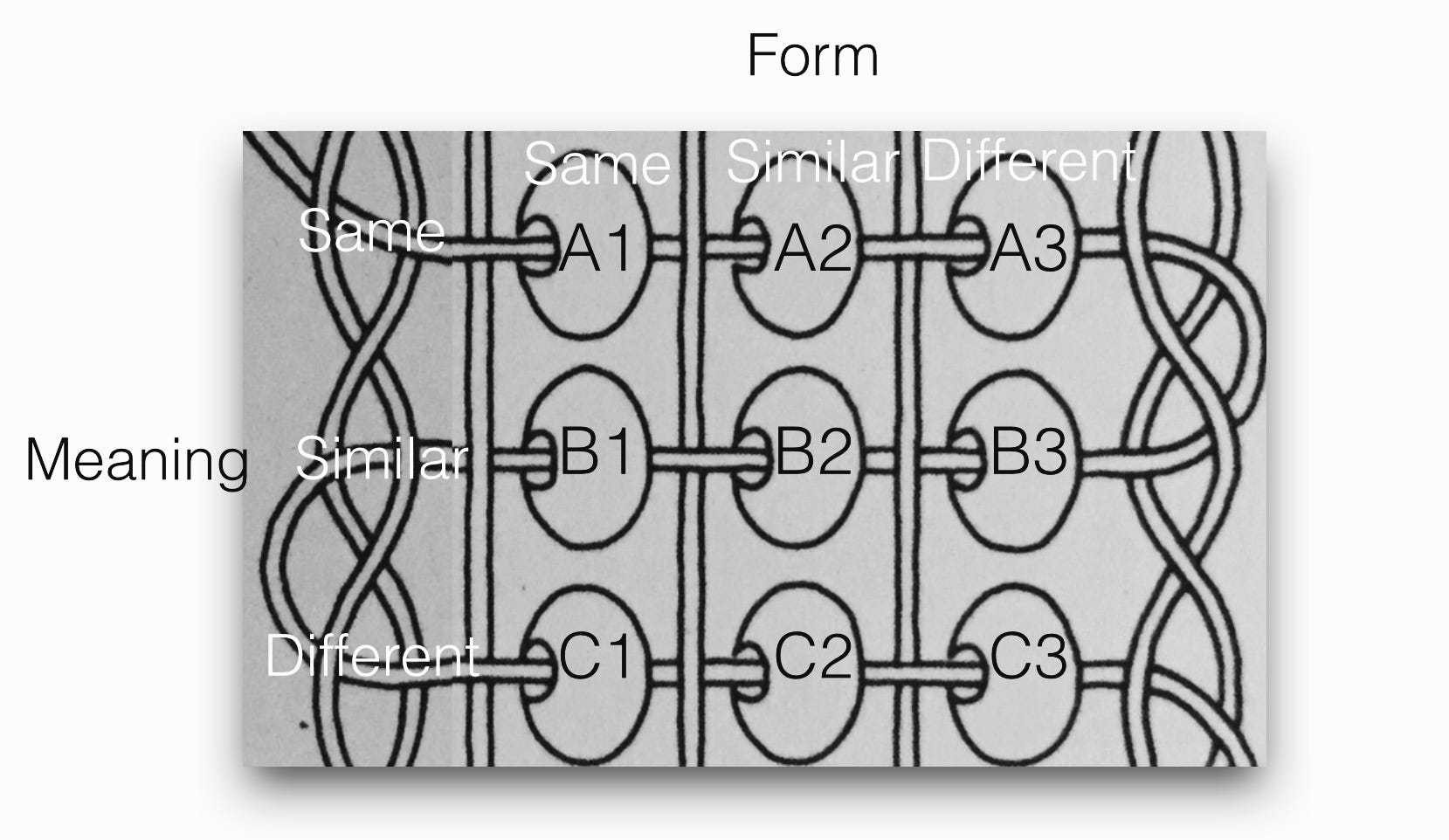
9 categories can be used to classify how forms, meanings and the connections between them change, develop and evolve in relation to each other. Put anything at the top left of this table, then:
**
Further readings:
The Loom of Form and Meaning
The Loom of Verbal Reasoning
Rattlesnake Games – Introduction and Example
Connecting forms to contexts in Rattlesnake Games
**
My own HipBone Games, like JustKnecht’s Rattlesnake Games, are inspired by Hermann Hesse’s Glass Bead Game as described in his novel of that name — and there’s enough kinship between them that Derek Robinson’s comments on my own games and Ai may be of use, mutatis mutandis, in setting a context for Rattlesnake Games, too:
Derek Robinson, HipBone Games, AI and the rest
**
Few things in life are as delightful as finding kinships of mind and heart.
Modernization leading toward confessionalization
From the comments:
I think what’s underappreciated is that hindu nationalism is partly caused by the collapse of the caste system. I know that may not intuitively make sense at first, but compared to when I was a boy the caste system has significantly weakened. People are finally starting to look at each other as hindus rather than by caste – and this has never been the case in the past. Obviously caste is still here and we all have a long way to go but it is substantially weakened and weaker than its ever been. I believe this is the major cause for the rise of hindu nationalism.
 One of the strange things that surprises many people is that modernization often produces stronger and more robust confessional identities. In Eric Kaufmann’s Shall the Religious Inherit the Earth? Demography and Politics in the Twenty-First Century he talks about the fact that urbanization and increased access to educational opportunities for the rural middle-class in Muslim countries resulted in gains in power to Islamist movements. The reasons are manifold, but one issue is that local power blocs centered around customary and traditional relationships and patronage networks were disrupted by development. In a flatter and more deracinated landscape simple and universal Islamist messages were appealing.
You see the same process happening in Indonesia. Traditional Islam among the Javanese is syncretistic. But its power and strength are in the solidities of the rural cultural order which has deep local roots. Development and migration to urban areas result in a shift toward more world-normative (santri) Islam which is not contingent on local cultural and social frameworks.
In this model then the economic liberalization ushered in by the Congress Party in the early 1990s sowed the seeds for the emergence of a broad-based Hindu nationalism, as economic dynamism and urbanization begins to erode the older caste-based solidities.