Brilliant, IMO — and hopefully of use to Ali Minai and others in the field of artificial intelligence — here the Loom is, as JustKnecht presents it on Medium:
**
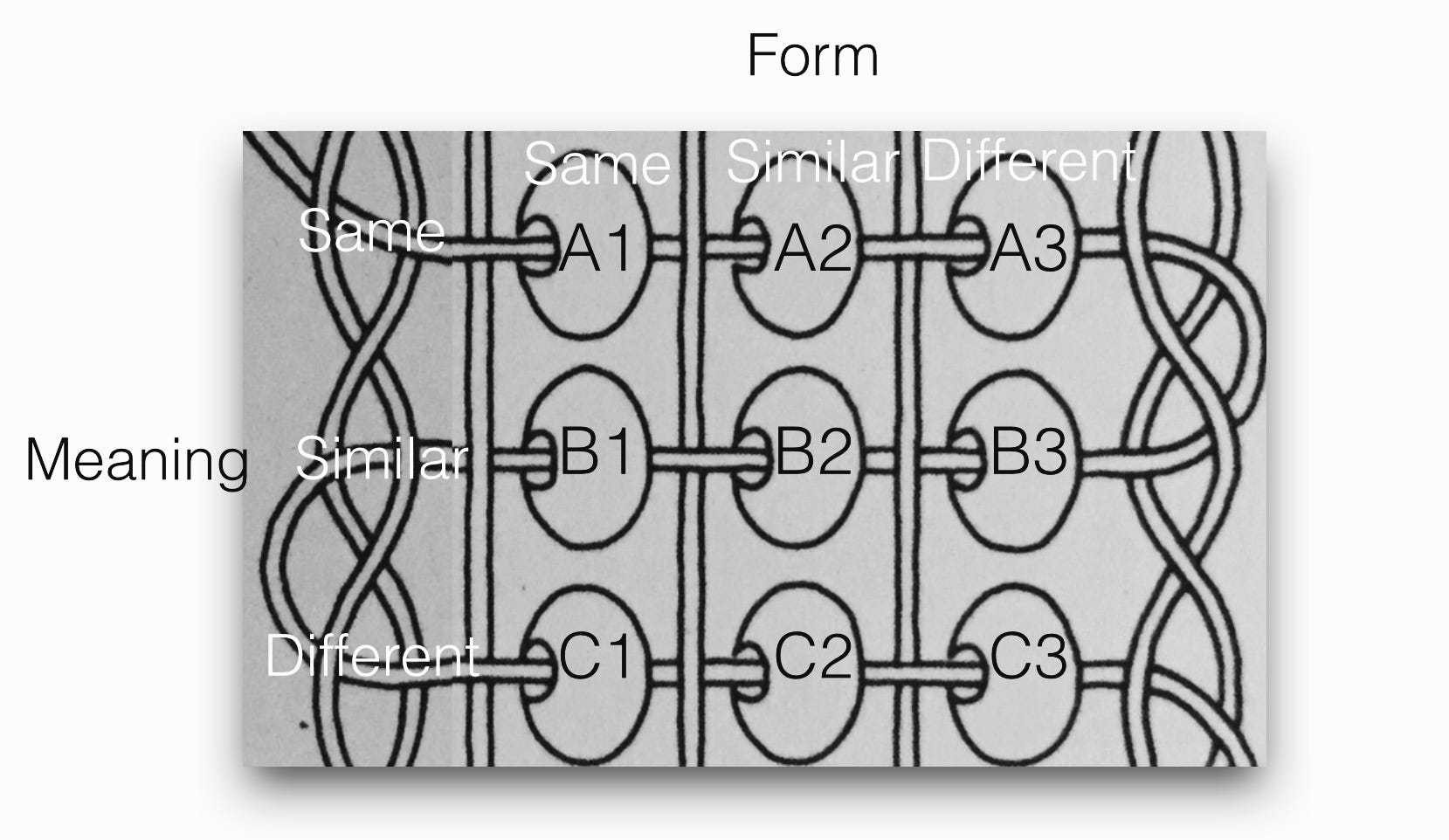
9 categories can be used to classify how forms, meanings and the connections between them change, develop and evolve in relation to each other. Put anything at the top left of this table, then:
**
Further readings:
The Loom of Form and Meaning
The Loom of Verbal Reasoning
Rattlesnake Games – Introduction and Example
Connecting forms to contexts in Rattlesnake Games
**
My own HipBone Games, like JustKnecht’s Rattlesnake Games, are inspired by Hermann Hesse’s Glass Bead Game as described in his novel of that name — and there’s enough kinship between them that Derek Robinson’s comments on my own games and Ai may be of use, mutatis mutandis, in setting a context for Rattlesnake Games, too:
Derek Robinson, HipBone Games, AI and the rest
**
Few things in life are as delightful as finding kinships of mind and heart.
Interesting read.
I think most ppl didn’t understand anything
JustKnecht is inviting us to a task that’s both simple — sorting different examples of analogy, metaphor, identity, similarity, opposition and so forth into baskets — and difficult — because we don’t have the habit of sorting analogies in that way.
Analogies etc are also things that spring spontaneously to mind — this reminds me of that, this is like that, look at those two, they might as well be twins — but unless we’re attorneys, philosophers or poets we probably don’t probe them much, and even the phrase “comparisons are odious” shows us that our spontaneous insights into similarity can also lead us into the dreaded zone of real or imagined “false equivalences” — as when someone uses the phrase “concentration camps”, which someone else feels should properly refer only to the Shoah.
Is that a false equivalence, or a fair use of language? Opinions differ — but you see what I mean, we’re not accustomed to check what you might call the balance of weights between two terms of a comparison or metaphor. And yet just such a balancing of weights is what we mean by justice.
And here, JustKnecht is inviting us to yet another, equally keen-bladed analytic method, and one which I think is his original contribution. I’m certainly enriched by the possibilities he’s opening to us here.