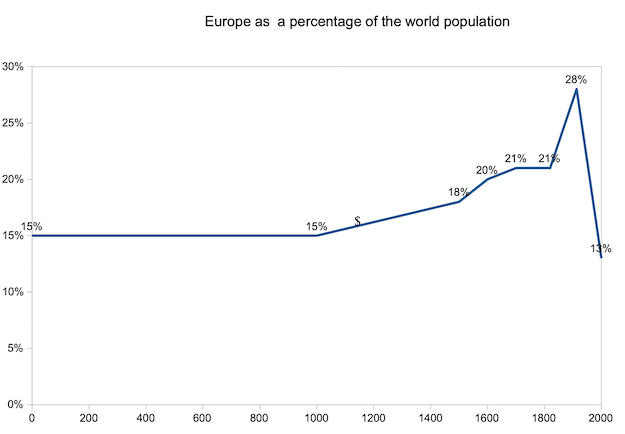
I made the above chart for a presentation I’m working on. You notice that in 1913 Europe is 28% of the world’s population. In 2000 it is 13% of the world’s population. In 2019 Europe is almost certainly closer to ~10% of the world’s population (the above estimates for Europe include Russia).
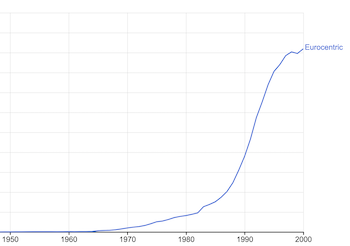
To the right, I’ve posted the screenshot of an Ngrams search of books with the term “Eurocentric.” Notice that that term shoots up just as European hegemony went into freefall.
Today there is a lot of talk about postcolonialism, “colonizers,” “white supremacy,” and whatnot. And yet what else is this but a shadow of ages gone by?
We as humans are always fighting the last war. European societies are geriatric. They are wealthy, healthy, and have great aesthetic qualities. Many people would love to live in Europe. But unless you are an acolyte of Madison Grant, who believes in the peculiar and unparalleled genius of European peoples, the numbers are telling a story you can’t avoid.
Another BP Podcast is up. You can listen on Libsyn, iTunes, Spotify, and Stitcher. Probably the easiest way to keep up the podcast since we don’t have a regular schedule is to subscribe at one of the links above.
You can also support the podcast as a patron. The primary benefit now is that you get the podcasts considerably earlier than everyone else. I am toying with the idea of doing a patron Youtube Livestream chat, if people are interested, in the next few weeks.
Would appreciate more positive reviews!
On this episode, we talk with Dr Amrik Chattha. Dr Chattha is the author of “Safar: A Child’s Walk To Freedom During the Partition of India“, available on Amazon. He talks about life in a Punjabi village before partition and the horrors that followed partition.
Pakistan is at an interesting (and dangerous) juncture today; in 2018 the military used the many levers it has at its disposal to get Imran Khan elected as Prime Minister and GHQ continues to strengthen its grip on power, but that is not the interesting part. That is just the normal Pakistani cycle of semi-civilian rule followed by a phase of more direct military rule, followed by another attempt at civilian government; what is interesting is that a significant section of the emerging Pakistani middle class (“Mehran Man”) has managed to convince themselves that this time there will be a revolution: the violent overthrow of one social order and its replacement by a very different order.
GHQ probably had no such revolution in mind when they promoted Imran Khan and made him prime minister. Some civilian leaders were to be sidelined and some military leaders planned to acquire more direct power, and in order to do this they activated their vast public relations apparatus and talked of revolution and grand transformations, as one does, but no Bolshevik or Chinese revolution was actually in the works. There was probably some fear that the “war on terror” dividend is over and hard times lie ahead, so the state should be prepared for a period of harsher authoritarian rule (i.e. the opposite of a revolution; not a desire to change things but a desire to harden the existing order to meet anticipated challenges). Of course every time GHQ think tanks notice that Pakistan is facing a crisis, they tend to revert to the old “Chakwal solution” paradigm all officers apparently learn during basic training. This PMA version of “how to fix Pakistan” has not changed since the 1950s and includes ideas such as :
Pakistan needs a firm hand (“shoot 5000 people and the country will become an Asian Tiger”)
Presidential system
22 provinces (to break up existing pre-Pakistani identities such as Pakhtoon, Sindhi, Baloch etc)
Get rid of corrupt politicians (ALL politicians are corrupt, but some join military regimes and are therefore excused)
Technocrat government, etc
So I do not doubt that some of the planners at GHQ did have such “reforms” in mind and just as the cart follows the horse, new policy disasters will no doubt flow from the naive implementation of such “reforms”, but even so, no real revolution was intended, just some “tweaking” of the system.
But while the planners at the top may not have intended more than that, their propaganda seems to have created a number of excited middle class social media warriors who sincerely believe a revolution is in progress. They are cheering every extra-legal step, every fake drug bust and every suppression of dissent. And because the geniuses at GHQ are also human, some of this excitement is filtering back to the bosses and even they may get carried away and imagine they are leading the 1949 Communist revolution in China and not some Sisi-level military coup. Which will be a tragedy because this is not a revolutionary party, this cannot BE a revolutionary regime; the same elite that was ruling the country yesterday is ruling it today. The social media warriors screaming for a revolution and “across the board” cleanup are not interested in seeing Uncle Jimmy or cousin Mithoo go to prison; they expect the revolution to hit other people (preferably “corrupt politicians”, i.e. politicians who have not thrown in their lot with GHQ), they do not expect their own friends and family to face some revolutionary tribunal in D-chowk. The status quo is meant to be improved, not replaced.
But humans can get carried away and this lot may have misunderstood their own position rather comprehensively. They may imagine they really ARE carrying out a revolution: the violent overthrow of one class by another. Some of them are surely sane enough to know this is just one more round of military rule and after it fails (as it inevitably must) they will have to compromise again with “dirty politicians” and restart the merry go round at 1988 or 2008, if not at 1970 (i.e. controlled democracy, with continued military domination of the heights of the state), but some of them do seem to be getting carried away. We may end up with the worst of both worlds.. The viciousness and disruptive destruction of an attempted revolution, without the creative energy and opportunities created by any genuine overthrow of an ossified ruling elite..
And if that is the case, then the corrupt status quo will evolve into something even worse: a corrupt narrowly based authoritarian regime that has destroyed existing politics (corruption ridden, but still somewhat responsive to public pressures) and replaced it with naked military rule over an unhappy population with no political safety valves and a worsening economic crisis. They may then find themselves facing an attempt at real revolution.. and that will not be good for anyone.
There is still time. They can step back and let politics take its course and maybe a slightly more competent regime can come into power once PTI crashes and burns. But just writing this sentence is enough to make one realize that they are not going to allow any such soft landing. This time, we will get the full Monty, the chakwal solution in all its glory. It will fail amidst much pain and suffering; you know this, I know this.. but they don’t know this and they will not learn until things fall apart.
Sad.
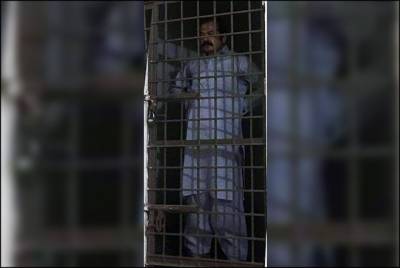
Rana Sanaullah, PMLN Punjab Chief, in prison
By the way, here is Brigadier Ijaz Shah, GHQs main enforcer in the Imran Khan regime, giving his side of the story.
And here is the full ISPR version of recent events:
Mr. @realdonaldTrump The most widespread, the largest and the most genuine administration throughout human history, belongs to the Iranians, which emerged under the rule of the most renowned ruler worldwide, i.e. Cyrus (Kourosh) the Great.
— Mahmoud Ahmadinejad (@Ahmadinejad1956) July 4, 2019
The historian Sumit Sarkar, in hisModern India: 1885-1974, writes that literary Hindi was very much “an artificial creation closely associated with Hindu-revivalist movements.” Bharatendu, Sarkar notes, “combined pleas for use of swadeshi articles with demands for replacement of Urdu by Hindi in courts, and a ban on cow-slaughter.” Around the same period, a historian and linguist named Shivaprasad was promoting another link language, Hindustani. Where Bharatendu’s Hindi was highly Sanskritised, Shivaprasad wanted something closer to the languages already popular at the time. The champions of Hindi were especially offended by Hindustani’s incorporation of Urdu elements.
Hindi carried Brahminical and communal impulses from its inception. Later, its installation as a dominant language came to be a demand in the nationalist movement, though even then this was highly contentious. Anil Chamadia, a veteran journalist who has taught at Mahatama Gandhi International Hindi University in Maharashtra, told me that Bharatendu’s language prevailed because it appealed to the emergent, Brahmin-dominated nationalist movement and administration. The dominant castes, he said, saw in the Sanskritised tongue a tool to further theirvarchasv, or dominance, over society. Sanskrit, of course, had earlier served exactly that use. Chamadia described Hindi as “varchasv ki dhara”—a stream of dominance. Today, he said, those who control the Hindi language are the same who control the dominant societal narrative.
Apart from not touching untouchables or not eating with them, there was no feeling in the masses that they (Dalits) were separate from us.
The best analogy of the Dalits are blacks in the American South. If you won’t touch, eat or sleep with someone how can you claim any sort of kinship or connection to them?
Let’s not also forget that they were the ones who handled excrements and corpses (I could be wrong about the latter).
As my Kashmiri activist friends said the Indian state has a “territorialist” view of Kashmir in that the land not its inhabitants are vital.
The commentator above is exhibiting the same “territorial” nationalism; the Dalits belong not because they do but rather they are a part of the all-important landmass.
In some ways Pakistan is exactly opposite since we are nation rooted in a sense of “peoplehood” as evidenced by the Muhajir migration. We don’t have the Taj, Delhi or Lucknow but they are more ours since we have an intensely spiritual (and ancestral) kinship to those lost locations.
We are watching the film Kesari by Akshay Kumar. This is where Sikh collaborators, serving the British, were holding off the Afghan attack. The Hinditva tones of the film (we are only twenty minutes in) are breath-taking and I’m shocked to see Dharma Productions backing this (Hiroo Johar was in the credits).
However one scene that took my breath away was when Akshay Kumar is moaning about freedom after being humiliated by his British officer. He tells his colleague that “first we were conquered by the Mughals, then by the British but I thirst for freedom.”
I was shocked and frankly a bit horrified. Good luck to this Brave New India where historical revision is now par for the course.
Was Jinnah simply the right man who happened to be Muslim?
Or rather would the Muslim community have always produced a saviour to “save them?”
Addendum, Comment of the Day:
Apart from not touching untouchables or not eating with them, there was no feeling in the masses that they were separate from us.
The best analogy of the Dalits are blacks in the American South. If you won’t touch, eat or sleep with someone how can you claim any sort of kinship or connection to them?

 To the right, I’ve posted the screenshot of an Ngrams search of books with the term “Eurocentric.” Notice that that term shoots up just as European hegemony went into freefall.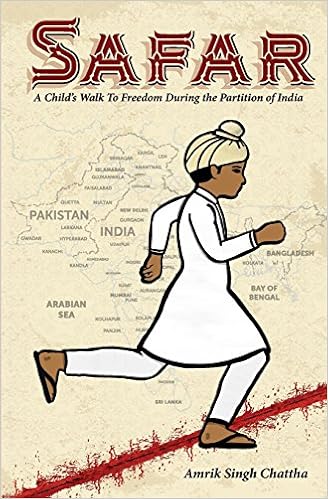
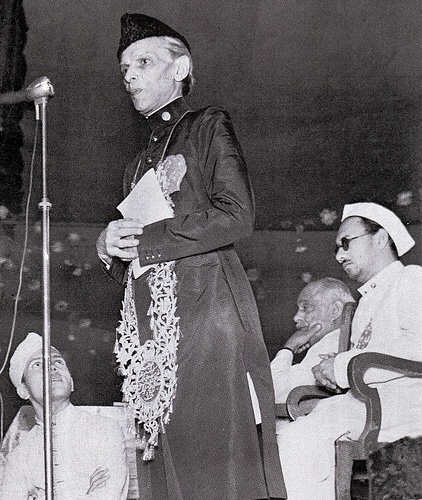 Was Jinnah simply the right man who happened to be Muslim?