The Post-White World

As I was scoffing down my lunch (I jest; I actually eat really healthy food) a thought came into my mind that a good book title would be “The Post-White World.”

Since 1492 (when Granada fell and Columbus set off) there has been an increasing consolidation of the West. It reached its apogee in the Victorian Era, where it was unabashed racial hegemony, and it took two World Wars to really shake it off. It’s interesting that Islam experienced so much “innovation” in the 19th century simply because the incursion of the West was finally being internalised. Continue reading The Post-White World

What is a “Brown Pundits” podcast?

One of the interesting things about asking people whether they would come on this blog’s podcast is that they often say “I don’t know if I’d be that interesting to the audience….” More specifically, there isn’t always a South Asian “hook” to some of the episodes.

But the name of the podcast is “Brown Pundits” because this podcast was started by a few brown guys. Not because we discuss purely “brown” things.

Our most popular categories

I’ve given myself the thankless task of “tagging” all my past posts. I noticed that we don’t have a tag on “Kashmir” (the only sub-region we do have is NWFP). It sparked a thought that for a Desi blog we really don’t discuss Kashmir all that much (even though it was going to drag the region into war earlier this year).

This mirrors the larger discourse on Kashmir where Indians & Pakistanis don’t seem as animated or defined by it as before. Two reason comes to mind: Continue reading Our most popular categories

Is the social justice exterior overwhelming the Indian nationalist interior?

One of the most interesting things I have experienced over the past 15 years or so interacting with young Indian Americans, usually of Hindu background, is the disjunction between the scripts that they are inculcated with in their education in broader society, and the quite nationalistic/parochial perspectives that are imparted to them by their parents.

You can say many things about me, but there isn’t much of a disjunction in what I will say you to privately about controversial topics and what I will say in public about controversial topics (the main skeptics of this view are some Hindu nationalists and Zionists, who are convinced that I’m an Islamic supremacist sleeper agent).

So, I when I began to spend some time around Indian Americans one of the peculiar things I was a bit surprised by his how different their extremely social justice Left external presentation could be from what they might say privately over some drinks, or if they perceived you to be an intimate acquaintance. Since my views on Islam were well known many of them felt quite free to openly state their privately skeptical views on the religion of Islam and the practices of Muslims, which reflected what their parents had told them, while in public these people might still denounce Islamophobia. People who would criticize caste privilege in public forums might still be privately smugly proud of their family’s caste background. And, the same people who might perceive American patriotism as to be jingoistic and declasse would express Indian nationalism that they had absorbed with their mother’s milk in private in the crassest of terms.

But there does come a time when you leave your parents’ home, and their influence. And I don’t interact much with Indian Americans on a day to day basis, but I do wonder if many progressive Indian Americans are bringing their two aspects into alignment, and shedding their private chauvinistic reflexes?

An analogy here might be young American Jews, who until recently were quite liberal in the American context, but might align with more ethnonationalist views in relation to Israel (even if they supported the Left parties in Israel, those parties are still more nationalistic than similar parties in the United States). Today the two views are coming into coherence, as most younger American Jews who are not orthodox are starting to distance themselves from Israel.

Review: Pakistan’s Inter-Services Intelligence Directorate: Covert Action and Internal Operations

Book Review sent in by Maj Agha Amin. Unfortunately the pictures in the original are low quality and I was unable to fix that problem. Still, you will get the gist of it. 

This is a very interesting book by a Montana University (adjunct) Professor (Owen Sirrs).

The author explains that the  genesis of this book was his:– (page-9)

Two- month stay at the Counterinsurgency Training Center in Kabul, Afghanistan during the summer of 2009. It was there that I learned a great deal more about Afghanistan–Pakistan relations in general and ISI operations in Afghanistan in particular.”

The book examines the following issues in the writers own words:–

  1. How has ISI evolved as an institution exercising intelligence and security responsibilities at home and abroad? What were the driving forces behind that evolutionary process?
  2. How does ISI fit into the larger Pakistani Intelligence Community?
  3. What does the decades- old relationship between ISI and the CIA tell us about the larger US–Pakistan security relationship?
  4. What is ISI’s record in providing accurate and timely early warning intelligence to decision- makers?
  5. To what extent has ISI disrupted and abused Pakistan’s democratic processes? 
  6. Is ISI a rogue agency or a state within a state? 
  7. Can ISI be reined in and the PIC (Pakistani Intelligence community) reformed? 
  8. How has ISI employed UW (Unconventional warfare) in support of the state’s national security objectives? To what extent has UW been a successful strategy for Pakistan?

 These are the very interesting question that the writer has formulated as stated in the books beginning and has attempted to answer in this most interesting book. Continue reading Review: Pakistan’s Inter-Services Intelligence Directorate: Covert Action and Internal Operations

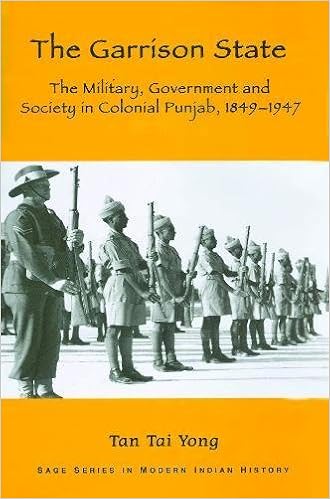
Review: The Garrison State: Military, Government and Society in Colonial Punjab, 1849-1947

The Garrison State: Military, Government and Society in Colonial Punjab, 1849-1947 (SAGE Series in Modern Indian History)

The following is a review sent in by Major Agha Humayun Amin (retd). As usual, Major Amin is sometimes, shall we say, harsh, but his knowledge of this subject is encyclopedic and always worth reading..

My first association with works of Professor Tan Tai Yong started in 2000 when he wrote an article that as per his own admission forms the basis of this book.

Although Professor Yong seemed at that time in 2000 to be a well meaning scholar,there were serious basic flaws in his research.

I wrote a letter to the Journal of Military History at that time in 2000 which that journal , keeping in line with its tradition of intellectual dishonesty, did not publish, citing lame excuses about lack of space. That letter is appended at the end of this review, so that the reader may have an idea about what was the basis of my criticism.

The West is in the habit of accepting so called scholars like Professor Yong as experts on Indo Pak history. So Journal of Military History of USA was merely following this strange tradition.

When I read this book under review in 2018 some 18 years after my initial critique I was disappointed to find that Professor Yong had not improved his knowledge , although most the faults he has committed in this book were entirely avoidable.

The first issue is regarding why the British started preferred Punjab and Frontier for the army recruitment.

First the assertion that it was only by the 1880s that the British started favoring soldiers from Punjab is wrong.

The hard facts of the situation are that some 90 % of the pre 1857 Bengal Army recruited from UP and Bihar had rebelled or disbanded in 1857 and an entirely new army was created, composed mostly of set of regiments raised in Punjab (frontier being its part) in 1857-58.

While Lord Roberts pronouncements can be credited as “ Martial Races Theory” a clear shift in British recruitment policy favouring Punjab over UP and Bihar had been initiated in 1857-58.

Peel Commission of 1858-59 had clearly laid the basis of this policy. Thus the “Peel Commission” constituted after 1857 to study and analyse the future composition of the Indian Army recommended that the native army should be composed of different nationalities and castes, and as a general rule mixed promiscuously through each regiment! Such system had existed in the Madras and Bombay armies but these were much smaller as compared to the Bengal Army. However, India was now viewed in terms of loyal and disloyal.

Professor Yong , if I am to understand this book , simply denies the existence of the British loyalist Syed Ahmad Khans landmark work “Causes of Indian Mutiny” written in 1859 and republished as an Indian translation in 1873.

This pamphlet which suggested formation of class regiments did have immense impact on British thinking and pre-dates Robert who only came into prominence after 1885.

Lord Canning’s views about the policy of “Divide and Rule” expressed in 1857 are thought provoking; Canning thus said in a letter dated 9 October 1857:’ “the men who fought against us at Delhi were of both creeds; probably in equal numbers. If we destroy or desecrate Mussulman Mosques or Brahman Temples we do exactly what is wanting to band the two antagonist races against ourselves…..as we must rule 150 million of people by a handful (more or less small) number of Englishmen, let us do it in the manner best calculated to leave them divided (as in religion and national feeling as they already are) and to inspire them with the greatest possible awe of our power .

Canning went further and very subtly defined certain guidelines regarding employment of various classes after 1857:-

“All exclusion of Mahomeddan, Rajpoots or even of Brahmans should be a matter of management rather than of rule; and indeed that it will be right to take an opportunity, though not just yet, to show by an exception here and there, that the rule does not exist. It is desirable that no class should feel that it had henceforward nothing to expect from the government”

Continue reading Review: The Garrison State: Military, Government and Society in Colonial Punjab, 1849-1947

Collaboration and Loyalty in British India

This topic comes up a lot and there are many (contradictory) nationalist myths about who did and did not collaborate with the British during their rule in India. Major Amin has a short podcast about this topic that is worth listening to:

India was conquered by the East India Company using (mostly) the Bengal army, recruited primarily from what is now eastern UP and Bihar. Most of these soldiers were Hindus and a large section were Brahmins, but all religions, ethnicities and castes joined the EIC army at various points and all have examples of mutinies (many small, one large), frequently triggered by grievances over pay and conditions, but sometimes acquiring or having a nationalist color as well. Have a listen.

Did the Brits “Indianise” the NorthWest?

I was picking up the comment thread on the linguistics podcast. To my mind there are some inconsistencies about modern-day Pakistan:

(1.) Ever since MBQ conquered Sindh in 712; Sindh has remained under Muslim rule. When it did have local rule it was essentially a tussle between the Baloch and Muslim Rajputs, which has replicated itself to this day. Benazir Bhutto is of Rajput ancestry (Bhatt) while her husband Zardari is a Baloch. The Hindu minority were either merchants or serfs and as far as I know the caste Hindus of Sindh are a basically heteregenous lot (there is only one Brahmin surname among the Amils and the castes tends to have strong geographic regions).

(2.) As for Baluchistan and KPK; It’s basically seen the incursion of Iranian speakers the past millennia or so.

So the real question left is Punjab (the 5th major Indus region Kashmir is out of scope). Continue reading Did the Brits “Indianise” the NorthWest?

Browncast Episode 33: an ethnography of doubting Darwin

Another BP Podcast is up. You can listen on LibsyniTunes, Spotify,  and Stitcher. Probably the easiest way to keep up the podcast since we don’t have a regular schedule is to subscribe at one of the links above.

You can also support the podcast as a patron (the primary benefit now is that you get the podcasts considerably earlier than everyone else…). Would appreciate more positive reviews.

Today I am posting a podcast that I decided to record on a lark. I talked to Benjamin Dierker, the author of Why One-Third Of Biologists Now Question Darwinism. To be frank, this is a case where you need to read beyond the title…

Dierker and I had a lot of common ground and his main project is not a defense of Intelligent Design, as much as an ethnography of it. We hashed out what Neo-Darwinism means, as well as how conservatives should bury the hatchet when it comes to their historical enmity to evolutionary theory. In fact, we discussed extensively how the left’s revolt against human nature in the past generation opens up an avenue for conservatives to be on the side of science.

Browncast Episode 32: Indian Linguistics Podcast

You can listen on LibsyniTunes, Spotify,  and Stitcher. Probably the easiest way to keep up the podcast since we don’t have a regular schedule is to subscribe at one of the links above.

You can also support the podcast as a patron (the primary benefit now is that you get the podcasts considerably earlier than everyone else…).

We had a conversation about Indian linguistics. It was Razib, myself, Avtansa, Indian Linguist and TianChengWen.

I’m quite proud of this podcast since I was able to get some of the linguistic luminaries together. The topic was a broad overview of language in South Asia.

We were able to keep a very strong regional balance since TCW’s specialty is Dravidian. We touched on the role of Sanskrit and its prominence as a literary lingua franca until the late medieval period (until it was supplanted).

Incidentally, we didn’t talk all that much about Indian English instead we delved into the “dialects.” There seems to be a turning point in that the Subcontinent is consolidating linguistically among regional, national and religious lines with English emerging as the great neutral and prestige language.

We touched a fair bit on the specific languages of the Hindi belt but I guess for next time we will have to tackle those that are tangential to the Hindi language sphere like Punjabi, Bengali, and Marathi.

Brown Pundits