The invention of Hinduism 1,000 years ago by a Muslim

On of the most annoying tropes in modern intellectual discourse, in particular of the postcolonial variety, is its Eurocentrism. That is, the focus on the Western colonial experience is so strong and unwavering that operationally the rest of history becomes prehistory, a formless period which we are ignorant of, when humans were different in fundamental ways.

Empirically this is of course false. Earlier I have mentioned that the Central Asian Iranian polymath, Al-Biruni, had much to say about India. His was one of the earliest extensive anthropologies we have about the subcontinent from the prespective of an outsider. Though Al-Biruni was from a region which had once had a flourishing Buddhist presence, by the 10th century this had faded from historically memory. Whereas earlier Islamic scholars from previous centuries allude to the persistence of Buddhists in what is today Central Asia and Afghanistan, by Al-Biruni’s lifetime non-Muslims were in sharp retreat (though in the fastness of area like Chitral paganism persisted for a thousand years).

In any case, here are some extracts of Al-Biruni on Indian religion:

The belief of educated and uneducated people differs in every nation; for the former strive to conceive abstract ideas and to define general principles, while the latter do not pass beyond the apprehension of the senses and are content with derived rules, without caring for details, especially in questions of religion and law, regarding which opinions and interests are divided.

With regard to God, the Hindus believe that he is one, eternal, without beginning and end, acting by free will, almighty, all-wise, living, giving life, ruling, and preserving; one who is unique in his sovereignty, beyond all likeness and unlikeness, and neither resembling anything nor having anything resemble him. In order to illustrate this, we shall produce some extracts from the Hindu literature….

This is what educated people believe about God. They consider the unity of God as absolute, but that everything beside God which may appear as a unity is really a plurality of things. The existence of God they consider as a real existence, because everything that exists, exists through him. It is not impossible to think

If we now pass from the ideas of the educated people among the Hindus to those of the common people, we must first state that they present a great variety. Some of them are simply abominable, but similar errors occur also in other religions. Nay, even in Islam we must decidedly disapprove of the anthropomorphic doctrines, the teachings of the Jabriyya sect, the prohibition of the discussion of religious topics, and such like. Every religious sentence destined for the people at large must be carefully worded, as the following example shows. Some Hindu scholar calls God “a point,” meaning to say thereby that the qualities of bodies do not apply to him. Now some uneducated man reads this and imagines that God is as small as a point, and he does not find out what the word “point” in this sentence was really intended to express. He will not even stop with this offensive comparison, but will describe God as much larger, and will say, “He is twelve fingers long and ten fingers broad.” Further, if an uneducated man hears what we have mentioned, that God comprehends the universe so that nothing is concealed from him, he will at once imagine that this comprehending is effected by means of eyesight; that eyesight is only possible by means of an eye, and that two eyes are better than only one; and in consequence he will describe God as having a thousand eyes, meaning to describe his omniscience.

Similar hideous fictions are sometimes met with among the Hindus, especially among those castes who are not allowed to occupy themselves with science, of whom we shall speak hereafter.

As the word of confession, “There is no god but God, Mohammed is his prophet,” is the shibboleth of Islam, the Trinity that of Christianity, and the institution of the Sabbath that of Judaism, so metempsychosis is the shibboleth of the Hindu religion. Therefore he who does not believe in it does not belong to them, and is not reckoned as one of them. For they hold that the soul, as long as it has not risen to the highest absolute intelligence, does not comprehend the totality of objects at once. Therefore it must explore all particular beings and examine all the possibilities.

The point of this post is not to show that Al-Biruni had a good idea of what “Hinduism” was, though I think if you read it on the whole he isn’t that far removed from how some moderns would characterize it. Rather, it is to show that the distinctiveness of Indian religious thought was noticed long before Europeans arrived to create a specific categorization system which we utilize today. The details of the system might deviate from Al-Biruni, or Adi Shankara, but in its broad outlines it’s describing the same thing.

(since some people are not subtle, the title is not to be taken literally)
Book Review: Ye Khamoshi Kahan Tak (Silent no more?) by Lt Gen (Rtd) Shahid Aziz

The late great Asma Jahangir once described Pakistan’s generals as ‘duffers’ on national TV. While it would be disingenuous to generalize a whole group as duffers, one can infer that within a strictly hierarchical structure as the army, loyalty to the force and to the commanders is considered a greater asset than intelligence or aptitude. A better experiment would be to take a look at the books written by various retired generals through the decades and reach a conclusion. It can also help us understand what type of characters are highly valued by the institution and thus given promotions. Many of the earliest officers in Pakistan Army wrote their memoirs including (but not limited to) General Ayub, General Sher Ali Khan, Air Marshal Asghar Khan and General Gul Hasan.  General Sher Ali Khan was an ‘ideologue’ of the elusive ‘Ideology of Pakistan’ while Ayub Khan and Asghar Khan had slightly more pragmatist views in that regard. Lt Gen Shahid Aziz belonged to the former category. According to his account, he was an honest officer who always put the interest of institution before any other interests.

He described himself in the following words in his book:

“Why am I full of contradiction? Why can’t I be balanced? Then I console myself with the thought that a pendulum has a balance too; what use is a balance that is static and frozen? Real balance is in movement. One should be flying back and forth on a swing.” (Translation: Khaled Ahmad)

Reading the book, one gets the impression that he was slightly more PakNationalist than the average military Joe and his levels of self-righteousness were high enough to prompt him writing that book. He knew exactly what he was doing and was a man of his (however flawed) convictions. He was the kind of guy who refused to vote for Zia in the sham referendum held in 1984, despite being asked by his superiors in the military, the type of officer who wouldn’t display a star and Pakistan’s flag on his staff car.  Musharraf obviously was wily enough to see through Shahid Aziz’s simplistic stupidity and didn’t promote him as the Vice-Chief of Army Staff. You can see his cognitive dissonance in the book that he has no shame (or self-awareness) appropriating Faiz’s work (the book is littered with poems by Faiz and Ahmad Faraz, both of whom were harsh critics of despotism and military rule in Pakistan and left the country rather than stay under a military dictatorship).

I think he’s the ultimate Nasim Hijazi character (Man on a white horse), someone who imbibed the whole PakNationalist Muslim narrative and decided to live accordingly. By PakNationalist Muslim narrative, I mean believing wholeheartedly in the ‘Two Nation Theory’, believing in conspiracy theories that the US-Israel-India nexus is constantly working to undermine the sovereignty of Pakistani state, holding the military at a higher pedestal than politicians and believing that Pakistani Islam is supposed to save the rest of Muslim world. Throughout the book, he refers to Taliban (of any variety) as ‘Mujahideen’, without any shame or remorse. His view about Pakistani Taliban (TTP) is the following:

“The bombs that kill innocent Pakistanis in bazaars and mosques are planted by friends of America, and this terrorism is done to persuade Pakistan to embrace America more closely, allow the government to pursue pro-America policies, and to alienate Pakistan from the mujahideen. But this trend of support to the killers of Muslims is an open rebellion against Allah.”

In the book, he mentioned two instances during his training in the US when he was approached by people who wanted him to leave Pakistan army and join the US army in the same position that he held in Pakistan. This sounds preposterous because you need to be a green-card holder or a national to enlist as an officer and you can’t be inducted straight as a commanding officer.

One of the more interesting (but not completely unsurprising) aspects of his book was the discussion of nepotism and corruption within the ranks of the army (especially corruption during weapons procurement and the way DHA scams people). Such things, if ever pointed out by civilians, would constitute heresy and treason. Another aspect that intrigued me was his criticism of war tactics during 1971 (he fought along the Kashmir border) and during Kargil (when he was part of ISI).

The most useful part of the book is when he discusses his role as a first-hand observer of Musharraf’s coup and its aftermath. He was also part of the team that selected people for running different ministries under Musharraf and he spilled the beans on how Ministers of Finance, Commerce, Trade, Industry, and Petroleum were ‘pre-selected’ and Shaukat Aziz never even appeared before the interview panel. He was initially optimistic about the monitoring mechanism put in place to hold the relevant ministers accountable but things didn’t work as smoothly or ideally as he wished. He laid the blame squarely at Bureaucracy’s feet.

His thoughts post-9/11 were:
“After 9/11 the bitter reality of a unipolar world was exposed. This incident happened under suspicious circumstances. A lot of American experts claim that this incident was orchestrated by American Intelligence Agencies and Jewish terrorists”.

He was bitter about the fact that Musharraf allowed US forces to use some of our Airbases (Shamsi, Zhob, Dalbandin, Jacobabad). He also mentioned how Indians sneaked into Afghanistan right after the organisedUS-led operation and took over TV stations in Kabul. According to his account, American forces didn’t keep Pakistan informed regarding their hunt for Al-Qaeda militants and knowingly pushed then towards Pakistan. About the first encounters between SSG unit and Al-Qaeda militants, he was full of praise for the militants and commented: ‘how can you compare a salaried individual with a guy who is looking to be martyred?’

Regarding the Indian Parliament attack in December 2001, he had this to say: “After The Delhi bomb attacks, Pakistan was accused in the world as a terrorist haven. This was a ridiculous claim. By that time, Pakistan had ceased help to Kashmiri Mujahideen. ISI was strictly acting upon the new policy. Obviously, Kashmiri Mujahideen were not an organized group, they were nothing more than a ragtag army who were fighting in the way of Allah, not listening to anyone. However, the government wasn’t involved.”

There were tensions within the top brass in 2002-03, which have been highlighted by the author. There were turf disputes between ISI and Army, involving some captured Al-Qaeda militants, close coordination between Army and CENTCOM,  and development of a Quick Response Force and a Special Operation Task Force within SSG. There were two assassination attempts on Musharraf in the period 2003-4 which were orchestrated by people within the military.  He, however, voted for Musharraf in the 2001 Referendum. (Just an aside, I was an ‘observer’ for the Referendum near a village in Mansehra and saw how people brought NICs of dead people to the voting station so that those people’s vote could be counted).

His reflections on becoming CGS (Chief of General Staff):
“My tenure as CGS was really hard for me. Everything that could go wrong, went wrong. In Afghanistan, we collaborated with the U.S. while waving the flag of non-partisanship and were equally responsible for massacre of fellow muslims, a dictator who came to the fore promising change became President for five years based on a sham election, Incapable and corrupt politicians were promoted by the army to run the country, compromises were made on Kashmir under American pressure, separatism in Balochistan was promoted, commercial TV channels were allowed to manipulate our nation’s narrative, ‘Pakistan First’ was used as a slogan and there were efforts to reform Islam under the auspices of ‘Enlightened Moderation’. He argued with Musharraf in favor of keeping the Kashmiri ‘Mujahideen’ as proxies against India.

He rails against both secular people and religious people because they don’t follow what he thinks is the righteous path. According to his plan, religious education in regular schools should be updated and secular education in religious schools should be updated so that in a decade, students of both systems are on par with each other. He sparred with Musharraf and his friends over this at dinner parties. The more alarming insight from the book is that such view and such officers were popular in the army. He also had a romantic view of the ascetic life, free of the burdens of money, job and retirement.

Bangladeshi freethinker shot dead

Freethinking writer and politician shot dead in Bangladesh:

Shahzahan Bachchu was known locally and within the secular Bangladeshi movement as an outspoken, sometimes fiery activist for secularism. He printed poetry and books related to humanism and freethought via his publishing house Bishaka Prakashani (Star Publishers). He was also a political activist, serving as former general secretary of Munshiganj district unit of the Communist Party.

He was reportedly shot and killed this evening near his village home at Kakaldi in Munshiganj district near the capital Dhaka.

The fool hath said in his heart, There is a God.

Genetic variation in South Asia

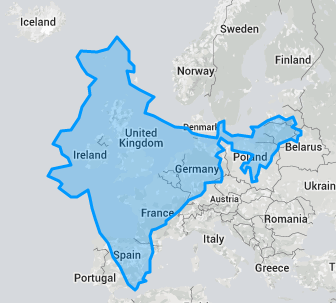
I don’t have too much time right now. So a quick data post. The map above shows India’s scale in relation to Europe.

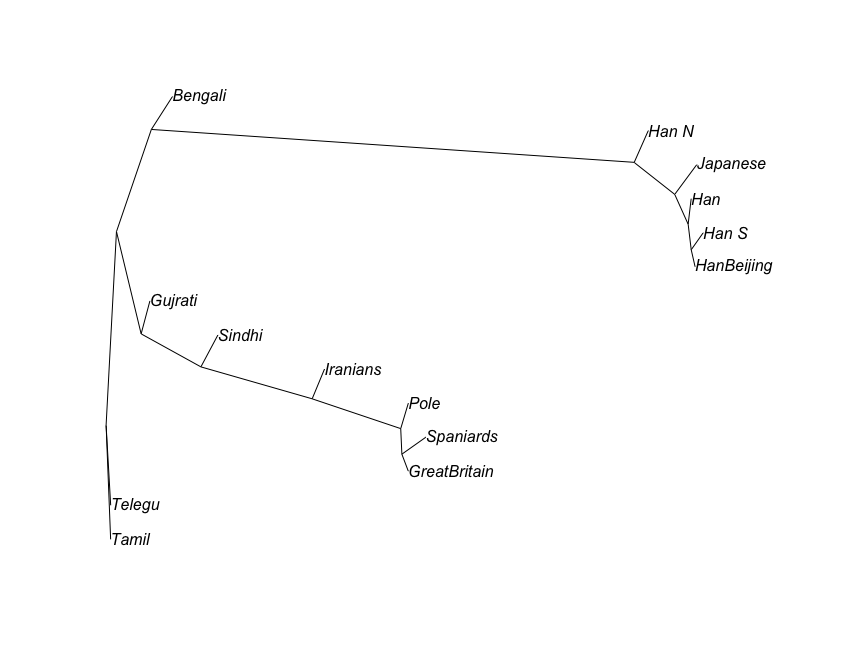
Below is an NJ tree that shows pairwise Fst values (genetic distance):

Please notice the small genetic difference between Britain/Spain/Poland. Compare to Gujrati vs. Sindhi, let alone Gujrati vs. Telegu.

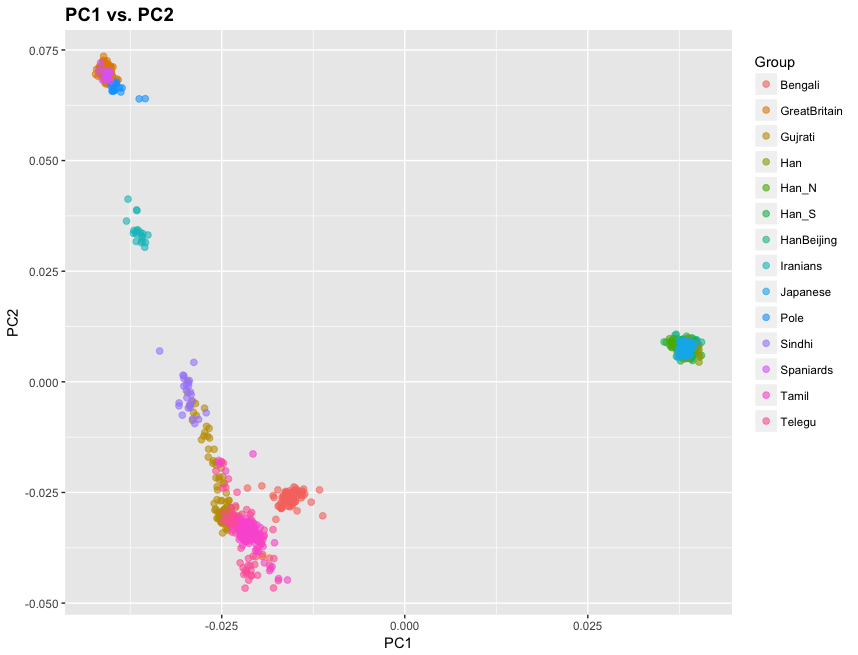
Now, PCA:

Genetically Sindhis occupy a place between South Indians and Iranians. Some Gujaratis are nearly where Sindhis are, but many are far more shifted toward South Indians. The Fst display masks this since it aggregates populations.

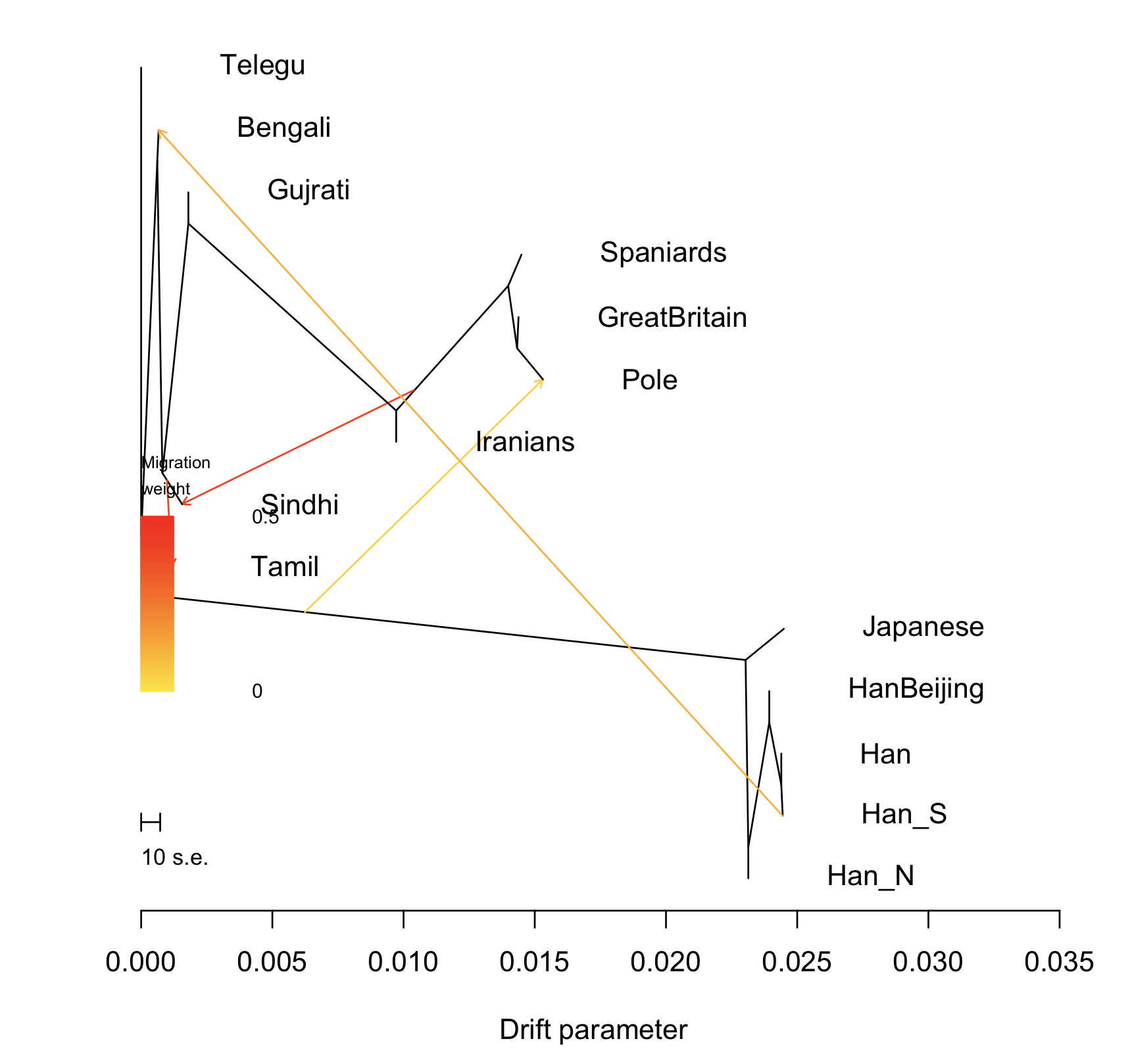
Treemix shows the relationships and their scale. South Asians have a lot of drift between them.

Some of you are probably bored by this post and wonder about it’s practical implication. If so, keep on paging down (or up).

On the rectification of names and religion

A major influence on my thinking about human social phenomenon is Scott Atran’s In Gods We Trust: The Evolutionary Landscape of Religion. Atran, along with other scholars such as Dan Sperber and younger researchers such as Harvey Whitehouse, work within a “naturalistic” paradigm, as opposed to the more interpretative framework currently ascendant within American anthropology.

The interpretive framework emphasizes “thick description,” and avoids generalities (unless they are convenient ones!), as well as exhibiting a suspicion of synthesis with the natural sciences. Ways of thinking such as post-colonialism are part of the umbrella of paradigms which are consonant with interpretive anthropology’s premises.

Both naturalistic and interpretive frameworks are useful. But I believe in modern discourse the latter is given almost monopolistic power to adjudicate on factual matters, even though in other contexts those who engage in interpretation are wont to say that facts are fictions!

Let’s start with the idea that the idea of religion qua religion is Protestant, Christian, or Abrahamic. I’ve seen all three flavors of the argument using a narrow definition of religion. It’s hard to deny that Christianity, and often in particular Protestantism, have resulted in a reorganization and reimagining of non-Christian religions. For example, the “confessionalization” of South Korea after World War II, and the transformation of Won Buddhism into an institution which resembles Protestantism would be a case in point. Or the emergence of Arya Samaj in the 19th century, and its relationship to the stimulative effect of evangelical Protestantism.

It is hard to deny confessional Protestantism is a very particular form of religion, and a clear and distinct one. The emphasis on individual volition in this view of religion makes it such that identity is clear and distinct through adherence to a precise formula and community. Practitioners are self-conscious in their identity. They come to it, it is not given to them.

But is it fair to say that religion by necessity must follow the outlines of confessional Protestantism? Or that it has to be a congregational faith with exclusive boundaries, as the Abrahamic faiths tend to be?

Not necessarily. A Ju/’hoansi tribesman in the Kalahari does not follow any of the organized world religions. He or she surely does not have the word for religion in their language, unless he or she is in extensive contact with missionaries. But the Ju/’hoansi have a rich supernatural world in which they believe, and which is seamlessly woven into their lives.

Do the Ju/’hoansi  have a religion or not? If you asked them they might not know what you are talking about. The Ju/’hoansi lack many of the institutions which modern societies have, so they don’t need all the labels of modern societies. Do the Ju/’hoansi have “daycare”? Again, they would look at you in a very confused manner. But the do have  Ju/’hoansi some alloparenting. It’s just something implicit, tacit, and taken for granted. It might not be labelled daycare, but that’s what it is. Functionally they have daycare, even it’s not institutionalized.

To bring it back to the central focus of this weblog, there has been some assertion that Hinduism as such was invented/defined by the British. That Hinduism as a coherent ideology is a very distinct and novel thing from the welter of beliefs and practiced of Indians more generally.

It is clear there is some truth in this. The Hinduism of a Brahmin expositor of Sanatana Dharma is distinct from the local spirituality of a adivasi group, and both differ from something like Gaudiya Vaishnavism.

But the reality is that Hinduism is not particularly unique. American Presbyterians exhibit self-conscious identity and adherence to elite-mediated belief and practice. This sort of individualistic confessional Christianity is arguably the apotheosis of a modernist conception of religion. But this is a relatively new development in the West among Christians.

The vast majority of the European peasantry did not exhibit this sort of Christian self-consciousness before the later medieval centuries, and much of it did not become self-conscious until after the Reformation period. This is one reason that some Reformed Protestants argue that Europe was not Christianized until after the Reformation. Peasants may have had a sense that they were Christians, and others were heathens, but the full liturgy and deep catechism were not necessarily a part of their lives (in contrast to the elite).

And yet it seems ridiculous to assert in the context of the Crusades, the rise of Gothic cathedrals, and the conversion of Northern and Eastern Europe by missionaries, that Europe was not Christian before the late medieval period. Individual Europeans may not have been self-conscious confessional Christians, but everyone around them was at least nominally a Christian. Additionally, the Christian Church, whether West or East, saw itself as bringing salvation to everyone within the society, high or low, poor or rich, and devout or ignorant. Many Europeans were not Christian in the individual way modern evangelical Protestants would understand, but European civilization was Christian.

I think this is the best way to understand what Hinduism was, and what it became. Indian civilization was long seen to be distinct by the ancients. It was not a random and disparate collection of peoples, but a civilization with various centers, and jostling competition between aspirant elites.

It is well known in the pre-modern period “Hindu” seems to have bracketed people who lived in India. From the Muslim perspective all non-Muslims who lived in the subcontinent. It was a geographical designation more than a religious one as such. But it is clear that already by the time of the arrival of Muslims in the Sindh in the 8th century, and definitely by the era when Al-Biruni wrote his well known ethnography of South Asia around 1000 AD, that Indian religion had taken on some distinctive forms and outlines, even if it was not self-consciously termed Hinduism. It is clear because outsiders describe normative Indian religious practices and beliefs that we would recognize today (e.g., reincarnation).

There are two other elements to this broader issue. First, it curious that the British had to define Hinduism, when it seems Muslims had been doing so for the whole period after the initial incursions. Al-Biruni made the most thorough early attempt, and his writings on India would make an Orientalist proud. And I say that not as a dismissal, but a description. Al-Biruni seemed rather clear-eyed that Indian hostility to Muslim was due to the predatory character of the warlords who also patronized his scholarship. The focus on the British reflects the recency-bias in post-colonial studies, where the only colonialism and conquest of interest is tht which is executed by Europeans.

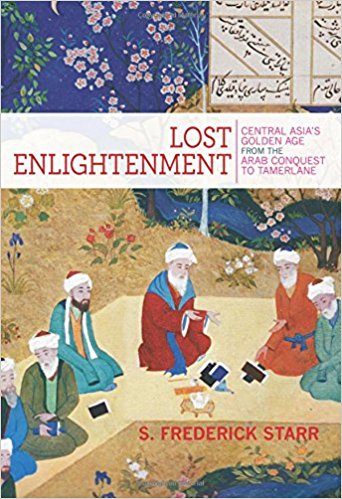
Additionally, I am  convinced by the arguments in Buddhism and Islam on the Silk Road, Lost Enlightenment: Central Asia’s Golden Age from the Arab Conquest to Tamerlane, and Warriors of the Cloisters: The Central Asian Origins of Science in the Medieval World, that Turanian Buddhism was essential and instrumental in shaping Islam as we understand it from the Abbassid period onward (in particular, the emergence of madrassa and the hadith traditions). Though Turanian Buddhism is clearly not Hindu, connections to India to the south and China to the east were part of a broader “Buddhist international” which flourished in the 4th to 7th century.

This is not to deny the distinctiveness of the Islam Al-Biruni used as a contrast to Indian religious thought. But, by his life Central Asian Buddhism was extirpated, and he would not have been able to see the influence of that Indian-influenced tradition on Islam because it had become thoroughly integrated.

Second, Indian religious civilization was successfully exported to the east so it was not constitutively associated with being Indian. The Balinese of Indonesia and the Cham of Vietnam are recognizably Hindu. It would be curious to tell them that the British defined Hinduism in the early modern period…when they were practicing Hinduism 1,000 years ago. The Ankgor temple complex was built in the 12th century, when Hinduism was Cambodia’s dominant elite religion.

Finally, an addendum to my post on caste and genetics. I read Castes of Mind many years ago. I think many of the arguments in that book aren’t necessarily invalidated by the genetic data. But, we need to think hard about whether we really expected the genetic data given the thesis that British colonialism was highly determinative in shaping the hierarchy and structure of South Asian society.

In fact, the genetic data makes it clear that most South Asian communities have been distinct and endogamous for several thousand years. That the genetic differences between castes groupings and jati within regions are closer to what you could expect of from differences between antipodes of a continent. And, within a given region ancestry which is closer to West/Central Eurasian tends to be enriched in groups “higher” up the modern caste ladder, across the subcontinent (at least if there is a correlation).

Additionally, this is not well known, but the genetic structure seems to exist even if you remove Indo-Aryans from the picture. Groups such as the Reddys and Nadars in South India who do not have any northern/western affinity at all are still genetically quite distinct from adivasis and scheduled castes in the local region. They also tend to have more West/Central Eurasian ancestry than adivasis and scheduled castes in the local region.

Everyone needs to take Chill Pill

None of us here on this blog can claim to be from some discriminated class/religion whatever.  Just the ability to write (and have the time) to write in fluent English means you are one of the top 5% in opportunity in the world.

I like to identify with Shudra/Dalits, and can justify bcos my genetic inheritance has a large component of ASI.   Then equally well I id with African Americans in when in the US.  That said will I invite a US gang banger into my house. Or a Sri Lankan gangster. I knew a few when I was young.   Now I cant deal with that type of young people as in guests to my backwater.  On the streets a many chats/words and thats it.

Anyway, all this caste/religion is academic to the commenters in this blog. But still good.

As they say a picture is a worth a thousand words, the Bauls of Bengal.
Whats with the guy (whose voice I love) with an Afro. Where the heck did he get an Afro. The whole crowd looks like our generic Sri Lankan.

Hopefully some recall my comment everyone is Sri Lankan Dalit/Shudra. Kabir obviously has to deny Pakistani Christians look like Sri Lankans, and said they looked like Punjabis.  Maybe Punjabis look like Sri  Lankans, for sure the eat and drink like Sri Lankans.


Genetical observations on caste

One of the more interesting and definite aspects of David Reich’s Who We Are and How We Got Here is on caste. In short, it looks like most Indian jatis have been genetically endogamous for ~2,000 years, and, varna groups exhibit some consistent genetic differences.

This is relevant because it makes the social constructionist view rather untenable. The genetic distinctiveness of jati groups is very hard to deny, it jumps out of the data. The assertions about varna are fuzzier. But, on the whole Brahmins across South Asia have the most ancestry from ancient “steppe” groups, while Dalits across South Asia have the least. Kshatriya is closer to Brahmins. Vaisya has lower fractions of “steppe”. And so on. These varna generalizations aren’t as clear and distinct as jati endogamy. Sudras from Punjab may have as much or more “steppe” than South Indian Brahmins. But the coarse patterns are striking.

As a geneticist, and as an irreligious atheist, a lot of the conversations about “caste” are irrelevant to me. They’re semantical.

You can tell me that true Hinduism doesn’t have caste, that it was “invented” by Westerners. They may not have had caste, but the genetical data is clear that South Asians were endogamous for 2,000 years to an extreme degree. Additionally, the classical caste hierarchy seems to correlate with particular ancestry fractions.

Second, you can say Islam, Sikhism, Jainism, and Buddhism don’t have caste. That they picked it up from Hinduism. Or Indian culture. That’s true. But I think Islam, Sikhism, Jainism, and Buddhism are all made up, just like Hinduism. I don’t care if made up ideologies don’t have caste in their made up religious system. I am curious about the revealed patterns genetically.

I have a pretty big data set of South Asians. Some of them are from the 1000 Genomes. Here is where the 1000 Genomes South Asians were collected:

Gujarati Indians from Houston, Texas
Punjabi from Lahore, Pakistan
Bengali from Dhaka, Bangladesh
Sri Lankan Tamil from the UK
Indian Telugu from the UK

Some of the groups showed a lot of genetic variation, so I split them based on how much “Ancestral North Indian” (ANI) they had. So Gujurati_ANI_1 has more ANI than Gujurati_ANI_2 and so forth.

Continue reading Genetical observations on caste

American Caste

Our featured post modernist scholar Daria Roithmayr appears to believes that America has four castes: caucasions, latinos, blacks, asians; and emphasizes the importance of caste (which she calls “race”) over class in understanding how the world works and changing societal socio-economic outcomes. And our featured hero, leader of the intellectual dark web, global respected elder, and leading global intellectual Glenn Loury believes in emphasizing class over caste. I am 200% with my hero Glenn Loury on emphasizing class over caste.

Discussions at Brown Pundits seem to be overrun with discussions on caste that I don’t fully understand. The parallels of caste in the muslim world (various different sects of Islam), Arya societies (Iran, Hindu Jain Buddhist influenced societies) and America are uncannily similar. Perhaps a discussion of American caste might help lower extreme passions and facilitate a more productive discussion of caste in muslim societies and Arya influenced societies.

Start watching 35 minutes in if interested.

Daria Roithmayr believes that due to a series of historical events humans are not born with the same social capital. This inequality in social capital is inherited across generations and she believes drives differences in average socio-economic outcomes between America’s four castes. The way she believes social capital in inherited across generations is:

  1. Inter-generational wealth transfer from parents to children [I think this is easily overcome]
  2. Rich kids go to better public schools funded by high property tax revenues [I don’t think school funding matters as much as she does. Expensive versus cheaper public schools matter far less than the power of “good company”, or the effect of kids being surrounded by other amazing kids.]
  3. Social networks [this or the power of “good company” is even more important and valuable than she thinks]
  4. Leadership of or influence on social networks [I don’t think I understand this point]

Daria Roithmayr is right that social capital advantage is inherited across generations. My belief is the way social capital transfers across generations is through affecting four types of privilege:

  1. Physical health [Sharira Siddhi in Sanskrit]
  2. Mental health [Chitta Shuddhi in Sanskrit]
  3. Intelligence [Buddhi in Sanskrit] {Intelligence is affected by physical and mental health as well as by meditation in eastern philosophy}
  4. Good company [This is the least important of the four and primarily works via the influence good company has on physical and mental health and intelligence. There is an eastern saying: “tell me your company and I will tell you who you are”. Social networks or what Glenn Loury calls “relations over transactions” is part of “good company”.]

The other issues Daria is discussing has a far smaller effect on inter-generational social capital transfer than these four.

Caste in Pakistan

I disagree with this notion completely. Caste matters a lot in Pakistan, especially when you need to get something done at a government office. A lot of ‘untouchables’ who converted to Islam still are known as ‘chuhras’ which literally means untouchable. For more information, you can read ‘The Unconquered People: The Liberation of an Oppressed Caste’ by John O Brien. If you go beyond the PakNationalist view of history, Sir Syed was a caste chauvinist, Ali Garh School and later college were reserved for Higher caste Muslims. Religious leaders like Ahmad Raza Khan Barelvi, Qasim Nonotwi (founder of Deoband), Mufti Shafi Osmani, Hussain Ahmad Madni were also against teaching ‘lower-caste’ muslims.

Yes, caste seems invisible in Pakistan’s bigger cities (Lahore and Karachi) and one can say that caste doesn’t play a role in daily life BUT it matters during elections, during matrimonial activities and during dealings with the state bureaucracy. If you ever go to a government office (Police, Judiciary, Income Tax), try looking at the leaderboard of that office’s previous incumbents there and notice how most people on that list have their caste listed after their name. Also, go to the district courts in Lahore or any city and see how many lawyers have mentioned their caste after their names.

Abdul Majeed

As an aside I was googling John O’Brien and came up with a few interesting snippets about the Pak Christian community:

c) Great honour is given to the Bible and compared with many older and more developed Churches in other countries, there is real familiarity with its text and message. There is a richness here which cannot be overlooked. In fact it cries out to be contextualised and deepened. The singing of the Psalms in Punjabi is a very distinctive and enriching feature of church life here. Yet this esteem for Sacred Scripture could be undermining of a real sense of Church inasmuch as it is conceived in rather Islamic terms: there is an unspoken assumption (a false one) that the Bible functions in Church life and theology as the Quran sherif does in Islam. This leads to and is further exacerbated by the prevalence of a literalist and fundamentalist reading and preaching of the text. As a result, all sorts of self-appointed preachers abound, each offering a more exotic explanation and application of the text. Rivalries increase and with them, factionalism. There seems little sustained effort to promote a communitarian reading of Scripture, contextualised on the one hand, by the living tradition of the People of God and on the other, by the concrete struggle for justice and dignity which is the daily bread of our people.

A) Strengths:

The Church which under God’s grace, has come into being here in Pakistan has many fine qualities and strengths:

i. It continues to exist and grow in a non-Christian and non-supportive environment:

ii. It is very much a Church of the poor, God’s chosen ones:

iii. It is engaged in an on-going and far-reaching practical ecumenism:

iv. It is a Church with a profound religious sensibility:

v. There is a growth in local vocations to ministry:

vi. At all levels it is socially involved; both “religiously” and “developmentally”:

vii. It has a highly developed organisational infrastructure:

viii. Among the People of God there is a tangible love for “The Word”:

xi. The Church membership has retained a strong cultural identity: the Church in Pakistan is very much a Pakistani Church.

x. The communities have a very strong identity as “Christians”

xi. Among Pakistani Christians there is a very solid sense of family and kinship.

xii. There is a strong devotional life with many indigenous resources; songs, pilgrimages, Marian meals etc.

This is the light; if there is light there is also shadow!

B) Shortcomings:

i. At nearly all levels, the Christian community can be easily divided by the factionalism (partibazi) which characterises social relations and by the consequences of other internalised oppression:

ii. It is a Church massively reliant on foreign money:

iii. It is constantly under threat externally and internally from fundamentalism and sectarianism:

iv. The Liturgy has been translated but not inculturated:

v. There is an impoverished Eucharistic sense:

vi. A dependency mentality is still very stong:

vii. Politically, psychologically and even physically it tends to be ghettoised:

viii. The culture is consolidated but seldom critiqued by ecclesial praxis and therefore not sufficiently enriched by faith:

ix. In general terms, the leadership remains authoritarian or patenalistic, reinforcing the dominant socio-political pattern rather than offering an evangelical alternative to it:

x. The dignity and role of women are scarcely recognised:

xi. There is little or no missionary outreach:

xii. It mirrors the society in that personal freedom and responsibility are not really valued above conformity.

Book Review: The Sensational Life & Death of Qandeel Baloch

Qandeel baloch was murdered in cold blood two years ago. She had rose to prominence as a ‘bold’ social media personality, challenging Pakistani society’s consensus on ‘morality’. Her selfies, vlogs, Live videos and twitter posts were shared and re-shared thousands of times as soon as she posted them. Sanam Meher’s book on her life is a poignant portrait of Qandeel’s (real name: Fauzia Azeem) life, where she started, whom she encountered on her ascent up the ladder of popularity and the obstacles she faced by Pakistan’s entrenched patriarchal culture. The book is important not only because of Qandeel’s story but because it focusses on other people, such as Digital Rights Activtist Nighat Dad and a female police officer who was tasked with investigating Qandeel’s murder. While she was alive, I personally didn’t care much for her but I remember receiving the news of her killing while I was in a library preparing for my USMLE Step 1 and the shock that I felt. She has been re-branded as an icon of feminism after her death and the National Assembly closed a loophole in the law regarding ‘Honour Killings’ soon after her death.

P.S

Islamabad-based band Bambu Sauce sang a song titled ‘Wazir-e-Azam Qandeel Baloch’ a few days before she was killed. You can listen to it here:


Brown Pundits