
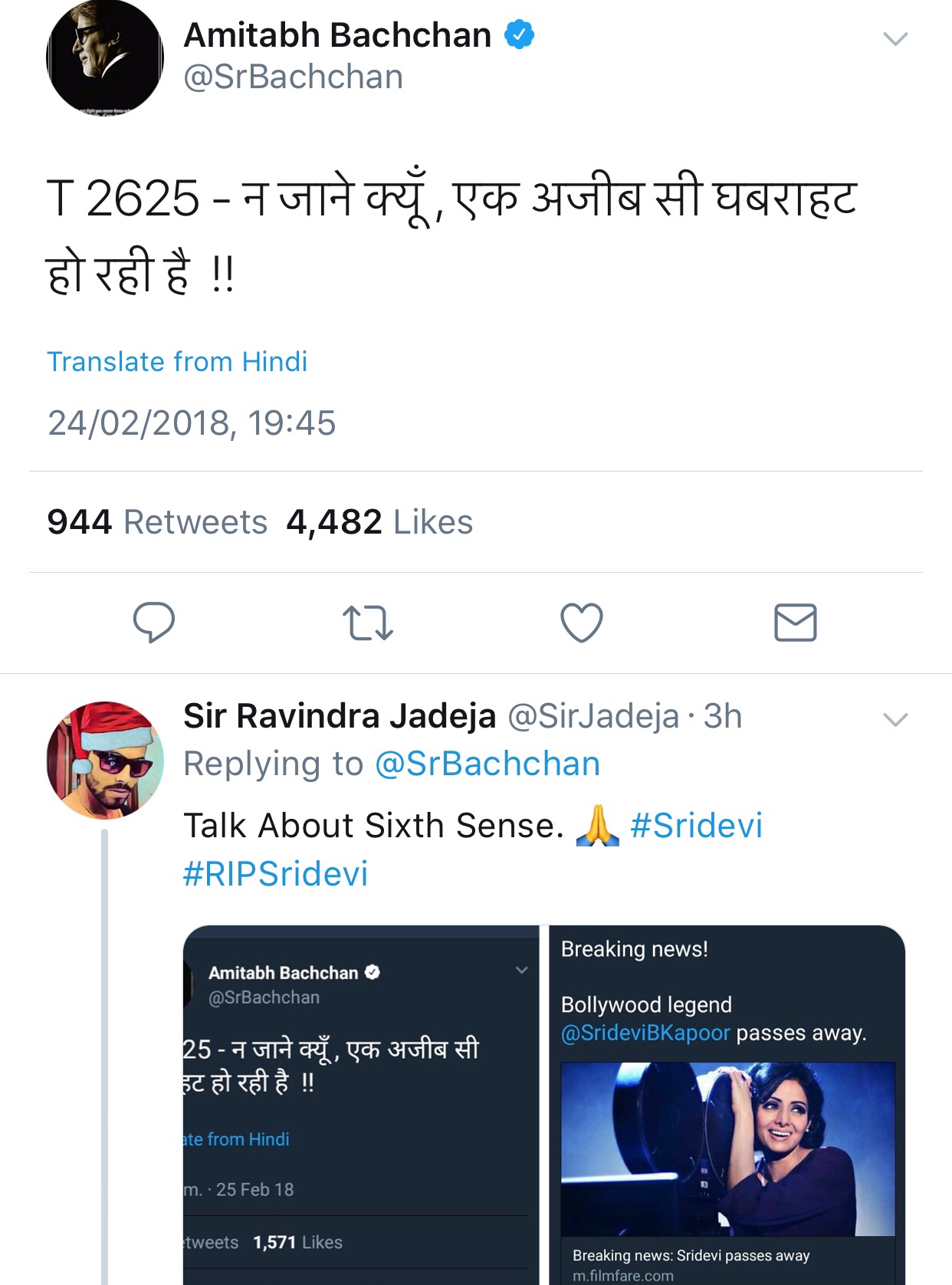
Sad shocking news. Amitabh felt it, an hour before it happened!
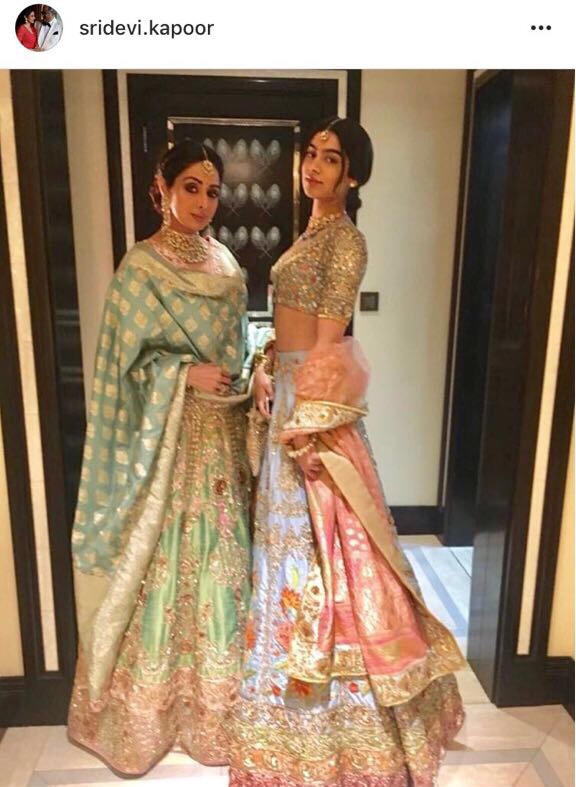
The girl next door, now everyone’s favourite auntie & an Indian Beauty icon, has passed away.
Sad shocking news. Amitabh felt it, an hour before it happened!
The girl next door, now everyone’s favourite auntie & an Indian Beauty icon, has passed away.
https://www.nytimes.com/2018/02/23/world/asia/pakistan-terror-finance-list.html
China, the GCC, the US and the whole world are putting Pakistan on a Terrorism Financing List. What does everyone make of this?
My main take-away is the sea change in the UAE, Kingdom of Saudi Arabia and Qatar regarding Pakistan. MBS is the most liberal, least pro Jihadi, least pro Islamist Wahhabi Salafi leader in Saudi Arabian history. While it is easy to snidely say “compared to what?”; I really hope and pray that MBS is authentic and succeeds. The alternative is just too scary.
What does everyone think?
Update: Trudeau and Bhangra; is he taking it too far?
I had seen a picture of the Trudeaus by the Taj but then the wife did mention to me that there wasn’t any picture of Modi with them. A quick google search:
It gets worse. The beautiful, photogenic Trudeaus went to see the Taj Mahal in Agra, where they were welcomed not by the provincial chief minister, not even a junior minister, but by district officials. Still, the Trudeaus managed to make memorable visuals at India’s famous mausoleum of love. Modi often likes to take visiting dignitaries to Ahmedabad in Gujarat, his home state. Many good visuals have been produced in Gujarat with Modi showing world leaders around Mahatma Gandhi’s Sabarmati Ashram or just taking them around the city. But the Trudeaus had to go alone to Gujarat, where they wore ethnic Indian clothes to visit a Hindu temple and Gandhi’s abode.
There seems to be no end to the Indian snubbing of the Canadians, even as the Trudeaus are trying their best to disarm the Indians with a charm offensive.
Why is India being so rude to Trudeau? Answer: It has to do with the Sikhs.
India has often accused Canada of sheltering Sikh separatists. Sikhs in Canada form a voting bloc for Trudeau, so much so that he even attended a Khalsa Day parade organized by a radical Gurudwara, or Sikh temple, in Toronto. Some Sikh Gurudwaras in Canada have also barred the entry of Indian diplomats.
Amazing movie; even the wife (she likes science and I like sci-fi) was impressed!
Throwing in a controversial question: why do Black people have such better PR over brown people?
Does being a model minority make us ever so (slightly) boring?
Either way #wakanda4ever. As an interesting aside I used to live next to Wakanda (in Uganda) for a little while.
My wife sent me this link, exultant in how her fellow countryman triumphed in this particular Indo-Pak exchange. I know better than to disagree with her though I’m quite ambivalent on the K-issue.
The whole Indo-Pak issue seems interminable especially when the future of the world has shifted over to the technocratic West Coast.
https://www.youtube.com/watch?v=8PNBm0kCNQE&feature=share
Off-topic words that start with C tends to be quite powerful (it prefigured heavily in Vidhi’s life) but that’s just my bias after seeing Shashi rhapsodise about how India forged a national consensus out of different castes, creeds, colours, costumes, customs & cuisines (he could have added communities but who’s counting).
Other c-words that have a descriptive/identitarian nature; countries, counties, creatures, cretins..
Extracts from Major Amin’s history of the 1947-48 war.
THE 1947-48 Kashmir War
Major Agha Humayun Amin
The war of lost opportunities
History is made by those who seize fleeting opportunities in the critical time span in any particular situation and relentlessly execute their plans without second thoughts, subduing inner fears, overcoming procrastination and vacillation, and above all by those who are propelled by the burning desire to defeat the enemy rather than any half hearted judiciousness and timidity. Ninety years of loyalism and too much of constitutionalism had however made the Muslims of 1947 slow in taking the initiative and too much obsessed with consequences of every situation.This attitude was excellent as long as the British were the rulers, but not for a crisis situation, in which geography, time and space, alignment of communications and weather temporarily favoured Pakistan, in case initiative and boldness was exercised and simple but audacious plans were executed in the shortest possible time!
Today, it is fashionable to blame the Indians, Mountbatten, Gracey etc as far as the 1947-48 War is concerned. A dispassionate study of the events of 1947-48 clearly proves that victory was closer in 1947 than ever again as far as the Pakistan Army was concerned. Opportunities were lost because very few people who mattered at any level apart from Mr Jinnah, Brigadier Akbar Khan and some others were really interested in doing anything!
Continue reading 1947-48 Kashmir War
The following is a long extract from Major Amin’s book on the India-Pakistan wars. Other extracts will be posted later. Since this is a very long chapter, I have highlighed and italicized certain sections that the reader can jump to and get the basic story, without bothering with the details. Of course, anyone interested in the details can read the whole thing.
OPERATION GRAND SLAM
By Major Agha Humayun Amin
Background
1965 was an eventful year in Indo-Pak history. The Pakistani military ruler Ayub emerged victorious in the Presidential elections held in January 1965 amidst allegations of rigging. This factor created a desire in Ayub to improve his political image by a limited gain in the realm of foreign relations. He got an opportunity to do so in April 1965 over a minor border dispute with India in the Rann of Kutch area. The Pakistan Army dominated the skirmishes in the Rann area as a result of which a climate of overconfidence was created in the Pakistani military and political establishment.7
In May 1965 following the jubilation in Pakistan because of the Rann affair Ayub became keen to launch the proposed “Operation Gibraltar”: a proposed plan to launch guerrillas into Indian held Kashmir with the objective of creating a popular uprising, finally forcing India to, abandon Kashmir. Ayub went to Murree on 13 May 1965 to attend a briefing on the conduct of Operation Gibraltar.8 We will not go into the controversy surrounding this plan, which is basically an exercise in futility, and mud slinging initiated by some self-styled experts, motivated largely by personal rivalry and ulterior biases, since the prime aim of this article is to discuss the military significance of Operation Grand Slam and its connection with “Operation Gibraltar”. In this briefing Ayub “examined” the “Operation Gibraltar” plan prepared by Major General Akhtar Malik, the General Officer Commanding (GOC) 12 Division. The 12 Division was responsible for the defence of the entire border of Pakistan occupied Kashmir from Ladakh in the north till Chamb near the internationally recognised border to the south. It was during this briefing that Ayub suggested that the 12 Division should also capture Akhnur.9 This attack was codenamed “Operation Grand Slam”. General Musa, the then C in C Army and Altaf Gauhar the then Information Secretary and Ayub’s close confidant, the two principal defenders of Ayub have not given any explanation about what exactly was the strategic rationale of “Grand Slam” and what was its proposed timing in relation to “Operation Gibraltar”. We will discuss this aspect in detail in the last portion of this article. Continue reading Operation Grand Slam (1965 War)
Well, not really. Not a conspiracy of the sort you can take to court. A balanced and well researched look back at the nutrition wars and recent talk of a “sugar conspiracy” in this article in Science.
“Was there ever really a “sugar conspiracy”?
Their conclusion:
Historical investigations of “merchants of doubt” have been invaluable in showing that scientific uncertainty is sometimes the product of deliberate acts of deception. Such studies underscore the essential insight that the existing evidence base is powerfully shaped by social forces and political choices, and that had decisions unfolded differently, our areas of knowledge (such as genomics) and blind spots (such as obesity prevention or gun violence) would be shifted. But ahistorical accounts thwart our ability to critically evaluate the often long and zigzag process of scientific conjecture and refutation. They provide spurious cover for changes to policy by suggesting that old ideas are illegitimate. And, they advance a false impression that doing the “right” kind of science will somehow avert the messy business of making policy based on incomplete evidence, public values, and democratic politics
The core of the problem is the willingness to jump in and give “expert” advice when the evidence is so limited (for any advice); but then again, demand for advice was so strong, it was bound to be fulfilled, just as demand for finding a “conspiracy” (fat conspiracy, sugar conspiracy, whatever) is so strong. These things probably arise from deep features of human cognition and social interaction.. anyway, I think this is a balanced article, but maybe not harsh enough about the limitations of nutrition advice and the damage done by experts offering advice where the science is not yet settled..
First they came for Babri Masjid, and I did not speak out—
Because they called it Ram Mandir.
Then they came for the Gujarati Muslims, and I did not speak out—
Because 170mn Indian Muslims shivered with fear.
Then they came for Beef and I did not speak out—
Because red meat has side effects.
Then they came for Akbar- and now it’s war!
It so happens that I happened to see the following two videos around the same time.
2. The other video appears to be from closer to the other end of the socio-economic spectrum. In this case I have no clue who the speaker is (she states she is from Kasur, and she mentions at one point that she has been “pushed into prostitution”, I have no idea what the back story is) but clearly she is not from the elite class. The thing I am focused on in this post is that while her Urdu is in fact much better than Waj Bro’s Urdu, it is also quite clearly not her mother tongue. One gets the impression she would have done better in Punjabi.
My point today has nothing to do with the politics of each video (and in the case of the second one, I have no clue who she is and what the back story is, we all know cases where the story behind the video turned out to be quite different from what is immediately apparent), I just wanted to ask what people think about the language issue in Pakistan.
Urdu is the national language and is (supposedly, ideally?) the main language of everyday use, high culture and education. But seems in trouble at both ends:
You can see where I am going. The language issue in Pakistan. Which is connected with culture, with nationalism, with modernity. What do people see as the future? (again, not a rhetorical question, I am genuinely curious to know what people think is the current situation, and where it is likely to go).