Brown Pundits Archive · December 18, 2017 · 9 comments
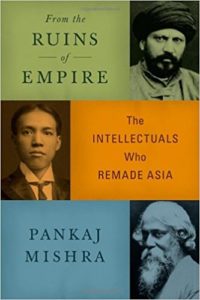
This was a long rolling rant I wrote 5 years ago while reading Pankaj Mishra’s book “From The Ruins of Empire; The Intellectuals Who Remade Asia“. The format is that I commented as I read the book. So early parts are comments on early chapters and so on. Quotes from Pankaj are in bolded italics. I am reposting today after editing it a little because the topic came up once again.
Spoiler Alert. since the “review” is really a very long rolling rant, written as I read the book, some people may just want to know this one fact: this books is NOT about the intellectuals who remade Asia. That book would have to start with people like Aizawa in Japan, the first Asian nation to be “remade”, but that is one nation and one set of thinkers you will not find in this book. Why? because this book is not about Asia, its history or its renaissance, it is about post-liberal virtue signaling. For details, read on..
Introduction: After being told that everyone from Orhan Pamuk to Pakistani Ambassador (and liberal feminist Jinnahist icon) Sherry Rahman is in love with Pankaj Mishra’s new book I have finally started reading it.
I have only read 50 pages so far but it is beginning to set a certain tone. And its not a very encouraging one. I am not impressed. At all. So Far.
On page 18 he says:the word Islam, describing the range of Muslim beliefs and practices, was not used before the 19th century.
WTF?
This is then negated on the very next page by Mishra himself. The only explanation for this little nugget is that Pankaj knows his audience and will miss no opportunity to slide in some politically correct red meat for his audience. There is a vague sense “out there” in liberal academia that Islam is unfairly maligned as monolithic and even that the label itself may be “Islamophobic”. Pankaj wants to let people know that he has no such incorrect beliefs. It is a noble impulse and it recurs. A lot. Continue reading Review: From the Ruins of Empire; The Intellectuals Who Remade Asia
Omar Ali · December 18, 2017 · Comments Off on The Indian Political Service (Raj era)
There is not much known about Indian Political Service (IPS); a service that was involved in three important areas of Empire. It was part of indirect control of Indian states, frontier areas and peripheral areas of the Empire in Persia and Persian Gulf states. Following was part of an exchange on the subject.
Indian Political Service (IPS) is a very little studied subject. My two cents worth comments bolded in the main text. Hope that adds some additional flavor to a savory dish.
Hamid
ASPIRING FOR THE INDIAN POLITICAL SERVICE – A CASE STUDY OF A FAILED ATTEMPT
By Maj Gen Syed Ali Hamid (Retd)
Syed Shahid Hamid was commissioned from Sandhurst in 1933 and joined 3rd Cavalry a recently Indianised regiment in which he spent six years. The second half of this term were not easy as he did not get along well with the second-in-command who was subsequently promoted to command the regiment. Since there were no vacancies for Indian officers in the other two Indianised cavalry regiments, Shahid sought an entry onto the hallowed ranks of the Indian Political Service (IPS).
The IPS was the cadre of officers which dealt with the Princely States and foreign affairs of the Government of British India. Its genesis lay in a department which was created in 1783 by the East India Company for conducting “secret and political business”. Since in the India of that period Persian was the language of diplomatic correspondence, the head of the department was known as the ‘Persian Secretary’. Its primary responsibility was dealing with the Princely States through British Residents appointed from the Department. It also housed the officers of British India’s diplomatic service i.e. its emissaries to the countries surrounding India and the Trucial States in the Gulf. (The early organization performed various functions including intelligence gathering, diplomatic and foreign affairs. The Secret & Political Department established in 1784 had three branches; secret, political & foreign. This set up remained in place until 1842. In 1843, the name was changed to Foreign Department. In 1914, it was named Foreign & Political Department of the Government of India. In 1937, the title was changed to Indian Political Service.)The IPS cadre was generally referred to as Political Officers, or colloquially as “politicals”. Some famous names in the history of the Middle East served as Political Officers including Sir Percy Coxs who masterminded the British policy in this region during the First World War. (on frontier, the name ‘poltical’ in Pushto still generates an aura among tribesmen although they fondly remember British officers of a bygone era.)Continue reading The Indian Political Service (Raj era)
This topic comes up every year in December (for obvious reasons) and this year Dawn has published an unusually good summary of events (from a liberal/progressive/reasonable Pakistani POV) and Ahsan Butt has an excellent article about the thinking behind the genocide. You can read these, or read one of the many good books written about the events leading up to the Pakistan army’s surrender in East Pakistan. I have something of a personal interest in this subject (my father and two uncles served in various capacities in East Pakistan in 1971). In this post, I just want to share my personal opinion about a few aspects of this story. This will likely upset many people, both in Pakistan AND Bangladesh, but my aim is not to upset people, just to get as close to the truth as possible. So here goes..
How many people were killed in East Pakistan and who killed them?
This question gets debated every year; Bangladesh says 3 million Bengalis were killed by the Pakistani army in one of the great genocides of the 20th century. Pakistani nationalists either deny the killings altogether, or insist that “only a few thousand” were killed (which is pretty awful in itself, when you think about it) and that shit happens in civil wars, everyone should move on. In addition, Pakistanis also blame the Bengalis in turn for two separate rounds of killings. The first one in March 1971 when Bengali mobs are accused of killing West Pakistani civilians and Biharis during the civil disobedience phase of events and a second (and bigger) round of killings that took place after the Pakistani army surrendered, when the Mukti Bahini and Bengali mobs took revenge against collaborators and against the Bihari community in general.
The army’s refusal to call a national assembly session after the Awami League had won the elections led to province wide and near-total civil disobedience in early March 1971; civil disobedience was so complete that the military leadership was unable to find a Bengali judge willing to administer the oath of office to their new governor; banks, post offices, civil administration, everything ground to a complete halt; cantonments were running short of food because no one would sell it to them. The Biharis were Indian immigrants (mostly, not exclusively, from the state of Bihar; they were Urdu speaking, generally leaned Islamist, and supported the army during its crackdown against the Bengalis; many of them joined special “Razakar” (volunteer) groups that fought alongside the Pakistani army and served as their eyes and ears. Many of their members also took the opportunity to settle personal scores and grab Bengali (especially Hindu Bengali) property. Biharis also played a disproportionate role in two paramilitary organizations set up by the Islamist Jamat Islami party (Al Shams and Al Badar) whose members did much the same as the razakars, but with far greater enthusiasm and ideological commitment. Incidentally, both the razakars and AlShams and Albadar did have Bengali members, though this is now underplayed in Bangladeshi historiography. The Jamat e Islami related groups (Alshams and Albadar) are also the prime suspects in a major crime that occurred on the eve of surrender, when many leading Bengali nationalist and progressive intellectuals in Dhaka were mysteriously picked up and killed, most likely as a heinous and calculated attempt to “decapitate” the new state whose independence seemed to be imminent.
So who is telling the truth? No one will ever know with total certainty because the opportunity to systematically examine these events, interview survivors, collect records and produce statistics was lost in the chaos that followed the independence of Bangladesh. What follows is my personal opinion, based on all that I have read and heard: Continue reading East Pakistan 1971
X.T.M · December 12, 2017 · Comments Off on Anushka Sharma – Virat Kohli wedding
So we used the same video company (Wedding Filmer) and Anushka Sharma wore a similar shading and walked to the same song for the pheras as my wife did ??
Hi, this is anan. Omar invited me to post at Brown Pundits. I am deeply honoured [Queens English spelling versus US spelling] to participate in this community, which I have read since its inception. If it is okay with all of you, I would like to write a series of articles on why nonmuslims treat muslims so badly. Please watch this video on how the UK mistreats UK muslims:
“honour” based violence includes forced marriage and FGM reported to the police
However, despite the rise in reporting, the volume of cases referred to the CPS for a charging decision is the lowest it has been for five years.
The number of “honour” crimes reported to the police increased from 3,335 in 2014 to 5,595 in 2015 – a rise of 68%, according to data collected by the charity from every police force in the country.
The number of reports dropped slightly to 5,105 in 2016.
However, the latest figures published by the CPS show only 256 “honour” crimes were referred to the organisation by police in 2016/17 – just 5% of the cases reported over a similar period.
The 256 referrals resulted in 215 prosecutions and a subsequent 122 convictions.
a man was to be charged for FGM, following an investigation by the Metropolitan police. If the prosecution is successful it would mean the first British conviction for FGM since the practice was outlawed in 1985.
Insp Allen Davis who leads Project Azure, the Met’s response to FGM, said: “These are hidden crimes and police data is never going to reflect the true scale of the problem. The data is really useful for shining a light on this complex area but it needs to be taken in context.
“For example, with FGM, we get a lot of reports where a child may be at risk but it doesn’t necessarily mean a crime has occurred. It will be counted as a police report but the response may involve obtaining a protection order.”
From other crime reports, honour [Queens English spelling versus American spelling] crimes against young muslim females are prosecuted at a much lower rate than other types of crime in the UK. I don’t understand why this is. Is it because of widespread bigotry, sectarianism and racism in UK society? A sense that young female UK muslims “deserve it”? What am I missing?
I think society should bend over backwards to be respectful of muslim culture and religion. For example, if a patriotic UK muslim family wants to nonviolently punish their minor daughter for what they see as inappropriate conduct; they have the right to do so. Any UK muslim family can ask their relative who is 18 or older to leave their house and excommunicate her. What is illegal is to use violence. What is wrong is not to give young UK muslim females the same legal protection and help that non muslim UK females get. What is wrong is to treat muslims worse and differently than nonmuslims.
I believe that when nonmuslims fail to protect muslims from Islamists, this hurts not just muslims, but all nonmuslims too. This makes muslims afraid of Islamists and resentful of unequal treatment by nonmuslims. Which in turn ends freedom of speech for muslims and kills dialogue with Islamists, since muslims are afraid that they won’t be protected from Islamist violence. I believe that dialogue with extremists is the only way to ameliorate Islamism. For dialogue to happen, those who engage in dialogue need to be protected. And that starts by protecting vulnerable young muslim females from “honour” [Queens English spelling versus American spelling] violence. Muslim families and communities have the right to engage in “honour” social ostracization, but don’t have the legal right to engage in “honour” violence.
To be clear FGM is a complex issue. I don’t think that male circumcision should be banned, and perhaps that logic might apply to some very light forms of FGM to accommodate muslim culture. But most FGM is far more dangerous and intrusive than male circumcision. Global society needs an open and honest discussion about FGM and what to do about it; including banning very dangerous types of FGM.
The UK isn’t the only country that mistreats her muslims. The same is true for many other countries around the world, which might be the subject of future articles.
My views on this and most other things are not set in stone and I am open to changing them based on new information. Please let me know the many things I am missing or misunderstanding.
Thanks again for letting me be a part of the Brown Pundit community.
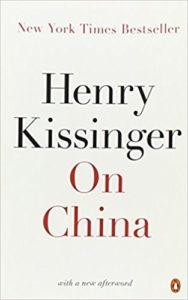
“On China” is a curious mixture of history, geopolitical analysis and self-serving memoir (concentrating mostly on the last two elements). Kissinger reviews some of the highlights of Chinese history; ancient and medieval China is covered quickly and superficially and the material is pretty much standard issue, but the level of detail increases after greatly from the opium war onwards and the book becomes much more interesting at that point. Kissinger makes the case that the Qing bureaucrats, in dire straits thanks to internal revolts, financial crisis and administrative decay, were not completely clueless or apathetic. Faced with determined, ruthless and far more technologically advanced European powers who had already overcome or overawed other great non-Western empires, Qing diplomats did their best to play European powers against one another and try to use (very limited) breathing space to try some fitful reforms, but the court was too far gone and the situation could not be salvaged, which led to 100 years of defeat, disorder, revolutions, famines and other disasters. Continue reading Review: On China
Not a surprise that Hari Kondabolu goes there. The problem with making everything about racial dynamics is that more white people in the United States might take a page from that. I don’t wish to encourage that.
Also, believe it or not racializing a topic that the majority probably agrees with you on might make it less popular. But if you now talk to people who just agree with you all the time on these things you might not remember that.
I’ve been exceptionally busy the past few weeks (and likely only to get busier in the run up to the New Year). What do Indian commentators think on the Padmavati furore (indefinitely postponed).