Popcorn + missiles = funtimes

…a kind of “cinema”
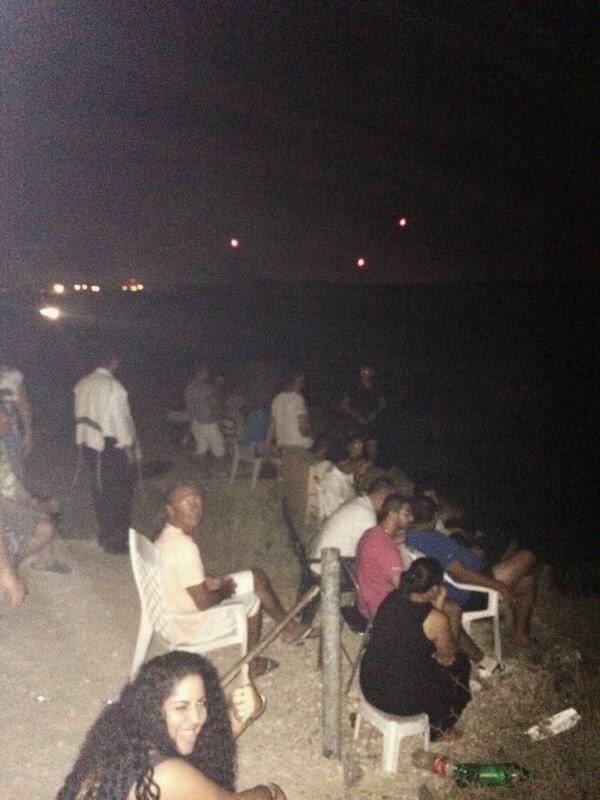
on the hilltop outside Sderot…“Clapping when blasts are heard.”…..more than 50 people who had
transformed the hill into something “most closely resembling the front
row of a reality war theatre”…..people were seen taking popcorn up onto the hill with their chairs, and that they sat cheerfully smoking hookahs….

We are aware that there are no saints in war. It is just mindlessly brutal and it brutalizes ordinary citizens who are not involved in the fighting. Still the imagery manages to shock us. What have we become? Is there no common humanity left anymore??

Having said that the muslim world (if there is such a term) needs to think long and deep about how it treats minorities. There is now no home left for millions of Christians in the Middle East proper. Everywhere else, the intolerance meter is always dialed to maximum. Why?

Meanwhile, Israelis, Indians, Chinese, Russians, Burmese, Sri Lankans…are also treating their muslim citizens shamefully. Both sides claim that the “other” has been the first mover in crime. This eye-for-eye set-up is not helping anyone.

If we step back and look at the big picture, the (relatively speaking) safe-home(s) today for muslims is any number of non-muslim lands. In South Asia and elsewhere more muslims are being killed by other muslims than non-muslims. 

We all know what is wrong with the “Sderot Cinema.” But does anybody know why things have gone wrong in Aleppo, Mosul, and so many other places? How will we fix things so that people can co-exist peacefully? We need answers now. It is too easy to blame others. If the muslim world takes the lead in offering solutions, we are sure the whole world will sit up, take notice and lend a hand. 

This is not blaming the victim…it is a request for the leaders and the people to take responsibility and a call for action. And the most urgent requirement for action is at home.
….
An image that appears to show a group of Israelis on a hilltop
cheering and applauding as they watch the deadly aerial bombardment of
Gaza has caused international outrage after it was shared by thousands
on Twitter.


Taken by the Middle East correspondent for a Danish newspaper, the
picture shows rows of people sitting on plastic chairs looking out over
the Gaza Strip as rockets and explosions light up the night sky.

Allan
Sørensen, who posted the image, wrote that it showed a kind of “cinema”
on the hilltop outside the Israeli town of Sderot, and a caption added:
“Clapping when blasts are heard.”

Sørensen’s newspaper, the Kristeligt Dagblad,
reported that the gathering involved more than 50 people who had
transformed the hill into something “most closely resembling the front
row of a reality war theatre”.

It said that people were seen taking popcorn up onto the hill with their chairs, and that they sat cheerfully smoking hookahs.

“We are here to see Israel destroy Hamas,” said Eli Chone, a 22-year-old American who lives in Israel.

Sørensen’s
tweet was met with anger by fellow Twitter users. One user wrote: “If
this is true then God help us all. What’s become of the human race?”

Another said: “This is the most gruesome image I’ve seen the last few days.”

Further images have since emerged showing larger crowds on subsequent
days – suggesting that the so-called “Sderot cinema” was far from a
one-off. They showed groups standing and pointing out to the horizon,
and one had even brought a sofa up onto the hilltop.

…………….

Link: http://www.independent.co.uk/news/world/middle-east/israelgaza-conflict-sderot-cinema-image-shows-israelis-with-popcorn-and-chairs-cheering-as-missiles-strike-palestinian-targets-9602704.html

……..

regards

Saeed: Pak and India are one nation!!!!

….Saeed….said she did not understand why India and
Pakistan were considered different nations….so much of
similarity between the two countries…..both countries were
indeed one nation….

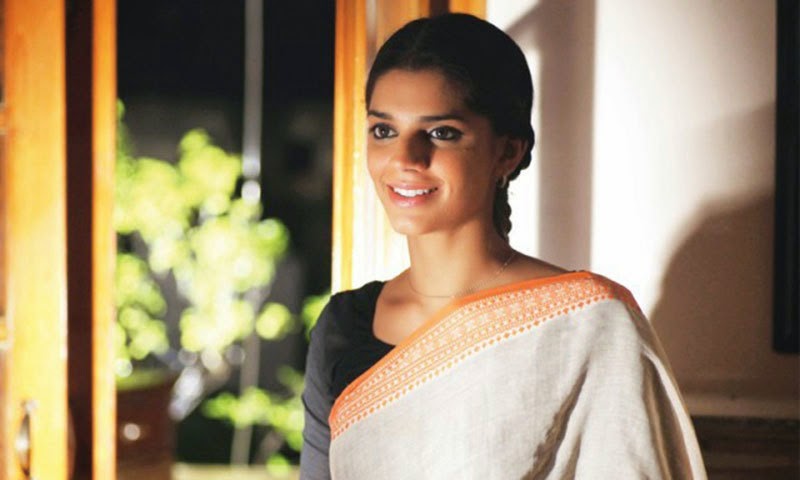
No, no…not THAT Saeed…..it is Sanam Saeed from Zindagi Gulzar Hai.

BTW, India and Pakistan…one nation…gosh, those are fighting words!!!! Only a British (West) born actor can say such incendiary stuff. Hopefully her career does not suffer from plain-speaking, at any event she can migrate to India (we hope).

The big question in our mind….is the saree is un-islamic or not? General Zia-ul-Haque was the foremost proponent of this theory. But we imagine it has become conventional wisdom now amongst the more deeply faithful across South Asia and even amongst expat populations. 
Our keywords “saree un-islamic” brought up this intriguing thread.

Enquiry: my husband and i married in love marriage, we are both british born asians, he is half pakistani and indian, while i am bengali….
My husband is very religious, and even though before marriage i did not
wear hijab, he asked me to wear one after marriage and i happily did so….

But he is a bit more
extreme when it comes to things like clothing, he does not like me
wearing sari which is very commen in bengali culture for us women to
wear. he thinks the revealing flesh around the midriff is haram.
 

i have
explained to him that i can conceal such an area with my sari (which is
what most bengali girls do anyway) and i have even demonstrated it to
him, but he still says it is not right and does not permit me to wear
one outside of our home.
 

Response: In regards to wearing a saree, i have a few bengali neighbours and most
of the women folk wear sarees especially on Eid and other formal
occassions and it is clear to me that it is not appropriate for a women
to be wearing outside and around non mahrams even if the waist is
covered because it is still worn fitted to the body so the bodily
definitions can be seen and it is also of bright colours etc.

When you are around your husband and mahram members of your family then
it is fine but when non mahrams are around and when going out then one
should be very careful and wear full hijaab and jilbaab.
…..It is a good thing that a husband wants to protect his wife from the
evil gazes of other men. You should be happy that your husband only
wants your beauty for his eyes and not the eyes of other men.

…………….


Pakistani model and actor Sanam Saeed said she was glad that
Pakistani shows were having a positive impact on people in India – which
was the same effect they had on people in Pakistan.

In an interview with the Times of India,
Saeed, who was has been associated with Pakistan’s entertainment
industry in various avatars, said she did not understand why India and
Pakistan were considered different nations when there was so much of
similarity between the two countries stressing that both countries were
indeed one nation.

The 29-year-old was grateful and happy that Zindagi Gulzar Hai,
the drama where she enacted the role of a girl from the lower
middle-class, was the first serial which broke the ice across the
borders in recent times.

“India uses Bollywood, rather cinema, to
tell its stories. It is one of the largest filmmaking nations in the
world and so your talents get to tell stories about politics, love and
drama through films. In Pakistan, our medium is the small screen.

“We
don’t make many films, and hardly have theatres. A majority of people
seek entertainment while sitting at home and TV gives it to them, so we
excel on that part,” Sanam said.

The British-born actor, who
shifted to Karachi at the age of six, also said that she selected roles
which showcased a woman’s struggle.

Elaborating on how the people
in Pakistan only had TV as a form of entertainment, she said she tried
to do shows which had inspirational value and enacted characters that
could be role models for young girls and help change people’s
perspective.

…….


Link (1): http://www.ummah.com/forum/showthread.php?271646-im-very-confused-about-my-husband

Link (2):  http://www.dawn.com/news/1119376/im-glad-pakistani-shows-have-a-positive-impact-on-india-sanam-saeed
……

regards

Burma and Imperial Britain

Their relationship with the British Empire is that of slave and master….Is
the master good or bad? That is not the question…his control is despotic and….self-interested….

As we all know, Arundhati Roy is considered as one of the leading (if not the leading) thinkers of the world. If Obama can be gifted the golden gong then we do not see why she should not be considered as well.

As it so happens, Imperial Britain also suffered heavily at the hands of a Roy-like figure, one Mr E.A. Blair (also a Nobel winner, but for literature). 

Here is Blair’s take on British exploitation of Burma. The background is very much relevant to India as well. We found it to be an interesting read. Enjoy.  
……
British politics in Burma is the same as in India.

Industrially speaking, India was deliberately kept in ignorance.
She
only produces basic necessities, made by hand. The Indians would be
incapable, for example, of making a motor-car, a rifle, a clock, an
electric-light bulb etc. They would be incapable of building or sailing
an ocean-going vessel.

At the same time they have learnt in their
dealings with Westerners to depend on certain machine-made articles. So
the products of English factories find an important outlet in a country
incapable of manufacturing them herself.

Foreign competition is
prevented by an insuperable barrier of prohibitive customs tariffs. And
so the English factory-owners, with nothing to fear, control the markets
absolutely and reap exorbitant profits.

……

How a Nation Is Exploited – The British Empire in Burma

Following
the recent troubles in India, we have asked our contributor, Mr E. A.
Blair, whose investigations on ‘The Plight of the British Worker’ have
already appeared in these pages, to tell us something of the unrest
which has been fermenting in the sub-continent for some years, and which
is threatening to spread to English Indo-China.

Burma lies between India and China. Ethnologically it belongs to Indo-China.
It
is three times the size of England and Wales, with a population of
about fourteen million, of whom roughly nine million are Burmese.

The
rest is made up of countless Mongol tribes who have emigrated at
various periods from the steppes of Central Asia, and Indians who have
arrived since the English occupation.

The Burmese are Buddhists; the tribesmen worship various pagan gods.

To
be able to talk in their own language to the people of such diverse
origins living in Burma, you would need to know a hundred and twenty
different languages and dialects.

This country, the population of
which is one-tenth as dense as that of England, is one of the richest in
the world. It abounds in natural resources which are only just
beginning to be exploited.

There are tin, tungsten, jade and rubies, and these are the least of its mineral materials.
At this moment it produces five per cent of the world’s petroleum, and its reserves are far from exhausted.

But the greatest source of wealth-and that which feeds between eighty and ninety per cent of the population-is the paddy fields.
Rice is grown everywhere in the basin of the Irawaddy, which flows through Burma from north to south.
In the south, in the huge delta where the Irawaddy brings down tons of alluvial mud every year, the soil is immensely fertile.
The harvests, which are remarkable in both quality and quantity, enable Burma to export rice to India, Europe, even to America.
Moreover, variations in temperature are less frequent and sharp than in India.
Thanks
to abundant rainfall, especially in the south, drought is unknown, and
the heat is never excessive. The climate as a whole can thus be
considered one of the healthiest to be found in the tropics.

If we
add that the Burmese countryside is exceptionally beautiful, with broad
rivers, high mountains, eternally green forests, brightly coloured
flowers, exotic fruits, the phrase ‘earthly paradise’ naturally springs
to mind.

So it is hardly surprising that the English tried for a long time to gain possession of it.

In
1820 they seized a vast expanse of territory. This operation was
repeated in 1852, and finally in 1882 the Union Jack flew over almost
all the country.
 

Certain mountainous districts in the north,
inhabited by small savage tribes, had until recently escaped the
clutches of the British, but it is more and more likely that they will
meet the same fate as the rest of the country, thanks to the process
euphemistically known as ‘peaceful penetration’, which means, in plain
English, ‘peaceful annexation’.

In this article I do not seek to
praise or blame this manifestation of British imperialism; let us simply
note it is a logical result of any imperialist policy.

It will be
much more profitable to examine the good and bad sides of British
administration in Burma from an economic and a political standpoint.

* * * * * * * * * * * * * * * *

Let us turn first to politics.
The
government of all the Indian provinces under the control of the British
Empire is of necessity despotic, because only the threat of force can
subdue a population of several million subjects.

But this despotism is latent. It hides behind a mask of democracy.

The
great maxim of the English in governing an oriental race is ‘never get
something done by a European when an Oriental can do it’. In other
words, supreme power remains with the British authorities, but the minor
civil servants who have to carry out day-to-day administration and who
must come into contact with the people in the course of their duties are
recruited locally.

In Burma, for example, the lower grade
magistrates, all policemen up to the rank of inspector, members of the
postal service, government employees, village elders etc. are Burmese.

Recently,
to appease public opinion and put a stop to nationalist agitation which
was beginning to cause concern, it was even decided to accept the
candidature of educated natives for several important posts.

The system of employing natives as civil servants has three advantages.
First, natives will accept lower salaries than Europeans.
Secondly,
they have a better idea of the workings of their fellow countrymen’s
minds, and this helps them to settle legal disputes more easily.

Thirdly, it is to their own advantage to show their loyalty to a government which provides their livelihood.
And
so peace is maintained by ensuring the close collaboration of the
educated or semi-educated classes, where discontent might otherwise
produce rebel leaders.

Nevertheless the British control the
country. Of course, Burma, like each of the Indian provinces, has a
parliament-always the show of democracy-but in reality its parliament
has very little power.

Nothing of any consequence lies within its
jurisdiction. Most of the members are puppets of the government, which
is not above using them to nip in the bud any Bill which seems untimely.

In
addition, each province has a Governor, appointed by the English, who
has at his disposal a veto just as absolute as that of the President of
the United States to oppose any proposal which displeases him.

Yet although the British government is, as we have shown, essentially despotic, it is by no means unpopular.
The
English are building roads and canals-in their own interest, of course,
but the Burmese benefit from them-they set up hospitals, open schools,
and see to the maintenance of law and order.

And after all, the Burmese are mere peasants, occupied in cultivating the land.
They have not yet reached that stage of intellectual development which makes for nationalists.
Their
village is their universe, and as long as they are left in peace to
cultivate their fields, they do not care whether their masters are black
or white.

A proof of this political apathy on the part of the
people of Burma is the fact that the only British military forces in the
country are two English infantry battalions and around ten battalions
of Indian infantry and mounted police. Thus twelve thousand armed men, mostly Indians, are enough to subdue a population of fourteen million.

The
most dangerous enemies of the government are the young men of the
educated classes. If these classes were more numerous and were really
educated, they could perhaps raise the revolutionary banner. But they
are not.

The reason is firstly that, as we have seen, the majority of the Burmese are peasants.
Secondly,
the British government is at pains to give the people only summary
instruction, which is almost useless, merely sufficient to produce
messengers, low-grade civil servants, petty lawyers’ clerks and other
white-collar workers.

Care is taken to avoid technical and
industrial training. This rule, observed throughout India, aims to stop
India from becoming an industrial country capable of competing with
England.

It is true to say that in general, any really educated
Burmese was educated in England, and belongs as a result to the small
class of the well-to-do.

So, because there are no educated classes, public opinion, which could press for rebellion against England, is non-existent.
* * * * * * * * * * * * * * * *

Let
us now consider the economic question. Here again we find the Burmese
in general too ignorant to have a clear understanding of the way in
which they are being treated and, as a result, too ignorant to show the
least resentment.

Besides, for the moment they have not suffered much economic damage.

It
is true that the British seized the mines and the oil wells. It is true
that they control timber production. It is true that all sorts of
middlemen, brokers, millers, exporters, have made colossal fortunes from
rice without the producer-that is the peasant-getting a thing out of
it.

It is also true that the get-rich-quick businessmen who made
their pile from rice, petrol etc. are not contributing as they should be
to the well-being of the country, and that their money, instead of
swelling local revenues in the form of taxes, is sent abroad to be spent
in England.

If we are honest, it is true that the British are robbing and pilfering Burma quite shamelessly.

But
we must stress that the Burmese hardly notice it for the moment. Their
country is so rich, their population so scattered, their needs, like
those of all Orientals, so slight that they are not conscious of being
exploited.

The peasant cultivating his patch of ground lives more
or less as his ancestors did in Marco Polo’s day. If he wishes, he can
buy virgin land for a reasonable price.

He certainly leads an arduous existence, but he is on the whole free from care.
Hunger and unemployment are for him meaningless words. There is work and food for everyone. Why worry needlessly?

But,
and this is the important point, the Burmese will begin to suffer when a
large part of the richness of their country has declined.

Although
Burma has developed to a certain extent since the war, already the
peasant there is poorer than he was twenty years ago.

He is beginning to feel the weight of land taxation, for which he is not compensated by the increased yield of his harvests.
The worker’s wages have not kept up with the cost of living.

The
reason is that the British government has allowed free entry into Burma
for veritable hordes of Indians, who, coming from a land where they
were literally dying of hunger, work for next to nothing and are, as a
result, fearsome rivals for the Burmese.

Add to this a rapid rise
in population growth-at the last census the population registered an
increase of ten million in ten years-it is easy to see that sooner or
later, as happens in all overpopulated countries, the Burmese will be
dispossessed of their lands, reduced to a state of semislavery in the
service of capitalism, and will have to endure unemployment into the
bargain.

They will then discover what they hardly suspect today,
that the oil wells, the mines, the milling industry, the sale and
cultivation of rice are all controlled by the British.

They will also realise their own industrial incompetence in a world where industry dominates.
* * * * * * * * * * * * * * * *

British politics in Burma is the same as in India.

Industrially speaking, India was deliberately kept in ignorance.
She
only produces basic necessities, made by hand. The Indians would be
incapable, for example, of making a motor-car, a rifle, a clock, an
electric-light bulb etc. They would be incapable of building or sailing
an ocean-going vessel.

At the same time they have learnt in their
dealings with Westerners to depend on certain machine-made articles. So
the products of English factories find an important outlet in a country
incapable of manufacturing them herself.

Foreign competition is
prevented by an insuperable barrier of prohibitive customs tariffs. And
so the English factory-owners, with nothing to fear, control the markets
absolutely and reap exorbitant profits.

We said that the Burmese
have not yet suffered too much, but this is because they have remained,
on the whole, an agricultural nation.

Yet for them as for all
Orientals, contact with Europeans has created the demand, unknown to
their fathers, for the products of modern industry. 

As a result, the
British are stealing from Burma in two ways:

In the first place,
they pillage her natural resources; secondly, they grant themselves the
exclusive right to sell here the manufactured products she now needs.

And
the Burmese are thus drawn into the system of industrial capitalism,
with any hope of becoming capitalist industrialists themselves.

Moreover
the Burmese, like all the other peoples of India, remain under the rule
of the British Empire for purely military considerations. For they are
in effect incapable of building ships, manufacturing guns or any other
arms necessary for modern warfare, and, as things now stand, if the
English were to give up India, it would only result in a change of
master. The country would simply be invaded and exploited by some other
Power.

British domination in India rests essentially on exchanging
military protection for a commercial monopoly, but, as we have tried to
show, the bargain is to the advantage of the English whose control
reaches into every domain.

* * * * * * * * * * * * * * * *

To sum up, if Burma derives some incidental benefit from the English, she must pay dearly for it.

Up
till now the English have refrained from oppressing the native people
too much because there has been no need. The Burmese are still at the
beginning of a period of transition which will transform them from
agricultural peasants to workers in the service of the manufacturing
industries.

Their situation could be compared with that of any
people of eighteenth-century Europe, apart from the fact that the
capital, construction materials, knowledge and power necessary for their
commerce and industry belong exclusively to foreigners.

So they
are under the protection of a despotism which defends them for its own
ends, but which would abandon them without hesitation if they ceased to
be of use.

Their relationship with the British Empire is that of slave and master.

Is
the master good or bad? That is not the question; let us simply say
that his control is despotic and, to put it plainly, self-interested.

Even
though the Burmese have not had much cause for complaint up till now,
the day will come when the riches of their country will be insufficient
for a population which is constantly growing.

Then they will be able to appreciate how capitalism shows its gratitude to those to whom it owes its existence.

E. A. BLAIR

…..

Link: http://theorwellprize.co.uk/george-orwell/by-orwell/essays-and-other-works/how-a-nation-is-exploited-the-british-empire-in-burma/

……

regards

Baby, light my fire

…..as her father had no son, she had
every right to light the funeral pyre…..Opposing one and all, she finally
lit the funeral pyre of her father, Ajay Yadav…..”I will just
not perform all the rites but also allow some of my hair to be cut”……

Simple equation for the 21st century: tweak the theology(s) and make all clauses gender neutral. And with that excuse out of the way, son preference will disappear (hopefully). And yes, Viking funerals are classy (but we suspect…not sustainable).

Truth be told, we sympathize with Arya Samaj people who claim not to believe in caste, rituals and idolatry. But then we also feel that people should be free to follow the path that suits them. However girls must have justice and they must be honored. Otherwise, forget about that thing called society.
……………………….

She
may be in the eye of a storm for lighting the funeral pyre of her
father ignoring objections from her close relatives and immediate
neighbours on Saturday, but Shalini, a Class XII student, remained
unrepentant.


She claims that as her father had no son, she had
every right to light the funeral pyre. Opposing one and all, she finally
lit the funeral pyre of her father, Ajay Yadav, on Saturday. Now, she
is determined to go ahead with the rest of the ‘shhradh’. “I will just
not perform all the rites but also allow some of my hair to be cut,” she
says.

An alcoholic, Ajay Yadav, breathed his last at his small
house in Maranga locality on the outer fringe of Purnia town after
protracted illness on Saturday leaving behind his wife, Mira Sinha and
two daughters, Rohini and Shalini. Mira Sinha is an anganwadi sevika
since 2007 while Rohini is married to Ravi Kumar in Jamalpur in Munger
district.

Though close relatives and neighbours did everything
possible to stop Shalini from lighting the pyre quoting Hindu
scriptures, she went ahead with it. Her close relatives and immediate
neighbours did not go to the cremation ghat as a mark of opposition. 

Now
the same people are doing everything in their power to stop Shalini
from going ahead with the rest of the rites. “They are preventing the
local pundits and thakur from performing ‘shhradh’ and related rites,”
Shalini told local reporters at her house on Sunday. “But, if they are
bent on such mischief, I will bring pundits and others from outside,”
she said. “What crime have I done if I lit the funeral pyre of my father
and want to observe the rites,” she says with a tinge of defiance.

Quoting the last wish of Yadav, his close relatives, however, maintain
that he always wanted his nephew to perform the last rites. Ajay Yadav
was always shabbily treated by his wife, two daughters and even his
son-in-law, they insinuate. This is, however, strongly disputed by Mira
Sinha who tied the nuptial knot with Yadav in 1994 in spite of stiff
opposition from relatives. It was an inter-caste marriage.

A
small piece of land has been left behind by Yadav, averred Mira Sinha
before newsmen. “My husband had five brothers and some of them have
already forcibly grabbed a small piece of land,” she said.

Meanwhile, Purnia Mahila Morcha chief Nutan Anand, who called on the
bereaved members on Sunday, has assured them of all possible help, even
promising to approach the district administration for providing security
to them. 

…………………………..
……

regards

Bad blood overflows in Baksa

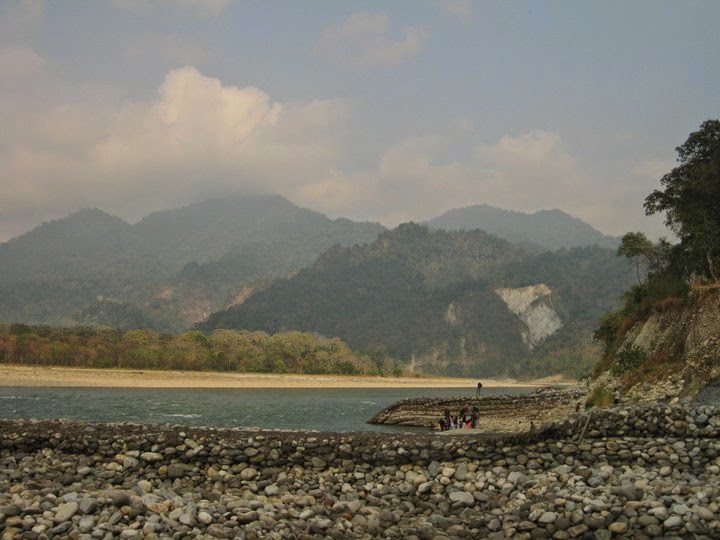
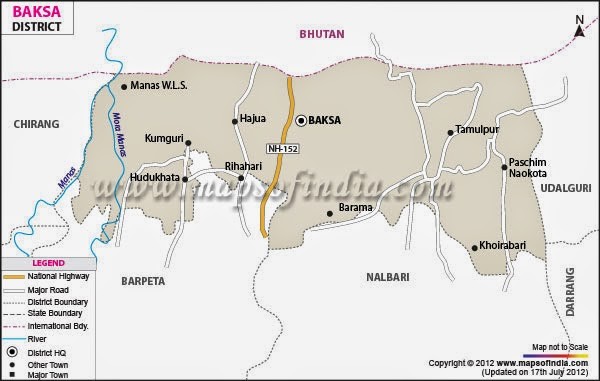
Supremely beautiful place bordering Bhutan- the Manas Wild Life Sanctuary is famed for one-horned rhino and many other life-forms. It is sadly being polluted by evil people killing teenage boys. Illegal migrants or no, the govt has a duty of care to protect people.

For the majority communities everywhere tolerance for minorities is a lesson that must be learned (the easy way or the hard way). Killing people is soul destroying. Every religion, all big men (and women) agree. Kicking out the short-term minded criminal goons (aka politicians) will help.  

Look to Iraq and learn not to live in a divided house. Learn from the animal kingdom if you have to. And if you do not learn you will never prosper. Never. 

How about the minorities? We propose a silver bullet: give freedom to the women to live life as they please. Yes, some girls may marry outside the community (no coercion allowed in either direction). In the worst case scenario the minority will be merged in the melting pot. So what? Is multi-generational life in a ghetto any way  to live?
…………………………………….
Bodies of all the four who were kidnapped on Friday night by suspected
NDFB (Songbijit) militants, including two teenaged boys, have now been
found. The first body, bearing a cut mark on the head, was recovered
last evening from the river in Barpeta district.


……..

The bodies recovered today were identified as those of Ataur Rahman
(27), Rubul Amin (45) and Saddam Ali(13), while that of Bakar Ali(13)
was found yesterday.


The four were among seven lemon traders who had gone to Labdanguri market in Baksa district from the adjacent Barpeta district.

….

The family members and villagers in Barpeta district, from where the
four hailed, have refused to conduct the last rites demanding that Chief
Minister Tarun Gogoi visit the area to address their grievances.


….

The police fired in the air to disperse a mob protesting against the
kidnap ignoring the curfew at Anand Bazar area, Seshan said, adding
“police had to use force as the people violated the curfew and refused
to leave the place.”


The state government last evening replaced the Baksa Superintendent of
Police Nimbalkar Vaibhav Chandrakant and appointed 10th Assam Police
Battalion commandant Mojibur Rahman in his place.


In May this year, 50 people were killed in Baksa and Kokrajhar in
Bodoland Territorial Area Districts by suspected Bodoland Peoples
Front-supported militants. NIA and the state government are separately
probing the incidents.


In another incident, a police official was beaten up and critically
injured by agitated people while he was taking the three bodies for
post-mortem in Baksa, forcing the police to resort to lathicharge and
fire tear gas shells.


Nine persons were arrested in connection with the incident on the charge
of rioting and attacking a police officer on duty during curfew,
Additional Director General of Police (Law and Order) Ajit Prasad Rout
said.


The official had been admitted at the Barpeta Medical College and Hospital for treatment, he said.

“After the bodies were recovered and some tense situation during the
day, we requested the Army to show ‘area dominance’ but no flag march is
ordered yet,” Baksa Deputy Commissioner Vinod Seshan said.


….

Rout said the ‘janaja’ (last rites) of Abu Bakkar was performed during
the day, while those of the other three will be carried out tomorrow
after the post-mortem was done.


The state goverment has announced payment of ex-gratia of Rs eight lakh each for the next of kin of the victims.

….

Indefinite curfew has been clamped in the Gobardhana police station and
Anandbazar police station areas in Baksa district as well as the
northern side of railway line in Barpeta district since yesterday.

……..

Link: http://www.outlookindia.com/news/printitem.aspx?849585

……

regards

Hafeez Hindu bhai bhai!!!

….”He denied all the allegations against him”….”He
said he came to know about the 26/11 Mumbai terror attacks…on television”
…. Saeed now says “he would
welcome Mr Modi in Pakistan.”

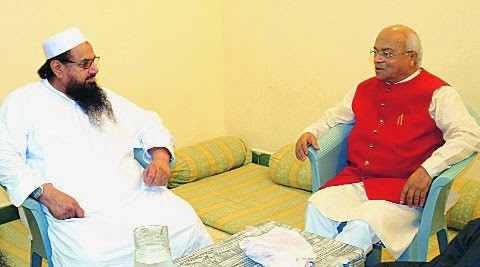
So…the Hindu Brotherhood is bromancing Hafeez
Saeed. South Asians do love drama-bazi, but if this is not ridiculous, what is?

Remember, LK Advani was pilloried for having merely praised Jinnah (a past enemy). Dr.
Vaidik is breaking bread (he sweetly refused sweets in honor of Ramzan) with a
living enemy, a $10 mil terrorist.
……….
Dr Ved Pratap Vaidik’s recent 20-day tour of Pakistan seems to have been
precociously productive. He met a number of former soldiers, diplomats,
experts and journalists, even Prime Minister Nawaz Sharif. 

As with any
good trip, there are photographs. None sadly are selfies — which is all
that is missing from Vaidik’s excellent adventures in Pakistan.


From Vaidik’s point of view, it was time well spent, a discovery of a
kinder, gentler ‘other’. He went looking for a big, bad Muslim state
bent on total annihilation of India, but found instead a peace-loving
padosi.


This time, the mood has changed. Nobody made any comment about Prime
Minister Narendra Modi that could have upset me. Overall, Pakistani
leaders and scholars’ opinion was that if the Indian people had accepted
Modi, then why should Pakistanis not accept it?… Pakistanis don’t
fear any longer that India can destroy Pakistan or seize ‘Azad Kashmir’
at gun-point…” Vaidik writes in his blog.


…..
Open the Wagah border, now!

….

As all dutiful self-appointed diplomats, Vaidik did not shy away from
the more daunting tasks of his goodwill tour.  He met former ‘prime
minister’ of Pakistan Occupied Kashmir Sardar Ateeq, his father, the
90-year-old Sardar Qayyum, PoK’s seniormost leader. 

And, oh yes, Hafeez
Saeed, the prime conspirator of the 26/11 attacks in Mumbai, wanted by
Indian courts, under trial in Pakistan and leader of the Jamaat-ud-Dawa,
the political arm of terror group Lashkar-e-Toiba and recently itself
named a terror outfit by the US.


Right, that guy.

….

Vaidik said the meeting was unplanned, and arranged all of a sudden.
Then again, he also says the meeting had been in the works for over a
year, arranged by the anchor of a prominent Pakistani news channel.
Whatever the case, Vaidik was in the neighbourhood…. so why not,
especially since the meet-and-greet seems to have gone so swimmingly
well.


…..

According to The Indian Express,
things were a bit chilly on the outset —  first dates can be awwk-ward
— but happily they soon broke the ice when Vaidik refused the offered
snacks in solidarity with his host who was observing roza. And things
just got better and better, especially once Saeed cleared up all those
silly misunderstandings involving bombs, hotels and dead people.


…..

“He denied all the allegations against him,” Vaidik told Times Now. “He
said he came to know about the 26/11 Mumbai terror attacks only two
hours after the attack on television news,” he added.


…..

Really? You don’t say. And here we have a warrant out for his arrest —
or more accurately, his head. It’s almost like a shuddh Bollywood
romance: warring clans, crossed wires, cue tragedy. All it takes is two
hearts filled with true aman ki asha to bring everyone together in
peace, love and understanding. 

This is why Vaidik wants the Indian
government to invite Saeed to India to “hold a large public meeting and
clarify his standpoint”.


….

There was a whole lot of clarifying going on. While Saeed got an
opportunity to ‘clear’ his name, Vaidik did his best to clear that of
his leader, as he told ANI, “Hafeez Saeed asked me about Narendra Modi.
He said Modi is dangerous and now he has become the Prime Minister of
India. He said that Modi is dangerous for the whole of South Asia. I
said that his thinking is not right. There is no need to fear Modi.”


/////

So strenuous were Vaidik’s efforts that  Saaed now says “he would
welcome Mr Modi in Pakistan.” Now that’s an invitation no Indian prime
minister can resist. Maybe Modiji can take Saeed some dhoklas.  And they
should have plenty to talk given Saeed’s keen interest in all things
Modi, including his personal life.


……..

“I don’t know why they ask such questions but when he persisted I also
asked him whether he is a brahmachari (bachelor). He said he has three
wives and I told him he is one short at which he burst out laughing,”
Vaidik told Express, fondly giving a whole new meaning to the term
‘fraternising with the enemy.’


……

We don’t know what Modi himself feels about at this unexpected
breakthrough in Indo-Pak relations. Both he and his government have
refused to comment on Vaidik,  as has his party spokesman Mukhtar Abbas
Naqvi — — other than to say that they had nothing to do with the
meeting. 

But Vaidik is an aide of a prominent supporter of the BJP and
Modi, ie Baba Ramdev. That’s a bit inconvenient for a party that created
a ruckus in Parliament back in 2012 just because then Union home
minister Sushilkumar Shinde referred to Hafeez as  “Shri Saeed” and “Mr
Saeed”.  (Though now if Vaidik has his way, it will be Hafeez Bhai from
here on out.) And yet the Modi sarkar resolutely refuses to condemn the
man.


….

In political terms, this will all be a storm in a parliamentary teacup. 
All that will be left is the enduring embarrassment of the Indian Right
who have to accept that one of their own has outdone even that
‘terrorist loving’ Arundhati Roy.  And there is no cure for that.

……..

Link (1): http://www.firstpost.com/

Link (2): http://indianexpress.com/article/india/india-others/met-jud-chief-he-wants-to-visit-india-ex-scribe-vaidik/

……

regards

Sikh-Brahmins of Chakwal

…“When I first went to a local college two years ago, students and
teachers gave me a strange look…
..They gave me a bizarre
glance because being a Hindu I was an alien to them and such a
situation always hurts me but I don’t express my feelings”…
 

Fascinating life story of the Mohyal Brahmins. When people talk about syncretic culture they should keep such examples in mind.

So….one fine day, the leaders of British India joined hands to declare that the nation-body must be partitioned (it so happens we are refugees from both East and West Pakistan) . Just like that, people were forced to abandon the lands to which they have belonged for eons.

When they arrived as refugees in a foreign country they were often bewildered and without hope. Some people turned back knowing full well that they are walking towards their funeral. Now they are just aliens in the place they used to call once call home. Nice.

We have to accept this for what it is. The successful application of two nation theory to a country of many communities who are now unable to co-exist even if they share the same faith. As a result there are people as “na ghar-ka, na ghat-ka” – those who come from nowhere and belong to no place. The poison of ideologies has made living ghosts out of all of us. The debts that are being accrued will need to be paid off with a lot of blood over a long long time.
………………….


“When I first went to a local college two years ago, students and
teachers gave me a strange look,” recalls 18-year-old Manisha Chhiber, a
Hindu girl whose family lives a secluded life in Kariyala village
located at the top of Surla Hill, some 10km away to the south of Chakwal
city.

Manisha’s family is one of the only two Hindu families
living in Chakwal district (the other lives in Kot Chaudhrian village
located some 40km to the west of Chakwal).

“They gave me a bizarre
glance because being a Hindu I was an alien to them and such a
situation always hurts me but I don’t express my feeling,” Manisha
continues.

But in village Kariyala she and six other members of her family live peacefully and do not feel isolated.

Manisha now waits for her BCom result and wants to become an officer by passing the Central Superior Services (CSS) exam.

“Although
we have mixed up with Muslim villagers in such a way that we do not
feel alienated, sometimes feeling of loneliness haunts us,” says
Manisha’s father Ravindar Kumar, the head of the family.

The
family of Ravindar Kumar belongs to Chhiber clan which is one of the
seven lineages of Mohyal Brahmins. Ravindar’s clan has a tumultuous
history replete with sufferings and bravery.

It was Baba Paraga
Das, a Chhiber who laid the foundation of the sleepy village Kariyala in
the 16th century and the village remained the hub of Chhibers till
partition uprooted them. 

As Mohyals were greatly influenced by the preaching of Sikh Gurus,
they played an active role during the formative years of Sikh religion.

Many notables of Mohyal Brahmin caste remained the disciples of Sikh Gurus and they still worship Sikhism along with Hinduism.

The
Aurangzeb rule was a bit hard for those Mohyals who devoted themselves
to Sikh Gurus. The three revered martyrs of Sikhism Bhai Mati Das and
his two brothers Bhai Sati Das and Bhai Dyal Das who were killed by
Aurangzeb were also Chhibers and belonged to Kariyala village.

The three brothers were the disciples of Guru Tegh Bahadur, the ninth Guru of Sikh religion.

Their
sole crime was that they supported the newly emerging Sikhism and
refused to embrace Islam. The three brothers were bestowed the title of
‘Bhai’ and Sikhs revered them.

Later, all the Chhiber men in Kariyala village added the word ‘Bhai’ to their original name.

Ravindar
Kumar’s father Bhai Jaggat Singh (who was given a Sikh name due to the
family’s devotion to Sikhism) was not only a landlord but also a Zaildar
(an officer in-charge of a Zail, an administrative unit comprising 40
villages) during British Raj.

One could imagine how one can
migrate to an alien land by relinquishing such a great social position
leaving a vast agriculture land behind.

Jaggat Singh never wished
to migrate but when his uncle Bhai Daleep Singh was assassinated by
Muslim rioters, he surrendered to other family members and set out for
Delhi.

“Life in Delhi refugee camp was painful for such a man who
lived a luxurious life. This forced my father to come back,” tells
Ravindar Kumar. But Jaggat’s two sons and wife refused to accompany him,
he said adding that he had to return alone.

After returning from
India, Jaggat resettled in Kariyala and contracted a second marriage.
Although he managed to preserve his land, the high social position which
he used to hold before partition was lost forever. He had two sons from
his second marriage – Ravindar Kumar and Surindar Kumar.

At present, Surindar Kumar lives with his elder brother Ravindar Kumar.

Living
in a thickly Muslim populated society, Ravindar Kumar and his family
members observe Muslim, Hindu and Sikh festivals. “On the occasion of
Eid, I decorate my hands with henna as my Muslim friends do. I visit
homes of my Muslim friends and they too visit my home.

On the
occasion of Diwali, my Muslim friends join me in the celebration,” says
Manisha, but she adds hastily: “Had I been able to celebrate Diwali with
my community, it would have been a different feeling.”

Being a sole Hindu family in the village, they do not celebrate Holi. Ravindar also mixes up with Muslim on their rituals.

“Whenever, any of my Muslim friends dies, I go to offer his/her funeral prayer,” Ravindar says.
“The
old people of the village treat us in a normal and friendly way but the
migrants and the youth’s behaviour is always skeptical towards us,”
Manisha explains.

Ravindar and his family members also visit Panja Sahib and Katas Raj regularly.

Being
a hub of Hindus, Kariyala had a number of Hindu temples but many of
them were damaged in riots. The state of two surviving temples was
deplorable till Musharraf’s regime.

The local bodies system came
as a blessing for Ravindar who was elected as member of the district
council on a reserved seat for minorities. He managed to get some funds
for the renovation of one of the temples where now he and his family
members worship.

But if one wants to visit the temple, heshe is
greeted by buffaloes tied in front of the temple. The buffaloes are
owned by a Muslim family who lives next to the temple.

“I
requested them many a times to find some other place for their animals
but they did not pay any attention. I could not do nothing but plead,”
says a distressed Ravindar.

The other abandoned temple has been
rented out to another Muslim family by Evacuee Trust Property Board and
this temple has become a goat pen.

“Humanity should not be slaughtered at the altar of religion and we should take care of each other’s feelings,” says Manisha.
“It is very painful to bear the desecration of our temples but we prefer silence,” says Ravindar.
……

Link: http://www.dawn.com/news/1118926/chakwals-lone-hindu-family-leads-peaceful-but-secluded-life/

……

regards

Ban on “demonic” Yoga

….nothing wrong with stretching…but when the tenets of yoga are
included…..a worship act to spirit beings other than
the God of the Bible….A faithful
Christian can no more say they are practicing yoga for Jesus than….committing adultery for Jesus…..

……. 
Not just Yoga, but also on the dislike list are…Tai Chi and Reiki. Even pilates may not be quite kosher (see below). However only Yoga is considered demonic (for a very long, detailed explanation see link below).

Best quotation from the comments: They banned yoga from the Church Hall. Then they figured out they need the money so they withdrew the ban….not quite the impact of ye olde England pubs being converted into Muslim prayer halls but still, a living, breathing example of demonic powers….

As far as Catholics are concerned, the current Pope seems to see nothing amiss with Marxism, which actually disparages religion as opium of  the masses and which has a lived record of persecuting Christians (in China and elsewhere) much more than Hindus-Buddhists have ever done.

Finally, we are not sure of how spiritual “yoga in the nude” actually is, but we recommend it strongly.
……..

In an unprecedented move against bendy people, it was reported this week that a Catholic priest has been campaigning against yoga. A missive from Father Padraig O’Baoill to his parishioners in County Donegal warns that yoga, tai chi and reiki
are “unsavoury activities”
that could endanger their souls. 

And before
there are any disparaging remarks about Donegal’s slogan being “Up here it’s different”, it should be noted that a Catholic priest in Southampton banned yoga from his church hall in 2012 because it was advertised as “spiritual”; and there is even a US pastor willing to say something extreme, outlandish and bigoted on the subject, with one spluttering, in 2010, that yoga is “demonic”.

Much
of this criticism stems from the fact that yoga has its roots in
Hinduism and Buddhism. But as anyone who has tried yoga a handful of
times knows (and it is mostly only ever a handful of times – first as a
new year’s resolution, then because you’ve spent money on the mat, and
finally, well, it’s been at least a year since you tried …), the yoga
practised in the church halls of this country comes as close to Hinduism
as your head is to your backside when you’re in an “upward facing dog”.

………..

A priest has banned yoga from a church hall because the class was “not compatible” with the Catholic faith.


Instructor Cori Withell from Hampshire said her yoga and
pilates classes at St Edmund’s Church building in Southampton were
cancelled with 10 days to go.


Father John Chandler said that the hall had to be used for
Catholic activities, and he banned it because it was advertised as
“spiritual yoga”.


Ms Withell, 37, said it “seemed terribly petty to cancel the classes”.


The ban is not Catholic Church policy and decisions are left to the discretion of individual priests.

………….


There is nothing wrong with stretching, exercising, or regulating
one’s stress through breathing. But when the tenets of yoga are
included, it’s by definition a worship act to spirit beings other than
the God of the Bible. 

By way of analogy, there is nothing inherently
wrong with intimacy, sex, and pleasure. But when the tenets of adultery
are included, it’s a sinfully idolatrous worship act. A faithful
Christian can no more say they are practicing yoga for Jesus than they
can say they are committing adultery for Jesus.


A little over a year ago, I said yoga was demonic. My stance hasn’t
changed since then, but I thought I’d take this opportunity to provide a
much fuller and comprehensive teaching on what yoga is and why it is in
fact demonic.
 

By demonic I mean it’s a spiritual act to a being other
than the God of the Bible. And, for those unfamiliar with me, I’m no
raging Christian fundamentalist. My most vocal critics tend to be from
the fundamentalist tribe as I do drink alcohol, have been known to use
strong language, and talk very frankly about the joys of married sex.
I’m no prude, but I am a pastor.


Giving sound teaching on yoga is important because there is
increasing adoption of yoga by our culture, with over 15.8 million
people practicing yoga and nearly every store you go into selling all
kinds of yoga products. 

It’s gone mainstream. As such, Christians are
also adopting it as a healthy aspect of exercise and lifestyle—complete
with things like “Holy Yoga,” which is an oxymoron. 

Saying yoga can be
Christian because you do it for Jesus is a bit like going into a mosque,
going through the worship practices, and then saying you’re not a
Muslim because you’re doing it for Jesus. They don’t mix.


When looking at the acceptance of yoga in the Christian church, I
find that there are two issues at hand: (1) People simply don’t
understand what yoga is, its roots, and its tenets; or (2) People think
that they can engage in yoga because it’s just stretching, while
ignoring the religious aspects of the practice of yoga.


As one woman who identified herself as a mainline Protestant said in
an article about my comments a year ago, “Here we go again with
fear-based, black-and-white thinking. . . . It’s not fair to say yoga is
demonic. In fact, I find it insulting. There are many ways to grow
spiritually.” To this I would reply, “No. There are not many ways to
grow spiritually. There is one way, which is through the power of the
Holy Spirit provided through Jesus’ death and resurrection on the cross,
as part of God the Father’s plan for salvation.” 

Comments like this
woman’s are the exact reason why it’s important to explore what yoga
really is and what it teaches, and to understand that the spiritual
elements of yoga make their way into our life and culture in ways we
don’t necessarily see overtly.


In this lengthy post, I’ll define what yoga is, give a history of
yoga, talk about the various forms of yoga, and take a look at yoga
through the “receive, reject, or redeem” matrix that I commonly use.

…………..

Link (1): http://www.theguardian.com/commentisfree/2014/jul/11/father-obaoill-yoga-unsavoury-irish-priest

Link (2): http://www.bbc.com/news/uk-england-hampshire-19729211

Link (3): http://pastormark.tv/2011/11/02/christian-yoga-its-a-stretch

……..

regards

Viva Afghanistan!!!!

….former Finance Minister Ashraf Ghani Ahmadzai and former
Foreign Minister Abdullah Abdullah agreed to…..internationally supervised audit of all 8 million ballots…..They vowed to form a national unity government
once the results are announced….

As we have always pointed out, democracy is not about voting, it is about the loser accepting the result in good faith and to agree to perform the role of a loyal opposition. In Afghanistan we will have to wait for democracy to mature fully, for now the compromise plan is a national unity govt. Even this is excellent news and heartiest congratulations.

It is especially good considering the nightmare that is now Iraq (after the Americans left 3 years ago on Iraqi demands).


Afghanistan will need to go a long way in order to develop robust institutions that will support individuals not tribes. As always it is critical that women get the safe harbor that they deserve.

Unfortunately for the minorities (Hindus, Sikhs….) it is high time that they leave the country. There will be no tolerance now or in the future (when the Taliban makes a comeback attempt). Here is an idea: make a direct appeal to PM Modi. After all the BJP and the Akalis are in an alliance and resettlement of migrant Hindus and Sikhs are the humane and right thing to do.
…………………….
Afghanistan’s two rival candidates reached a breakthrough agreement
Saturday to a complete audit of their contested presidential election
and, whoever the victor, a national unity government. 

…..
The deal, brokered by U.S. Secretary of State John Kerry, offers a
path out of what threatened to be a debilitating political crisis for
Afghanistan, with both candidates claiming victory and talking of
setting up competing governments.

Such a scenario could have dangerously split the fragile
country’s government and security forces at a time the U.S. is pulling
out most of its troops and the Taliban continues to wage a fierce
insurgency.

Instead, former Finance Minister Ashraf Ghani Ahmadzai and former
Foreign Minister Abdullah Abdullah agreed to abide by a 100 percent,
internationally supervised audit of all 8 million ballots in the
presidential election. They vowed to form a national unity government
once the results are announced, presumably one that includes members of
each side.

Kerry, who conducted shuttle diplomacy between the two candidates
late into the night Friday and Saturday, warned that much work still
remained.

“This will be still a difficult road because there are important
obligations required and difficult decisions to be made,” Kerry told
reporters after briefing Afghanistan’s current president, Hamid Karzai,
shortly after midnight.

The audit, which comes after widespread fraud allegations, is
expected to take several weeks, beginning with the ballot boxes in the
capital of Kabul.

Boxes from the provinces will be flown to the capital by
helicopter by U.S. and international forces and examined on a rolling
basis. Representatives from each campaign as well as international
observers will oversee the review, and the candidate with the most votes
will be declared the winner and become president.

Both candidates agreed to respect the result, and the winner
would immediately form a national unity government. The inauguration,
which had been scheduled for Aug. 2, would be postponed, with Karzai
staying on a little longer as president.

Abdullah said the election created “serious challenges.” But he
praised Ahmadzai for working toward the accord on the the audit and the
unity government.

Ahmadzai returned the compliments, lauding his competitor’s
patriotism and commitment to a dialogue that promotes national unity.

“Stability is the desire of everyone,” Ahmadzai said. “Our aim is
simple: We’ve committed to the most thorough audit” in history. Such a
process would remove any ambiguity about the result, he added.

Abdullah and Ahmadzai spoke first in English, then in Dari.
Ahmadzai also spoke in Pashto. When they were done, they shook hands and
hugged. Kerry later joined them as they raised their arms in triumph
hand-in-hand.

The announcement came as a relief to a country on edge and
worried about how the election dispute would resolve itself. Both the
full audit and the agreement to form a unity government drew praise from
television commentators immediately after the speeches.

The prolonged uncertainty about the outcome of the election had
jeopardized a central plank of President Barack Obama’s strategy to
leave behind a stable state after the withdrawal of most U.S. troops at
year’s end.

Preliminary runoff results, released earlier this week against
U.S. wishes, suggested a massive turnaround in favor of Ahmadzai, the
onetime World Bank economist. He had lagged significantly behind
Abdullah in first-round voting.

Abdullah, a top leader of the Northern Alliance that battled the
Taliban before the U.S.-led invasion in 2001, claimed massive
ballot-stuffing. He was runner-up to Karzai in a fraud-riddled 2009
presidential vote before he pulled out of that runoff, and many of his
supporters see him being cheated for a second time. Some, powerful
warlords included, have spoken of establishing a “parallel government.”

Kerry and Karzai discussed the deal past midnight Saturday. When
they emerged early Sunday, the Afghan leader endorsed the outcome.

Speaking alongside Karzai at the Presidential Palace, Kerry said
the democracy springing up in Afghanistan “deserved its full bloom.” He
offered robust U.S. support to ensure the deal holds.

The U.N. chief in Afghanistan, Jan Kubis, who will direct much of
the technical aspects of the audit, delivered his strongest praise for
Kerry. He said Kerry’s work wasn’t typical diplomacy but almost a
“miracle.”

Extended instability would have immediate consequences for
Afghanistan. If no process had been established and both Ahmadzai and
Abdullah attempted to seize power, the government and security forces
could have split along ethnic and regional lines. 

The winner amid such
chaos could be the Taliban, whose battle against the government persists
despite the United States spending hundreds of billions of dollars and
losing more than 2,000 lives since invading the country after the Sept.
11, 2001, terrorist attacks.

The Taliban have intensified their spring offensive in a bid to
undermine the Western-backed government. Saturday’s breakthrough came
after two roadside bombs killed at least 10 people, authorities said.
The Taliban was blamed for the larger attack in Kandahar province.

Kerry repeatedly stressed in his mediation that Washington isn’t taking sides.

Kubis and other officials said the talks in Kabul focused on the
technical particulars of the U.N. audit. Kerry spent significant time
hammering home the point that each side must come together at the end of
the contest for the good of the country.

With Iraq wracked by an extremist Sunni rebellion, the Obama
administration moved quickly to ensure Afghanistan’s political
instability also didn’t break out into violence. A prolonged crisis also
could have had other security implications for Washington.

Both Ahmadzai and Abdullah have vowed to seal a bilateral security pact with the U.S. that Karzai has refused to sign.

The United States says it needs the legal guarantees in order to
leave behind some 10,000 troops in Afghanistan next year. If the pact
isn’t finalized, U.S. officials say they may have to pull out all
American forces, an undesired scenario that played out three years ago
in Iraq.

……..

Link: http://www.theguardian.com/world/feedarticle/11439300

……

regards

2%

…..Francis also condemned child sex abuse as a “leprosy” in the Church…. “the level of paedophilia in the
Church is at 2%”…….”That two per cent includes priests and even bishops and cardinals”…… 

…..
An explosive truth from the representative of God on this earth (Vatican has since then refuted the quotes). 
The question remains- is this a special condition exacerbated by celibacy? Or is 2% the normal rate for paedophilia in society ??
……..
Pope
Francis promised “solutions” to the issue of priestly celibacy in an
interview on Sunday that raised the possibility the Catholic Church
could eventually lift a ban on married priests, but was quickly refuted
by the Vatican.

Interviewed by Italy’s La Repubblica daily,
Francis also condemned child sex abuse as a “leprosy” in the Church and
cited his associates as saying that “the level of paedophilia in the
Church is at two per cent”…..”That two per cent includes priests and even bishops and cardinals,” the pope was quoted as saying.


……..
Asked whether priests might one day be allowed to marry, Francis
pointed out that celibacy was instituted “900 years after Our Lord’s
death” and that clerics can marry in some Eastern Churches under Vatican
tutelage.

“There definitely is a problem but it is not a major
one. This needs time but there are solutions and I will find them,”
Francis said, without giving further details.

But Vatican
spokesman Federico Lombardi said the quotations in the newspaper on the
existence of paedophile cardinals and the possible reform of priestly
celibacy did not correspond to what the pope actually said.

“This is not at all an interview in the normal sense of the word,” he
said, accusing the newspaper of “manipulating ingenuous readers”.

The interview was the third in a series with the 90-year-old founder of
La Repubblica daily, Eugenio Scalfari, a famous journalist and known
atheist.

……..

Link: http://www.abc.net.au/news/2014-07-13/pope-promises-solutions-to-priestly-celibacy-report-says/5593408

……

regards

Brown Pundits