
What’s up?
Reinforcing Caste Boundaries in Everyday Social Interactions
I stumbled upon a thought-provoking but rather “vitriolic” thesis during my search. While I haven’t fully read it, it discusses the role of upper-class Bania women in reinforcing caste boundaries. The thesis suggests that while these women are subject to patriarchy, they actively contribute to upholding the caste system, benefiting upper castes. Through interviews with seven Bania women, the study explores their influence on everyday social interactions, including food practices, dating, marital relations, and interactions with lower castes.
Statistically, 46% of people in Corporate boards in India are Banias, followed by 44.6% of Brahmins, while the lower castes collectively make up only 3.8% (Patel, 2009).
An examination of the caste diversity of Indian corporate boards of a thousand top Indian companies – accounting for four-fifths of market capitalization of all companies listed in the major stock indices in India – measured by the Blau-index shows that their median score for 2010 is zero, indicating that there is no diversity at all. Indian corporate boards continue to remain “old boys clubs” based on caste affiliation rather than on other considerations (like merit or experience).
Namma EN
The Beginning
2002, September 19
At the coffee pot , a dear friend asked me why I haven’t bought a car.
His following questions were
Do you not have money ?
I said I do have some savings
Do you not know the car you want to buy ?
I said of course I do for a long while
Do you not know the colour you want to buy ?
I said there is only one colour I want
Then?
Just haven’t thought about it since I have been traveling all the while
OK , which car ? Which colour , How much many do you have now ? Any birthdays coming up
The next few calls from the friend to the a few banks for the loan sanction .. On the call he negotiated the rate
He called the the car showrooms and said whoever delivers day after tomm will get the deal
September 20th
Morning : Was instructed to go pay 10000 advance on the way to work for the car
Did you get your check book ? Yes .
The Loan guy from ICICI came and got a 1000 signatures and 36 cheque leaves post dated signed . The friend told him by evening the loan has to sanctioned and paid to the dealer
September 21st
Morning : calls to everyone , ensured this beauty was ready to be driven that evening after work. Only 1 problem … Who will drive it ? I had driven only a few times and that too an automatic ..Again he came and drove this wonderful pride possession home . A White Maruti Zen ..Was this an impuslive buy ?
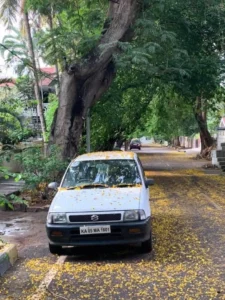
” Baharon Phool Barsao”
We celebrate a common birthday me and my Zen . Rishi was in love as a small fella and continues to be in love with it that a very very long time ago he refused to exchange it for a Merc my uncle offered .
The later Zen’s never caught my fancy
He called it the EN ( namma EN) when he was 3 or so ,since the letter Z has fallen off ..
The zEN’D .

Rishi’s impression of the Zen at a GP …
The Ambani Wedding & the Modern Face of India

Capsule Review: How to Love in Sanskrit

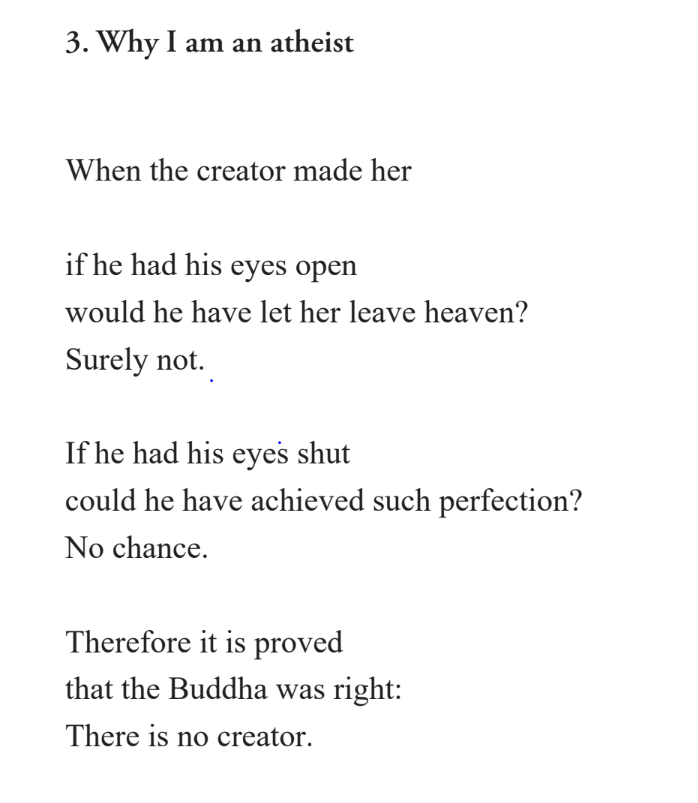
A very nice collection of short Sanskrit poems (and a few short prose pieces) about love, longing, separation, etc. The originals are all in in the footnotes, so those who know sanskrit can comment on the translation. Translations are generally very contemporary (even cell phones make an appearance), but the originals are available if you want to see how they have captured (or failed to capture) the essence of the original. Since I do not know sanskrit, I cannot comment on that, but the collection is a lot of fun and worth a read. As india rises, so will the market for such works (which is a good thing).
Check it out.
available on Kindle.
Original in devnagri is here
Random samples:

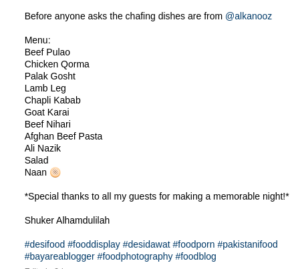
Do Pakistanis eat this much red meat?
I was surprised when I perused the dinner menu at Californistan’s dinner dawat and found not a single vegetarian option.
Iranic-origin dynasties of the Christian Caucasus

The histories of Armenia and Georgia are intricately intertwined with Greater Iran, as evidenced by several dynasties with Iranian origins. Georgia shares a similar historical profile, indicating close ties between the two regions (I won’t even touch on Azerbaijan, which to my mind is simply Russified Iran). With regards to the North Caucasus, notwithstanding Russian ethnic cleansing & genocide (apparently what inspired Dune), there is heavy Persian-Iranian influence (though of course I don’t know nearly enough of the history of the region).
All three of the Great Houses of the Kingdom of Armenia (331 BC to 428 AD) were Iranian origin.
- Orontid Dynasty (potential ancestral ties to the Achaemenians): Dating back to the 6th century BCE, the Orontids were influential rulers in ancient Armenia during the Achaemenid Persian Empire’s reign.
- Artaxiad Dynasty (descendants of the previous Orontids, the clue is in the Iranian-loaded name Arta): Succeeding the Orontids, the Artaxiads governed the Kingdom of Armenia from the 2nd century BCE to the 1st century CE, overseeing its territorial expansion and cultural flourishing.
- Arsacid Dynasty (Armenia): A branch of the Parthian Arsacid dynasty in Iran, the Armenian Arsacids ruled from the 1st to the 4th century CE, with periods of Roman influence interspersed with periods of independence.
There are many other dynasties like the Chosroid, Mihranids, Bagratid (the clues are so obvious in the names) and then even in the Kingdom of Cilician Armenian (the region & inhabitants suffered genocide under the Young Turks) the Rubenid–Hethumid Dynasty had Iranian-links even in the Middle Ages. There is an exotic dynasty, the Mamikonians, who apparently had Chinese-origins but even they intermarried with Iranian nobility eventually.
However, the case of St. Shushanik (pictured above & below) highlights the tension between Christianity in the Caucasus, with its Eastern roots but “West-facing” orientation, and Iranianism, particularly Zoroastrianism.
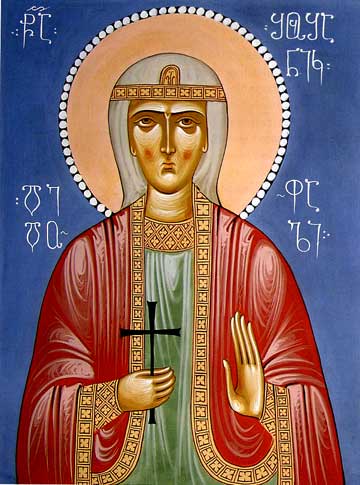
Continue reading Iranic-origin dynasties of the Christian Caucasus
Bengalis are all basically very similar (except for Brahmins)
The new paper, 50,000 years of Evolutionary History of India: Insights from ~2,700 Whole Genome Sequences, is very good. It also answers a question that comes up sometimes: how different are West Bengalis from Bangladeshis? We haven’t had a apples to apples comparison until this paper that’s easy to understand.
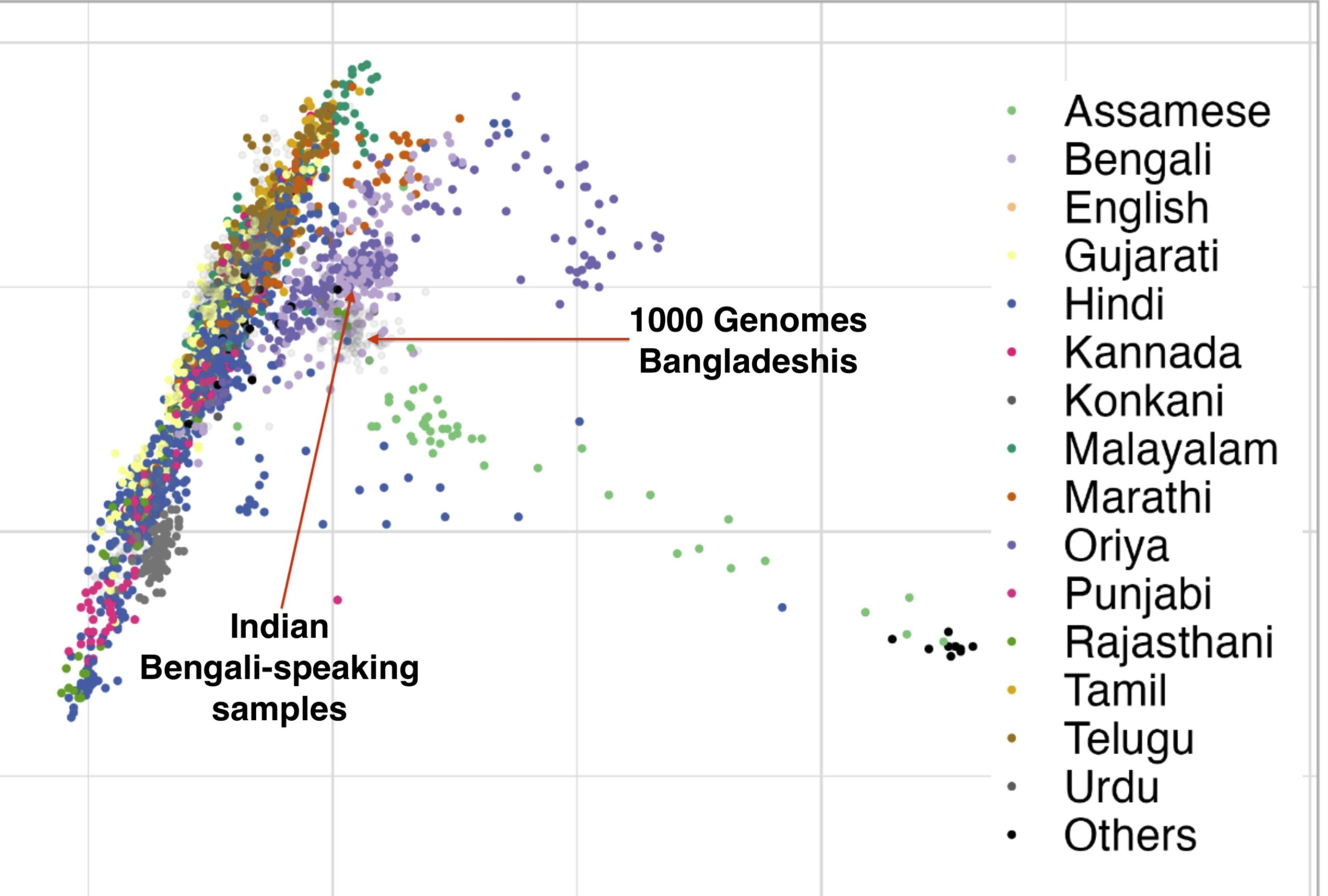
There are figures in the paper that make the overlap clearer. The main difference is more variance in the West Bengalis, and a greater East Asian shift among Bangladeshis. But the latter is clearly just geography; those whose ancestry is from the east of the Padma (like me) always have more East Asian ancestry than those from the west, while those in the north also seem to have more.
The variance in West Bengal is probably driven by caste. You can see Brahmins, and probably what are Bengali-speaking scheduled castes and tribes. In the Bangladesh Muslim population everyone eventually intermarried.
The Assamese are even more East Asian shifted than the Bangaldeshis. As I said in a previous post, these Indo-Aryan groups look like they mixed with a Khasi-like population at some point.
Finally, the West Bengal population had admixture from an East Asian group between 500 and 600 AD. This is the same date as for the Bangladeshis, meaning they are both the same population with the same origin. The major difference seems likely to be the proportion of East Asian ancestry and lack of caste structure within eastern Bengal.
Hardliner Who Also Liked Going To The Movies
Author’s Note: This is not an academic or objective essay; rather a personalised opinion on the recent Bharat Ratna awardee.
Lets begin with two excerpts:
First one:
Then out spake brave Horatius,
The Captain of the Gate:
“To every man upon this earth
Death cometh soon or late.
And how can man die better
Than facing fearful odds,
For the ashes of his fathers,
And the temples of his Gods.”
From Horatius by Thomas Babington Macaulay.
Second:
“Mardania! eh Ajudhia nagari Sri Ramchandra Ji ki hai. So, chal, iska darshan kari ”, which translates to: “Mardana! This Ayodhya city belongs to Sri Ramchandra Ji. So let us go for his darshan.”
From Bhai Man Singh’s Janam Sakhi which states that Guru Nanak visited Ayodhya.
Considering the aforementioned excerpts it is perhaps unsurprising that it was a Nanakapanthi Macaulayputra who charioted the movement to reclaim the birthplace of Lord Ram in Ayodhya and rebuild the Ram Temple. Additionally it was his organisational and political manoeuvring skills that shifted the political balance of India from the dominant secular leadership of the Congress party to the widely popular and ascendant Bharatiya Janata Party. It was for all that and many other activities that the current regime awarded him the land’s highest honour the Bharat Ratna. What made the moment more momentous was that it came days after the consecration of the Ram Temple in Ayodhya.
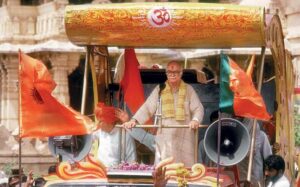
Though currently, the immensely popular Prime Minister Narendra Modi is synonymous with the BJP’s dominance across India’s political landscape, it was the Lal Krishna Advani who acted as one of the chief characters to shift the political levers of the country. Before proceeding further, it is necessary to give the reason behind his moniker – Nanakapanthi Macaulayputra.
LK Advani belonged to a Sindhi Amil Nanakpanthi family whose religious tradition “used to be Sikh rituals”, the holy book at his home being the Sri Guru Granth Sahib. He was educated at St. Patrick’s High School, Karachi, and by his own admission was unfamiliar with Hindi, preferring to speak his mother tongue Sindhi at home, while preferring English as functional language. Even his introduction to the so-called dreaded Rashtriya Swayamsevak Sangh was for lack of a better word, bourgeois one, in his own words:
During my vacation and before joining college, I started playing tennis. One of my regular partners on the tennis court was a friend, Murli Mukhi. One day, right in the middle of the game, he said, ‘I am going’. Utterly surprised, I asked him, ‘How can you go like this, without even completing the set?’ He replied, ‘I have joined the RSS a few days ago. I cannot be late for the shakha because punctuality is very important in that organisation’.
A contextual point to mention here would be the view that the RSS also had certain inspirations behind it. Many scholars quote contemporary accounts about how senior political figures of the early 20th Century like Madan Mohan Malviya and Dr Moonje wanted an organisation fashioned after the British boy scout and army, including but not limited to their marching songs. The RSS march as seen today was inspired by that of British voluntary forces in areas of trouble to warn citizens. Supposedly Sangh leaders borrowed English tunes to train the RSS band. The aforementioned figures, besides celebrating native heroic legends like Chhatrapati Shivaji Maharaj and Peshwa Baji Rao, also stated that Indians had to develop patriotism the way the British developed theirs. Important wars fought by the British like the Battle of Waterloo and Trafalgar were given as examples.
Considering this scenario, it is not strange for a moderate Macaulayputra like LK Advani to familiarise himself with the organisation. Thus he joined the RSS in 1942 besides attending discourses on the Bhagavad Gita by Swami Ranganathananda the president of the Karachi centre of Ramakrishna Mission. This shows Advani to be the recipient of the Indian, rather Indo-Anglian renaissance that swept British India from 1850’s to 1930’s. Couple that with his Amil Nanakpanthi family roots which is the recipient of Bhakti movement.
Also lesser known is the fact that he was related to famed Sufi poetess Dadi Ganga , in fact Advani mentions in his memoirs that his wife Kamla along with her sister Sarla published Dadi Ganga’s Sufi poetry. All these make him the ideal reformist as opposed to the Hindu hardliner the media likes to portray him as; or would it be a leap of faith to say in certain cases, Hindu hardliner is the ideal reformist.
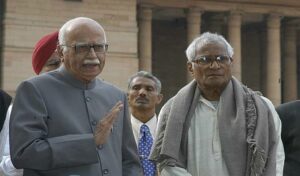
The leap can be taken considering how he organised the political networks connecting the BJP to figures stretching from fiery socialist George Fernandes to Shiv Sena supremo Balasaheb Thackeray.
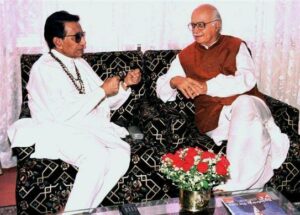
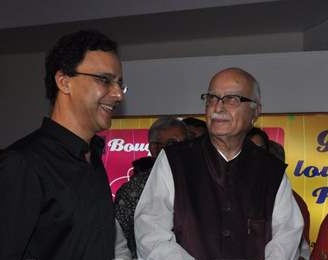
Besides political networking, what is less spoken about Advani (maybe intentionally) is his penchant for films and the filmmakers. As stated by Vidhu Vinod Chopra whose An Encounter with Faces was nominated for the Academy Award under Best Documentary Short Film in 1979:
“When I got nominated for an Oscar I had no money, I had nothing and I read in the paper that I was nominated. He gave me an Air India ticket and $ 20 a day and that I owe it to Mr LK Advani. I want the world to know why he is so special to me. Not because he is a politician but because he is the man who sent me to the Oscars.”
On multiple occasions other Hindutva icons like Atal Bihari Vajpayee and Balasaheb Thackeray have been lauded as poets and artists, but Advani as the admiring film buff has been less talked of. Be that as it may, 2024 can be now seen as honouring a Nanakpanthi Macaulayputra who charioted a saffron trail across India’s political landscape and who also liked going to the movies.
The essay has been published in the following blog as well.
Open Thread – 2/14/2024 – Brown Pundits
Happy Valentine’s Day!