🗓️ One Year Ago Today: The Taj Mahal, Sacred Lands, and the Power of Timing

Friends,

The spirit of Brown Pundits has always been dialogue — open, searching, and at times, fierce. But dialogue only flourishes when it is consistent and principled.

Recently, a contradiction has emerged in Kabir’s contributions: applying one set of standards to India and Pakistan, and a different set to Israel. This has led to repeated cycles of disruption, rather than genuine exchange.

To preserve the integrity of our space, Kabir’s participation will be paused until this inconsistency is clarified (we will remove any of his comments that do not address and acknowledge the contradiction; we will also remove any replies to his comments). This is not censorship, but stewardship. Free speech here is not about endless repetition; it is about coherence, accountability, and respect for the whole.

🕊️ On Confirmation, Coincidence, and the Return of Brown Pundits

Exactly one year ago today, 17 September 2024, I published a piece titled “The Battle for the Taj Mahal: India’s Sacred Lands & Waqf Boards Under Fire”.

At the time, Brown Pundits was stirring from hibernation. Readership had dwindled to near-zero, the commentariat was dormant, and the site, once lively and interrogative in its heyday, felt like a forgotten archive. That post, like so many others before it, was written in solitude. There was no traction, no expectation. Just thought, laid down with care.

And yet here we are, one year to the day, and the blog has roared back to life.


📿 What the Baháʼí Tradition Calls “Confirmation”

In the Baháʼí tradition, we don’t reduce these moments to mere coincidence. Instead, we speak of confirmation; divine endorsement coupled with meaningful alignment. A subtle assurance that what was offered in silence may still echo in relevance.

Sometimes, truth takes time. It must be planted, and it must ripen. And then, if the conditions are right, it re-emerges at the very moment it’s needed again.


🏛️ Revisiting the Taj & the Sacredness of Land

That post, exploring Waqf Boards, sacred lands, and the Taj Mahal’s place in India’s civilizational memory, was written in a moment of saturation. Too many headlines, too little context. My intention wasn’t to settle the argument, but to recast it: What makes land sacred? Who has the right to remember? Who gets to reclaim?

Reading it now, what’s striking is not just how relevant it remains, but how the same debate has reassembled; not just thematically, but almost ritually, with new voices circling back in familiar orbits.


🌀 Same Debate, Same Deflection

And so we arrive back, with uncanny symmetry, to Kabir. He’s long argued that nations must be judged by their own internal frameworks: Continue reading 🗓️ One Year Ago Today: The Taj Mahal, Sacred Lands, and the Power of Timing
The Long Defeat: How Hinduphobia Hollowed Out Pakistan

I lost an entire post earlier, but perhaps it’s for the best. I’ve had the time now to clarify my thoughts and this is better to make clear the new policy of just junking comments that don’t “smell right.”

What prompted me to write again was a small but telling excerpt from a recent Dawn article. It wasn’t just that they misspelled “Brahman”; they wrote “Barhaman,” a word that doesn’t exist in any linguistic tradition. It was also the order in which they listed religions. They wrote:

“…revered for not only the followers of the world’s three major religions — Buddhism, Sikhism and Hinduism…”

Hinduism, the oldest and most foundational of the three, was placed last. This is not trivial. Both Buddhism and Sikhism evolved from Hinduism. Yet in Pakistani discourse, so marked by dislocation and disavowal, Hinduism is routinely treated as a junior or fringe faith. This is what endemic Hinduphobia looks like: not explicit violence, but civilizational misordering, semantic erasure, and the subtle, continuous downgrading of Hindu memory.

It’s barely recognized. And that’s the point. Continue reading The Long Defeat: How Hinduphobia Hollowed Out Pakistan

War in the Sanskritopolis

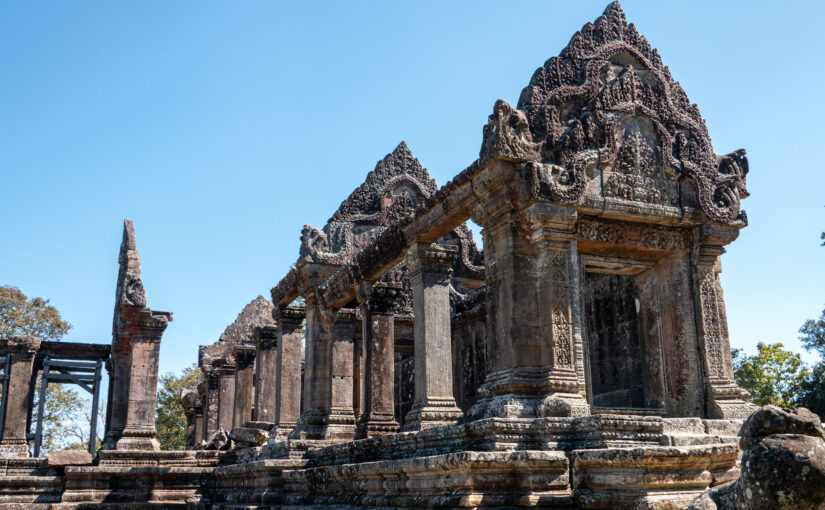
The long-running dispute between Thailand and Cambodia dates back more than a century, when the borders of the two nations were drawn after the French occupation of Cambodia.

Things officially became hostile in 2008, when Cambodia tried to register an 11th Century temple located in the disputed area as a Unesco World Heritage Site – a move that was met with heated protest from Thailand.

Why A Cluster Of Hindu Temples Is At Heart Of Thailand-Cambodia Conflict

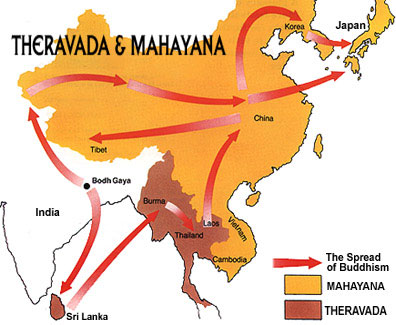
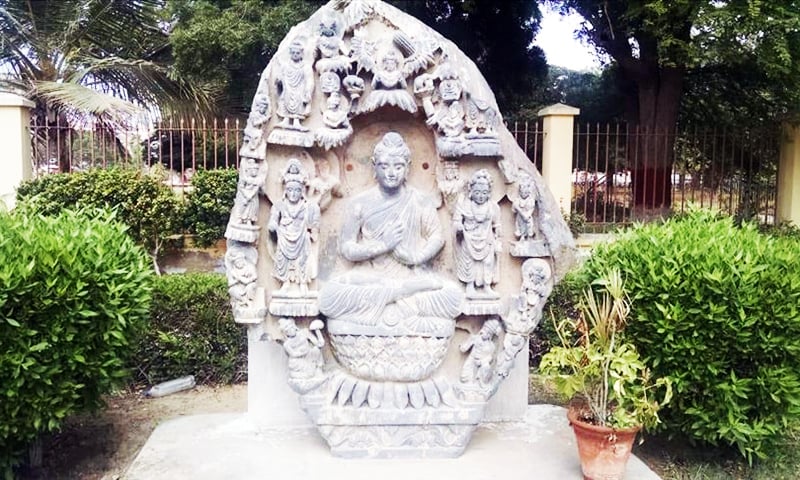
It’s striking to see just how deeply Dharmic culture shaped Southeast Asia — not just as historical residue, but as a living civilizational layer. Buddhism, in many respects, prepared the civilizational terrain that Islam would later traverse.

The Buddhist Studies: Theravada and Mahayana - buddhanet.net

Buddhism, too, was not monolithic. The Sri Lankan Theravāda tradition influenced the western flank of Indo-China, while Mahayana currents, traveling through Sumatra, appear to have looped back toward Guangzhou, feeding into the Sinosphere.

HISTORY OF MAHAYANA BUDDHISM | Facts and Details

The sectarian divergence between Thailand and Cambodia — Theravāda vs. Mahayana— adds nuance to territorial and cultural disputes like the Preah Vihear Temple, whose iconography and inheritance clearly align more with Cambodian history.

These are not just archaeological debates. They’re about cultural legitimacy, historical continuity, and civilizational memory.

In such moments, India, that is Bharat, must not remain a bystander. As the civilizational fountainhead, it should be playing a constructive role in cultural mediation and soft power diplomacy.

Hans Zimmer and the Polite Dismissal of the Ramayana

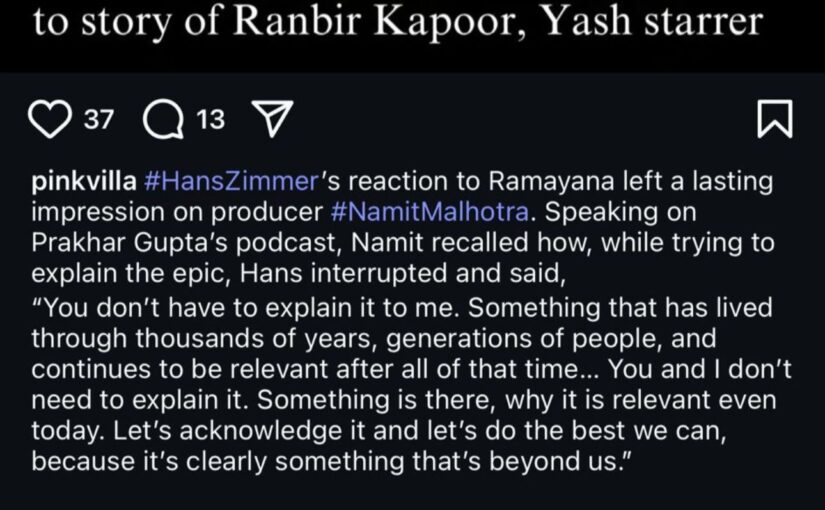
When producer Namit Malhotra began explaining the Ramayana to Hans Zimmer, the legendary composer cut him off:

“You don’t have to explain it to me. Something that has lasted thousands of years clearly has meaning. Let’s just do our best. It’s beyond us.”

Malhotra took this as reverence. In fact, it was erasure.

No serious Western artist would score The Ten Commandments or Schindler’s List without knowing the story. Imagine a composer saying, “Don’t explain the Illiad to me, it’s beyond me.” They’d be fired. But when it comes to Indian epics? The bar is subterranean. That’s not reverence.

That’s: I’m Western, I’m famous, I’m here for the cheque; not the history. The tragedy isn’t Zimmer’s line. It’s Malhotra’s awe. A Westerner shrugs off our most sacred text, and we call it wisdom. That’s not cultural pride. That’s civilizational confusion. It’s a pattern. Many elite Indians are fluent in the language of Islamic grievance; but tone-deaf to Western condescension.

Divide and rule still works:

  • Hindus thank the British for “freeing” them from Muslim rule

  • Muslims thank the British for “protecting” them from Hindu majoritarianism

Meanwhile, the West shrugs at our stories and we applaud.


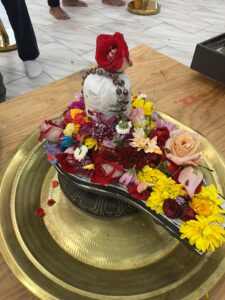
Shravan Monday at the New England Temple

Continue reading Hans Zimmer and the Polite Dismissal of the Ramayana

Brown Pundits