
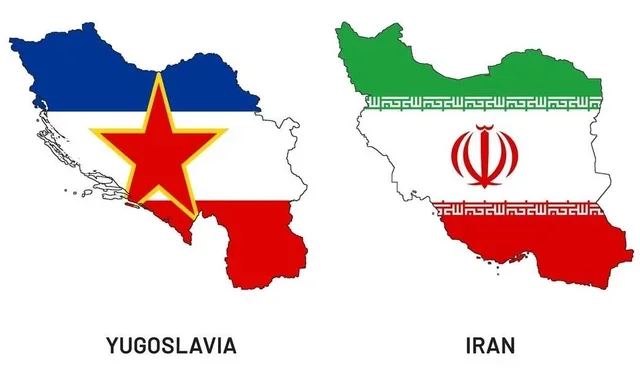
Pakistan Is Not Yugoslavia

There is a recurring Saffroniate habit, when it comes to Pakistan, that deserves to be named plainly. It assumes collapse. It treats Pakistan as a Yugoslavia-in-waiting, a state held together only by force and denial. This is not analysis. It is projection, reinforced by confirmation bias.

Pakistan is not Yugoslavia. It is, in many ways, the opposite.

Yugoslavia fractured once the external logic binding it disappeared. Pakistan was born under siege and continues to organise itself around that fact. Whatever one thinks of this psychology, it has consequences. States that internalise permanent vulnerability do not casually dissolve. They centralise, harden, and adapt. That is not a moral defence. It is an empirical observation.
Continue reading Pakistan Is Not Yugoslavia

Why Balochistan Is Not Kashmir

Also, wanted to add – Its arguably quite morally lazy to simply sweep the multi-generational struggle of the Baloch for self-determination – if not outright secession, that has repeatedly and consistently raised its voice in speech and in blood over the last 7-8 decades.

Nobody on BP outright denies or pretends that there disaffected secessionist tendencies do not exist in the Sunni Valley. Why then, are we going to pretend that the ‘troubles’ in Balochistan are somehow… inconsequential?

This growing tendency to treat every internal conflict in South Asia as if it were interchangeable with Kashmir (the “Sunni Valley“). This is a mistake, and in the case of Balochistan, a very serious one.

The distinction was once put very clearly to me by Benazir Bhutto herself. In the 1990s, while seeking international advocacy on Kashmir, she was asked by Saddam Hussein a blunt question: If we support Kashmir, why should the world not support Kurdistan? Her reply was immediate and precise. Kashmir, she said, is an international dispute. Kurdistan is not.

That distinction matters, and it still holds.

Kashmir is internationalized by design. It is anchored in UN resolutions, formal bilateral agreements, wars between recognized states, and sustained global diplomatic engagement. It belongs to the same narrow category as Palestine or Cyprus; flashpoints where sovereignty itself is contested between states and therefore cannot be reduced to a domestic matter. Continue reading Why Balochistan Is Not Kashmir

Pakistan Is Not About to Break Apart

There is a persistent habit, especially among our soi-disant commentators, of predicting Pakistan’s imminent disintegration. The arguments are familiar: Baloch insurgency, Pashtun irredentism, low Kashmiri fertility, economic weakness, and analogies to 1971. They are also, taken together, wrong.

To begin with, most people discussing Pakistan do not understand its internal sociology. They begin with a conclusion, “Pakistan is artificial and unstable”, and then select facts to confirm it. This is confirmation bias dressed up as analysis.

Consider the Pashtuns. The claim that they are natural irredentists misunderstands who they are and how they live. Pashtuns in Pakistan are not a marginal population looking across the border for salvation. They are deeply integrated into the Pakistani state, economy, and military. They dominate transport, logistics, security, and large parts of urban informal commerce. Large numbers have moved permanently into Karachi, Lahore, and Islamabad. Assimilation is not failing; it is proceeding at scale. Continue reading Pakistan Is Not About to Break Apart

Brown Pundits