The Hindification of Muslim Culture

Something in a recent thread caught my attention. A commenter praised several khayal singers, almost all Hindu, while omitting equally eminent Muslim vocalists. Kabir pointed this out, but the exchange exposed a larger pattern: the slow Hindification of Muslim cultural inheritances in India.

This is not new. It has happened before in the Balkans, Spain, North Africa, and now South Asia. When Muslim political power retreats but its aesthetic legacy endures, successor communities begin absorbing, domesticating, and rebranding the cultural capital that Muslim rule left behind.

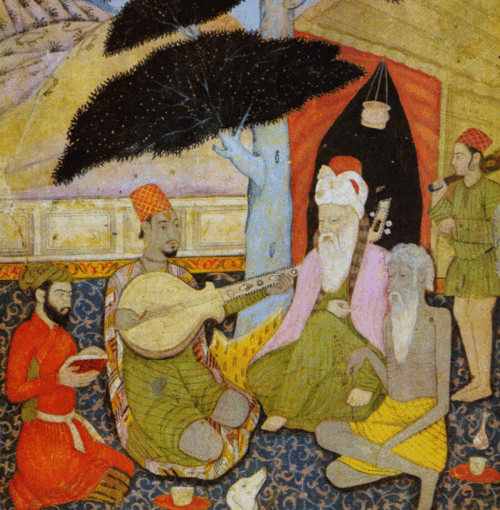
Hindustani music is a prime example. The foundational grammar, khayal, thumri, tarana, bandish, raga–riyaz discipline, gharana boundaries, was shaped by Persian, Turkic, and Indo-Muslim lineages. Yet today, the most visible custodians of this tradition are overwhelmingly Hindu: Bengali virtuosos, Maharashtrian stalwarts, the great Dharwad families, plus a handful of Muslim houses that continue against the grain. A few dozen performers make a strong living; a select few have global reputations. But the overall demographic shift is unmistakable. Continue reading The Hindification of Muslim Culture

🎶 Bravo, Kabir | Artists Across Borders

This Sunday, something quietly powerful is taking place: Indian and Pakistani artists will share a virtual stage, and among them is our very own Kabir Altaf, performing as a Hindustani classical vocalist and ethnomusicologist based in Pakistan.

Kabir shared that Sheema ji personally invited him to sing, and he’s planning to perform the Kabir bhajan already available on Spotify. A simple act but a potent one. Rooted in shared heritage, offered in public.

It’s easy to be cynical about India–Pakistan relations. But these moments matter. When musicians from Sindh and Delhi, translators from Karachi, and filmmakers from Mumbai come together, even on Zoom, they create a space that politics cannot reach. A space where memory, performance, and shared roots do the work diplomacy cannot.

This is the kind of initiative we need more of: not policy, but presence; not diplomacy, but dialogue. These exchanges don’t dilute identity; they deepen it.

Bravo and huzzah to Kabir, and to all involved.


🗓 Event:

Indian–Pakistani Artists in Dialogue

📅 Saturday, 3rd August 2025

7:30 PM Pakistan time / 8:00 PM India time

👩‍🎤 Moderator:

Sheema Kermani – Bharatanatyam dancer, theatre personality, Karachi

🎙 Featured Speakers & Performers:

  1. Dr. Syeda Saiyidain Hameed – Writer, former Member of India’s Planning Commission

  2. Dr. Ghazala Irfan – Philosopher and Chair, Department of Humanities, LUMS; affiliated with All Pakistan Music Conference

  3. Anand Patwardhan – Documentary filmmaker, Mumbai

  4. Saleema J. Khawaja – Vocalist of Punjabi Kafi and Guru Nanak verses, Lahore

  5. Neela Bhagwat – Hindustani vocalist (Gwalior Gharana), Mumbai

  6. Azhar Shan – Folk musician from Sindh

  7. Dhruv Sangari – Hindustani classical and Sufi vocalist, Delhi

  8. Zainub J. Khawaja – Musician, member of Harsukhiyaan, Pakistan

  9. Yousuf Saeed – Documentary filmmaker, known for work on classical music in Pakistan, Delhi

  10. Kabir Altaf – Hindustani classical vocalist and ethnomusicologist, Pakistan

  11. Nishtha Jain – Documentary filmmaker, Mumbai

  12. Zahra Sabri – Lecturer and translator, Karachi

  13. Zulaikha Jabeen – Independent scholar, India


🔗 Join via Zoom

Click here to join

Meeting ID: 897 8701 6742

On Moderation, Minoritization, and the Elite

Pulse: The Threads We Weave —

Lately I’ve wondered whether I over-curated the threads. Things feel quieter. Maybe too quiet. But perhaps that’s the cost of raising the bar—of asking for dialogue instead of dopamine. Still, this lull has me reflecting not just on moderation but on why some arguments no longer move me.

Take the Indo-Pak conflict: once electric, now strangely inert. That shift reflects my own evolution over two decades. I no longer inhabit that binary. I carry a layered identity—a South Asian Bahá’í sensibility shaped by Persian aesthetics, grounded in British institutions, and fluently navigated through English. That complexity is my compass. It’s why I care less about flags and more about forces.

And the real force that shapes our lives? The elite. Not as a pejorative, but as a structural reality. I see it as nested tiers: Continue reading On Moderation, Minoritization, and the Elite

Brown Pundits