A couple of instances of Christianity in the world around us

I saw Omar Ali yesterday — terrific conversation — and when I asked what topics I should discuss here, he suggested I post whatever interests me — so here’s the anointing of Brazilian strong-man Bolsonaro, and hymn singing in Hong Kong.

Religious behavior in general fascinates me — but when it affects politics, people often don’t realize what powerful motivation it can provide.

**

Religion can be coercive, as in the anointing of Bolsonaro

see video

— Remember the laying on of hands over Donald Trump? The overarching authority of religion has Trump bow his head, but sets Bolsonaro on his knees! —

— and religion can be liberating —

see video

— That’s a crowd of protesters in Hong Kong singing “Sing Hallelujah to the Lord”.

Remarkable.

**

From Reuters in June:

Sing Hallelujah to the Lord’ an unlikely anthem of Hong Kong protests

For the past week, the hymn has been heard almost non-stop at the main protest site, in front of the city’s Legislative Council, and at marches and even at tense stand-offs with the police.

It started with a group of Christian students who sang several religious songs at the main protest site, with “Sing Hallelujah to the Lord” catching on among the crowd, even though only about 10 percent of Hong Kong people are Christian.

“This was the one people picked up, as it is easy for people to follow, with a simple message and easy melody,” said Edwin Chow, 19, acting president of the Hong Kong Federation of Catholic Students.

The hymn is simple, optimistic yet adds a touch of solemnity and calm to the proceedings, and also affords some legal protection to the protesters —

The students sang the songs in the hope of providing a cover of legitimacy for the protest. Religious gatherings can be held without a permit in the financial hub.

“As religious assemblies were exempt, it could protect the protesters. It also shows that it is a peaceful protest,” Chow said.

The hymn was composed in 1974 by Linda Stassen-Benjamin in the United States for Easter. Its five words are repeated over four stanzas in a minor key, which gives it an air of meditative solemnity.

**

Between the anointing of a dictator and the hymn singing of a crowd of protesters demanding democratic freedoms from the Chinese state, we have quite an instructive confluence of ways in which religion can enter the public square.

No doubt there are others. In Nepal, there’s the tantric cultus of the goddess Kubjikaa. What’s religion up to in your neck of the woods?
Invisibility, Jeff Sharlet’s The Family, and the goddess Kubjikaa

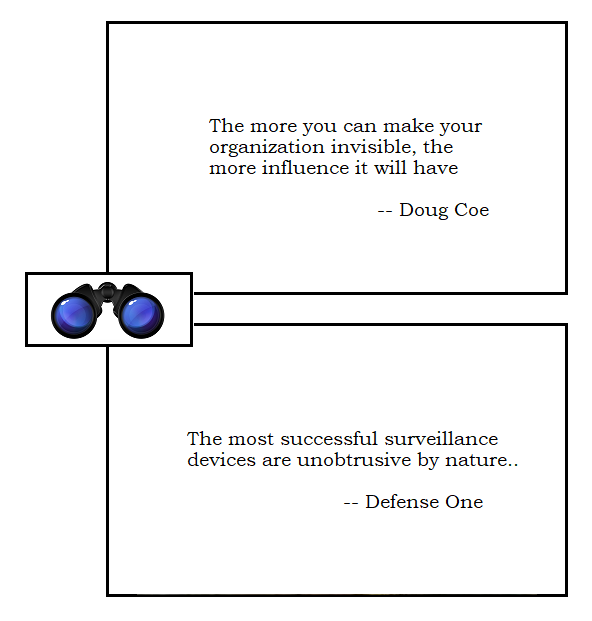
It’s like a waterfall: you stumble on an idea that comes from the mouth of Doug Coe, describing the principle behind the influence of The Family, of which he was the long-time leader —

— and it turns out the same principle is referenced in an article on surveillance in Defense One

— only to re-emerge in Dr Mark SG Dyczkowski‘s work on the tradition, philosophy and practice of the goddess Kubjikaa.

**

There’s clearly a principle at work here that could find application in many fields, contexts, silos — and the concatenation of such instances is itself a demonstration of the value of silo-breaking thinking.

FWIW, I wouldn’t have so much as heard of the Goddess Kubjikaa were it not for my half-century friendship with Mark Dyczkowski, to whom I owe so much, and into the waters of whose scholarship so deep I have dipped no more than a toe.

Toward a beige future

Update: They removed the slander on Vance. But it will happen again. There is clearly a strong demand for this judging by the reaction of liberal Twitter. End update


The Washington Post:

As border controls tighten, though, the links between pronatalism and nativism have once again become visible. Inspired by Steve King’s admiring remark about Geert Wilders, Ayla Stewart, creator of a popular white nationalist blog called Wife with a Purpose, issued a “white baby challenge” that went viral in alt-right circles; the mother of six asked audience members “to have as many white babies as I have contributed.” Meanwhile, as replacement discourse enters the conservative mainstream, talk of birthrates comes along with it. “Our people aren’t having enough children to replace themselves. That should bother us,” J.D. Vance, author of the best-selling “Hillbilly Elegy,” told his audience at the National Conservatism Conference last month; earlier this year, he described himself as “appalled” by Democrats’ permissive attitudes toward abortion. Vance did not spell out exactly who was included in the word “our.” He didn’t need to.”

As I have noted on this weblog Vance’s wife is South Indian, his son is mixed-race. He also recently converted to Roman Catholicism. His life is a literal reflection of cosmopolitanism.

This piece goes into a long line of thinking whereby liberals think that they can infer things about conservatives. But the reality is many liberals don’t have the cultural competencies to do so. It’s like non-Muslims trying to understand the idioms and signs within Muslim subculture. We’d all acknowledge that something beyond what you might read in a newspaper is probably important in this case. But American liberals and conservatives don’t give each other this benefit of the doubt. Conservatives are racist. Liberals are socialists. You know what they really think….

(I strongly suspect most liberals have a model where white conservatives can’t marry and have children with non-white people, so the writer and publication didn’t bother to check)

Browncast Episode 64. We Talk with Meru Media about India, Pakistan, Hinduism, TNT, Aryans..

Another BP Podcast is up. You can listen on LibsyniTunesSpotify,  and Stitcher. Probably the easiest way to keep up the podcast since we don’t have a regular schedule is to subscribe at one of the links above.

You can also support the podcast as a patron. The primary benefit now is that you get the podcasts considerably earlier than everyone else. I am toying with the idea of doing a patron Youtube Livestream chat, if people are interested, in the next few weeks.

Would appreciate more positive reviews!

In this episode we talk to Mukunda Raghavan, who runs Meru Media (“your home for all things Indic”). We talk about Hindu drinking culture, India, Pakistan, Tambrams, Aryan Invasion, all the fun stuff. Do check it out and leave comments.


The masses hitting the internet


Back in the mid-90s people on the newsgroups and message boards we would complain about people with AOL addresses. More recently, I think one reason Twitter is a problem today is that so many people are on the platform, and that means more stupid people are on the platform.

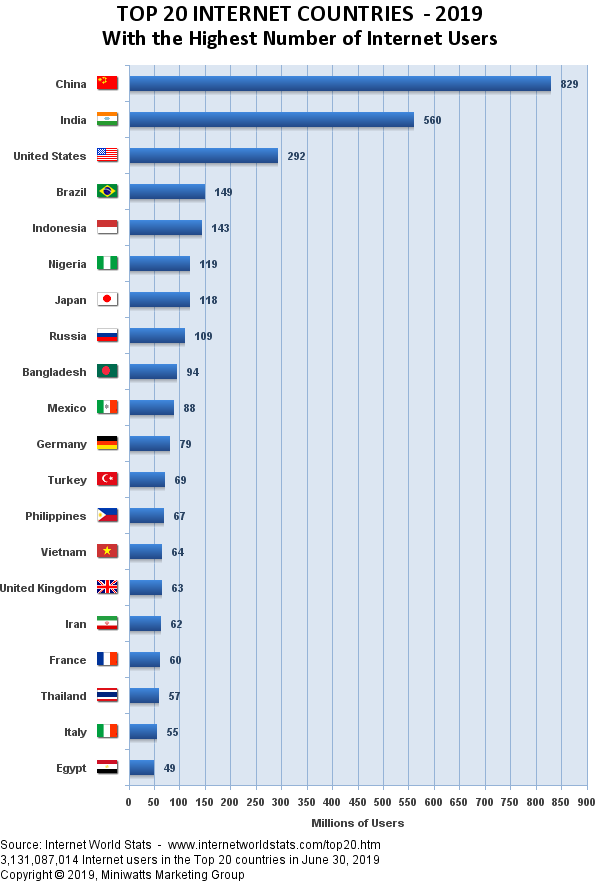
Another aspect I’ve noticed is the prominence of “Indian Twitter.” India is one of the top countries for the platform. Many of these people are quite dumb and inane…but most people are that way. The chart above shows how many people from India are on the internet. It strikes me that a bit of the “OMG AOL people are on the internet!” effect is going on. This too shall pass.

Note: In the last few years Bangladesh has apparently zoomed up the list of internet penetration due to various initiatives. The ranking surprised me, especially in light of the fact that Bangladesh sends very little traffic to this website even compared to Pakistan.

An observation for David Ronfeldt

[ cross-posted at Zenpundit — suggesting that the “how do we know when a radicalized thinker shifts into violent action mode?” question is frankly a koan ]
.


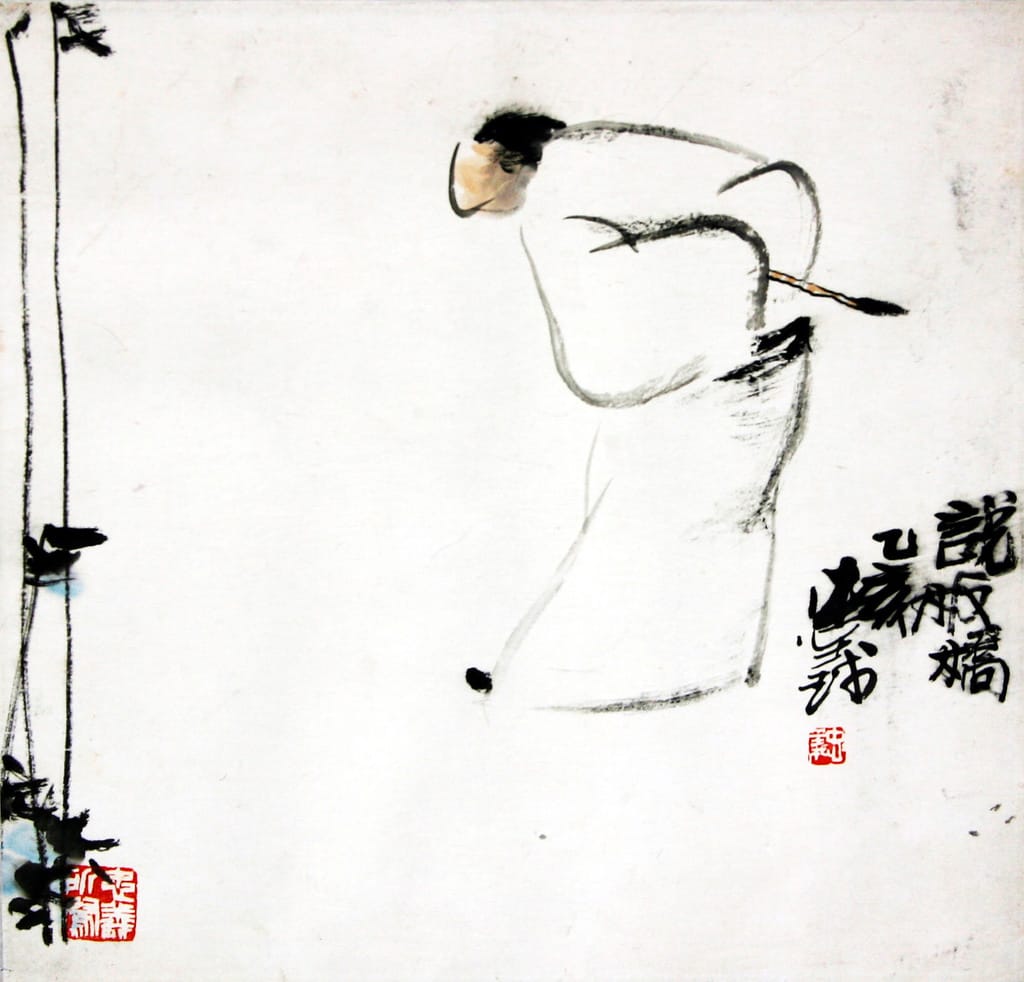
stern task-master image borrowed from The Zen Priest’s Koan

**

We’d been discussing on FB The Right Way to Understand White Nationalist Terrorism, and in particular this observation:

This movement is often called white nationalist, but too many people misunderstand that moniker as simply overzealous patriotism, or as promoting whiteness within the nation. But the nation at the heart of white nationalism is not the United States. It is the Aryan nation, imagined as a transnational white polity with interests fundamentally opposed to the United States and, for many activists, bent on the overthrow of the federal government.

and an idea occurred to me that seemed interesting enough for me to re-post it here on Zenpundit and Brownpundits:

We’re seeing a lot of discussion of how to foresee the switch from a terror-propensity thought into a terrorist act. Even in retrospect this is very difficult to manage, although lots of people elide the difference or feel constrained to separate the two, and managing an effective strategy to accomplish forewarning seems close to impossible.

I’d like to observe that the great leap between thought and act is in fact a leap across the mind > brain distinction, ie the “hard problem in consciousness”. > It’ds called the “hard problem” because it’s a question so basic that our best reaches of thought can’t stretch across the inherent paradox, a koan in effect.

Perhaps if we started with that koan, we could at least understand the “size” of the problem that predicting terrorist violence poses.

**

I think that’s, technically, an audacious idea.

What the hell do I mean by that? It doesn’t threaten my physical well-being, nor, I’d suspect, national security. It’s “just a thought” — so what’s the big deal?

Well, it concerns a matter of immediate strategic and tactical concern, for one thing. And for another, it takes that strategic and tactical issue way past its present discursive parameters, and analyzes it to a level of fundamental abstraction — so much so that it invokes one of the few most basic unresolved issues in scientific thought, a veritable western koan.

That’s quite a reach, but I believe it’s a reach that illuminates the difficulty of the “strategic and tactical issue” from a fresh point of view that’s frustratingly so deep as to be virtually impenetrable.

**

In Chalmers‘ words, the “hard” problem is:

how physical processes in the brain give rise to subjective experience … the way things feel for the subject. When we see for example, we experience visual sensations, such as that of vivid blue. Or think of the ineffable sound of a distant oboe, the agony of an intense pain, the sparkle of happiness or the meditative quality of a moment lost in thought

You remember the kids’ mathematical saying, “three into two won’t go”? Well here’s a case of “mind into brain won’t go” in the sense of Chalmers‘ hard problem.

**


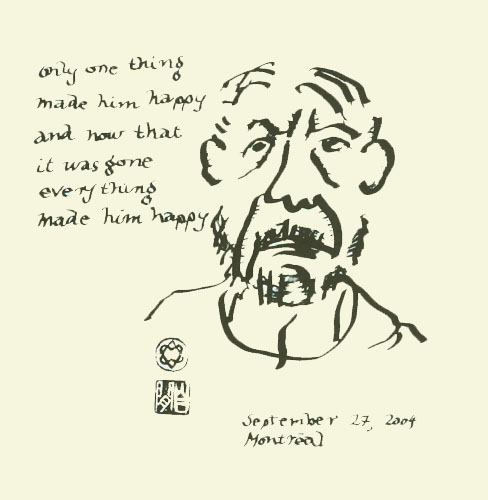
Leonard koan, yes, yes — from Leonard Cohen (1934-2016)

Brown Pundits