
Please keep the other posts on topic. Use this for talking about whatever you want to talk about.
Tag: Identity and culture
Guest Post: India, a wounded civilization
Rohit will (once technical issues are sorted out) be joining our stable of writers. Until that happens, he asked me to post this from his own blog:
(again, to be clear, this is not my writing, it is written by Rohit Pradhan)
India: A Wounded Civilization
The sheer absurdity of the Karachi bakery case is mind boggling but it reveals many of India’s psychological wounds
The facts are starkly clear. The Bangalore branch of a storied bakery chain based in Hyderabad was targeted by certain individuals who forced it to cover Karachi. And replace it with the Indian flag. Never mind that the extant organization was founded by a post-partition Sindhi immigrant in the memory of the land he had been forced to flee in the orgy of the violence which followed India’s partition. The parent chain issued an abject clarification on multiple social media channels reiterating its Indian roots. It wasn’t a homage to Karachi which happens to fall in the Pakistan of 2019 but the city which was home for generations of the ancestors of its founder. The utter absurdity of this entire episode is beyond belief.
Perhaps, one is reading too much into a single incident. Perhaps, in a country of 1.3 billion people, it is easy enough to assemble a mob of few who are offended by everything. Or anything. Or perhaps it is not as singular as it may superficially appear and there are some larger lessons to learn here. Three points follow.
First, Karachi bakery has been forced to issue that absolutely shameful apologia because no one expects the Indian state to protect it from the anger of righteous mobs. The mobs which can cite whatever perverse version of nationalism they are extolling currently. And while the blame for it majorly goes to the ruling dispensation, the fact that its establishment was targeted in a state ruled by the opposition simply can’t be ignored. One formation may encourage this perversity; the other side has mostly abdicated its responsibilities so fearful it is now of rocking the prevailing doctrine. Politics is not a purist sport but if you can’t draw even the most basic distinctions, then it may not be one participating in as well. This is no attempt at false equivalence but underlining the fact that a reassurance from the leaders of Karnataka would have gone a long way in assuaging the frayed nerves of a bewildered organization caught in the middle of India’s cultural wars.
Second, the kind of nihilistic nationalism which thought it fit to assault a blameless commercial organization has sadly received a major assist from the social media. Where hunting down alleged anti-nationals has become a major sport and a pathway to gain popularity, cheap retweets, and potentially significant monetary rewards. The more strident the tone; the more heartfelt the criticism is the absurd logic where even a national icon like Sachin Tendulkar can no longer be insulated by his humongous achievements and services to India.
Liberals can’t escape the blame entirely here: their previous prescriptions of people-to-people contact or decrying war as a priori have failed abjectly to deliver any sensible results. They have long dominated the conversation utilizing similarly convenient rhetorical tools dismissing every criticism as warmongering.
As the narrative has dramatically shifted, they have no epistemological counter to this closing of the Indian mind. In this new world, they have failed to craft a new language which can counter this toxic and self-defeating nationalism. The neo-Right has intuitively understood and adroitly exploited the frustration of ordinary Indians. The liberals have withdrawn from this tough fight favoring the easy environs of their echo chambers facilitating the further normative dominance of this singular version of nationalism. Unless they are prepared to embrace patriotism located in the Indian genius and not their ersatz explication, their further disfranchisement is assured.
Third, writing in the Indian Express, Pratap Bhanu Mehta, has recently argued that India has lost to Pakistan. If further evidence was required of that interrogation of India’s deep psychological wounds: Karachi bakery provides the perfect instance. The anger, the frustration, the fecklessness, the sense of being utterly helpless have found the fullest expression. A country which in its own estimation deserves a place among the comity of the most powerful nations in the world has been utterly shown up. And it has nowhere to hide: unable to counter repeated terror attacks from an apparent also-ran which it had long left behind in its wake.
It maybe couched in the braggadocio of sneering twitter insults and memes recalling 1971, but no one should confuse it for what it really is: utter and complete surrender. Unable to punish the external perpetrators, its sullen frustration has turned inwards: manufacturing villains where none exist. The social media nationalists would indubitably disagree but this is weakness masquerading as strength and vicious backlash corralling the weak. A schoolyard bully lashing out at the vulnerable because even as its parades its strength, it is utterly aware of its decrepitude. A wounded civilization too proud to recognize its own ruins.
It makes one go back and read V S Naipaul’s An area of darkness A stronger criticism of the Indian civilization is yet to be written and its searing postmortem of its psychological wounds has never been surpassed. Unfortunately, because Naipaul was so unsympathetic a figure both as a writer and in his writings, both Indian liberals and nationalists have often misunderstand him as a brown sahib, and not what he really was: a man who wanted to embrace the land of his ancestors, and whose love story went awry.
There is anger, and then there is anger. There is the fury of Naipaul which uses a surgeons’ scalpel to bludgeon a country which had left him frustrated and confused. But it still stems from a deep reservoir of affection almost willing it to do better. And there is anger which is self-destructive; which appeals to the most baser instincts; and which simply can’t countenance the wisdom of a better India.
India must choose wisely. And must select which version serves it better: the defeatism of the inward looking malignancy which has long given up on India, and must therefore pander or the the one which pricks and raves and rants because giving up is simply not an option. And a better future might still arise from the debris of an eviscerated India. And from recognition of its weaknesses.
Naipaul’s next two Indian travelogues were more hopeful of its future. Perhaps therein lies redemption.
Muslims and Islamophobia
I have realized this long ago and said this often in private but I feel this needs to be said more and more in public. Muslims care more about Islam than Muslims and that’s why they are inseperably attached to the term Islamophobia and cannot adopt a more appropriate term. This is also a primary reason why both Islamophobia and Muslimophobia are rising inexorably.
The Christchurch killer and his inspiration Brevik, both showed in their manifestos that how interconnected the global medium is and how America sits at the very commanding center of this globalized interconnected minds. Reading and watching some of the most famous Muslim discourse-makers in the aftermath of the shooting, it seems clear to me that beneath all the outrage about Trump, White Nationalism, far-right etc etc, what they really want to do is ban criticism of Islam. They may spew tons of words about Trump, White Nationalism, far-right but what they really hate with every core of their being are New Atheists and Ex-Muslims. I have no doubt that Mehdi Hasan eats, sleeps and breathes thinking worst things about Sam Harris. In Britain probably Majjid Nawaz would be a close rival of Sam Harris in terms of being object of hatred by media Muslims.
The saddest thing is that their efforts are all going down the drain at all corners except amng the wokes. Even after a great tragedy like Christchurch, very few joined their bandwagon to stop criticism of Islam. People like Majjid Nawaz and ex-Muslims will keep getting more and more attention. The right, not just far right, are unashamable through cudgel of atrocities. They will hurl back their grievances, big and small. A tragedy like Christchurch barely gives a short pause now in attacking both Islam and Muslims.
The center is confused, it may invite Mehdi Hasan time to time, but it understands uncomfortably that there is something very askew in this guy. Nodding along boilerplate rants doesn’t mean that very mixed thoughts about Islam and Muslims are not going on in the heads of people at the center. Even in this age of wokeness, the center knows how central is freedom of criticism of ideas to liberalism. Nobody in the center believes that Islam is in any way better than Christianity. After the buldozing Christianity faced in modernity, few would want Islam to be treated any differently. That is not just fair.
The term Islamophobia is exacerbating Muslimophobia. Protection of ideas at this day and age is very very costly. Muslims are paying the cost of protecting Islam. All decent people want to protect people, most decent people do not want to protect ideas. Just wait till the next San Bernadino or Nice attack happen. Neither ideas nor people will be spared.
Open Thread – Brown Pundits
Please keep the other posts on topic. Use this for talking about whatever you want to talk about.
Two phases of Brown Pundits

No idea what happened in Feb of 2018. But that’s when engagement/traffic really went up to a new plateau.
How Indian are Pakistanis (vs. non-Indian)
I was sent this link via Twitter, Pakistanis are Arabs:
OK – so clearly that’s nonsense … but while I have your attention ..
Back in 2012, the Aspen Institute held a discussion called “My Middle East” featuring authors from around the “modern Middle East”. This included participants from various Arab countries, Turkey, Iran, Afghanistan and Pakistan. Each author was given an opportunity to provide insight into their unique Middle Eastern experience. The brilliant Daniyal Mueendin was representing Pakistan. When it was his turn to speak, he started rambling about how the question was confusing to him as he was not a Middle-Easterner and so didn’t really know what to say – in other words, he missed the point completely i.e for all practical purposes (and particularly from the perspective of the audience) his cultural experience was Middle Eastern enough. I should add that the participants from Turkey and Afghanistan had no such problems. To me this brought to the fore an issue that’s been bothering me for a while namely a tendency among affluent, liberal Pakistanis to underplay Pakistan’s cultural affiliation with the Greater Middle East and instead fixate eastward, towards India, for such cultural linkages.
To be frank there is no substance I can see to the blog post, just some assertion. After reading this I am more convinced that Pakistanis are South Asian and shouldn’t be included as part of the “Greater Middle East,” because the argument presented is so weak, vacuous and contentless.
Pakistanis, especially the ones who are from Pashtun backgrounds, are more Middle Eastern than other South Asian peoples, even Muslims from Uttar Pradesh. I don’t deny that. But the dominant Punjabi culture of Pakistan is South Asian. Indian if you want to remove the term “Indian” from its current political valence.
Note: It is not surprising that this is the question where some of our local Hindu nationalists agree with Pakistani nationalists. Reality damns them both.
Open Thread – Brown Pundits
Please keep the other posts on topic. Use this for talking about whatever you want to talk about.
The Syeds of South Asia are the sons of Hindus and Magians
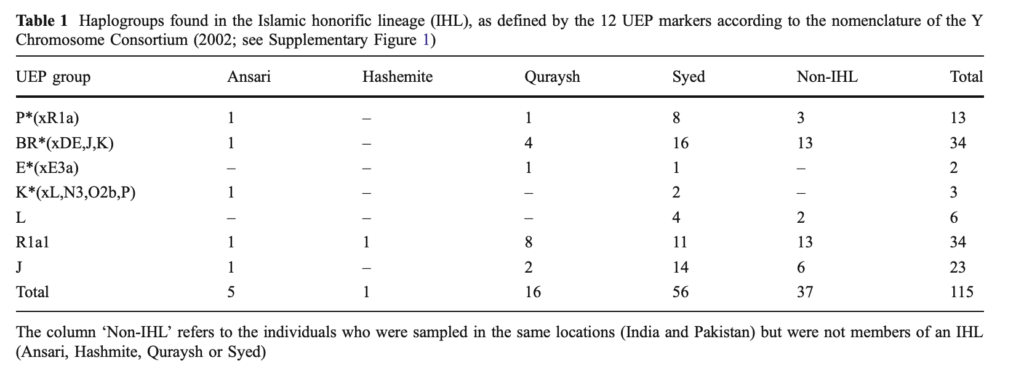
The above figure shows the frequencies of Y chromosomal haplogroups of men of South Asian who claim to be descended from the prophet or his tribe, as cross-referend with their surnames. The “Non-IHL” category indicates those who are not of these honored lineages.
The paper from which I drew the data, Y chromosomes of self-identified Syeds from the Indian subcontinent show evidence of elevated Arab ancestry but not of a recent common patrilineal origin, actually somewhat support the idea that these people descend from Muhammad or the Quraysh or the Ansar.
I think this is wrong.
But first, why do think these data results show Arab affinity? The “IHL” lineages have a higher proportion of haplogroup J, the most common haplogroup among Arabs. J is not exactly rare in South Asia (lots of <<<Brahmins>>> who are not sons of Indra have it because they are the scions of cunning Dasa priests), but there’s clearly a frequency discrepancy.
And yet this paper was published in 2010. We now know through various tests of confirmed descendants of Muhammad, and who descend in the male line from his cousin Ali, that they carry a branch of haplogroup J1.
Even among the Syeds, most do not descend from Muhammad assuredly. There are nearly as many scions of Lord Indra, R1a1, as those who bear haplogroup J. Of the J’s within the Syed community, I think the most likely scenario if they are not South Asia is that they are Iranian. J is found at frequencies of 35% in Iran, and Iranians, along with Turks, were the most common migrants into South Asia.
In other words, the Syeds of the Indian subcontinent are the sons of magians, not Muhammad.
BrownCast Podcast episode 19: Conversation with Saloni – a globalist centrist edgelord
 Another BP Podcast is up. You can listen on Libsyn, iTunes and Stitcher. Probably the easiest way to keep up the podcast since we don’t have a regular schedule is to subscribe at one of the links above.
You can also support the podcast as a patron (the primary benefit now is that you get the podcasts considerably earlier than everyone else…). Would appreciate more positive reviews.
Nearly 20 episodes in, I thought it would be useful to gain some perspective. Here are the traffic trends:

In the next month or so I will be recording a podcast with Thomas Chatterton Williams and Shadi Hamid. The podcast explores what we’re interested in, but I have to be honest that I doubt this would have ever happened without reader feedback.
On this episode, I have a wide-ranging discussion about globalization, globalism, and being Steven Pinker’s bulldog with my friend Saloni. A graduate student in behavior genetics at KCL, Saloni grew up in Hong Kong, carries an Indian passport, and is a hanger-on in the neoliberal shill conspiracy. Somehow she became an “internet person.”
Open Thread – Brown Pundits
Please keep the other posts on topic. Use this for talking about whatever you want to talk about.