

BrownCast Podcast episode 17: India-Pakistan conflict, Hindu nationalism, Cosmopolitanism

Another BP Podcast is up. You can listen on LibsyniTunes and Stitcher. Probably the easiest way to keep up the podcast since we don’t have a regular schedule is to subscribe at one of the links above. You can also support the podcast as a patron (the primary benefit now is that you get the podcasts considerably earlier than everyone else…). Would appreciate more positive reviews.

My next planned podcasts were going to be next week…but then world-events intervened. We recorded this before the latest developments in the border clashes between India and Pakistan. We spend probably 35% of the conversation on that topic. But…in a wide-ranging discussion we discuss knitting & racism, Hindu nationalism, Maratha(i)(?) nationalism, and the future of India, with a cosmopolitan <<<Third Culture>>> Indo-British-American professional.

The conversation between our guest, Amey, myself, and Omar, was spirited. I actually had to edit out sections where we kept interrupting each other to get in a word in edgewise! That being said, there is one section where I drop into an American colloquialism which is atypical for me, and I state I’ll “edit it out.” But I left it in since to some extent I did play the role of the befuddled and fearful American from the heartland who just wants the world safe for freedom and consumerism!
Do people in India care about ‘racist’ knitters?


There is a weird controversy about a white knitter who was perceived to be racist against Indians because they were worried about going to India because it was so alien from her experience? At least that’s what I get from the conversation. See the above exchange for some more context.

The mainstream website Vox, published something relating to this, The knitting community is reckoning with racism. The post shows that this is really about Americans more than about Indians. For example:

As someone who is mixed-race Indian, to me, her post (though seemingly well-meaning) was like bingo for every conversation a white person has ever had with me about their “fascination” with my dad’s home country; it was just so colorful and complex and inspiring. It’s not that they were wrong, per se, just that the tone felt like they thought India only existed to be all those things for them.

The author of the piece is a mixed-race American. Her mother is Irish American, and her father an immigrant from India.

My question is simple: what do people in India think about this?

White Hepthalites?

This is a parody account, which has been started by that blonde twitter account (I can’t recall her name).

However what I find interesting is treating the Hepthalites as “white.” There is a strain in Anglo-Saxon civilisation to absorb other heritages into their own. Furthermore as a shadow of the Western hegemony, “whiteness” is a trait often bestowed (the Aryans are treated as a white people).

I understand that there are many nuances but as the Devil Wears Prada teaches us, subtleties in the elite level trickle all the way down into the popular one.

The average Persian or India has a continuous link to their ancient by way of geography, history or ethnicity. What link does the average WASP really have to Alexander the Great; except a sentiment that they belong to the same “civilisation.” Constantly absorbing the winners of history into a mythos is what led to disasters like the film 300. The last traces of colonisation is economic & psychological; you still have to perceive another civilisation as superior to be able to buy into their lifestyle.

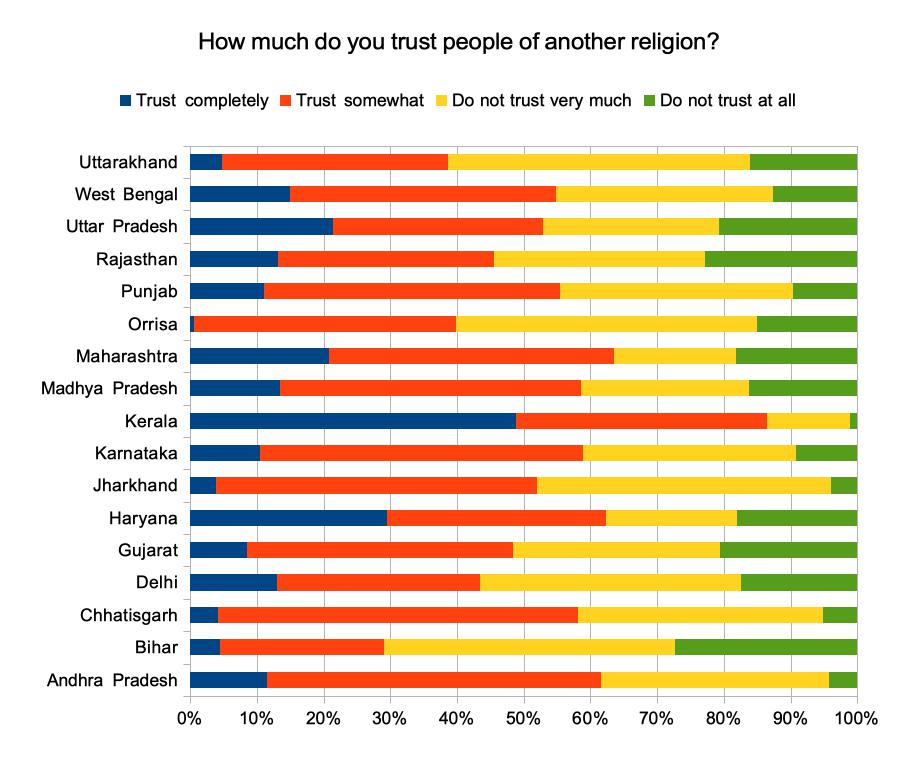
Indians in Kerala are less religiously polarized, those in Bihar are more polarized


Because some commenters on this weblog have a lot more lived experience within India than I do, you try to bullshit me. I suspect it, but I can’t prove it.

But I realized today that World Values Survey is broken down by region within countries. This means I can at least doublecheck some of the crazy assertions some of you make.

What I did is pretty simple: I selected India as the country and then selected regions as the first variable. I crossed it with a question about how much people trust those of other religions.

One thing that jumps out of the result is that trust across religions is highest in Kerala. There isn’t a huge difference across the north, but it seems lowest in Bihar. This makes sense.

These sorts of single results need to be treated with caution. The main issue is that respondents are usually asked in their native language, but word choice can bias the outcome.

I invite readers who are interested in bullshitting less to look at the WVS themselves. Raw table below the fold (with N’s).

Continue reading Indians in Kerala are less religiously polarized, those in Bihar are more polarized

Coloniser mansplaining beautiful Indian girl

https://twitter.com/fatfemmfatale/status/1096921912863870977

The guy is simply obnoxious; he epitomises the Coloniser complex that I write against.

She is obviously far above his league and he tries to defuse his insecurity by talking over her at every instance.

It’s strange that Netflix finds nothing wrong with this video when the level of aggression towards this lady is off the charts. You never walk out on a lady EVER but it’s only because she outright rejected him (she can do much better) that his ego couldn’t handle it.

As an aside I had no idea that she was Indian until he mentioned it and then only got more riled up.

Why I write on India’s lack of Asabiyyah

SC writes:

I have a suggestion for the bloggers. if you really want this blog to become popular and attract more insightful, witty and intelligent commenters, then you need to outgrow this India-Pakistan never-ending soap opera. This, and the other done-to-death Aryan-Dravidian debate occupies 90% of reading space on this blog.

There are many other interesting topics to talk about. If you are running out of ideas here are some from the top of my head. Continue reading Why I write on India’s lack of Asabiyyah

On the difficulties of cross-cultural communication

I speak English. But I speak a certain type of American English. I’m brown. But my culture is American.

On a blog like this, these structural problems give rise to particular issues. I actually saw it on the old Sepia Mutiny blog first. Indian English is a distinct dialect not only in accent and lexicon but also in idiosyncrasies in its idioms.

When we speak and write to the audience of this weblog, Indian and American (or British) audiences may actually infer different implications of the things we say. The easiest way to illustrate this is the use of the word “secularist.” The word is rich and pregnant with connotation and association for the Indian audience, but not so much for the American one, where it denotes something clear, distinct, and delimited. For the Indian audience, I avoid using the word “secularist” and “secular”, because I don’t want to get involved in a stupid argument that I have a marginal investment in.

I really can’t fix this issue of semiotics and linguistics. Sometimes confusions will ensue, and I will point out the reason.

But, there are two problems with some Indian commenters of this weblog that I want to highlight:

  1. Throwing up a “wall of text” in lieu of a concise argument.
  2. Obvious bad-faith posturing.

On my posts, if you engage in this behavior I may just delete your comments without warning. Those of you who have engaged in #2, I know exactly who you are, and I may delete your comments without warning too. Talking with a friend who is Indian but not raised in the United States, it could simply be that this behavior is taken for granted as normal by Indians (Hindu nationalist repurposing of SJW talking points without any shame suggests to me that this may be the case). That’s fine. But not on my posts.

I am not going to manage the posts of others. So perhaps my posts will become deserts of commentary. I am at peace with that.

Brown Pundits