
Please keep the other posts on topic. Use this for talking about whatever you want to talk about.
Tag: Identity and culture
The Colored Actors Hiding in the Favourite-
I went to watch “The Favourite” last night, which is getting rave reviews for Olivia Colman’s performance as Queen Anne. Considering that Olivia Colman will soon be playing HM the Queen in the upcoming series of the Crown it seems Ms. Colman is another Helen Mirren in the making.
I’m reading the auto-biography of one of my actors, Sir Nigel Hawthorne CBE. He played King George in the “Madness of King George” and of course Sir Humphrey Appleby in “Yes Minister.” When I read his experiences about being in perpetual penury and having to navigate landlords, it just reinforced how difficult it is to make it in the world of Acting even if you are a privilege white male.
Some of the excerpts on race in the biography are hilarious even though Sir Hawthorne’s views are exceptionally progressive for the time (and this was only written 20years) the milestones are moving so quickly in terms of race, gender and sexual orientation that most language gets dated.
My short thoughts are that even a movie as innocuous as the Favorite, which is ultimately a period piece on Royalty, gives such flavours on the immense upward struggle suffered by BAME (Black-Asian-Minority-Ethnic) actors.
While Emma Stone, as a White American, could plausibly play the lead Abigail Masham and half Jewish Rachel Weisz play Sarah Churchill (ancestress of course to Winston) the best Yorgos Lanthimos could do is “shadow” in 3 coloured actors. There was one Chinese girl in the violin who was in the screen for perhaps 2 seconds, an Indian boy as the help in the Bird Shoot and the final was a Black Server. All of these characters were on screen momentarily as though hinted at but never really featured.
Of course the question about whether colored actors have a place in Period Pieces is a particularly contentious one. However considering that the characters were wearing denim, which certainly wasn’t around in the early 18th century, it seems that either one go for complete authenticity or accept that Creative Licensing encompasses colour and race.
This topic won’t be solved now or in the future however I also wanted to add how Colonialism just makes this a vicious cycle. At the end of the day the only countries with viable and continuous Monarchies happen to in Northern Europe. The Gulf Kingdoms are merely Tribal leaders elevated to Monarchical dignity but nothing really more than that.
Without strength or coherence of a continuous Monarchy most third world countries simply do not have the heritage (or resources) to make compelling Period Pieces that spark the global imagination. The English Monarchy (even the French) resonates in the minds and most people can name at least a handful of monarchs.
In the case of “Independent” nations such as Siam, Afghanistan or Ethiopia; these were glorified buffer states that survived by juggling various European powers. Turkey is probably one of the few countries that somehow managed (through Ataturk) to survive as an independent power (and arguable it’s more European than Asian).
It is not inconceivable that if India had not been subject to foreign influence some sort of Composite Monarchy would have had to emerge (either Mughal or Maratha). The Hindu-Muslim labels certainly existed pre-colonisation and was significant at an elite level but in the early 1700’s (incidentally the time of Queen Anne) it would have been a much more syncretic and fused identity at the common level. It may have been that a Muslim-flavour Hinduism (Muslim Sufis internalised into the pantheon) would have been another sect like the Shaivites and Vaishnaivites.
Of course counter-factuals are always difficult since history is so unpredictable. But it would have been nice to have imagined that maybe in another reality the Favourite would have been about court intrigue in Aurangzeb’s court between his sisters Jahanara and Roshanara.
Some of our Indian friends will of course be outraged that I would use the example of someone so controversial as Aurangzeb. However it is not implausible to also imagine that in a continuous period of Indian Monarchy (whether Mughal or Maratha); Aurangzeb’s perfidy towards Hinduism would not have been the last word but simply treated as a sort of Bloody Mary figure.
At best the Mughals would have been seen as the Plantagenets of India. Instead of coloured actors darting sheepishly in the background in Period Pieces, they would have taken a centre stages since their stories and intrigues would have riveted the world.
If people think I’m being a melancholic Persian then let me ask this:
How many non-Desis cared about Padmavat?
Constructive feedback please –
Episode 9 has generated some interesting comments and I found these two comments to be the most interesting:
Okay, some feedback on the Podcast (s). Firstly, I like it. The range of topics is wide enough and conversations informative enough as well. Secondly, you guys need to invest in better Audio recording systems. Early podcasts had an issue where Omar could barely be heard and this one has an issue with massive and unacceptable lag which leads to long moments of silence. This leads to listeners fatigue and also increases the podcast needlessly. It is irritating. Though Omar voice issue has improved in recent podcasts the volume intensity of different speakers is still not consistent, some are louder and some less so. This needs to be dealt with. Thirdly, regarding this particular Ep9. content was good listen so no qualms there but man the long “Aaaa” pauses in speech are just too irritating after a while. Razib is a more fluid speaker. Fourth. Zack also needs to go on less redundant windings. He says the same thing multiple times worded differently. It is unnecessary, esp on a platform of Podcasts. Stick to the point and be concise, respect the listening audience to have a certain level of contextual grasp. I hardly doubt you guys are making this podcast to be some sort of educational material for 10-14 year olds. Listeners already have a certain level of grasp, stick to a standard and move on rather than spending minutes on redundant things. You guys seem new to this Podcast game and hence seem to be having above issues. Podcasts is a platform which is very mature now hence the sort of feedback I listed above, these are basic stuff on this medium but I think you can improve overtime, it is just about rounding off the edges because the core(content) is solid so majority of the battle is done anyway. Best of luck. Looking forward for more from you guys.
This chap hasn’t donated to the Patron account (or if he has, hasn’t mentioned that) and spews opinions on the whole podcast. It’s discourteous because we haven’t actually asked for feedback and what gets my goat is unqualified opinions; either invest or shut up.
The amusing thing with Xir Var is that he presumes that we really care as to whether he liked the podcast or not.
This isn’t me being defensive; I dislike the lack of respect by anonymous commentators and I always will. My persona is somewhat public (though it’s rapidly paring back as I grow tired of the phone and online word) and I think it’s unfair to parry with opponents in the dark.
FWIW I had wanted to step out of the podcast with Slapstick because I thought that Razib and SS would have had a much more fruitful conversation but I stayed on simply to make the logistics work.
This was the first comment that I read that pricked my ears and I thought was out of line:
This was my first podcast, as the topic interested me. By the first 3 minutes upon hearing assertions of Vedic originating in BMAC and etymology of Atharvaveda is based on the root Athar = fire in Iranian I was extremely amused. That amusement pulled me through a few more minutes and it ended, when I heard Pashto and Persian are dervied seperately and directly from a proto language. At that point i decided to stop the cast at about 18 minutes in. To be fair to real scholars who have or may come on the podcast in future, you guys might want to seperate the streams into something like BrownPunditWannabe for amateur hobbyists and BrownPunditReal for guys who actually can back up their assertions with something concrete. Also this is nothing personal against slapstick, everyone has their personal views. Just my thoughts.
I understand there is such a thing as jealousy but to attack SS in such a manner was simply unwarranted.
My patience is growing thin and so is my libertarianism (I’m turning into an authoritarian in my old age) and I don’t see the point of such callous disrespect.
Both of these comments could have been couched in much more dignified ways (while retaining the feedback) without coming across as condescending or patronising.
The sad part is that I had wanted to write my post on Collette but instead I’m simply issuing a broader notice as to my moderation style. It’s a grey area, to be fair, but considering that this is an unpaid hobby I don’t expect gratuitous (and anonymous) condescension acceptable anymore. Especially to those of us who take the time and effort to make the blog what it is (I also notice it’s not the regular commentator handles that are falling foul of our standards).
Commentators may presume that they are doing a favour by reading BrownPundits, leaving a comment or hearing a podcast. The numbers are extraordinarily healthy and rising with or without individual commentators and BP has a life of it’s own hence why I’ve toned down the Masalification on my side.
Also finally for what it’s worth I do happily admit that I fluff a fair bit but then I’m kind of “learning on the job” and it’s going to take a few more podcasts for me to get it right and to understand the “rough knowledge” of the listener.
Brown Pundits – Episode 7, Sarah Haider, Islam, identity, and the “public life”
 The latest BP Podcast is up. You can listen on Libsyn, iTunes and Stitcher. Probably the easiest way to keep up the podcast since we don’t have a regular schedule is to subscribe at one of the links above.
The guest this week is Sarah Haider. She is executive director of Ex-Muslims of North America.
Sarah and I are friends so I switched into a more informal register. The contrast between her very polished speaking style and my own is pretty striking and unsurprising. Also, please note that an outraged two year old child kept attempting to take over my home office, and you can hear him now and then.
If you want to hear more from her, please check out her speaking on YouTube.
Open Thread – Brown Pundits
Please keep the other posts on topic. Use this for talking about whatever you want to talk about.
An Unfair Comparison: Modi and Liaqat Ali Khan
Someone on Twitter posted a video of Arundhati Roy speaking out against Indian liberals who have “normalized” Narendra Modi by treating him as just another PM or CM.
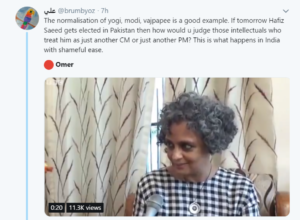
The tweeter is an Indian Muslim (who, as far as I can tell, now lives in Australia) and I assume that he regards Modi, Yogi and Vajpayee as Hindu Nationalists who are out to make India a “Hindu Pakistan”, where minorities (especially Muslims) will be second class citizens who will fear for their life and live under humiliating and unfair restrictions. Let us assume this is true (that the BJP is a Hindu Nationalist party with exactly such ambitions), then liberals who “normalize” this party and its leaders are indeed guilty of betraying liberal principles. But even if that is true (and to some extent it surely is; we can debate to what extent), there can be several objections to this tweet, especially to the fact that ALL THREE are being compared to Hafiz Saeed. I raised this particular objection in the following tweet:
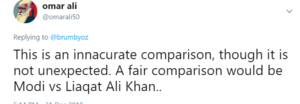
I will be the first to admit that this was mildly trollish, since I am well aware of the fact that the “done thing” is to make such judgments in terms of “local standards”.. by Pakistani standards, Hafiz Saeed is a religious extremist and a terrorist. So when Brumby wants an unflattering comparison for Modi, he picked Hafiz Saeed. On the other hand, Liaquat Ali Khan (first prime minister of Pakistan) is a Pakistani moderate. But my point was precisely this: the two standards are NOT the same. What Modi (or Yogi, or Vajpayee) may want is what Liaqat Ali Khan and Jinnah demanded and already got (thanks to some timely British help): an Islamic state, with discriminatory rules and laws that privilege one religion over all others. In that sense, Jinnah and the Muslim League leadership are indeed the correct comparison for a Hindu nationalist party.
But people also have other objections in mind. One is that Modi was CM during the Gujrat riots, when around 2500 people (mostly Muslims) died in a well organized pogrom during which the state machinery either stood aside or actively cooperated with the killers. Surely Liaquat Ali Khan cannot be compared to such a person? but even this objection stands on shakier ground than people may imagine. Liaquat Ali Khan was prime minister of Pakistan during a period when there was near-total ethnic cleansing of Sikhs and Hindus in Punjab and Karachi. This was not simply one or two spontaneous riots; there were well organized pogroms and the state machinery mostly stood aside (as in Gujrat, there were exceptions) and there is at least SOME evidence that Liaqat Ali Khan wanted them to stand aside because he did not really object to this cleansing (at a minimum he considered it the natural response to what was happening to Muslims in many parts of India). You can read more about this aspect here, but I will just post a paragraph from that newspaper article:
The above facts made me write that the violence against Sindhi Hindus and their mass migration to India was a tragic loss scripted, orchestrated and implemented by non-Sindhis in Sindh. I will happily withdraw my claim when furnished with the evidence to the contrary.
Published in The Express Tribune, June 5th, 2012.
The final objection I heard to my tweet was that Modi is an illiterate rabble rouser while Liaquat was the highly educated Westminster type. While it is true that Liaquat Ali Khan came from a rich feudal family (his grandfather, the nawab of Karnal was boss of 300 villages and had been given many honors because of his support of the British during the Indian Mutiny of 1857) and was educated in Oxford, he was never as thoroughly English as Jinnahbhoy, and neither is Modi as illiterate as his opponents make him out to be. That said, this objection has does have a little truth to it. My defense is that I was not saying they are exactly alike, I was only saying that as far as comparing BJP leaders to Pakistani politicians goes, the correct comparison is “any Muslim League leader” and not Hafiz Saeed.
I understand that many readers will find this comparison (BJP to Muslim league) hard to digest, but that is the point; it is hard to digest because it is unfamiliar. TIME magazine would not make this comparison and they have conventional wisdom on their side. But then again, we are not TIME magazine 🙂
PS: Arundhati, who admires Lenin (and Mao) has far to go before she can sit in judgment on liberals who “normalize” violent leaders.. If nothing else, we can all agree on that (see my article on Arundhati and her ilk here)
PPS: For details about partition violence (and later episodes of mass killings in Pakistan), see here..
Open Thread – Brown Pundits
Please keep the other posts on topic. Use this for talking about whatever you want to talk about.
Happy New Year!
All the very Best for 2019 for you, family, friends and the world.
Peace Happiness, Health and Wealth is my wish for all.
Every day is the beginning of the future and the years to come.
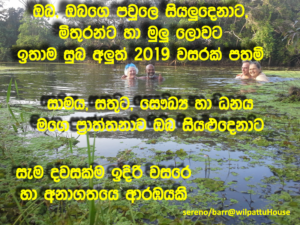
ඔබ, ඔබගෙ පවුලෙ සියලුදෙනාට, මිතුරන්ට හා මුලු ලොවට ඉතාම සුබ අලුත් 2019 වසරක් පතමි.
සාමය, සතුට, සෞඛ්ය හා ධනය මගෙ ප්රාත්තනාව ඔබ සියළුදෙනාට
සැම දවසක්ම ඉදිරි වසරෙ හා අනාගතයෙ ආරඹයකි

Its been good discussions, regards to all sereno/barr-kum
Book Review: Flat Earth News by Nick Davies
One of the many things in life that fascinate me is the way something becomes news. In my previous life in Pakistan, I had the opportunity to explore this issue further. I interacted with plenty of journalists, both as a source of news and sometimes as a reporter. I was never involved in decisions that happened in the newsroom or any particular editorial decisions but I saw journalists working at close quarters. I was intrigued by many things and asked a lot of questions. One of my friends who used to work at BBC Urdu service once said that BBC’s way of reporting a story is to give everybody a chance to speak. If a bicycle is stolen from an apartment complex, BBC journalists would like to talk to the owner, the thief and if possible, even the bicycle. BBC’s standards are not widely followed in Pakistan (based on my limited view) and a lot of local reporting by correspondents of major newspapers and TV channels is cursory. I also became aware of this issue when I talked to people working at Punjab Lok Sujag, a non-gvovernmental organisation with local roots which had previously worked in making Punjab’s culture more popular (by staging plays in Punjabi, translating major works of fiction in Punjabi and holding an annual Punjabi mela [fair]).
I recently read a excellnt book that dealt with issues of all things ‘news’. It was published in 2007-8 by British journalist, Nick Davies. He spent most of his career working at the Guardian and The Observer in England but he did oversees stints in Australia and United States as well. The book starts off with an exploration of the ‘millenium bug’ story that gripped the attention of a lot of people at the turn of the twentieth century. I’ll let Mr. Davies do most of the talking here.
Where did the millenium bug story start?
“As far as I can tell, the story first hatched one Saturday morning in May 1993, in Toronto, Canada. Inside the city’s Financial Post, on page 37, there was a single paragraph. Under the headline, ‘TURN OF CENTURY POSES A COMPUTER PROBLEM’, the story recorded that a Canadian technology consultant called Peter de Jager was warning that many computer systems would fail at midnight at the start of the new century and that few companies had taken steps to head off the problem.
Rather like the B-movie egg which is laid by the alien in the dark corner of the peaceful suburb, this little story broke out of its shell and slowly started to distribute its offspring around the undefended planet. By 1995, it had spread out of North America into Europe and Australia and Japan. By 1997, bug stories were being sighted all over the globe. By 1998, they had multiplied tenfold, infiltrating media outlets of every kind, and they were still mutating and dividing, still penetrating more and more newspaper columns, more and more broadcast news bulletins until finally, as Millennium Eve approached, they achieved a global conquest of the media, tens of thousands of bug stories infesting almost every news outlet on the planet.”
The financial cost of the story
“Journalists reported that the British government had spent £396 million on Y2K protection. They also reported that it had spent £430 million. And that it had spent £788 million. The American government had spent far more, they said – $100 billion, or $200 billion, or $320 billion, or $600 billion, or $858 billion, depending on which journalist you were reading. Anyway, it was a lot. Beyond that, the private sector had spawned a mini-industry of companies selling millennium bug kits, while publishers turned out bug books and bug videos, and estate agents sold bug-resistant homes, and a few families sold their houses and fled to remote cabins in order to give themselves a chance to survive the coming bug-related chaos.”
How he defines ‘Flat Earth News’
“This [millenium bug story] is Flat Earth news. A story appears to be true. It is widely accepted as true. It becomes a heresy to suggest that it is not true – even if it is riddled with falsehood, distortion and propaganda”
An issue that befuddles ordinary consumers of news (like myself) is the difference between objectivity and neutrality. Should journalists be telling the truth (Objectivity) or just giving both sides of the story (Neutrality)?
“Neutrality requires the journalist to become invisible, to refrain deliberately (under threat of discipline) from expressing the judgments which are essential for journalism. Neutrality requires the packaging of conflicting claims, which is precisely the opposite of truth-telling. If two men go to mow a meadow and one comes back and says, “The job’s done”, and the other comes back and says ‘We never cut a single blade of grass’, neutrality requires the journalists to report a controversy surrounding the state of the meadow, to throw together both men’s claims and shove it out to the world with an implicit sign over the top declaring, ‘We don’t know whats happening-you decide’.
The damage goes further than merely abandoning the primary purpose of journalism. It actually transfers the truth-telling judgments out of newsrooms and into the hands of outsiders.”
Mr. Davies mentions that most of the news stories in major newspapers are lifted straight from news agencies, which could be local and global. Two global agencies that he talked about are Associated Press (AP) and Reuters.
“Just like PA (Press Association, England), their concern with accuracy is deliberately different from a newspaper’s concern with truth. One man who has spent many years as a senior executive from Reuters echoed Jonathan Grun from PA explaining to me that Reuters was not concerned about the truth. The agency would try to provide an accurate amount of an opposing point of view: ‘But it isn’t an agency’s job to start choosing between these voices and saying who is telling the truth’. All the great flat earth news stories have travelled via wire agencies into the unprotected global media. It was AP and Reuters who told the world about the millenium bug and the weapons on mass destruction, who carried the myths about drugs and crime and radiation and education and all the other Huckers, big and small. All these stories were accurate, in that they faithfully recorded what somebody had said; none of them were true”.
The epilogue of the book starts with some golden words from The Simpsons: “Journalists used to question the reasons for war and expose abuse of power. Now, like toothless babies, they suckle on the sugary teat on misinformation and poop it into the diaper we call the six ‘o clock news”.
No such thing as South India
This is such a dangerous deleterious, and also a false thesis
There is no such thing as "South India".
A Telugu speaker is as distant from me as a Maharashtrian. A Keralite is even more distant.https://t.co/XWK1dQRyOe
— श्रीकान्तः (@shrikanth_krish) December 29, 2018
The original article by Mahatma’s grandson is equally intriguing, People of the South constitute an equal and single community: Rajmohan Gandhi.I don’t have too many opinions on this (for a change) but my inclination is that caste (and then creed) have dramatically reduced regional identities in India.
The states that have been most problematic to the Indian Union (East Punjab, Srinagar area, 7 sisters) have more homogenised profiles (and incidentally happen to be on the periphery). Continue reading No such thing as South India