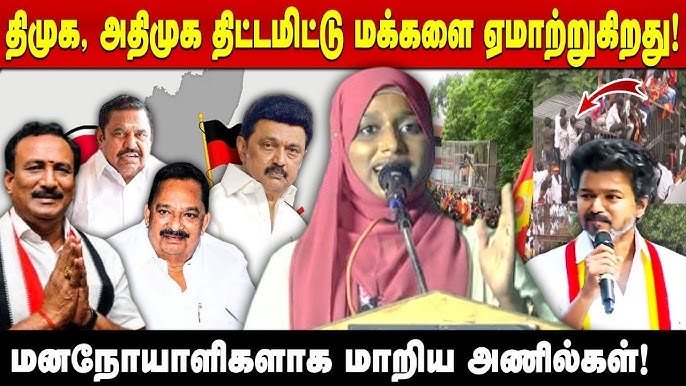
Sbarr sent a simple reel: a female Tamil Muslim politiciann in Ranipet, near Vellore, waving an LTTE flag during an election campaign. What followed was not simple at all. The reaction treated the image as an ideological provocation rather than a local political act. Why is a Muslim woman waving a Tamil separatist symbol? What does this say about loyalty, religion, or the nation?
Islam in South India did not arrive through conquest. It arrived through trade. Arab merchants settled along the Malabar and Coromandel coasts centuries before the Delhi Sultanate existed. They married locally, learned the language, adopted food, dress, and social habits, and became Tamil, Malayali, or Konkani Muslims. Religion changed. Civilisation did not.
This is why South Indian Islam does not behave like a foreign layer imposed on a hostile society. It is woven into the local fabric. Tamil Muslims are Tamil first in language, culture, and political instinct. Their solidarities are shaped by region before theology. This is not syncretism as rebellion. It is indigeneity as habit.
Tamil identity in Tamil Nadu routinely transcends religion. I was reminded of this years ago in Chennai, asking my dentist, who was Christian,about her name. Like many South Indian Christians, it was a mix of Hindu and Christian forms. I asked whether they were also Tamil. She looked at me as if the question made no sense. Of course she was Tamil, “very Tamil.”
That response explains more than a thousand editorials.
In Tamil Nadu, religion is real but it is not totalising. Tamilness is older, deeper, and more organising. This applies to Hindus, Christians, and Muslims alike. Political expression follows that logic. A Tamil Muslim expressing Tamil nationalist sentiment is not a contradiction. It is normal.
This is what happens when South India is constantly interpreted through North Indian assumptions. Islam is assumed to be oppositional. Symbols are assumed to be exclusive. Politics is assumed to be communal by default. None of this holds in the Tamil world.
Tamil lands occupy a distinct face of Indian civilisation. Fully part of India, yet unmistakably their own. Deeply Indian, yet not reducible to Gangetic history or North Indian templates. This is not fragmentation. It is civilisational strength.
India has always had multiple faces. The Tamil one is maritime, linguistic, ancient, and self-assured. It absorbed religions without surrendering itself to them. That is why its Muslims do not behave like guests. They behave like natives.
The reel was never the problem. The inability to see India’s southernmost face was.
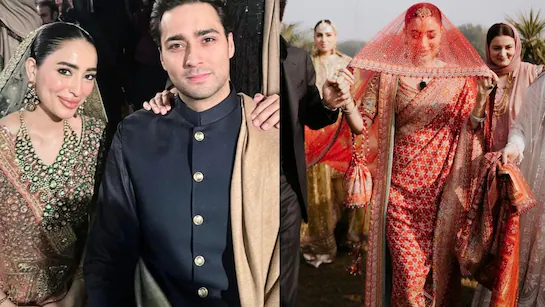
There is a tweet circulating of Nawaz Sharif’s grandson’s wedding. It is meant to be ordinary; the bride wore Indian designers, Sabyasachi and Tarun Tahiliani. Instead, it is revealing, the extent of Indic soft power. The colours are unmistakably Indian: red, gold, marigold. The symmetry is ritualistic rather than theological. The staging is ceremonial, not Quranic. The aesthetics are not Arab, Persian, or Turkic. They are Hindu-Indian; not in belief, but in form.
This is not a criticism. It is an observation. For seventy-five years, Pakistan has insisted that it is not India. That it broke away not only as a state but as a civilisation. That Islam did not merely replace Hinduism but erased it. Yet when Pakistan’s most powerful family marries its children, what appears is not a purified Islamic aesthetic but a recognisably Indic one.
Civilisation does not obey ideology.
Islam in Jambudvīpa did not enter an empty space. It arrived in a world already shaped by colour, hierarchy, procession, music, and spectacle. It adapted to that world. It did not abolish ceremony; it repurposed it. Nikah replaced vivah, but the social grammar remained. Weddings stayed long, public, ornate, and familial. They did not become austere. They became Muslim in name and Indian in structure.
As one does, we were discussing societal rise and collapse on twitter and I said at some point:
“I have no clue about EU etc but I think stories of the demise of France, the Vikings and the Poles all look unlikely to me.. And given the evidence of the last 500 years of Russian asabiya, I wouldn’t write them off either.. They will all survive wud be my guess.. Meanwhile, the gods have arranged a once in a millennium opportunity for Indians and it will be an unforgivable tragedy to miss it.. Go big, or go home”
User @whatwasthataga4 on X.com (an Indian American) asked: “I don’t understand this once in a millennium opportunity. What exactly is it and how is it supposed to work in the best case?”
I posted an off the cuff reply and wished I could sit down and do a proper post on this. But knowing that I may not get to it, I am just quickly updating my tweet and hoping that commentators will add value.. So here is my “off the top of my head” explanation of this “once in a millenium opportunity” claim.
We will come back to why “once in a millenium” (i.e., did this opportunity not exist before? will it not exist in the future?), but I think you have to begin with belief in certain things, some of which seem obvious, but others are hotly contested by HBD types (and I think the HBD types are wrong here). So here are some things I believe are true and which constitute a “once in a millennium opportunity to become a developed and powerful nation” (we will dismiss the fantasists who think humans have moved beyond nations, yadda yadda yadda).
1. Indian human resources are potentially world class; the wetware is actually OK (though disease and malnutrition do lower IQ in some significant subsets, but cultural strengths compensate as well, so even that is not a lost cause)
2. So, wetware can work. What about software? I think even the software is not entirely corrupted. The bios is still intact for most people (though under threat) and the culture has many elements that make it potentially successful. For example, there is a significant commercial class and tradition, of the South Chinese type, if not equally developed right now. There is also significant respect for teachers and learning (again, not at Confucian levels, but it is very much there) and respect for legal authority (sometimes, maybe a lot of times, too much respect for authority, but there is also a romantic anti-authoritarian assault from Wokish Leftist ideologies that now threatens to over-correct).
You may be getting a hint of why i say its a chance, not a done deal. These are also strengths that are under sustained assault from Postleftist wokish ideologies and in India there is such significant domination of western leftish narratives in the educated classes that there is the possibility they could actually destroy these cultural strengths in another generation. That would be one way to miss the bus. Another would be to start a religious civil war. The second is very high on the list of fears for leftists and liberals, but I suggest we should be equally fearful of too much leftism 🙂
3. The administrative and military machinery of the Raj is intact, vast and relatively modern, and can be redirected to new purposes. I listed this at 3, but this is probably what many people think of when they say “India has a chance, thanks to the Raj”. I think the downsides of colonization exceed any benefits they brought, but no doubt the existence of this apparatus gives India (and even the other successor states of the Raj) an edge over, say, Afghanistan, for better and for worse. Its a mixed blessing but its there, and it CAN potentially be directed to new ends.
4. A vast and successful diaspora (a source of ideas, ideals, money and skills)
5. Relatively good asabiya for such a large country (I dont buy this notion that Indian people in general are not patriotic. If anything, they are excessively and over-sentimentally patriotic . Patriotism matters. (Pakistan has even better asabiya, so this is necessary, but not sufficient 🙂 )
6. The biggest population in the world Demographic dividend. Another obvious point where the opportunity is there now, but wont be there forever.
And so on.. There is a lot more
Add your comments. (I have left the meaning of development vague, but what I personally mean is very conventional success as the first layer (the thought is that this layer itself implies others), so things like being a giant middle income or more economy, with no serious invasion fears and a clearly functional political and economic system that is a very big source of innovation and ideas for the whole planet; I dont mean people will be more virtuous, or a “new man” will be born after the glorious revolution).
BTW, here is a conventional western view of why a chance for very serious development exists in India (at least this was the view last year, relations are more tense now and the strategic directives behind such programs may have shifted)
Postscript: My conspiracy theory is that a thousand conspiracies are launched and some turn out to be workable, but nobody knows in advance that A or B is a sure shot.. It’s a leap into the dark 🙂 (hence, work for the ones you want, when the time is right, it will happen)