Pakistan’s Inner Logic

On Nivedita & Archer’s joint request (Mamnoon/Tashakor/Merci for the kind words); I’m going to expand on my comment:

Kabir is definitely right. Ethnicity in Pakistan is complex; there are three tiers of society. The English speaking elite (Imran is part of that so is Kabir), who are “Pakistanis” and ethnicity isn’t really reflected on…

This comment, which the BP archives have tons of similar posts on (BP was venerable even in 2014), sketches the bones of Pakistan’s sociological map. But what lies beneath the skin?

Pakistan is feudal; India is not.

That one statement alone explains much. Landholding elites dominate politics, rural economies still function on patronage, and class mobility is rare. Caste, though “denied,” is real and sharper, in some ways, than it could ever be in India (the reservation system does not really exist in Pakistan except for religious minorities but not for socio-economic castes). Pakistanis can sniff out class in one another with a dexterity that’s probably only matched in the United Kingdom, which is the home of class stratification (I remember reading Dorian Gray in Karachi in the early millennium and shocked how similar late Victorian early Edwardian England was).

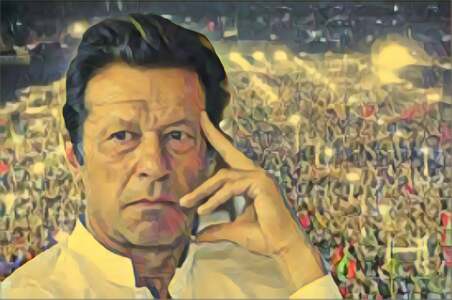
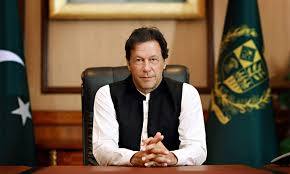
The postcolonial state froze itself in amber. There has never been a serious leftist rupture, excepting 1971’s successful Bengali revolution. Even Imran Khan, who styled himself a reformist, is a product of elite schools, Aitchison College, Oxford, and aristocratic lineage. His “Islamic socialism” was only ever viable because Pakistanis still believe in myths of the benevolent landlord.

And yet, Pakistanis sometimes seem happier than their Indian counterparts, even if not remotely successful. Why? Continue reading Pakistan’s Inner Logic
Hijab: Between Revelation and Regulation

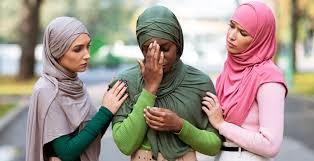
When Bahá’u’lláh wrote that every word of the Qur’ān bears meaning and intention, he was reminding us that revelation, properly read, resists reduction.  Scripture, like language itself, is alive; it breathes, it hesitates, it renews.  Yet somewhere between the living word and the legislated code, the hijab became a symbol, of modesty, of defiance, of cultural siege, of theological purity, until its nuance was lost to politics.

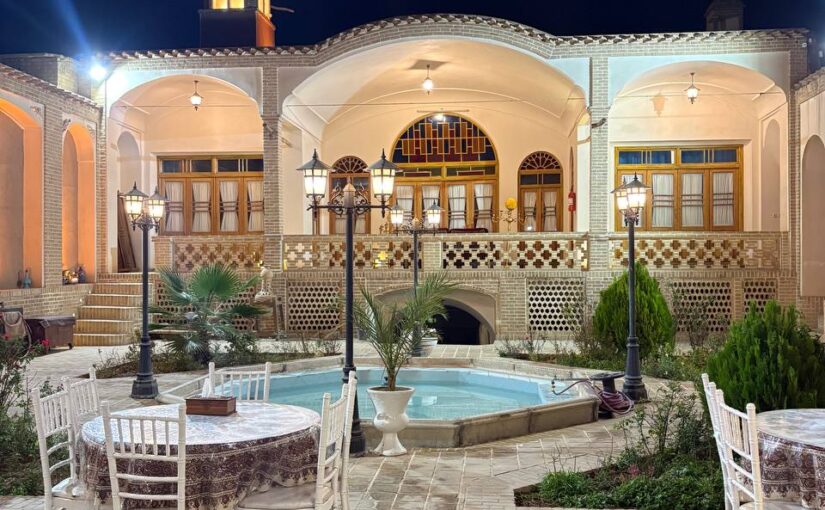
My friend is in Kashan, a city of gardens and scholars, and perhaps among the most traditional pockets of Iran.  She forgot her hijab back in her home city and now cannot step out of her hotel.  The irony is sharp: the veil that once signified spiritual privacy has become an enclosure of space.  Kashan’s cobbled lanes whisper poetry, but they also enforce silence.

Meanwhile, the liberal axis of Iran, Shiraz, Tehran, Gilan, Mazandaran, Semnan, walks the tightrope between revelation and rebellion.  The North dresses as Europe, the Centre prays as Qom.  Mahsa Amini’s martyrdom was Kurdish, and therefore doubly liminal: ethnically marginal, religiously symbolic (the Kurds are very secular as a rule of thumb; more Zoroastrian than the Persians).  Her death reopened a question the Qur’ān itself leaves open — what, after all, does ḥijāb mean?

1. The Qur’ānic Vocabulary of Modesty Continue reading Hijab: Between Revelation and Regulation

Pakistan, a young state but an old nation

no one is born a Bahá’í; even those who are “Bahá’ízadeh” (those born to Bahá’í homes) must first affirm their belief at fifteen and confirm it at 21

Dawn Posting

Most of my writing these days happens either at the dead of night, bleeding into the Dawn. This is when the world is quiet enough to hear one’s thoughts.

I’ve asked the Editors to lean into their moderation. But I’ve also emphasized that a copy of the moderated comments should be preserved in their original form; so that, if there’s an appeal or a misreading, I can assess it personally. My instinct has always been to under-moderate. I would rather allow something unpleasant to be said than suppress something vital.

That said, miscommunication is inevitable in a forum like ours. I recently had my own moment of misunderstanding with Indosaurus. But in many ways, that’s exactly what makes Brown Pundits an exciting space. We are not a hive mind. We’re a broad church; Anglican in temperament, not Catholic in control. Communion, not command.

The Commentariat Continue reading Pakistan, a young state but an old nation

Pakistan will recognize Israel?

There was a lot of hullabaloo in Pakistan over the Saudi defense agreement as well as the US warming up to it without considering the consequences.

Some Pakistani Nationalists were of the view that an Islamic Alliance led by Pakistan would liberate Al-Aqsa etc.

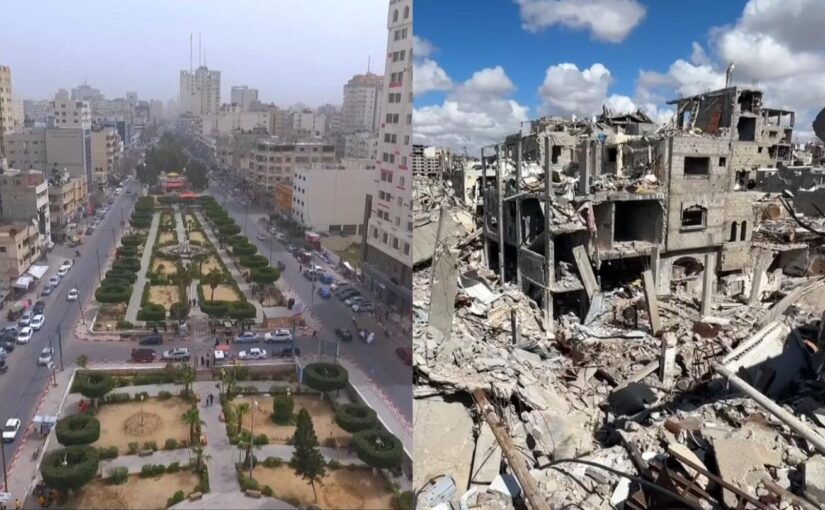
But reality is different. It seems all this was to ensure normalization with Israel and support a peacekeeping force in Gaza post war.

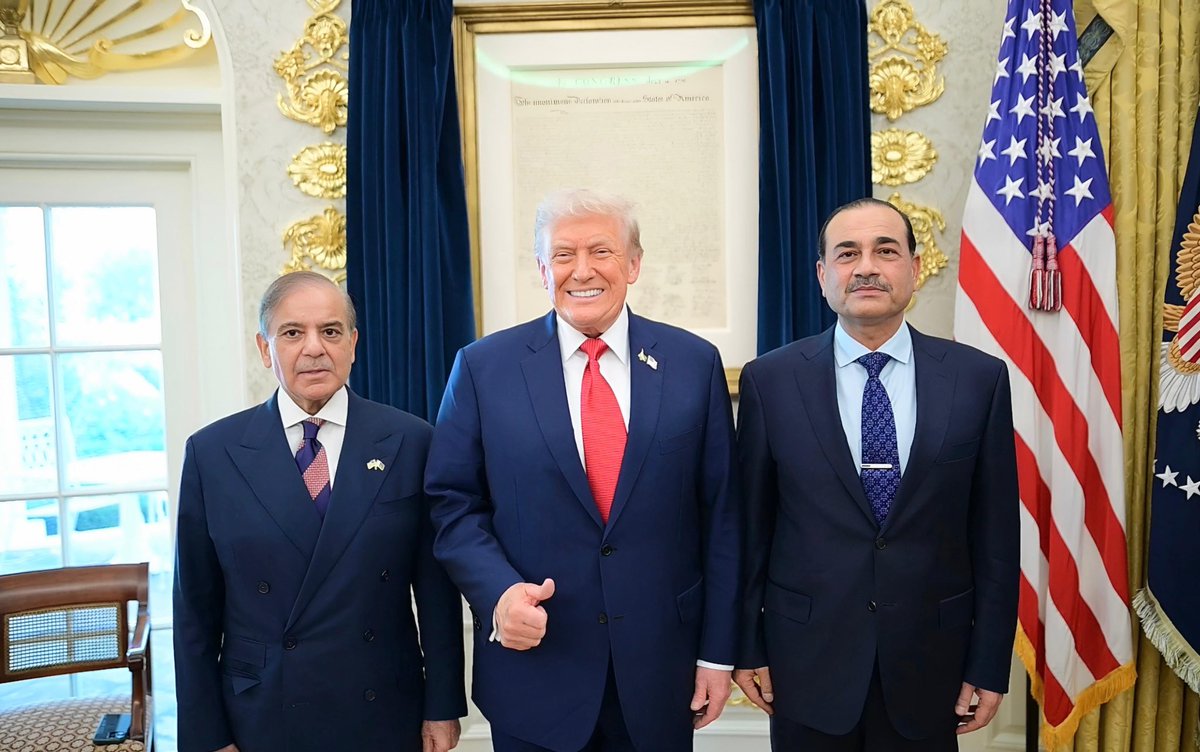
Shehbaz’s latest tweet seems to indicate the same.

I welcome President Trump’s 20-point plan to ensure an end to the war in Gaza.

I am also convinced that durable peace between the Palestinian people and Israel would be essential in bringing political stability and economic growth to the region.

It is also my firm belief that President Trump is fully prepared to assist in whatever way necessary to make this extremely important and urgent understanding to become a reality.

I laud President Trump’s leadership and the vital role played by Special Envoy Steve Witkoff in bringing an end to this war.

I also strongly believe that the implementation of the two state proposal is essential to ensure lasting peace in the region.

It would be interesting to see what the Pakistani masses think of this.

The River Cannot Go Back

I wanted to share something that floored me. Through Sahil Bloom, I came across this poem by Kahlil Gibran, and it struck me with its simplicity and depth. As an aside, it is worth remembering that Gibran was deeply inspired by ʻAbdu’l-Bahá, whose vision of unity and spiritual renewal touched many thinkers and artists of his time.

For the Commentariat, it’s worth noting that one of the 20th century’s greatest poets had Muslim antecedents: Gibran’s maternal great-grandfather converted from Islam to Christianity, a reminder that conversion did happen, and that traditions were more porous than the common perception that “Muslims can never leave Islam.”


The River Cannot Go Back

It is said that before entering the sea

a river trembles with fear.

She looks back at the path she has traveled,

from the peaks of the mountains, Continue reading The River Cannot Go Back

On Islamism, the Oneness of Mankind, and the Burden of Public Bahá’ís

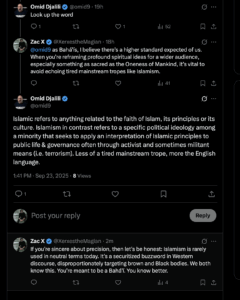
For too long, the term Islamism has functioned as a lazy shorthand in Western discourse; one that often sanitizes the dehumanization and securitization of Muslim bodies. And when it’s used by those claiming spiritual insight, especially from within a global Faith like the Bahá’í Faith, it becomes more than just a rhetorical misstep. It becomes a betrayal.

This week, a prominent British Bahá’í comedian made such a misstep.

A Moment of Caution — Dismissed

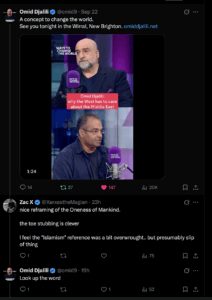
When Omid Djalili posted a news clip, which gently reframed the Bahá’í concept of the Oneness of Mankind, I appreciated the gesture. In fact, I said so. The “toe-stubbing” analogy was clever, and there was something moving in seeing profound principles gently repackaged for a wider audience.

But I raised one concern: the reference to Islamism. It was, I suggested, overwrought, unnecessary, and ultimately unwise. I proposed an alternative: perhaps rephrasing the same concern as “security anxieties around mass migration” or similar language that doesn’t dog-whistle. This wasn’t a condemnation. It was, as any Bahá’í should recognize, consultation. An invitation to reflection.

Instead, I was told: “Look up the word.”

The Burden of Bahá’ís in Public

It’s not about semantics. It’s about responsibility. And especially so when one is invoking sacred teachings, teachings that thousands upon thousands have died for; on public platforms. The Bahá’í Faith is not a marketing device to win over a Western liberal audience by soft-launching its principles in the language of border panic and counter-terrorism.

To reduce Islamism to a “technical English-language distinction” is disingenuous. The term has never been neutral. In nearly all Western contexts, it has become a floating signifier for violence, extremism, and “dangerous Muslims.” It serves to other, to isolate, and to justify state and vigilante violence often against entirely innocent people (Afghanistan, Iraq & Palestine).

And when Bahá’ís, of all people, repeat that language without self-awareness, without contrition, and without consultation, we should all be worried.

The Problem Isn’t the Joke. It’s the Response.

I understand the pressures of performance. I’ve done media. I know how easy it is to slip. What matters is what happens next. When another Bahá’í, someone you know, someone with many mutual connects, raises a concern gently and in good faith, the correct response isn’t smugness. It isn’t defensiveness. It certainly isn’t “learn English.”

That response is hurtful, racist, and deeply contrary to the values we both claim to serve. And that’s what cut. Not the line in the show but the refusal to listen afterwards. The arrogance of elite Bahá’ís who believe proximity to celebrity, applause, or power gives them carte blanche to reframe revelation in their own image.

This Is Why We Need to Talk

As Brown Pundits reshapes itself, I’m re-examining my own priors, too. What voices we platform. What values we uphold. Who gets to speak for our communities and under what banner.

So I say this plainly: The oneness of mankind cannot be proclaimed by marginalizing Muslims. And Bahá’ís, especially public ones, must hold themselves to the standard of humility, consultation, and truthfulness we profess to believe in. We cannot serve justice while echoing injustice. We cannot preach unity while casually reinscribing division. The world is watching. Let’s be worthy of what we claim.

Pakistan: The Realpolitik State

In a recent exchange, Kabir suggested that Pakistanis often feel unwelcome in our discussions on Brown Pundits, and that constant criticism of their country creates a sense of unease. It is worth pausing to reflect on this. Pakistanis, like all of us, are shaped by history and circumstance. And yet, there is something in the cultural tenor of Pakistan that makes open engagement difficult.

I say this not to provoke but to observe. Pakistan, as a society, often leans heavily on hierarchism, patronage, and a culture of deference. To borrow an old saying about the Somalis, that every man thinks himself a Sulṭán, one might say that Pakistanis often view themselves through the prism of status and validation. This instinct is hardly unique; Indians, too, have their caste-bound privileges and invisible hierarchies. But in India, these structures are embedded in a dense cultural fabric; family, caste, neighbourhood, ritual, that, for all their flaws, anchor society. Pakistan, by contrast, feels less rooted. It is a younger country (with old traditions), with fewer inherited cultural layers to draw on.

This is not simply an abstract point. When I married, we drew freely from Hindu rituals (dual ceremonies, Bahá’í incl.), Persian customs, and Sindhi traditions, blending them into something whole. But I realised there was nothing distinctly “Pakistani” to contribute; no cultural motif that stood outside India or Iran (we didn’t do a Walima, which is Muslim). Pakistan is, in many ways, a derivation: a state forged through separation, rather than a civilization with deep roots of its own. The cultural space it occupies has been overlaid with militant nationalism and, too often, Hindu-phobia (Kabir is so inured to it that he isn’t able to recognise that but on the flipside so is the Commentariat towards Islam).

To acknowledge this is not to deny the prejudices of Indians toward Muslims, which are very real and enduring. Nor is it to ignore the deracinated, secular archetype embodied by figures like Benazir Bhutto, who seemed neither fully Muslim nor fully Western, suspended between worlds and who are the cultural elite of Pakistan (what they give up on their bridge is their Hindu origins; more than being half-Persian, Benazir’s nani was Hindu). It is simply to note that Pakistan’s cultural story remains unsettled & thus interesting.


Validation and Audience Continue reading Pakistan: The Realpolitik State

Moderation Note: On Gaza, October 7, and the Limits of Tolerance

Kabir’s Muslim nationalism cosplaying as liberalism is vexatious (it would be excellent if he just disclosed his priors), but I give the admin full authority to handle that directly.

My immediate concern is with BB-HS. I have barred him from becoming an author and have removed his last twenty comments. Despite his earlier misrepresentation about being “half-Muslim,” I allowed him to return under a new handle, tabula rasa. His output, however, is increasingly defined by “fantasies” about what a model minority should be; deracinated and devoid of meaningful character.

BB’s Response (after I had deleted his past 20 comments)

“Why though? The only animus I have is with Kabir because he represents a demographic I loathe – The soft Islamist | The ‘liberal’ English-speaking version who whitewashes his more hardcore cousins’ atrocities. Actual people have died due to Islamists which Kabir downplays (Pahalgam, October 7th). Some ribbing online is nothing in comparison. And I haven’t even said anything insulting.”

My Response

    1. Kabir is not an Islamist. He is a Muslim nationalist—since Pakistan itself is sine qua non Muslim nationalism (the idea that Indian Muslims were entitled to their own nation). Just as every Israeli is, by definition, a Zionist/Jewish nationalist, even if individuals disagree with its implications, Kabir represents that current.
    2. What stands out is that BB mentions only Pahalgam and October 7—both undeniably tragic events, and I say this as someone who is not Muslim—while omitting the ongoing genocide in Gaza.It is akin to referencing 9/11, a devastating moment in history, without also acknowledging the destruction of Afghanistan and Iraq and the millions of lives lost in their aftermath.
    3. Unlike Kabir, vexatious, but rarely personal, BB makes his attacks direct. He is not Kabir’s friend indulging in ribbing; he is simply “Honey” under another guise.
    4. What sets him apart is an openly hierarchical stance: non-Muslim lives ranked above Muslim ones, echoing the very post-colonial divide-and-rule strategies we are meant to reject.
    5. Kabir manipulates through weaponised victimhood; BB chooses blunt hostility, lacing personal abuse into his commentary. I have permanently removed Honey’s comments for that reason, vulgarity leaves no space for debate and I treat BB and Honey as a single entity.
    6. Beneath the very different styles of BB-HS & Kabir lies the same contempt: the belief that the only acceptable minority is one hollowed out, compliant, and dead on the inside.

Moderation Philosophy

As a Founder, my job is to ensure Brown Pundits does not become an echo chamber. I have repeatedly critiqued Kabir’s contradictions, but once I accepted him as a Muslim nationalist cosplaying liberalism, I could also accept his place in the debate. We have multiple Hindu nationalists here, and when Kabir is challenged\moderated, the balance tends to restore itself. The ecosystem can correct for his presence.

Finally, let me stress: the comment boards are not the only heart of this site. Too often they descend into noise. If regular commentators want to influence debate constructively, they should apply to become Authors; where they can speak directly to our 2,000+ daily readers, not just the dozen or so regular commentariat.

Brown Pundits is rapidly emerging as the most interesting Indo-Pak cross-channel precisely because it is not an echo chamber. We literally upset everyone and that is a great thing because it means we are covering new difficult terrain. My moderation began with strict principles, but like everyone else, I have a life, job, and family. That means I must also be pragmatic.

The Honey Trap of the Ummah:

🕌 Reflections on Kabir, Afridi, and the Compact of Coexistence

The recent incident involving Kabir / Bombay Badshah / Honey Singh, and the orchestrated drama around his entrapment has, quite unexpectedly, become a catalyst for deeper discussion on Brown Pundits. While none have chosen to focus on analytics (“2,000 daily visitors”—thank you very much:-), the real story lies in how this drama has exposed, yet again, the deep ideological fissures within South Asian identity; especially in the India-Pakistan-Muslim triad.

Let’s begin by being honest: Brown Pundits, for all its digressions into Sri Lanka, Nepal, or Bangladesh, is still primarily a blog about India and Pakistan, and more crucially, about Indian and Pakistani Muslims. This is a feature, not a bug. The origins of the blog lie in the Sepia Mutiny, a scattered band of intellectually independent thinkers questioning dogma from every direction (which started in 2004 and if we are a “daughter blog” that we means have 20+yrs of intellectual antecedents on the Brownet), and it has now matured into one of the few platforms willing to wrestle with the ideological ambiguities at the heart of the subcontinent.

🧕 Kabir’s Point: Brotherhood, Boundaries, and the Big Choice

Kabir made an astute, if difficult, observation: that he views Indian Muslims as “brothers”, but does not feel the same about Pakistani non-Muslims.

This sounds contradictory until one understands the emotional exhaustion of watching Muslims oscillate between claiming ummah-hood when convenient, and weaponizing liberal values when needed. It’s a cognitive dissonance that creates what I can only call the moral coexistence trap: the idea that Muslims, especially in India, demand maximum accommodation, of their food (their nauseating right to murder Gau Mata on Bharat’s sacred soil itself), Faith, festivals, and foreign affiliations, while rarely extending the same pluralistic courtesy in return.

And then there’s that infamous Shahid Afridi clip, the one where he smashed his television after watching an Aarti, being performed. To many of us, that wasn’t just a cringe-inducing moment of bigotry; it begged a real question: Why do Indian cricketers continue to shake hands with Hinduphobes Hindu-hating men like Afridi and his ilk (the Pakistan cricket team)? At what point does tolerance become indulgence?

🚩 The Compact of Indian Minorities: Understand It or Leave It

Continue reading The Honey Trap of the Ummah:

Brown Pundits