Imran Khan in DC

So, thirty thousand Pakistani-Americans gathered in DC to hear PM Imran Khan, billed as the largest gathering of Pakistanis in North America ever. I am seeing that Bangladeshi and Bangladeshi-American social media is somewhat impressed. It is doubtful that any Bangladeshi leader can even pull half that crowd in North America. This is also a little bit puzzling. By most measures and in popular discourse, Bangladesh has been doing far better than Pakistan economy and society-wise in the last ten years. So how come a Pakistani leader, in midst of economic stagnation, fiscal crisis, currency crisis etc etc back at home manage to pull such a crowd? Is Imran Khan really popular among Pakistanis? Is there a home-expatriate divide? I am curious to know from Pakistanis.

This man makes me proud of being a Baha’i

For the first time one of my Social Media Tweets has gone *slightly* viral.

https://www.facebook.com/photo.php?fbid=10108204899981461&set=a.10100412680536691&type=3&theater

The animated story and the retelling of it by his brother is here:
https://www.youtube.com/watch?v=okF5UGpivR8&feature=youtu.be&fbclid=IwAR0YQdREazGS05Z4jw4vpQfyaMF2254T5qWvQswvuoRdgmwjyQWfvmQv7Cw
I did mention to V that I was shocked that I had only learnt about this story (and that too from a Pakistani not Persian Baha’i).
She immediately replied that’s because he was “a black man Zach.” While I’m proud of this story, which frankly is more impressive than any temple built by our institutions, I’m also ashamed of the endemic and silent racism within the community.
It is always interesting to me that in our avowedly “non-racist” (and non-sexist faith) it’s always Persian & White Men (and their Spouses) who become the Superstars of the Faith.
So it is interesting that while I’m busy with my one-man crusade online to Persianise Pakistan (restoring our High Culture is a difficult but worthwhile task) I’m fighting a very different battle to find moral equity within our Persianate Faith.

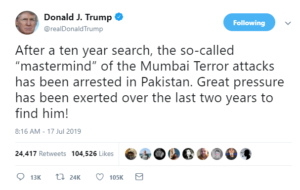
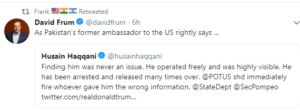
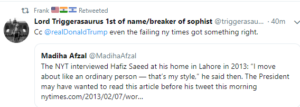
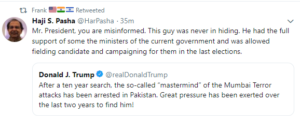
Trump Finds Hafiz Saeed..

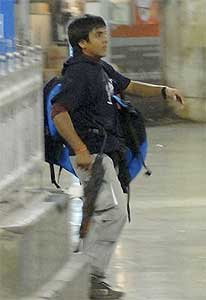
Pakistan has (once again, for the nth time) arrested Hafiz Saeed . This time the charge is “terror financing”. It should be clear to anyone who bothers to read a few newspapers that he was not hiding anywhere and did not need to be “found”. He has always lived and worked openly in Pakistan and this is not the first time he has been arrested (and may not be the first time he is let go after the dust settles and the IMF funds arrive). It is also worth noting that the charges have nothing to do with the Mumbai attacks and that the current military regime in Pakistan will not even admit that those attacks came from Pakistan. In fact their vast PR apparatus has successfully convinced many educated Pakistanis that the whole thing was an Indian (or Israeli) false flag operation and the attackers did not even come from Pakistan. While this is not the official stance of the government of Pakistan (which actually investigated the attackers to some extent under international pressure, and produced detailed evidence linking the attackers to Pakistan, including details such as where the boat was purchased and such like, and several people have been in jail at some point for their involvement in this attack), the domestic propaganda and management of witnesses etc  has been so effective that I regularly get whatsapp messages from friends “accusing” some Pakistani journalist or TV station of being Indian agents because they have said at some point that the sole surviving terrorist (Ajmal Kasab) was a Pakistani. As an aside, it would be interesting if someone can ask a senior member of the current military regime to publicly state on record that Ajmal Kasab was Pakistani. I doubt that anyone (except maybe Trump) can actually do this (i.e. I doubt that any senior official can come on TV and admit this.. it would be too far at variance with the domestic propaganda that ISPR has put out).

Mohammed Ajmal Kasab.jpg
Ajmal Kasab shooting civilians in Shivaji Train station

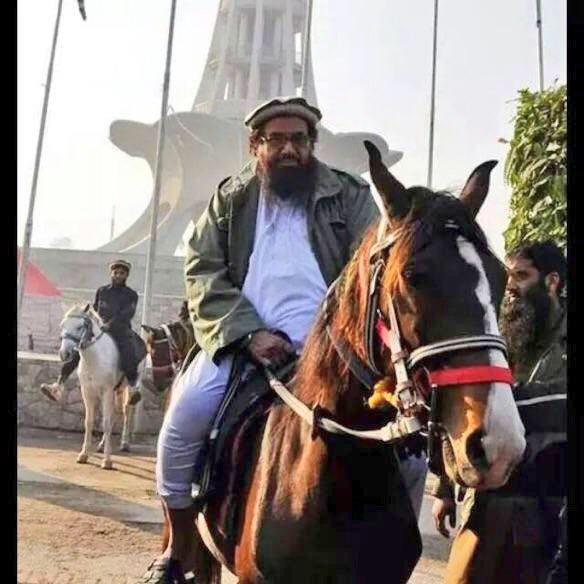
In 2014 Hafiz Saeed actually held a conference of his (renamed) Jihadi organization at the “minar e Pakistan” (Pakistan memorial) in Lahore and rode around on a horse to feel close to the spirit of the original Arab conquerors he idealizes.

Image result for hafiz saeed horse
Hafiz Saeed riding a horse at the JUD’s convention in Lahore in 2014

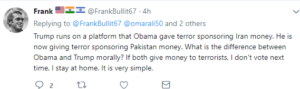
So anyway, everyone knew where Hafiz Saeed was, and even this latest arrest does not mention the Mumbai attacks, so either Trump is remarkably ignorant (possible) or he is just playing to his base, who love the whole “Western” movie ethos of wanted posters, dead or alive, manhunt, etc and finally, Sheriff Trump riding to capture the “bad guys”.  I find it hard to believe that even Trump can be ignorant enough to not know all this, so I vote for “bullshitting his base” as the most likely explanation for this tweet.

But while all this may be just show to get Pakistan off the FATF hook and to get some much needed cash (and maybe even weapons) from Trump, it is still hard to say who is conning who here. At one level Pakistan has “successfully” conned the US for 17 years and received billions in aid while supporting the Taliban and hosting multiple other Jihadi organizations. But it is hard to see this as a “win” for Pakistan. While Pakistan’s military regime (and this issue has ALWAYS been handled by the army, no civilian was allowed to butt in.. Mian Nawaz Sharif lost power for trying to minimally rein in this policy) has played these games and thinks it is winning, it has actually presided over Pakistan falling steadily behind India and even Bangladesh in every economic and social indicator. It would have been much better to swallow the bitter pill in 2001 and actually switch sides and give up on Jihad. By now Pakistan would be outperforming rickety India and even “rising star” Bangladesh in many areas. Instead, we have wasted a generation trying to play these games and may not have anything to show for it if this round of show arrests does not even get us off the FATF grey list (or worse, gets us on the blacklist).
Indians are (unsurprisingly) not delighted with this latest show of successful Pakistani conmanship (or even genuine change of heart), but in the proverbial long run, who gets the last laugh? India, a rising economic power in the world, or Pakistan, playing strategic games with multiple sponsors and just staying half a shaky step ahead of its multiple creditors?


Prime Minister Imran Khan on Pakistan National Day, in March.

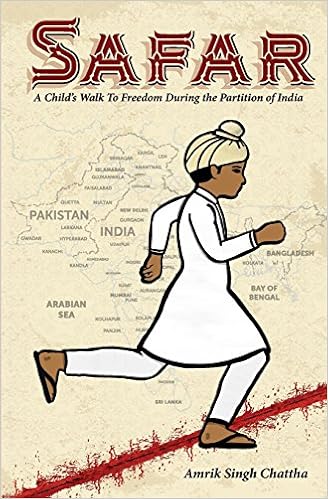
Browncast Episode 53: Memories of partition: Amrik Chattha

Another BP Podcast is up. You can listen on LibsyniTunesSpotify,  and Stitcher. Probably the easiest way to keep up the podcast since we don’t have a regular schedule is to subscribe at one of the links above.

You can also support the podcast as a patron. The primary benefit now is that you get the podcasts considerably earlier than everyone else. I am toying with the idea of doing a patron Youtube Livestream chat, if people are interested, in the next few weeks.

Would appreciate more positive reviews!

On this episode, we talk with Dr Amrik Chattha. Dr Chattha is the author of “Safar: A Child’s Walk To Freedom During the Partition of India“, available on Amazon. He talks about life in a Punjabi village before partition and the horrors that followed partition.

Pakistan’s Pseudo-Revolution Marches on..

Pakistan is at an interesting (and dangerous) juncture today; in 2018 the military used the many levers it has at its disposal to get Imran Khan elected as Prime Minister and GHQ continues to strengthen its grip on power, but that is not the interesting part. That is just the normal Pakistani cycle of semi-civilian rule followed by a phase of more direct military rule, followed by another attempt at civilian government; what is interesting is that a significant section of the emerging Pakistani middle class (“Mehran Man”) has managed to convince themselves that this time there will be a revolution: the violent overthrow of one social order and its replacement by a very different order.

GHQ probably had no such revolution in mind when they promoted Imran Khan and made him prime minister. Some civilian leaders were to be sidelined and some military leaders planned to acquire more direct power, and in order to do this they activated their vast public relations apparatus and talked of revolution and grand transformations, as one does, but no Bolshevik or Chinese revolution was actually in the works. There was probably some fear that the “war on terror” dividend is over and hard times lie ahead, so the state should be prepared for a period of harsher authoritarian rule (i.e. the opposite of a revolution; not a desire to change things but a desire to harden the existing order to meet anticipated challenges). Of course every time GHQ think tanks notice that Pakistan is facing a crisis, they tend to revert to the old “Chakwal solution” paradigm all officers apparently learn during basic training. This PMA version of “how to fix Pakistan” has not changed since the 1950s and includes ideas such as :

  1. Pakistan needs a firm hand (“shoot 5000 people and the country will become an Asian Tiger”)
  2. Presidential system
  3. 22 provinces (to break up existing pre-Pakistani identities such as Pakhtoon, Sindhi, Baloch etc)
  4. Get rid of corrupt politicians (ALL politicians are corrupt, but some join military regimes and are therefore excused)
  5. Technocrat government, etc

So I do not doubt that some of the planners at GHQ did have such “reforms” in mind and just as the cart follows the horse, new policy disasters will no doubt flow from the naive implementation of such “reforms”, but even so, no real revolution was intended, just some “tweaking” of the system.

But while the planners at the top may not have intended more than that, their propaganda seems to have created a number of excited middle class social media warriors who sincerely believe a revolution is in progress. They are cheering every extra-legal step, every fake drug bust and every suppression of dissent. And because the geniuses at GHQ are also human, some of this excitement is filtering back to the bosses and even they may get carried away and imagine they are leading the 1949 Communist revolution in China and not some Sisi-level military coup.  Which will be a tragedy because this is not a revolutionary party, this cannot BE a revolutionary regime; the same elite that was ruling the country yesterday is ruling it today. The social media warriors screaming for a revolution and “across the board” cleanup are not interested in seeing Uncle Jimmy or cousin Mithoo go to prison; they expect the revolution to hit other people (preferably “corrupt politicians”, i.e. politicians who have not thrown in their lot with GHQ), they do not expect their own friends and family to face some revolutionary tribunal in D-chowk. The status quo is meant to be improved, not replaced.

But humans can get carried away and this lot may have misunderstood their own position rather comprehensively. They may imagine they really ARE carrying out a revolution: the violent overthrow of one class by another. Some of them are surely sane enough to know this is just one more round of military rule and after it fails (as it inevitably must) they will have to compromise again with “dirty politicians” and restart the merry go round at 1988 or 2008, if not at 1970 (i.e. controlled democracy, with continued military domination of the heights of the state), but some of them do seem to be getting carried away. We may end up with the worst of both worlds.. The viciousness and disruptive destruction of an attempted revolution, without the creative energy and opportunities created by any genuine overthrow of an ossified ruling elite..
And if that is the case, then the corrupt status quo will evolve into something even worse: a corrupt narrowly based authoritarian regime that has destroyed existing politics (corruption ridden, but still somewhat responsive to public pressures) and replaced it with naked military rule over an unhappy population with no political safety valves and a worsening economic crisis.  They may then find themselves facing an attempt at real revolution.. and that will not be good for anyone.

There is still time. They can step back and let politics take its course and maybe a slightly more competent regime can come into power once PTI crashes and burns. But just writing this sentence is enough to make one realize that they are not going to allow any such soft landing. This time, we will get the full Monty, the chakwal solution in all its glory. It will fail amidst much pain and suffering; you know this, I know this.. but they don’t know this and they will not learn until things fall apart.
Sad.

Image result for rana sanaullah
Rana Sanaullah, PMLN Punjab Chief, in prison

By the way, here is Brigadier Ijaz Shah, GHQs main enforcer in the Imran Khan regime, giving his side of the story.

And here is the full ISPR version of recent events:

Good luck Pakistan-

Ordinarily I’m stuck between three teams, England (I don’t like failing the Tebbit Test), India (Vidhi) & Pakistan (apni Qaum).

So I don’t want to say anything to jinx Pakistan but I play pool the way Pakistan plays cricket, erratically with flashes of brilliance.

Between Marx and the mullah

There is a lot of talk on this weblog about deaths in premodern conflicts. I want to clarify a few points, at least from my perspective.

Both ancient DNA and conventional history and archaeology indicate that massive population turnovers occurred in the past. If you read a book like Genghis Khan: His Conquests, His Empire, His Legacy, you note that there is plenty of record of massacres and killings in targeted fashion during the Mongol expansion. The chaos and demographic collapse induced by the Mongols have been implicated in reforestation across vast swaths of Central Eurasia (which may then have produced climate change!).

We can also look to the deep past, and the more recent past. Latin America is characterized by incredible admixture between people of disparate ancestries. This is due in large part to 1) demographic collapse on the part of native peoples 2) migration of settlers from Iberia 3) transportation of slaves from Africa.

The evidence from Europe and South Asia is also strongly suggestive of massive population replacements. Depending on your model parameters about 50-75% of the ancestors of modern Northern Europeans who were alive 5,000 years ago had descendants who were intrusive to Northern Europe. Another way to say this is that 50-75% of the ancestors of modern Danes did not live in Denmark or nearby regions 5,000 years ago. A similar number for South Asia seems to be in the 10-30% range (again, depends on your model parameters).

This elicits the question: was there genocide?

The evidence from Latin America is clear. Though there was targeted genocide on the part of the Iberian conquerors, on the whole, the deaths were mostly due to the introduction of Eurasian diseases that resulted in a cascade of consequences which resulted in famine (the Black Legend is propaganda which has influenced our modern perceptions). When a human population lives on the Malthusian margin, small perturbations can result in death due to starvation. In the case of Latin America, it is known that incapacitation of a large enough proportion of prime-age adults due to illness resulted in famine, as crops were not planted or harvested in quantities necessary to sustain villages.

In other words, population collapse was a function of reduction in labor inputs into agriculture.

And, the reality is that the Iberian conquerors, who were often younger sons of aristocratic lineages, were not inclined to engage in mass-slaughter due to the reality of their aspiration of becoming rentiers. The importation of African slaves was to a great extent a direct consequence of shortages of exploitable labor (along with the humanitarian concerns of enslaving natives). Contrast this to the situation in the Phillippines or India, where Asian peoples provided resources to support leisure-seeking European elites.

A second fact is that premodern states were not capable of the sort of coordinated genocide that has been seen in the 20th-century. They lacked the weaponry, information technology, and organizational capacity to be particularly efficient. I don’t think it’s a coincidence that the coordinated genocides against Christian groups in the Ottoman and post-Ottoman realm occurred in the modern period (Armenians and Assyrians). The older Ottoman state was neither efficient enough nor did it have the means, to engage in total exterminationism (I also believe that 19th-century European-style nationalism probably made exterminationist feelings more ‘justified’ as well).

Probably the best premodern instance of ethnic cleansing we have on record is the Spanish expulsion of the Moriscos, which occurred on the basis of presumed blood lineage, not belief (e.g., many sincere Christian Moriscos were expelled as well!). But, that effort was incomplete and patchy, effective in some areas, totally ineffective in others, and haphazard in the criteria utilized (e.g., many people with Morisco ancestry were not expelled, while families which had been sincere Christians for generations were expelled).

Which brings me back to the earlier cases. What happened in Europe and India to induce population change?

There are several things going on in my opinion. First, not all late Neolithic/early Bronze Age societies had developed an ideology of elite exploitation to the level that we’d take for granted in the modern world. By this, I mean that the leaders of these agro-pastoralist societies may not have viewed farmers of different ethnicities as potential subjects, and so wealth. In conflicts between hunter-gatherer populations often warfare results in very high mortality rates, with young children and young women of the losers assimilated into the winners. There was no ideology of group assimilation for young men into an alien population, and in societies without specialized professions and economic systems, these men might not be seen as valuable in any sense except as consumption slaves (servants for powerful people, not economic producers).

In other words, conflicts between primitive societies can be thought of as “animal conflicts,” where two groups fight over resources and don’t view the losers of the other group as resources. In contrast, societies over the past few thousand years have tended to see the defeat of the enemy as a potential for elites to accrue new subjects from which they can extract rents. This was one of the arguments made to Genghis Khan by one of his Khitai advisors as to why he should not clear the land of northern China of people so as to create pastures for horses and sheep. People were more valuable than horses and sheep. He would be richer with more people.

Of course, these are people with spears (and later swords). I don’t think that most of the demographic collapse was due to direct killing. Rather, people living on the Malthusian margin, especially the sort of late Neolithic farming that was likely marginal in Northern Europe, were likely subject to the same famine dynamics as occurred in the New World. The IVC zone in South Asia was clearly more advanced, but it too many have been relatively fragile in comparison to the agricultural regimes of later South Asian societies.

The final issue is looping back to Muslims. Did they commit genocide? Did they exterminate the local populations? Probably. But, 95-99% of the ancestry of South Asian Muslims is the same as that of South Asian Hindus of the same region. Unlike the incursion of Indo-Aryans, the arrival of Muslims, mostly Turks, Afghans, and Persians did not have a major demographic perturbation in a direct sense (indirectly, technology and organizational skills introduced by Muslim elites may have resulted in disparate demographic growth of different regions in South Asia; e.g., Eaton’s argument for the expansion into eastern Bengal).

Additionally, Islam as a dominant ideology developed during the high-tide of rent-seeking elites. Though Muhammad’s status as a merchant meant that the religion was never constitutively anti-mercantile, conquest elites invariably aimed to extract wealth out of conquered populations. Arguably, the development of Islam is a direct consequence of how lightly Christianized Arab conquest elites developing an ideology which justified their extraction of rents (“protection taxes”) from conquered populations,  as well as maintaining their separateness and distinctness.

In the Indian context, many will point out that Islamic chroniclers note the despoilation and slaughter upon the local population. I would suggest that one be cautious about the propagandistic nature of ancient conflict and war (this begins with the Battle of Kadesh). Ancient chroniclers seem to have exaggerated numbers and effectiveness routinely. At least in the early modern period, most casualties due to battlefield injuries were the consequence of infection, not immediate trauma. Similarly, I suspect that the depopulation of an invaded region was more likely a consequence of the disruption of local social fabrics more than direct killing with arrows, swords, and spears (killing people expends a lot of energy and is risky).

Because of the nature of this blog, of course, this post ends with the arrival of Muslims to India. The stupid and the disingenuous (or a mix of both) seem to fix on two extreme positions:

  1. Muslims arrived and ushered in an orgy of slaughter driven primarily by the motive of oppressing the kuffar
  2.  Turks arrived in India, and like earlier invaders aimed to extract resources and dominate the location population
These caricatures serve ideologies but don’t describe reality. Both materialist and non-materialist motives need to be considered. The chroniclers of the arrival of self-conscious Muslim military forces to South Asia clearly wished to present it as an ideological and religious act. These were ghazis, just as far to the west, the Ottomans began as ghazis. But it is also impossible not to notice the family resemblance of Muslim Turks moving into South Asia in the centuries after 1000 A.D. with the invasions and conquest of China by Turkic, Mongolic and Tungusic peoples in the centuries after 1000 A.D.

Not surprisingly, the Khitai, Jurchen, and Mongols, all made some ideological claims for their acts of aggression of conquest, often post facto and tenuously. The Khitai and Jurchen integrated themselves into the Han Chinese worldview and presented themselves more worthy stewards of the Mandate of Heaven than the Song rulers of China. The Mongols also did this, though perhaps even more foregrounded was their own peculiar ideology than their sky god had given the whole world to them to subjugate (the Mongol Yuan dynasty also gave special consideration to Tibetan Buddhism, which alienated their Han subjects).

But of course, we would notice that the major consequence of the Mongol Yuan dynasty was the transfer of resources from Han Chinese elites to arriviste Mongol elites. The overthrow of the Yuan resulted in the expulsion of the killing of many of these hated Mongol landlords. Ideological rationales were given, but the memories of Han elite dispossession were fresh.
And yet despite the fig-leaf that ideology provides, differences may result from such distinctions. The Khitai and the Mongols were more punctilious is differentiating themselves from their Han subjects than the Jurchen. They maintained their separateness due to their reduced respect and veneration of Confucian norms. And, notably, the philo-Sinic Jurchen were assimilated into the Han to a far greater extent than the Khitai and the Mongols.

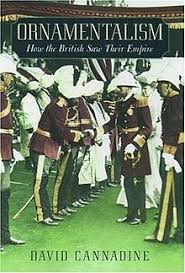
Similarly, in South Asia, the ideological distinctions between the rentier class of Turks and West Asian Muslims, and native Indians was sufficient for the absorptive process to halt. Synthesis occurred. But amalgamation did not proceed to completion. In David Cannadine’s Ornamentalism the author argues that the religious difference was also the key reason that the Indian elite, Muslim, Sikh, and Hindu, did not intermarry with the British gentry.

The various arcs of history cannot be easily defined by grade-school level Marxism, or internet Hindu level psychoanalysis. In all regions that self-conscious Muslim conquest elites established themselves, their sense of distinctness, superiority, and God-given right to rule are clear. But, all these groups, whether it be the slaving regimes of Arabs in East Africa, the Ottomans in the Balkans, and yes, Muslims in South Asia, exhibited a strong orientation toward pragmatic exploitation of the riches of the regions which they conquered.

Addendum: I’m going to delete stupid comments. This means if you leave a 2,000-word comment that’s stupid, it will be for naught.

My letter to the Cambridge Union

Dear Sir/Madam,

Hope you are well. I wanted to make a complaint about today’s event.

There was a Pakistan Society Event at the Union “the Asif Khosla talk.” Many of my friends were going to it and I had decided to come along. 

At the door I was stopped by one of the girls and asked for my student id. I explained to them that I wasn’t a student but I was told about the event from my friends at Pakistan Society and asked to come along.

My wife is also a PhD student at the University and accordingly spouses are allowed at University events.

At that point the gentleman (a young white student of around 20) just asked me to leave saying it’s for students only.

I later found out many non-students were there but it was rather humiliating and demeaning to be asked to turn around in front of my friends. I could have argued with them but it just felt so unnecessary and it seemed like he was on a power trip.

It’s upsetting to see that not only did the usual Town-Gown divide raise its ugly head (even though within the University statutes I have the same rights as the spouse of Gown) but it felt there was an additional race divide.

I feel if it had been Pakistanis gatekeeping; there would have been so much more sensitivity shown in the matter. I felt that either I was a terrorist or some hoodlum trying to barge the sacred gates of the Union.

The irony is of course I was speaking at the Union for Majlis in March; if it’s going to be such an unfriendly environment that only the privileged feel welcomed then all cries of accessibility ring hollow.

I’m a respectable Brit-Pak professional at 34; I don’t have the heart to continue being barred and demeaned by a 20year old white Male student on a power trip arbitrarily applying the rules.

I write to you to express my dismay and regret. Initially I wasn’t going to do anything about it but after speaking to a good friend at the University, who happens to be tenured faculty in STEM; at their urging they asked me to write to the Union (and Varsity- however I’ve omitted them) as a first step to redress.

I look forward to hearing back from you.

Best,

Zach

To understand Islam one must understand religion


Over the last few months, the traffic on this website has increased. The proportion of pageviews from India is now approaching parity with the proportion from the USA. To me, this suggests that perhaps it would be useful to outline a few things anyone who has read me in the past would probably know, but new readers will not know. I am in particular aiming this post to moderately above average intelligence readers, such as “Scorpion Eater.” Someone used to being the “smartest person in the room” due to the normal mediocre company of the unread or dull. The sort of person who leaves long comments on other peoples’ posts or articles. There’s a reason they aren’t writing anything original themselves.

In addition to being moderately intelligent, I also want to target the “internet Hindu” segment of the audience. I don’t mean the term pejoratively here, but more as a bracket for a wide range of people of different stances. One of the strangest things about internet Hindus in my experience is that:

1) They, like many Muslims, believe Islam is a religion of preternatural characteristics

2) Despite not being Muslim, and often hostile to Islam, they are convinced they know all about Muslims and Islam, even better than people who might be Muslim or of Muslim origin. They can get themselves inside the minds of Muslims

An analogy might be talking to a white nationalist who is convinced of the unique prowess of black people and seems inordinately confident that they know more about black history than black people themselves.

One thing that both internet Hindus and many atheists have in common is they lack a good intuitive feel for the phenomenology of religion. An internet Hindu or a village atheist will respond to the question of “what is Islam” with “read the Koran!”

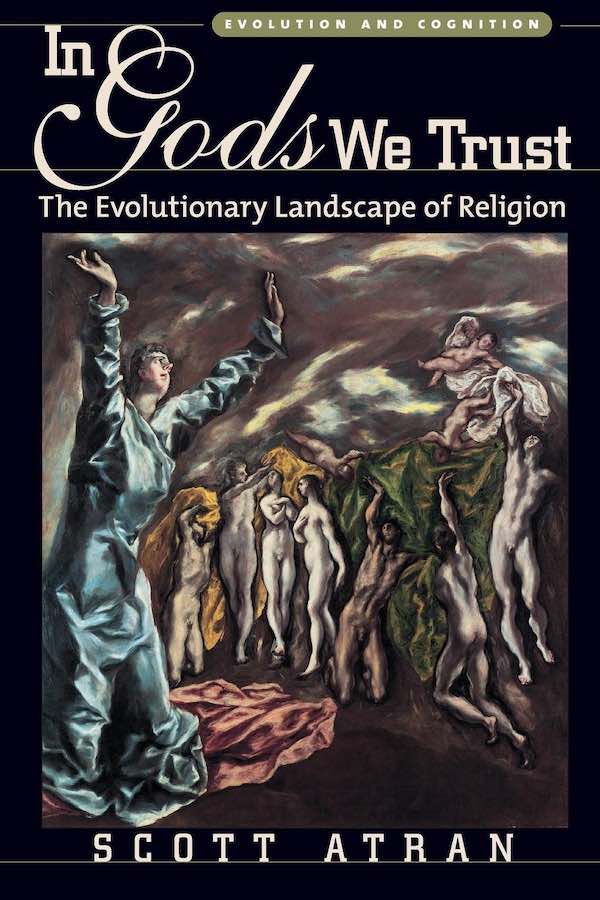
I was myself a typical village atheist, or more precisely a philosophical atheist (I had read books like Atheism: a philosophical justification and The Case Against God) in 2003 when I read Scott Atran’s In Gods We Trust: An Evolutionary Landscape of Religion. Atran is a cognitive anthropologist, who treats religion as a natural phenomenon. He is part of the “naturalistic paradigm” within anthropology. A small group of scholars, these intellectuals bring a multi-disciplinary framework to analyzing human cultures, with a strong theoretical basis in cognitive science and evolutionary biology. This is in contrast to the more common “thick description” that is the norm in much of modern anthropology,  which offers few broad generalities (or a Marxist viewpoint, which offers the same generality).

In Gods We Trust is a very dense book. Religion Explained is a similar work but written a bit more accessibly for the lay audience. But you get the picture.

What is the biggest takeaway from cognitive anthropology and religion? That religious phenomenon can best be understood as a manifestation of common psychological intuitions. The reduction of religion to complex theologies is to a great extent a propagandistic narrative promoted by religious professionals, who have written the histories of religion for the past 2,500 years. Those who exhibit mastery of texts, and dispense ritual, will naturally reduce religion to texts and rituals. That’s what they control.

But the underlying psychological impulses remain. This explains why “atheistic” Communist societies so often develop personality cults of charismatic leaders. The religious impulse is simply projected upon a different target.  Strip away the books and the incense, and the human mind still has as the basic fundaments of the religious phenotype.

How does this apply to Islam? In the book Theological Incorrectness, the anthropologist D. Jason Slone reports on his fieldwork in Sri Lanka amongst Theravada Buddhists,  Hindus, and  Muslims. Using psychological experiments, which remove participants from easy to comprehend cues and scripts, he showed that all three religious groups had the same conception of god(s). This is interesting, because, in theory, Hinduism and Islam have different conceptions of gods, while Theravada Buddhism deemphasizes gods.

One reaction to these findings, which tend to be cross-cultural (that is, humans tend to have the same conceptual framework for a god despite theological distinctions), is that believers misunderstand their religion.  I think a better interpretation is that religion can be thought of as two tracks, a conscious verbal track, which is quite superficial, and a deep cognitive track, which is harder to elucidate but primal and universal.

To illustrate, most Christians believe in a Trinitarian God, three persons with one substance. But this is really just a verbal script.  Most Christians don’t even know the technical philosophy of substances and essences which serve as the basis for the Trinity.

All of this brings me back to Islam and the internet Hindu. Muslims are wont to promote a story of a miracle in the Arabian desert 1,400 years ago, and the emergence of the armies of Islam from that desert with Koran in hand. Soon they accomplished a conquest of Persia and much of the Roman Empire.  This incredibly violent and organized religion then smashed against India and raped and assaulted the Hindu civilization. Finally, the assault ended, and India recovered,  though Islam is still a specter haunting South Asia.

I have a revisionist take. I think the most probable model is one where Islam developed organically in the 7th and 8th centuries after the conquest of the Arabs. The Arabs were probably something close to what we’d recognize as heretical Christians but developed Islam to separate and elevate themselves from their subjects. More precisely, Sunni Islam cannot be understood until deep into the 9th century, after the Mu’tazilite period, and the rise of law as the dominant tradition with the Islamic sciences.

The Koran cannot explain Islam because most Muslims were and are illiterate in the Arabic of the Koran, and Islam itself did not develop in its full form until well after various elements of the Koran had already come into being. The weakness of scripture in predicting religion can be illustrated by the fact that the Hebrew Bible is more violent than the Koran,  but Jews have been relatively pacific since the 2nd century A.D. (the reality of two failed rebellions left its mark on Jewish memory).

Of course, Muslim fundamentalists will tell you this is nonsense. That their religion is all about the Koran. That it’s a special religion.   And the internet Hindu agrees.  It is special (though in their case not a “good” way).

I am skeptical of that. I agree with Samuel Huntington’s empirical observation that “Islam has bloody borders.” At least today. But I would offer caution on chalking it up to something primal. In 1900 we might be wondering about in Jesus Christ’s message made it so that Christianity was an imperial religion of world domination and hegemony. Today we would laugh at that.

Note: I’m usually pretty lax about moderation on this blog, but if you are stupid, and you probably are, I will like trash your comment.  This post exists mostly to familiarize people with books.

Brown Pundits