Nasim Zehra’s Book on Kargil. Review by Maj Amin


Review from Major Amin. 

NASIM ZEHRAS TOO LATE AFTER THE EVENT KARGIL BOOK ANALYSED

Agha H Amin

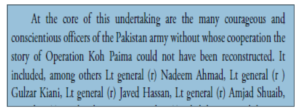
My first issue with this book is that analysis delayed is analysis lost and Nasim Zehra is guilty of publishing this analysis some 20 years late. Before that she was in the good books of many culprits of Kargil who 20 years later are fired cartridges with near zero nuisance value. More seriously, I take analytical as well as conceptual dispute with her in regarding characters like Lieutenant General Javed Hassan as “ courageous and conscientious”

Continue reading Nasim Zehra’s Book on Kargil. Review by Maj Amin

An apology to Brown Pundits

My quick Election 2019 reaction article “The rock that broke liberalism” in the local English daily Dhaka Tribune seemed to have blown up in social media. As I woke up this morning, the article has nearly 9000 shares and still growing by the hour. Most probably the blow-up happened because some prominent Indian media personality with lot of followers shared the article.

I want to apologize here to BP and also to Omar Ali bhai for not mentioning Brown Pundits or his his name directly. Althought by mentioning the key words in the BP 2016 article and also the thesis question, I made it very easy to find the article with minimum enterprise through Google search (Links at the end). I wrote the article with Bangladeshi audience in mind, I did not expect it to go ‘international’. Thus I unintentionally deprived Brown Pundits from some desereved publicity and Omar Ali bhai from due direct recognition.

The reason why I was shy about mentioning Brown Pundits is that I wanted to keep my column writing profile in Bangladesh and occasional Brown Pundits contributor and commenter seperate. Firstly, I regard BP as a forum where one can freely speak their minds about sensitive issues (very unwise I know. In internet nothing is safely hidden and everything is permanent). Secondly, as a Bangladeshi who wishes to travel to home country regularly, speaking freely about sensitive issue is a very ill-advised for me. Thus my reluctance to let my contributions/ comments in BP be known among home-circles.

This is the dilemmna of the era for us. We want to talk, yes just talk, debate, analyze, about issues that interest us but there are great number of people from all sides for whom talking freely is the biggest existential threat in the world. Of course Razib is a prime example of the reality of the threat. Awarded NYTimes op-ed contributor just for a day because the internet outrage mob mobilized in milliseconds.

https://www.dhakatribune.com/opinion/op-ed/2019/05/25/the-rock-that-broke-liberalism

Is Islam the rock on which the liberal order broke?


Pakistani women, Chinese men, the continuing story….

The New York Times has a follow-up story with some nuance, She Thought She’d Married a Rich Chinese Farmer. She Hadn’t.

Now there is coverage of Muslim girls going to China. The model is the same as the Christian girls, rural Chinese men who aren’t as wealthy as they present themselves, go through nominal conversions or affirmations of faith, and take the women back. Here for me is the interesting part:

Then, after a four-hour drive past fields of wheat and corn, they arrived at Dongzhang village in Shandong Province, where she saw her husband’s duck farm. It was not the sprawling operation of a wealthy man that she had envisioned, but a modest family farm where he lived with his parents and two brothers.

The New York Times was unable to independently verify Mr. Zhang’s income. But on a recent visit to the Zhang family home, a Times’ reporter found a newly built housing compound with multiple bedrooms and shiny tile floors.

Outside the family home, Mr. Zhang’s mother, who is in her 60s, recalled being puzzled by Ms. Kanwal’s reactions.

“She is religious, so when she came here I went out of my way not to give her any pork,” she said, as a small guard dog barked nearby. “I stir-fried chicken and made egg omelets for her. But no matter what I served her, she just refused to eat.”

Some of the more sordid stories of prostitution are likely true. And, it seems from the story above that some of the girls who moved to China are pregnant, and reasonably happy where they are. But many of the stories are grayer and not so clear.

The mother-in-law above seems well-meaning, after a fashion, but one can see the perspective of a young Muslim girl from Pakistan, encountering a world filled with pork, dogs, and without the washing facilities she was used to. Additionally, the reporters seem to agree that the farmer was prosperous, if not necessarily wealthy. With no real linguistic common ground, it’s pretty easy to imagine that wires could get crossed her. The huge cultural chasm, where most Chinese do not take religion that seriously, is probably almost impossible for a Pakistani girl from a non-cosmopolitan background to fathom.

Right now these stories are exotic. But if more and more girls stay and settled down in China, that will result in positive word of mouth. The precedent with other Asian countries is tragic and horrible stories will continue. But that may not be the whole, or the main, story.

A quick reaction to Indian Election

I wrote the following article for one of the English daily newspapers in Bangladesh. The main idea is directly borrowed from a very good post in Brown Pundits (2016) by always superb contributor Omar Ali bhai.  “Is Islam the rock on which the liberal order broke?”  https://www.brownpundits.com/2016/12/05/islam-is-rock-on-which-liberal-order/

Link to my article here.  Text follows. Just as a reminder, newspapers op-eds are not suitable place for good elaboration and defense of ideas. This is not an analysis or theorizing, just a reaction.

The rock that broke liberalism

https://www.dhakatribune.com/opinion/op-ed/2019/05/25/the-rock-that-broke-liberalism?fbclid=IwAR3cQVWjO1PYe6muE33Dijy44kR90fJRH1Iv6UBqS9KYqHr9e7AlTHKjvdo

I was watching live streaming of the India Election 2019 results on the NDTV website. Panelist after panelist was commenting on how significant were Balakot strikes in boosting BJP’s re-election prospects, and how ignorant are the liberal elites of India about the appeal of national identity among the masses.

This was NDTV, as a reminder, one of the citadels of India’s liberal elites. BJP’s triumphant re-election under Narandra Modi underscores the wave of right-wing populist nationalism sweeping across democracies of the world — Europe, Australia, Latin America, the US, Asia, maybe soon in Canada also.

With every election, every referendum taking place in established democracies, it is becoming apparent that this wave may not be just yet another right turn in the cycle of politics soon to be corrected by pivot to the left, but a fundamental shift in the people themselves.

A couple of years ago, in a South Asia focused blog I frequent, a much-admired Pakistani-American writer wrote a post posing a great question: “If and when modern humanism and liberalism crashes and burns, will future historians look back and say that Islam was the rock on which it first and decisively broke?”

His point was not that Islam single-handedly threw a powerful challenge to the liberal order, or “end of history” would have been achieved if Islam didn’t throw a wrench into the gears of civilization.

He argued that by obdurate refusal to accept the fundamental assumptions of post-enlightenment worldview, by obstinate resistance to assimilate with the mainstream when in the minority and by dogged persistence in recreating antediluvian theocracies when in majority, Muslims not only undermined the universal validity of the whole liberal project, but also sowed deep doubts about the liberal project among its previously most faithful adherents.

Muslim recalcitrance has hastened delivery of the contradictions that the liberal project was pregnant with from the beginning.

And the contradictions are huge indeed. The liberal order is prone to breakdown because it doesn’t sufficiently account for the fact that human nature itself is broken. People are not just utility or satisfaction maximizing beings. Enjoyment and suffering are intimately co-mingled.

People do not just want to reach heaven together; they want some, preferably who are somewhat different, to be confined to hell as well. Apart from the contradictions, surely undercurrents of technological and economic change, the shift in global power balance, the inevitable decay of political order, played a far more important role in undermining the liberal dominance than obstinate resistance of the followers of Islam?

However, it’s hard to deny any causative role of Islam. The emergence of right-wing, national identity politics was perhaps inevitable in India, but BJP’s astonishing dominance must be partially attributable to Pakistan’s persistent spoiling and nightmare-neighbour role? Right-wing majoritarians everywhere are scapegoating Muslims as the principal other; morality of their methods can be questioned, but the success cannot.

Moreover, I would argue that Islam has not undermined the liberal order by sowing doubts within liberal ranks or exposing its contradiction, it has weakened liberalism by emboldening and consolidating the enemies of liberalism in established democracies which were scattered and disheartened after the bloodbath of WWII and subsequent emergence of liberal world order.

Stubborn defense of group identity by Muslims of the world has made upholding group identity respectable for all groups, majority or minority, powerful or weak. In the age of mass politics, group identities like religion or nation have more elements in common than in difference. If Muslims can be unabashedly assertive about the sanctity of their religious identity and traditions, other groups can be unapologetic about their respective identities too.

Muslims may be a small minority in most of established democracies, but they comprise nearly one-fourth of humanity, and they have a very emphatic presence in Asia, Africa, and parts of Europe. To people of different faiths, Muslims, regardless of their actual numbers as minority, represent the much talked-about demographic threat from the south.

Muslims, whether in majority or minority, are on the other hand deathly afraid of the political, cultural, and economic threats emanating from the leading political and ethnic groups of the world. It’s a mutual cycle of fear spiraling downwards. Muslims cheering the probable demise of a liberal world order is the height of folly.

As the world’s most powerless and disunited major group, they will continue to pay the major price of breakdown in blood and misery. Uighurs of China portend that bleak future.

In established democracies, Muslims are generally politically allied with liberal progressives, and this alliance has opened liberals up to accusation of double standards in protecting a very illiberal minority identity. Abandoning universalism and embracing identitarianism is hollowing out liberalism from within. Either the principles of liberalism apply for all groups or none at all.

Browncast Ep 41: An Indian Muslim on Maharajah Modi

Another BP Podcast is up. You can listen on LibsyniTunesSpotify,  and Stitcher. Probably the easiest way to keep up the podcast since we don’t have a regular schedule is to subscribe at one of the links above.

You can also support the podcast as a patron (the primary benefit now is that you get the podcasts considerably earlier than everyone else…).

We speak to Jahanara, a Cambridge student who has extensive experience with the Delhi education system and who happens to be an Indian Muslim.

Image result for maharaja modi

I’m joined by MJ & LV (this is part 2 of Episode 38; I plan to do part 3 with Kushal of Carvaka) as we discuss the ramifications for India; it was a balanced podcast in the sense I felt that we respected all viewpoints and respectfully disagreed but enjoyed listening to one another.

As I alluded to in yesterday’s post; Jahanara is the “ideal Indian Muslim” by Indian standards. I don’t want to delve into her life details, to protect her privacy, but I can’t think of a prouder or more assimilated Indian. But it seems to me that her “Muslimness” is now almost being foisted on her; making her an incidental Muslim.

I get from the podcast that Indian Muslims, who are a multiplicity, are increasingly becoming a minority who have to prove their “Indianess.”

But listen to the podcast and make your own views. I did take LV & MJ to task for their “Hindu privilege”; a bit like white privilege, it’s so invisible in India that once can take it for granted.

I also called LV a Left-Liberal Hindu, her Hinduism isn’t necessarily important to her, but becomes an issue when she feels it’s being hijacked by Rightist forces.

So it was an interesting back and forth and as always I try to keep my views fluid so that the podcast can reflect the right balance of views. I did point out that Modi, in terms of his personal austerity and immense work ethic, is an enviable leader. He has no progeny to leave office to and no dynastic politics at work; he is all about the country. Incidentally Imran may be the same as I can’t see any of his three children succeeding him in terms of PTI.

I also feel that if India is heading towards the same type of governance as Pakistan (God forbid) then the idea that Hinduism is somehow manifestly superior to Islam is a bit weak. I do sense Indians want to keep the tagline of secular, liberal democracy but with overtly Hindu characteristics, which is fine albeit majoritarian.

MJ, as per usual, is off to good and great things; giving a speech today on Brexit and Dharma with Hindo Sengupta.

We would definitely appreciate more positive reviews. Many of you listen to us, but don’t leave any reviews!

Analysing The Election Podcast –

I woke up this morning to commentary on Episode 38:

https://twitter.com/bharat_policy/status/1130700354146971649?s=20

We had a bit of a twitter exchange though I find it odd that Aashish zeroed in on V by claiming that she was misinformed.

https://twitter.com/bharat_policy/status/1130830244603207680?s=20

I do not understand a community where the daughter is called Asifa Bano and the father Muhammad Yusuf are *not* Muslim. People who pray to Sai Baba retain Hindu nomenclature and would be understood to be Hindus.

To somehow *disregard* Asifa’s Muslim identity in an increasingly religiously identified India is irresponsible to say the least and to somehow only raise an ethnic angle is only part of the story.

Continue reading Analysing The Election Podcast –

Why I find it difficult to debate Hinditvas + liberal Zionists

It gets tiring that I have to constantly abuse Islam & Pakistan simply to avoid the allegation that I’m a double agent. Kabir actually makes a valid point; if India and Indians want to crow about their secular liberal democracy then they have to live up to those values.

Pakistan is not a secular liberal democracy nor is Iran. They are both Islamic Republics, which to varying degrees, reject the values of the Enlightenment. Now I may disagree with that and may want otherwise but this is the constitutional fiber of both countries therefore judging them on a different set of liberal Western values is not even wrong.

Before discussing Shariah or liberal democracies in the case of Irano-Pak; we would have discuss the type of government that they have chosen to have. Britain is technically a theocratic monarchy with an aristocratic upper house so it’s not necessarily that such types of government are incompatible with liberalism or democracy for that matter.

Continue reading Why I find it difficult to debate Hinditvas + liberal Zionists

Pakistan of the Provinces

We’re currently doing a podcast that is exploring Pakistan and China; I’m really shocked by what I’m hearing.

I predicted after last year’s Pakistan election that the Provincial Parties (which were dynastic) would set off against the military backed Imran Khan aegis (Madinat ethics).

I’m quite impressed by how Pakistan is transforming. I’m also a bit taken aback that it seems a Saffron wave is taking over India. Karan Johan is the last man standing for Islamicate culture in Hindustan.

Finally in Bilawal’s iftar; it’s interesting the Baloch and Pathan parties did not attend. Sindh & Punjab are vested in Pakistan but the periphery not so much (no word on MQM).

Bilawal also needs to lose 10-15kg if he wants to look Presidential whereas Maryam looks transluscent (she really lives up to the Kashmiri stereotype).

Brown Pundits