South Asia becoming more like the Middle East (in different ways)

NEW DELHI: Adultery must remain a punishable offence so the sanctity of marriage can be protected, the Centre told the Supreme Court today after a petition called for gender equality in the punishment for adultery. The British-era law on adultery says a man having sexual a relations with another man’s wife will get a jail term of five years and a fine. A five-judge bench is expected to hear the case.

The petition challenges the 157-year-old law on adultery and contends not just the man, but the married woman he has a relationship with must be punished, since she is the abettor and not a victim of the crime.

Pushing for a dismissal of the petition, the Centre said, striking down Section 497 of the Indian Penal Code and the Section 198(2) Criminal Procedure Code “will prove to be detrimental to the intrinsic Indian ethos which gives paramount importance to the institution and sanctity of marriage”.

Just to forestall any accusations of bias I thought I would excerpt what’s going on in the Land of the Pure:

https://www.facebook.com/Channel4News/videos/10153649028586939/

The story of Pakistan is the story of missed opportunities. I simply don’t understand why Pakistanis can’t get their shit together and get ahead. Venal elites, parasitic institutions and flawed ideologies make for a very toxic state..

Continue reading South Asia becoming more like the Middle East (in different ways)

Forbidden Fruit: Military and Politics in Pakistan (and beyond)

From Dr Hamid Hussain

While browsing through some old material, found an old piece written in 2003 when General Pervez Mussharraf had just completed the political engineering project. It is lengthy and indulges in some theories but gives some context to what is happening now. While pondering over it, I found words of Amjad Islam Amjad as best description;

Hum loog;

dairoon mein chalte hein

dairoon mein chalnen se

daire to barhtey hein

fasley nahin ghatey

aarzoen chalti hein

jis taraf ko jate hein

manzilein tammana ki

saath saath chalti hein

gard urhti rehti hey

dard barhta rehta hey

rastey nahin ghatey

subhe dam sitaroon ki

tez jhilmilahat ko

roshni ki amad ka

pesh baab kehtey hein

ik kiran jo milti hey

aftab kehte hein

daira badalne ko

inqilab kehtey hein

Enjoy if you have some extra time on hand.

Hamid

Forbidden Fruit – Military & Politics

Hamid Hussain

2003

Introduction

Politics and profession of soldiering has nothing in common. They are totally different but essential elements of any society. Politicians and soldiers have an interesting relationship in all societies. In societies where civilians are in control, military officers act in accepted boundaries though ready to defend their turf against civilian encroachment. In societies where political institutions are weak and there is lack of consensus on legitimate course of succession, soldiers gradually expand their area of influence. They gradually restrict the role of civilians in various areas and sometimes directly take over the state replacing the civilians. This generally accepted model does not mean that military as an institution has no relevance to the important policy decisions. Even in countries where the tradition of civilian supremacy is well established, military has a political role relating to national security, albeit a different one. One commentator has correctly pointed that “the military’s political role is a question not of whether but of how much and what kind”. [1]

This article will evaluate soldier’s attitude towards political activity and how it develops. This will be followed by the details of Pakistani experience of politicization of officer’s corps and how repeated and prolonged military rules have militarized the politics. In the end, the complex relationship between soldiers and politicians will be summarized. Continue reading Forbidden Fruit: Military and Politics in Pakistan (and beyond)

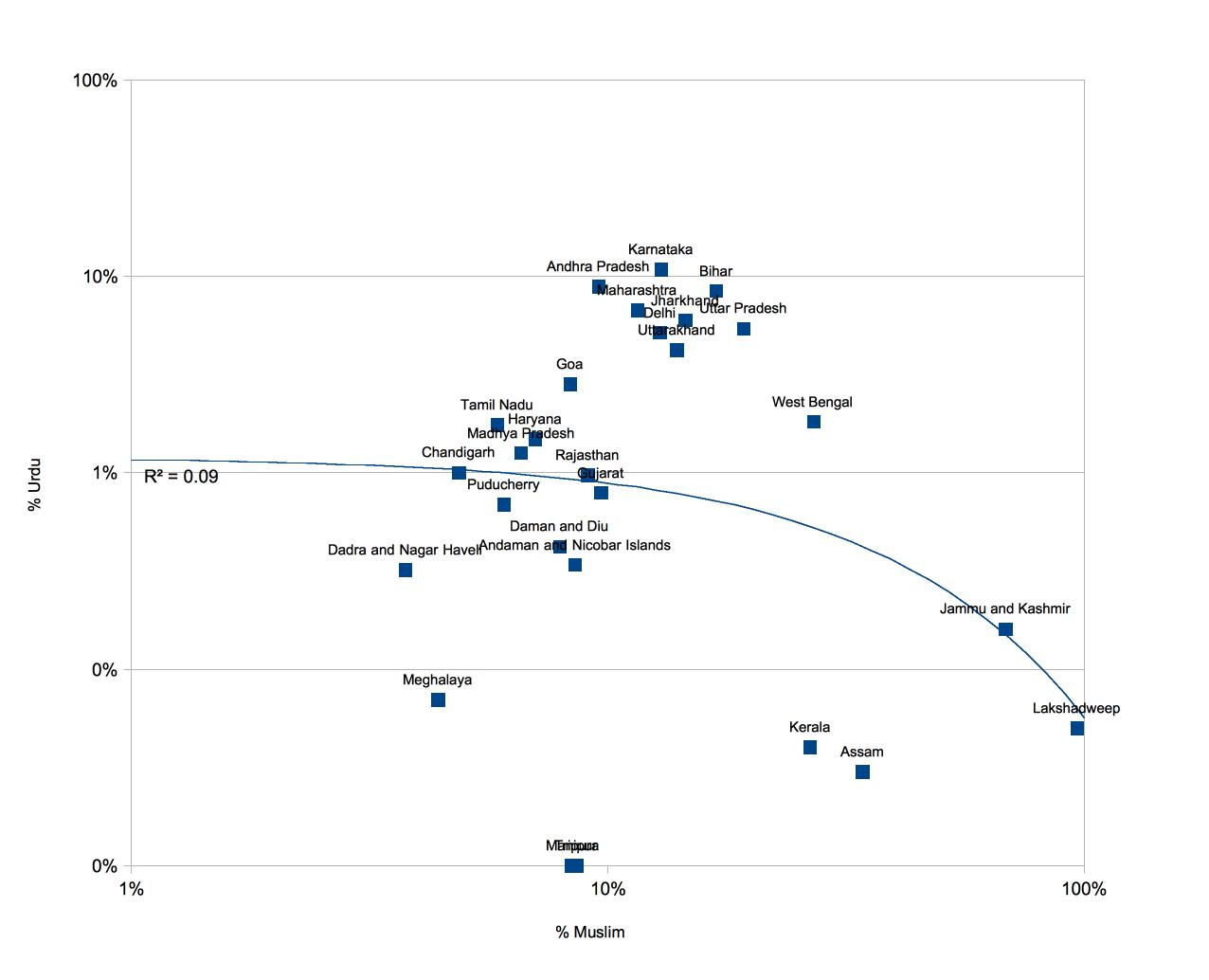
Muslims and Urdu in India

The plot above shows the % Urdu speakers vs. % Muslim in states where Muslims are 4% or more of the population. The data is from Census 2011 (thanks for Vikram of the language data). There are some interesting trends. Assuming that the vast majority of Urdu speakers are Muslim, it seems that in India the core Urdu-identified region is in the Deccan and to the east of its traditional heartland, in Bihar. In South India, 30% of Muslims in Tamil Nadu may be Urdu-speaking. But in Kerala the fraction is almost zero, while in Gujarat and West Bengal less than 10% of the Muslims are Urdu-speaking.

Below the fold is the table.

Continue reading Muslims and Urdu in India

Why do nonmuslims treat muslims so badly (a)?

Two of the world’s greatest and most beloved muslim leaders and scholars discuss the holy Koran, Hadiths, Pakistan. They discuss what being a muslim means.

34 minutes in, they discuss how Imam Ali went to Usman (also written Othman or Uthman) and presented him Ali’s copy of the holy Koran, also called the book of Ali or book of Fatimah. These were Imam Ali’s and Fatimah’s notes on the Koranic versus as they were revealed. As an aside Dr. James White and Jay Smith discusses how the holy Koran was composed:

Quietly Islamic scholars discuss this frequently but are afraid to discuss this in public for fear of retaliation at the hands of Islamist extremists. Please also watch the exceptional Islamic scholars Abdullah Gondal and Abdullah Sameer discuss the formation of the holy Quran:

After discussing the holy Quran, Imam Tawidi and Tarek Fatah discuss how and why Raswa Hind was written right after the holy prophet Mohammed pbuh passed away; which called for the conquest of Arya varsha (Iran, Turan, SAARC and related civilizations in South East Asia) and Asia. Tarek Fatah’s next book–“The Hindu is Not My Enemy”–elaborates on this. Many muslims believed that Pakistan was prophesied  in the holy Koran and by Mohammed pbuh because of Raswa Hind. Pakistani psychosis is discussed.

They mention how the numbering system of the Koran comes from India and how several of the Hadiths were written by muslims long after Mohammed pbuh passed away when muslims came to India–including the Hadith on how male monkeys stoned a female monkey for engaging in physical relations without formalizing her wedding with a male monkey  (at that time monkeys only lived in greater India).

They discuss the nexus of soft Islamists and their nonmuslim collaborators that now greatly influence and control America, Europe and much of the world. They often intimidate, oppress and harm patriotic good muslims. One of the ways they do this by accusing good muslims such as Tarek, Imam Tawhidi and Maajid Nawaz of being Islamaphobes. They are banned from many networks, publications, newspapers; and are on no fly lists. But despite this attempt by nonmuslims and Islamists to stifle them; their popularity and legitimacy among muslims continues to soar.

After watching this video, please see this very interesting discussion between the wise compassionate Jaʿfari jurisprudence extraordinaire Imam Tawhidi and the great atheist Bengali Islamish scholar Mufassil Islam moderated by Lebanese Canadian heart throb Gad Saad:

Continue reading Why do nonmuslims treat muslims so badly (a)?

Is Erdogan the Turkish Modi?

Erdogan has consolidated his power in yesterday’s election. This post was sparked by a Facebook friend’s (Indian Muslim) comment “why do Muslims in India hate Modi but love Erdogan.” Shashi provides some context here:

Comparisons are generally invidious, especially when they involve political leaders from different countries. But, while Turkish President Recep Tayyip Erdogan rose to power 11 years before Indian Prime Minister Narendra Modi, there is much about their personal and professional trajectories that makes comparison irresistible.

Both Erdogan and Modi come from humble, small-town backgrounds: Erdogan sold lemonade and pastries in the streets of Rize; Modi helped his father and brother run a tea stall on a railway platform in Vadnagar. They are self-made men, energetic and physically fit – Erdogan was a professional soccer player before becoming a politician; Modi has bragged about his 56-inch (142-centimeter) chest – not to mention effective orators.

Both Erdogan and Modi were raised with religious convictions that ultimately shaped their political careers. Erdogan’s Justice and Development Party (AKP) and Modi’s Bharatiya Janata Party (BJP) have both promoted a religiously infused, nationalist creed that they argue is more authentic than the Western-inspired secular ideologies that previously guided their countries’ development.

History has definitely not come to an end; Turkey and India (Israel/Hungary) seem to be on the vanguage of nationalistic revivals. Thankfully none of these countries border each other.

Related: Modi believed Vajpayee’s wooing of Muslims in 2004 was a fruitless exercise

Ps: All comments welcome except abusive or overwrought ones. Tone and tenor of any conversation (on my posts at least) must be calm and measured.

Why I don’t eat Pork

https://www.facebook.com/nasdaily/videos/1065986840220134/

This is a really interesting video because Nas asks the question that why don’t secular Muslims eat pork.

It taps into the old Jesuit saying “give me a child till 7 and I will show you the man.” In fact it’s supposedly Aristotle who said it but the idea that initial childhood impressions form our adult views.

Back to the questions of Muslims & pork; it’s the ultimate shibboleth. Allegedly Quaid-e-Azam ate pork; I don’t really know if there is a good quality pork in the Subcontinent but perhaps it was different in the Raj.

In all religions there is that red line of apostasy. In Islam it is pork, in the Baha’i Faith it’s alcohol, for Hindus it’s beef and for Sikhs I guess it would be not wearing the turban?

To requote the late & great Anthony Bourdain in his first seminal article all the way back in 1999:

Like most other chefs I know, I’m amused when I hear people object to pork on nonreligious grounds. “Swine are filthy animals,” they say. These people have obviously never visited a poultry farm. Chicken—America’s favorite food—goes bad quickly; handled carelessly, it infects other foods with salmonella; and it bores the hell out of chefs. It occupies its ubiquitous place on menus as an option for customers who can’t decide what they want to eat. Most chefs believe that supermarket chickens in this country are slimy and tasteless compared with European varieties. Pork, on the other hand, is cool. Farmers stopped feeding garbage to pigs decades ago, and even if you eat pork rare you’re more likely to win the Lotto than to contract trichinosis. Pork tastes different, depending on what you do with it, but chicken always tastes like chicken.

Continue reading Why I don’t eat Pork

Political Engineering in Pakistan Part II

From Dr Hamid Hussain.

June 12, 2018

Following piece is mainly the result of questions form non-Pakistanis to explain the context.  It may not be very interesting for Pakistanis as they are already well informed and it seems lengthy and a bit boring.  The noise is at a very high pitch making reasonable discourse very hard.  Reminds me tenth century Arab poet Mutanabbi’s words, “With so much noise, you need ten fingers to plug your ears”.   

 Summary could be single sentence quotes;

Political Leaders: Reminds me Liddelhart’s words “The prophets must be stoned; That is their lot, and the test of their fulfillment.  But a leader who is stoned may merely prove that he has failed in his function through a deficiency of wisdom, or through confusing his function with that of a prophet”.

Generals: The Times, April 6, 1961 issue statement that “it is difficult to envisage some thirty or forty generals and a smaller number of admirals and air force commanders appointed solely by Providence to be the sole judges of what the nation needs”.

Judiciary: Jorge Ubico of Guatemala’s words that “My justice is God’s”.

Enjoy.

Hamid

Political Engineering – Modus Operandi

Hamid Hussain

“The establishments in the US, Pakistan and India are usually working for their own good rather than for the good of their public.  Shaking them might not be a bad idea”.  Former Director General of Inter Service Intelligence (ISI) Lieutenant General (R) Asad Durrani quoted in Spy Chronicles

Pakistanis will be voting for general elections on 25 July 2018.  Events of the last one year have raised many questions about the process. The gulf between important institutions is widening by the day.  Attitudes have hardened and everyone is rallying behind their respective wagons.  Pakistan’s power stool is three-legged and at one time known as ‘troika’.  In the past, President, Prime Minister and Chief of Army of Staff were the three legs of this stool.  Change of President to a ceremonial role by taking most of his powers removed this leg. In due course, this leg was replaced by Judiciary. The three legs are uneven with executive as shortest, followed in size by Judiciary and then army.  There is an inherent element of instability in this arrangement.   Continue reading Political Engineering in Pakistan Part II

Book Review: Ye Khamoshi Kahan Tak (Silent no more?) by Lt Gen (Rtd) Shahid Aziz

The late great Asma Jahangir once described Pakistan’s generals as ‘duffers’ on national TV. While it would be disingenuous to generalize a whole group as duffers, one can infer that within a strictly hierarchical structure as the army, loyalty to the force and to the commanders is considered a greater asset than intelligence or aptitude. A better experiment would be to take a look at the books written by various retired generals through the decades and reach a conclusion. It can also help us understand what type of characters are highly valued by the institution and thus given promotions. Many of the earliest officers in Pakistan Army wrote their memoirs including (but not limited to) General Ayub, General Sher Ali Khan, Air Marshal Asghar Khan and General Gul Hasan.  General Sher Ali Khan was an ‘ideologue’ of the elusive ‘Ideology of Pakistan’ while Ayub Khan and Asghar Khan had slightly more pragmatist views in that regard. Lt Gen Shahid Aziz belonged to the former category. According to his account, he was an honest officer who always put the interest of institution before any other interests.

He described himself in the following words in his book:

“Why am I full of contradiction? Why can’t I be balanced? Then I console myself with the thought that a pendulum has a balance too; what use is a balance that is static and frozen? Real balance is in movement. One should be flying back and forth on a swing.” (Translation: Khaled Ahmad)

Reading the book, one gets the impression that he was slightly more PakNationalist than the average military Joe and his levels of self-righteousness were high enough to prompt him writing that book. He knew exactly what he was doing and was a man of his (however flawed) convictions. He was the kind of guy who refused to vote for Zia in the sham referendum held in 1984, despite being asked by his superiors in the military, the type of officer who wouldn’t display a star and Pakistan’s flag on his staff car.  Musharraf obviously was wily enough to see through Shahid Aziz’s simplistic stupidity and didn’t promote him as the Vice-Chief of Army Staff. You can see his cognitive dissonance in the book that he has no shame (or self-awareness) appropriating Faiz’s work (the book is littered with poems by Faiz and Ahmad Faraz, both of whom were harsh critics of despotism and military rule in Pakistan and left the country rather than stay under a military dictatorship).

I think he’s the ultimate Nasim Hijazi character (Man on a white horse), someone who imbibed the whole PakNationalist Muslim narrative and decided to live accordingly. By PakNationalist Muslim narrative, I mean believing wholeheartedly in the ‘Two Nation Theory’, believing in conspiracy theories that the US-Israel-India nexus is constantly working to undermine the sovereignty of Pakistani state, holding the military at a higher pedestal than politicians and believing that Pakistani Islam is supposed to save the rest of Muslim world. Throughout the book, he refers to Taliban (of any variety) as ‘Mujahideen’, without any shame or remorse. His view about Pakistani Taliban (TTP) is the following:

“The bombs that kill innocent Pakistanis in bazaars and mosques are planted by friends of America, and this terrorism is done to persuade Pakistan to embrace America more closely, allow the government to pursue pro-America policies, and to alienate Pakistan from the mujahideen. But this trend of support to the killers of Muslims is an open rebellion against Allah.”

In the book, he mentioned two instances during his training in the US when he was approached by people who wanted him to leave Pakistan army and join the US army in the same position that he held in Pakistan. This sounds preposterous because you need to be a green-card holder or a national to enlist as an officer and you can’t be inducted straight as a commanding officer.

One of the more interesting (but not completely unsurprising) aspects of his book was the discussion of nepotism and corruption within the ranks of the army (especially corruption during weapons procurement and the way DHA scams people). Such things, if ever pointed out by civilians, would constitute heresy and treason. Another aspect that intrigued me was his criticism of war tactics during 1971 (he fought along the Kashmir border) and during Kargil (when he was part of ISI).

The most useful part of the book is when he discusses his role as a first-hand observer of Musharraf’s coup and its aftermath. He was also part of the team that selected people for running different ministries under Musharraf and he spilled the beans on how Ministers of Finance, Commerce, Trade, Industry, and Petroleum were ‘pre-selected’ and Shaukat Aziz never even appeared before the interview panel. He was initially optimistic about the monitoring mechanism put in place to hold the relevant ministers accountable but things didn’t work as smoothly or ideally as he wished. He laid the blame squarely at Bureaucracy’s feet.

His thoughts post-9/11 were:
“After 9/11 the bitter reality of a unipolar world was exposed. This incident happened under suspicious circumstances. A lot of American experts claim that this incident was orchestrated by American Intelligence Agencies and Jewish terrorists”.

He was bitter about the fact that Musharraf allowed US forces to use some of our Airbases (Shamsi, Zhob, Dalbandin, Jacobabad). He also mentioned how Indians sneaked into Afghanistan right after the organisedUS-led operation and took over TV stations in Kabul. According to his account, American forces didn’t keep Pakistan informed regarding their hunt for Al-Qaeda militants and knowingly pushed then towards Pakistan. About the first encounters between SSG unit and Al-Qaeda militants, he was full of praise for the militants and commented: ‘how can you compare a salaried individual with a guy who is looking to be martyred?’

Regarding the Indian Parliament attack in December 2001, he had this to say: “After The Delhi bomb attacks, Pakistan was accused in the world as a terrorist haven. This was a ridiculous claim. By that time, Pakistan had ceased help to Kashmiri Mujahideen. ISI was strictly acting upon the new policy. Obviously, Kashmiri Mujahideen were not an organized group, they were nothing more than a ragtag army who were fighting in the way of Allah, not listening to anyone. However, the government wasn’t involved.”

There were tensions within the top brass in 2002-03, which have been highlighted by the author. There were turf disputes between ISI and Army, involving some captured Al-Qaeda militants, close coordination between Army and CENTCOM,  and development of a Quick Response Force and a Special Operation Task Force within SSG. There were two assassination attempts on Musharraf in the period 2003-4 which were orchestrated by people within the military.  He, however, voted for Musharraf in the 2001 Referendum. (Just an aside, I was an ‘observer’ for the Referendum near a village in Mansehra and saw how people brought NICs of dead people to the voting station so that those people’s vote could be counted).

His reflections on becoming CGS (Chief of General Staff):
“My tenure as CGS was really hard for me. Everything that could go wrong, went wrong. In Afghanistan, we collaborated with the U.S. while waving the flag of non-partisanship and were equally responsible for massacre of fellow muslims, a dictator who came to the fore promising change became President for five years based on a sham election, Incapable and corrupt politicians were promoted by the army to run the country, compromises were made on Kashmir under American pressure, separatism in Balochistan was promoted, commercial TV channels were allowed to manipulate our nation’s narrative, ‘Pakistan First’ was used as a slogan and there were efforts to reform Islam under the auspices of ‘Enlightened Moderation’. He argued with Musharraf in favor of keeping the Kashmiri ‘Mujahideen’ as proxies against India.

He rails against both secular people and religious people because they don’t follow what he thinks is the righteous path. According to his plan, religious education in regular schools should be updated and secular education in religious schools should be updated so that in a decade, students of both systems are on par with each other. He sparred with Musharraf and his friends over this at dinner parties. The more alarming insight from the book is that such view and such officers were popular in the army. He also had a romantic view of the ascetic life, free of the burdens of money, job and retirement.

Caste in Pakistan

I disagree with this notion completely. Caste matters a lot in Pakistan, especially when you need to get something done at a government office. A lot of ‘untouchables’ who converted to Islam still are known as ‘chuhras’ which literally means untouchable. For more information, you can read ‘The Unconquered People: The Liberation of an Oppressed Caste’ by John O Brien. If you go beyond the PakNationalist view of history, Sir Syed was a caste chauvinist, Ali Garh School and later college were reserved for Higher caste Muslims. Religious leaders like Ahmad Raza Khan Barelvi, Qasim Nonotwi (founder of Deoband), Mufti Shafi Osmani, Hussain Ahmad Madni were also against teaching ‘lower-caste’ muslims.

Yes, caste seems invisible in Pakistan’s bigger cities (Lahore and Karachi) and one can say that caste doesn’t play a role in daily life BUT it matters during elections, during matrimonial activities and during dealings with the state bureaucracy. If you ever go to a government office (Police, Judiciary, Income Tax), try looking at the leaderboard of that office’s previous incumbents there and notice how most people on that list have their caste listed after their name. Also, go to the district courts in Lahore or any city and see how many lawyers have mentioned their caste after their names.

Abdul Majeed

As an aside I was googling John O’Brien and came up with a few interesting snippets about the Pak Christian community:

c) Great honour is given to the Bible and compared with many older and more developed Churches in other countries, there is real familiarity with its text and message. There is a richness here which cannot be overlooked. In fact it cries out to be contextualised and deepened. The singing of the Psalms in Punjabi is a very distinctive and enriching feature of church life here. Yet this esteem for Sacred Scripture could be undermining of a real sense of Church inasmuch as it is conceived in rather Islamic terms: there is an unspoken assumption (a false one) that the Bible functions in Church life and theology as the Quran sherif does in Islam. This leads to and is further exacerbated by the prevalence of a literalist and fundamentalist reading and preaching of the text. As a result, all sorts of self-appointed preachers abound, each offering a more exotic explanation and application of the text. Rivalries increase and with them, factionalism. There seems little sustained effort to promote a communitarian reading of Scripture, contextualised on the one hand, by the living tradition of the People of God and on the other, by the concrete struggle for justice and dignity which is the daily bread of our people.

A) Strengths:

The Church which under God’s grace, has come into being here in Pakistan has many fine qualities and strengths:

i. It continues to exist and grow in a non-Christian and non-supportive environment:

ii. It is very much a Church of the poor, God’s chosen ones:

iii. It is engaged in an on-going and far-reaching practical ecumenism:

iv. It is a Church with a profound religious sensibility:

v. There is a growth in local vocations to ministry:

vi. At all levels it is socially involved; both “religiously” and “developmentally”:

vii. It has a highly developed organisational infrastructure:

viii. Among the People of God there is a tangible love for “The Word”:

xi. The Church membership has retained a strong cultural identity: the Church in Pakistan is very much a Pakistani Church.

x. The communities have a very strong identity as “Christians”

xi. Among Pakistani Christians there is a very solid sense of family and kinship.

xii. There is a strong devotional life with many indigenous resources; songs, pilgrimages, Marian meals etc.

This is the light; if there is light there is also shadow!

B) Shortcomings:

i. At nearly all levels, the Christian community can be easily divided by the factionalism (partibazi) which characterises social relations and by the consequences of other internalised oppression:

ii. It is a Church massively reliant on foreign money:

iii. It is constantly under threat externally and internally from fundamentalism and sectarianism:

iv. The Liturgy has been translated but not inculturated:

v. There is an impoverished Eucharistic sense:

vi. A dependency mentality is still very stong:

vii. Politically, psychologically and even physically it tends to be ghettoised:

viii. The culture is consolidated but seldom critiqued by ecclesial praxis and therefore not sufficiently enriched by faith:

ix. In general terms, the leadership remains authoritarian or patenalistic, reinforcing the dominant socio-political pattern rather than offering an evangelical alternative to it:

x. The dignity and role of women are scarcely recognised:

xi. There is little or no missionary outreach:

xii. It mirrors the society in that personal freedom and responsibility are not really valued above conformity.

Brown Pundits